
My trip to Kuwait started with a disaster; namely the crash of a Delta airplane at Toronto’s Pearson Airport. I wasn’t on the plane, but the closure of the runways meant that my later flight to New York was cancelled so I’d miss my flight to Istanbul and then onto Kuwait City. Luckily, after a 2 1/2 hour hold on the phone with Aeroplan, a sympathetic agent and Turkish Airlines booked me on a non-stop flight to Istanbul the next day, changed my flight to Kuwait City and didn’t charge a change fee!
I had tried to obtain an e-visa on-line in advance for Kuwait but the myriad of questions (religion, where were your parents born) and the request to upload a copy of my birth certificate frustrated me, so I decided to just get one on arrival. This was easier said than done. After locating the appropriate area, the Kuwaiti police officer barked at me to go get a number ( I was first in line). When I returned with a number, he directed me to a photocopy machine to make a copy of my passport, during which an entire plane load of Ethiopians came into the visa hall. I guess they didn’t have a number because I went straight to the front of the line and this time, the immigration policeman was friendly, smiled, took my visa fee and welcomed me to Kuwait.
Now about Kuwait. Kuwait City took shape in the 16th century when the Uteiba sect of a nomadic tribe settled in the area nestled between the current countries of Iraq and Saudi Arabia, attracted by its location as a trading post at the end of the Arabian desert and the start of the Arabian Gulf. It remained mostly a quiet trading center, with a pearling industry which dried up in the early part of the 20th century. It was governed by the Ottomans but backed the British in WW1. Britain ruled it as a colony and granted it Independence in 1961. It considers itself a constitutional monarchy, with an elected National Assembly with an hereditary monarch. Women were given the right to vote in 2005.
It went from a struggling colony to an immensely wealthy country with the discovery of oil in 1937. Today, Kuwait City is its only urban area, home to about 2.1 million Kuwaitis and 2 million foreign workers.
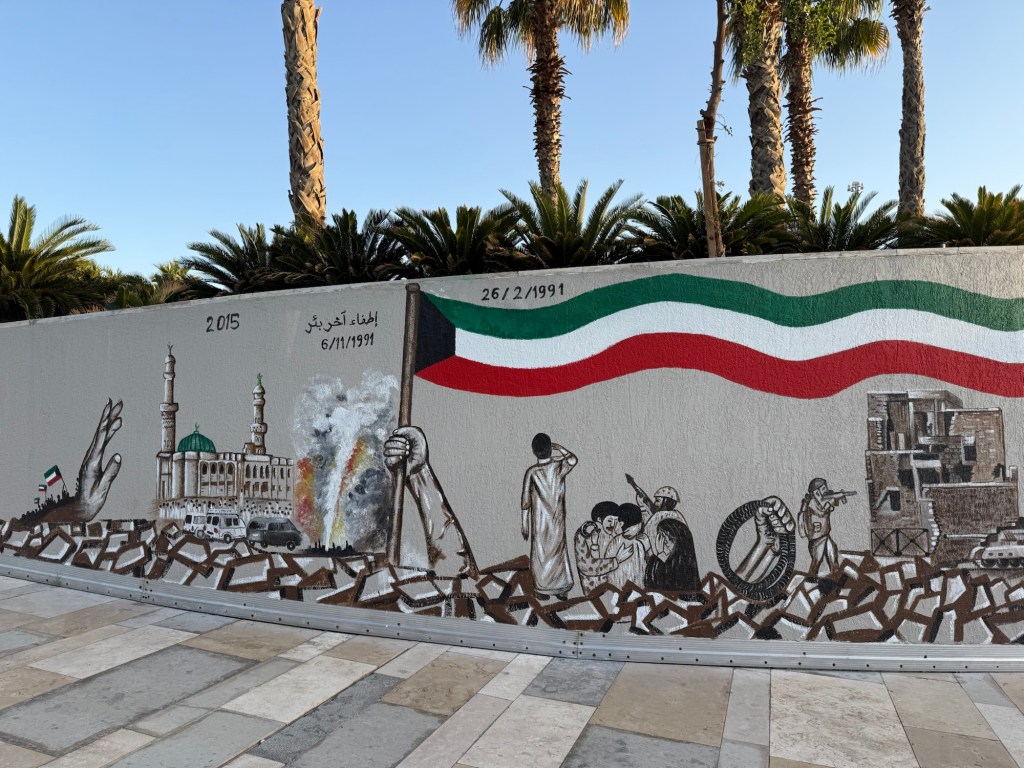
All of this information was freely available at the Memorial Museum, along with information about famous battles and the Iraqi invasion in 1990 when Sadaam Hussein sent his army in after Kuwait refused to increase the price of oil. In retreat after a Western-led coalition (Desert Storm), the Iraqis burned thousands of oil wells that took thousands of firefighters a year to extinguish. This is all commemorated on a wall leading to the museum:
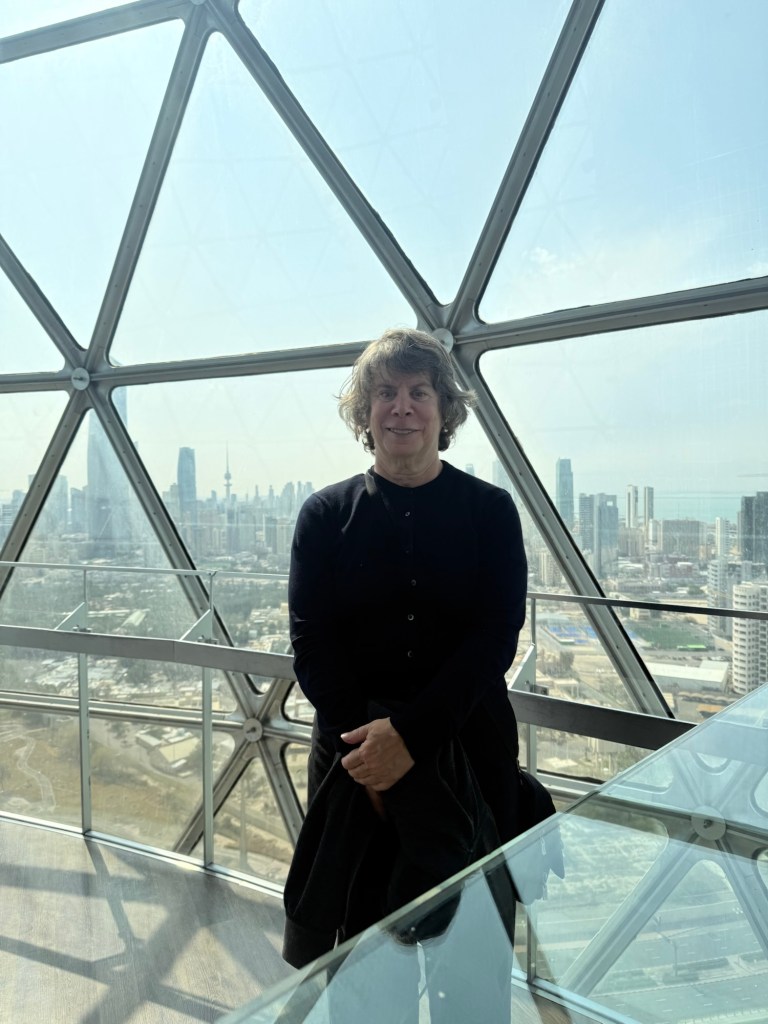
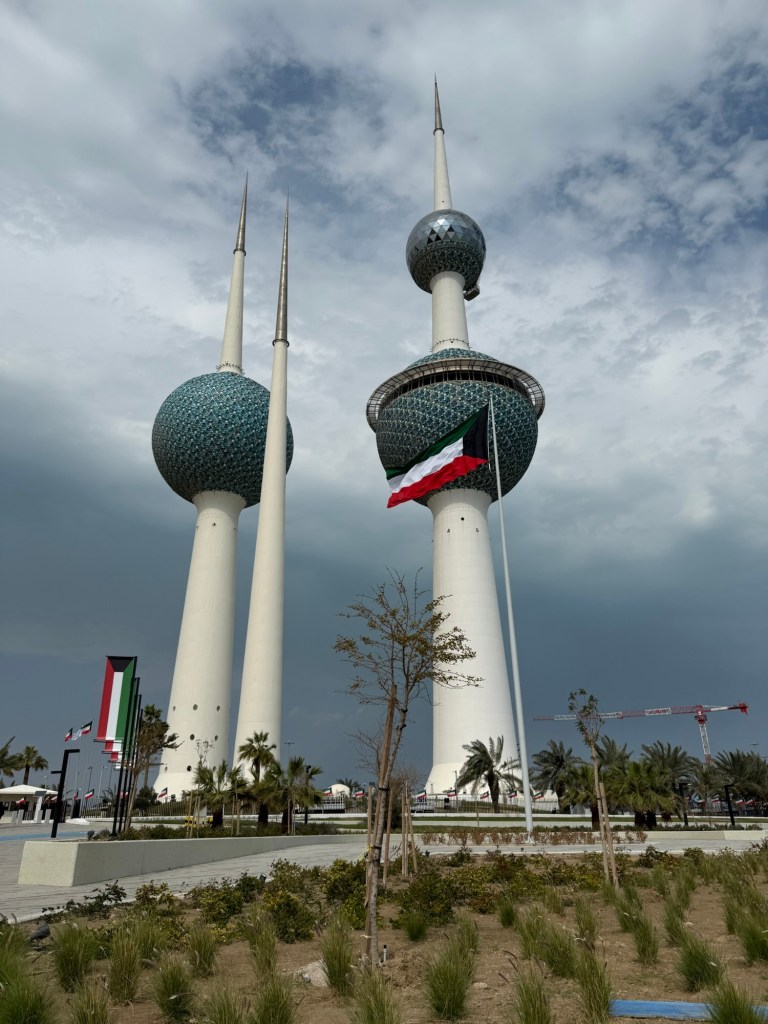
The iconic symbol of Kuwait is the Kuwait Towers, a series of 3 water towers opened in 1979. The one open to the public has an observatory and a floor which rotates every 30 minutes, allowing for panoramic views of the city and the sea:
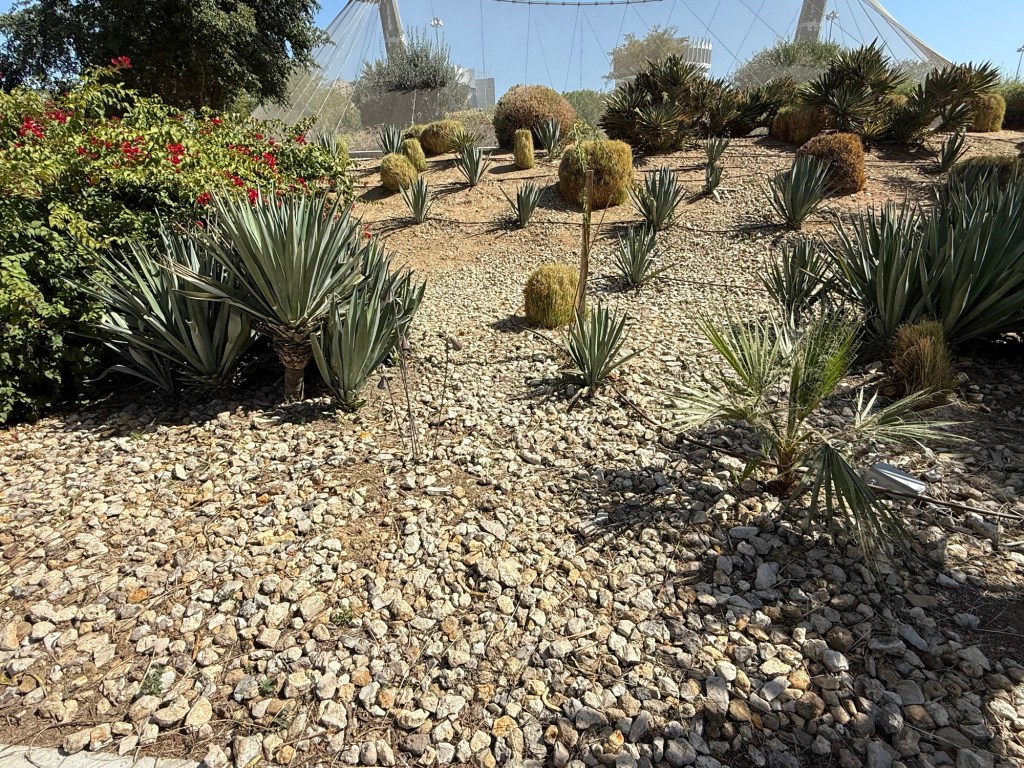
I took a cab to the National Museum of Kuwait, but despite its website saying it was open, the gates were inexplicably and firmly shut. So I returned to my favourite place in Kuwait City, Al Shaheed Park, a mammoth green space in the city featuring desert landscapes:
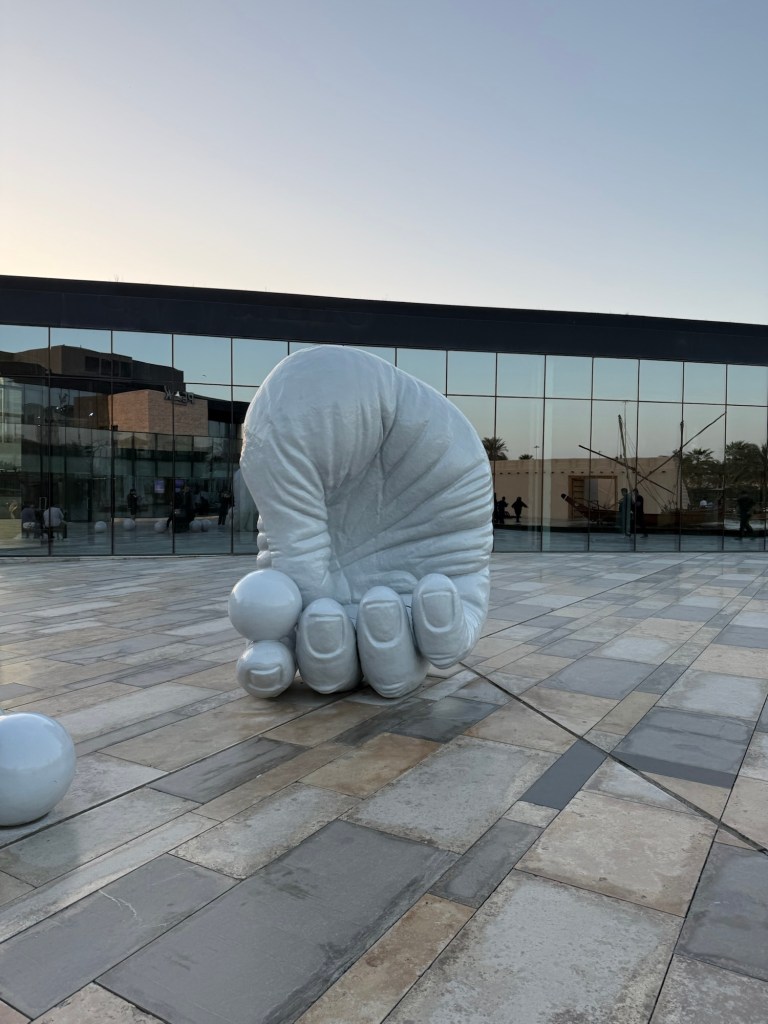
interesting modern art:
But my favourite in the park was the dancing fountain, which put on a brilliant performance nightly at dusk:
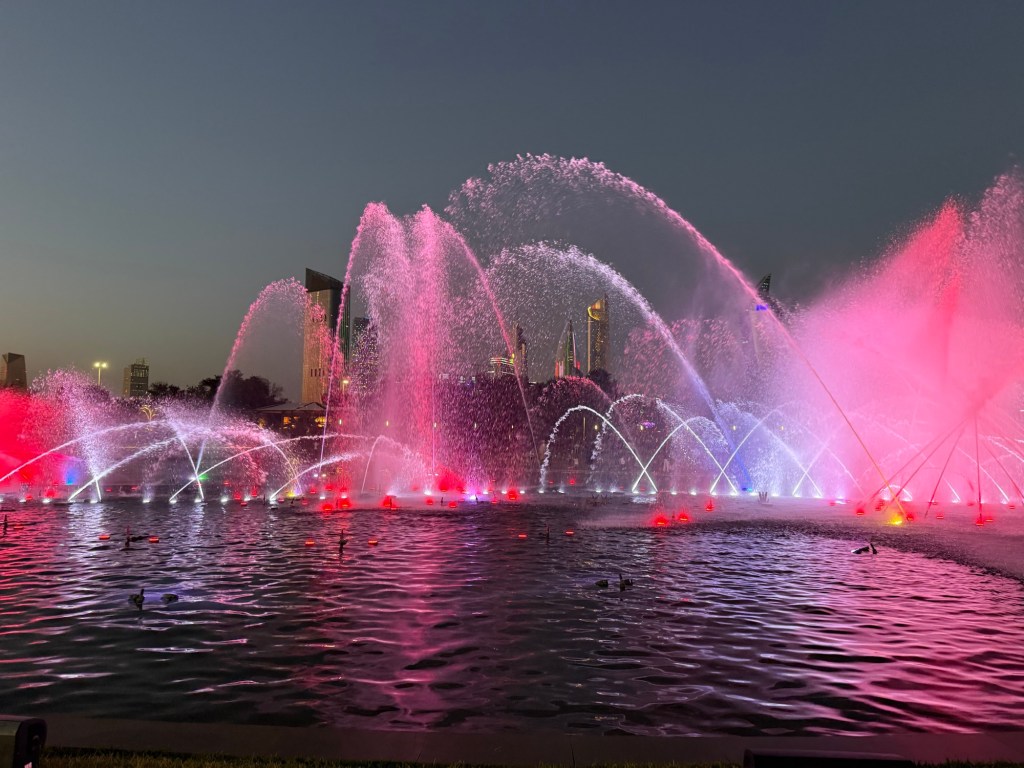
As a sucker for water shows, this was a treat. And more importantly, I walked the 30 minutes back to my hotel feeling completely safe and comfortable. I spoke with a Saudi friend who confirmed that Kuwait is one of the safest countries in the world. Taxis charge only the published rate, people stopped and asked if I needed help ( me looking constantly at google maps) and tipping is discouraged. It felt very comfortable.
Of course, it’s not without its issues for this Westerner. I had resigned myself to no alcohol whilst I was there; it is strictly prohibited. And though I was told to dress conservatively, I felt okay walking about in a t-shirt and long pants as did other non-Arab ladies. No cleavage and cover your knees and all was fine.
So what to make of Kuwait? It certainly failed to live up to its reputation as the rudest country in the Middle East; everyone I met was friendly. A few sights might interest tourists, but only for a day or two. In the end, a vlog I watched summed the country up best: it is very wealthy from its oil, so rich it has no need to build up a tourist industry. Tourists are not unwelcome, but unlike Dubai or Qatar, it’s not investing in mega projects to attract tourists. It’s just content being Kuwait.
Next: a glass ( or two) of wine….
 travelsnearlyeverywhere.com
Despite the difficult voyage, it sounds like the trip so far is successful. The pics are great.
Ellen
LikeLike