
Eight years ago, I would not have been able to travel to Saudia Arabia or, as a woman, drive a car in the country. But the rules have changed and Saudi Arabia is now welcoming tourists and permitting women to drive. Yes, advances have been made and travelling there is relatively simple, but Western tourism is still in its infancy and there’s room for improvement.
First, the prohibitions. No alcohol, period. The country is completely dry. My carry-on bags were inspected on entry to ensure I had no alcohol. But I’m not sure if my checked bag was somehow X-rayed. It didn’t matter; I had resigned myself to no alcohol for the duration.
Western women are permitted to have their hair and face exposed but must dress modestly; no skin showing below the neck. To prepare, I’d had a hip length tunic made, packed lightweight long pants and a scarf. They all turned out to be unnecessary as the temperatures were extremely cold- generally not exceeding 17 degrees- so I, like most everyone else, wore my parka and loose jeans, with no skin showing except my face, which was okay to not offend Saudi standards. As I didn’t visit any mosques, the scarf was not needed.
I was also there during Ramadan, the month when Muslims do not let anything, like food or water, pass their lips during daylight hours. Except in airplanes, airports and at Western tourist sites, I was strongly encouraged not to eat or drink in public, but it wasn’t much of a hardship. Bathroom stalls were useful for grabbing a sip of water and the hotels, whose restaurants were closed, offered room service throughout the day.
I started in Riyadh, the capital city with a population of about 15 million. Immigration was simple, especially with my e-visa acquired on-line, but slow as all foreigners were fingerprinted and photographed. As I had no pre-arranged transfer from the airport, I was met by a barrage of taxi drivers all vying for my custom even before I exited the airport. I eventually made my way to a pre-paid taxi booth, paid with a credit card and got into the taxi.
This was my first introduction to Riyadh traffic, which is terrible. The city of 15 million has traffic infrastructure for 1 million. An Uber ride to the At-Turaif UNESCO heritage site took 15 minutes going there, but 2 hours returning. The drivers are uniformly aggressive and impatient. Lanes and stop signs are routinely ignored. If a car actually stops at a red light, every car behind it starts honking as soon as the light turns green. It’s not for the faint- hearted, but at least Uber was available.
At-Turaif provides the origin story for Saudi Arabia. The Saudi’s were a tribe which settled in the southwest area in 1727 and built their capital in Al- Diriyah:
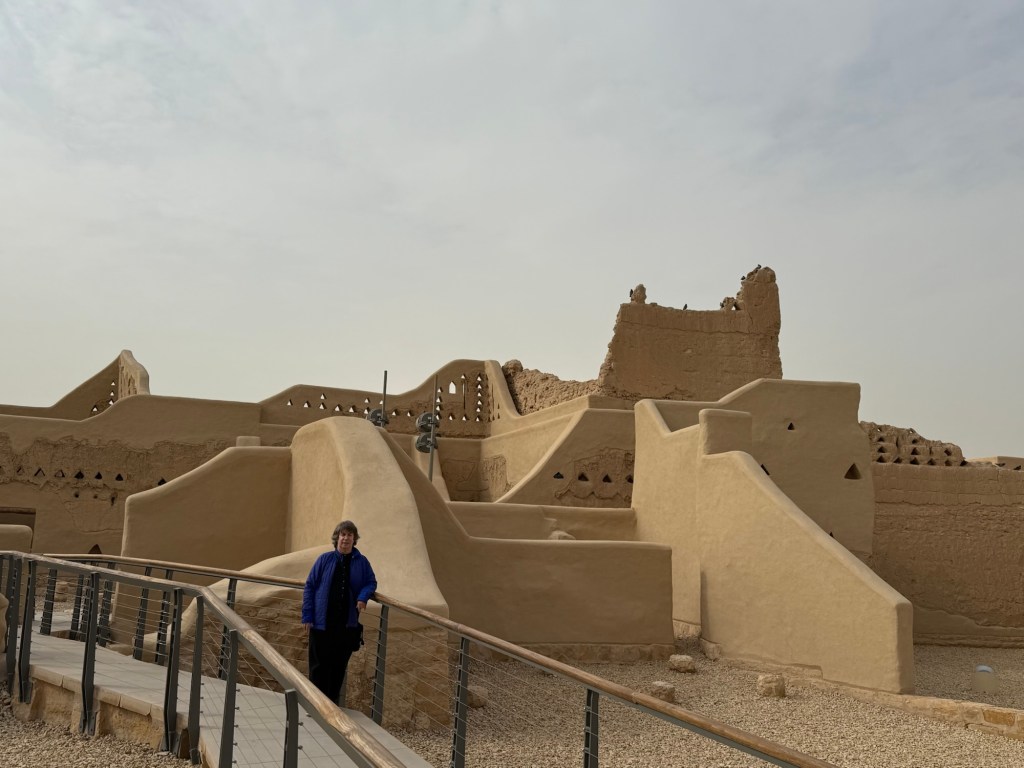
The first Saudi dynasty was born and captured most of the Arabian peninsula including Oman and Yemen. After a six year siege, in 1818, the Ottoman Turks, wanting possession of the holy cities of Mecca and Medina, took al-Diriyah, razed it to the ground and executed its King.
The second Saudi Dynasty ruled between 1824 and 1891, moving the capital to Riyadh, but beset by in-fighting, lasted only until 1891. The current dynasty began to rule in 1902, declared Saudi Arabia independent in 1932 and became very wealthy with the discovery of oil in 1938.
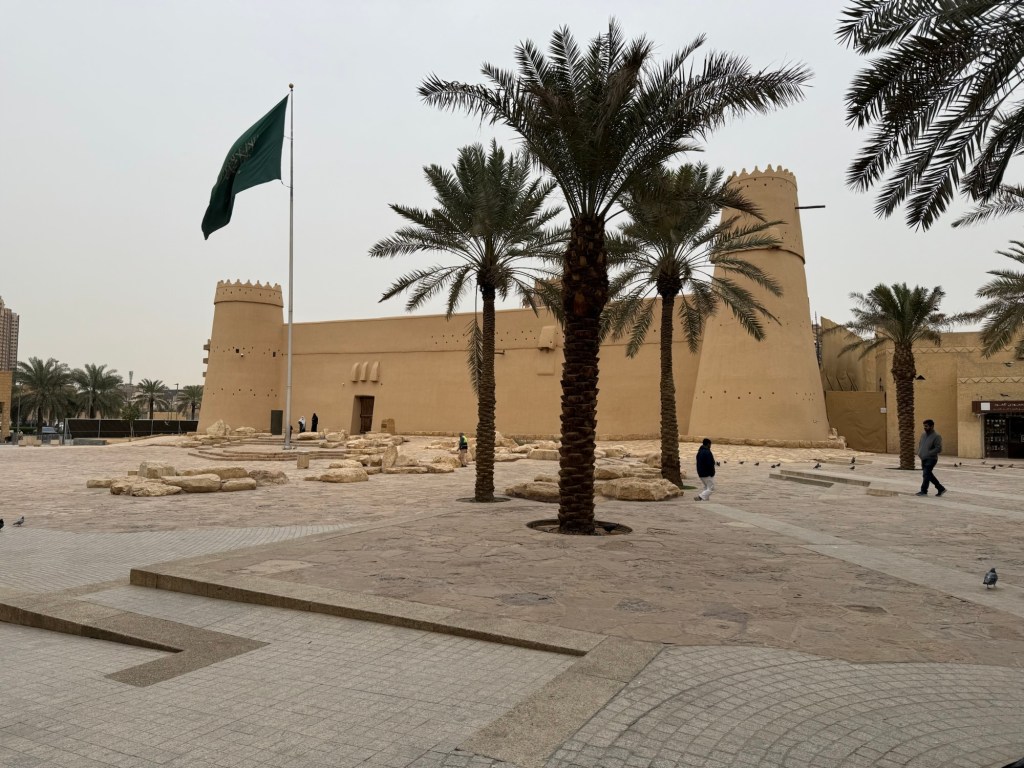
I tried to visit the historic Al Masmak fortress, whose website indicated it was open, but when I went there, it was firmly shut so the best I can do is provide a photo of its exterior:
Fortunately, for me, the Saudi National Museum was open. It contained informative exhibits about pre-Islamic Arabian civilizations who had inhabited the Peninsula and about the rise of Islam. However, if there were any exhibits post the rise of Islam, those exhibits were closed.
Riyadh has other sites appropriate for western tourist, like the Grand Mosque and the Boulevard Club, a sort of Epcot centre display of different cities from around the world and a dancing fountain, but I was hesitant to face Riyadh traffic again, so I passed on both.
AlUla is, to my mind, the gem of Saudi Arabia. It refers to both a desert area in the north east of the country and a city. I bravely arranged a rental car for myself, but the driving was easy as the roads are well maintained, and the drivers few and far between. Frustratingly, many of the road, signs, including the speed limits, are mostly all in Arabic, so I got lost a few times, but Google maps always led me eventually to the correct place.
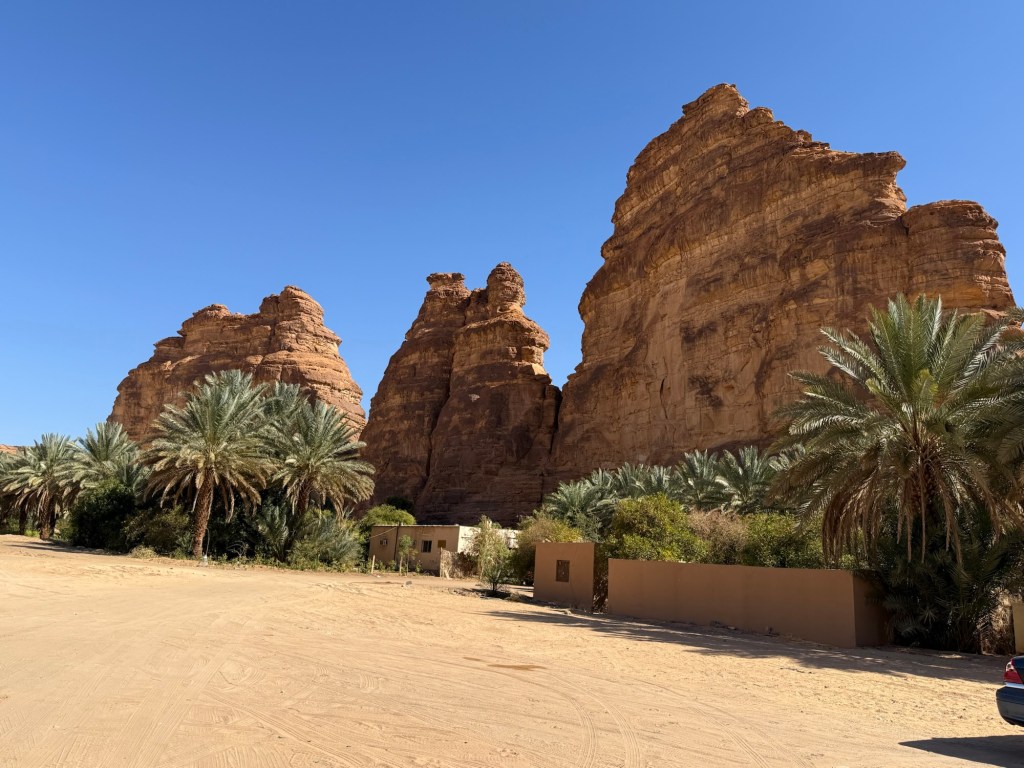
The area is nothing short of spectacular. Huge limestone mountains dot the landscape and date tree orchards are found near many of the oasis:
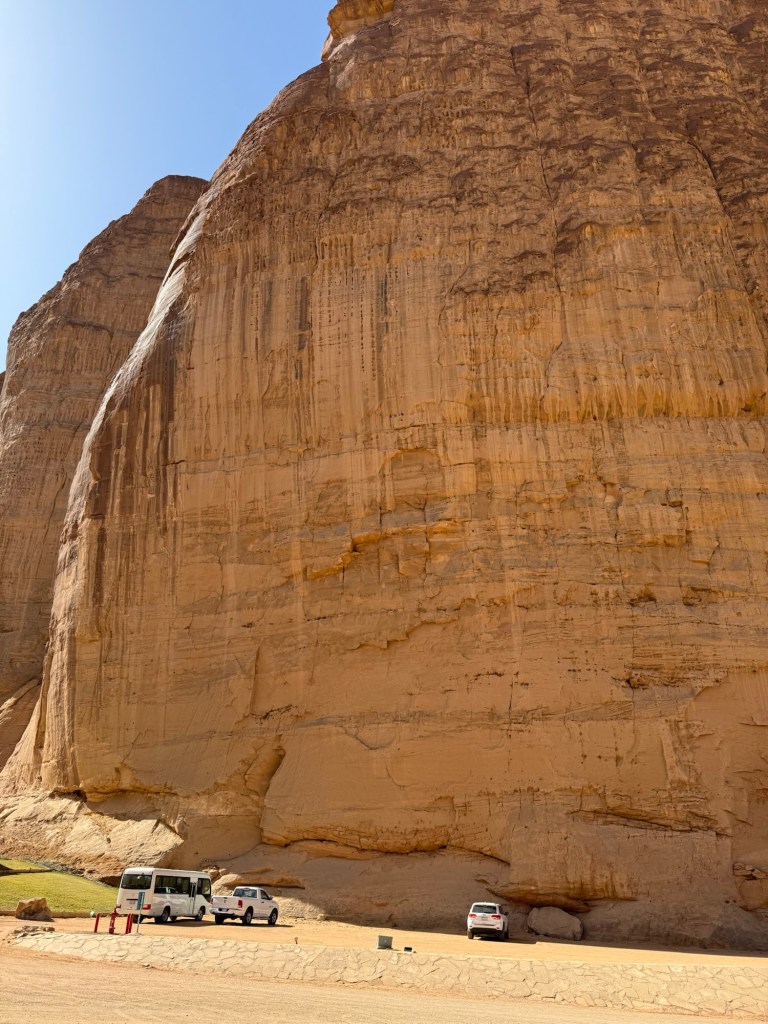
My hotel, the Shedan resort, is nestled amongst the limestone monoliths, with a parking lot adjacent to one of them:
Alula attracts mostly western tourists. Although alcohol is not available, the rules are relaxed and women can freely wear bikinis if they so choose around the resort’s swimming pool:
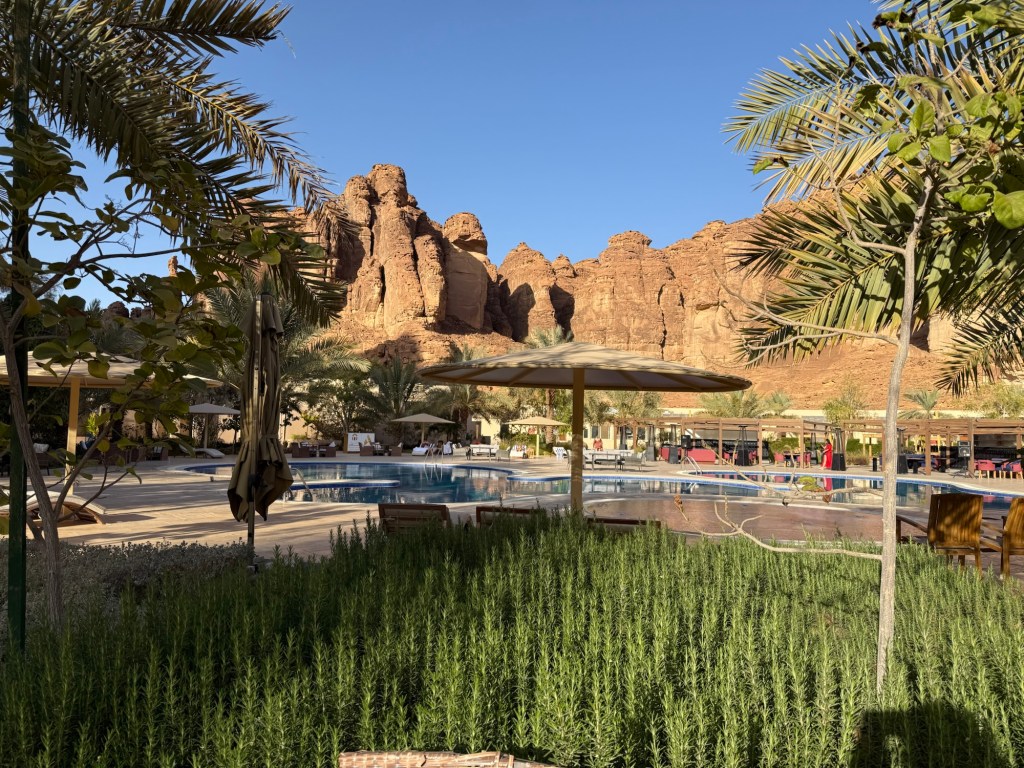
I didn’t, not out of modesty, but because it was too cold, with the temperatures unseasonably cold – highs of 18 to 20° -with morning chills of only 8.
The old town of AlUla is a warren of mud brick houses, meandering alleyways, and a few public spaces with a mosque and a fort. It has been inhabited, mostly by Bedouin , for nearly 1000 years, but the Saudi government cleared out the last inhabitant in 1983.
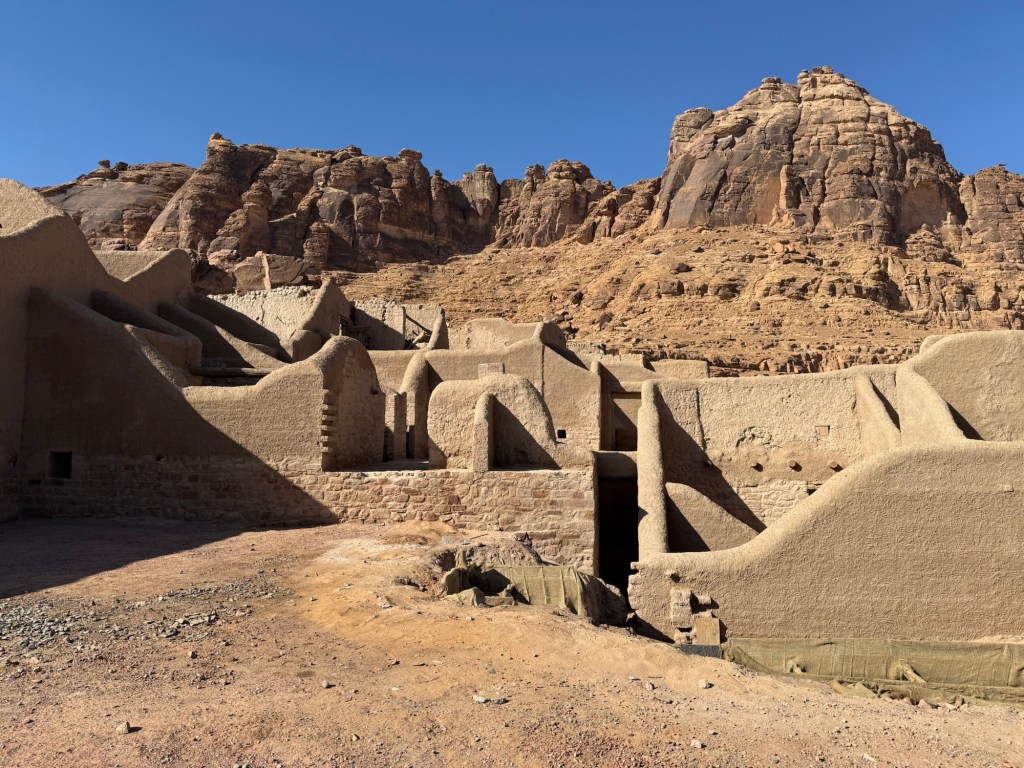
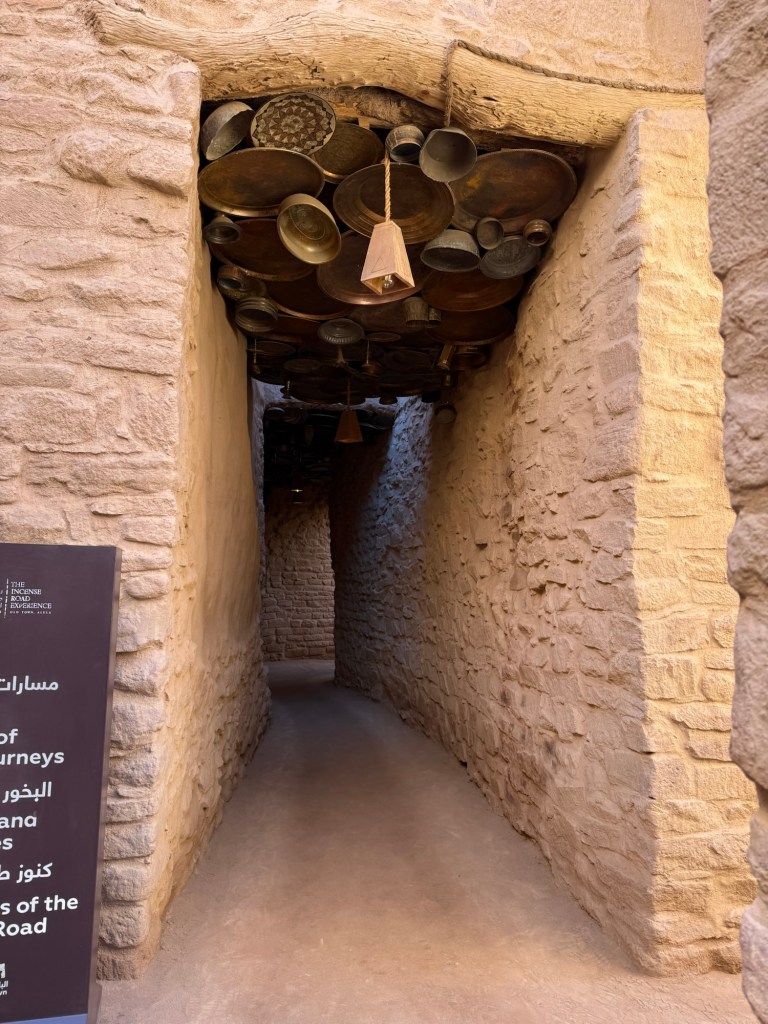
The Saudi government is renovating the area around the old town, with modern hotels, restaurants (Starbucks, Tim Hortons and a Dunkin’ Donut) and lots of souvenir shops showcasing local crafts:
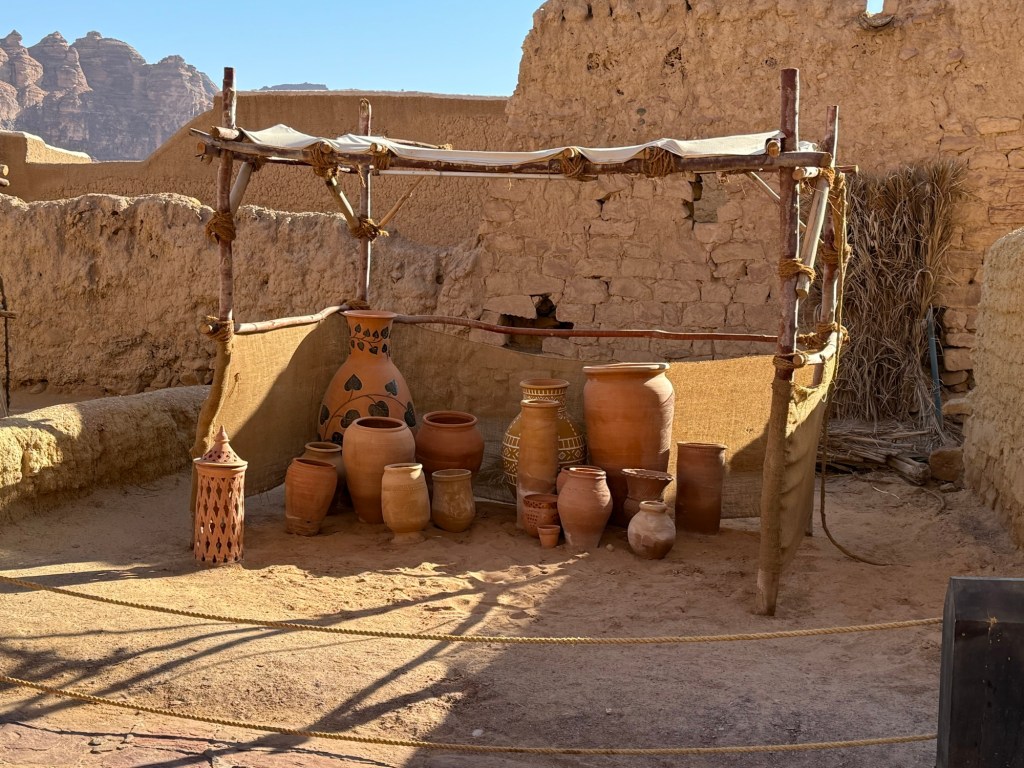
AlUla is located beside the ancient ruins of Daden, a civilization who occupied the area between the 8th and 1st century BC. The city is slowly being uncovered but over 100 rock carved tombs have been located in the mountains above:
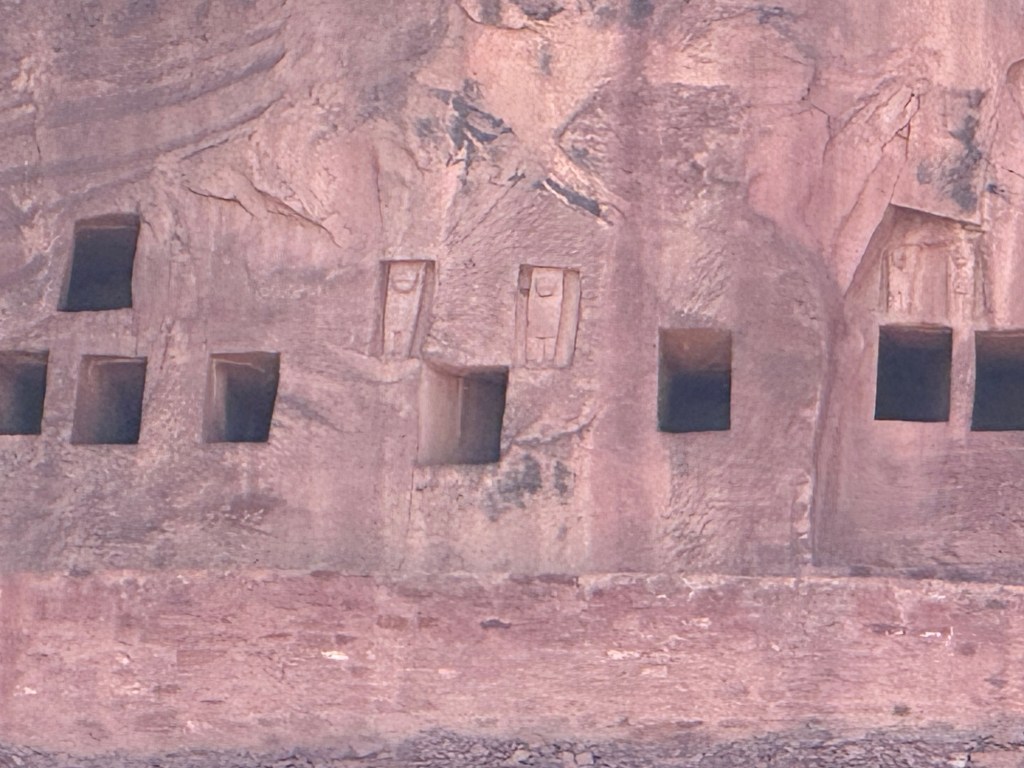
The real stars of the AlUla area are the Nabateans, a trading tribe more famous for its capital city of Petra in current day Jordan. They settled in the AlUla area because of its strategic location on the incense trading route and its plethora of spring water. Although their capital city of Hegra has been unearthed, it is underwhelming compared to its tombs:
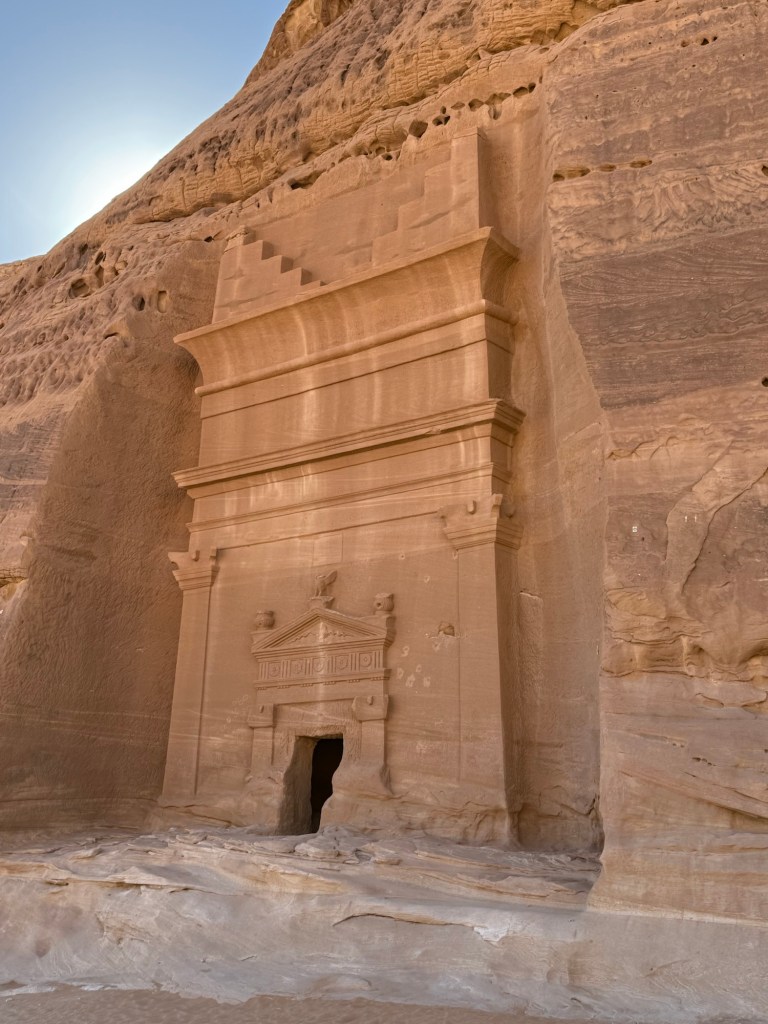
In Nabatean culture, the afterlife was far more important, so resources and energy were devoted to preparing for the afterlife rather than the current life. One of the most impressive tombs ( of over 100 discovered so far) is that named the Son of a Libyan King:
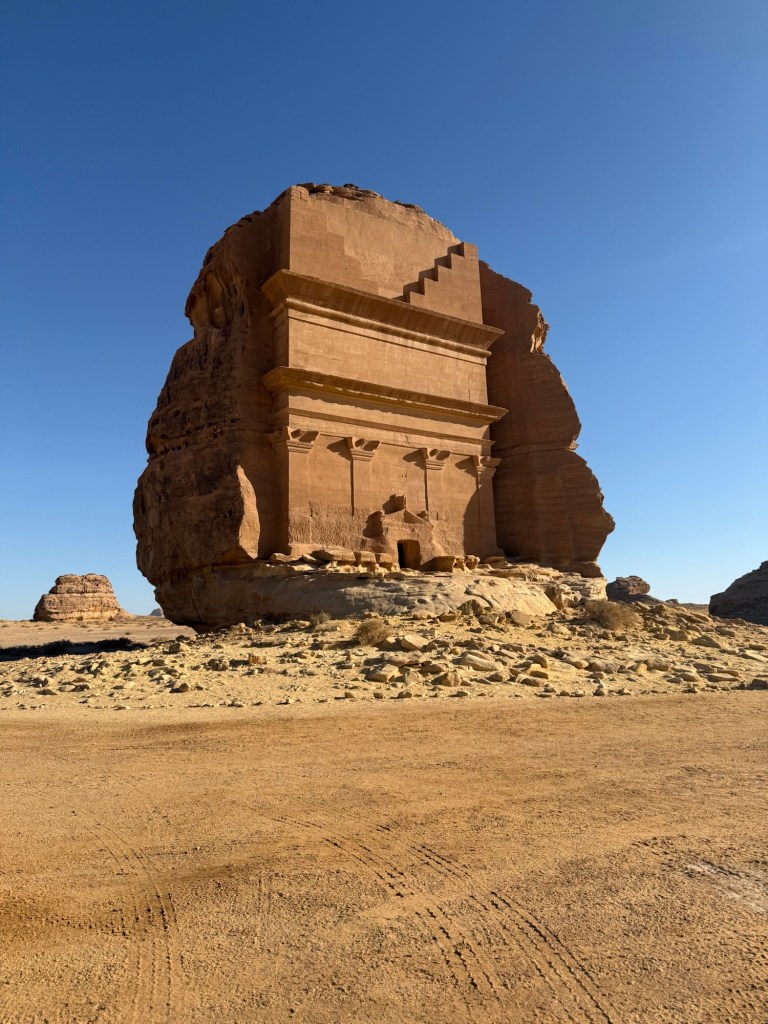
The whole area is wonderful, from fantastic rock formations:

to date oasis:
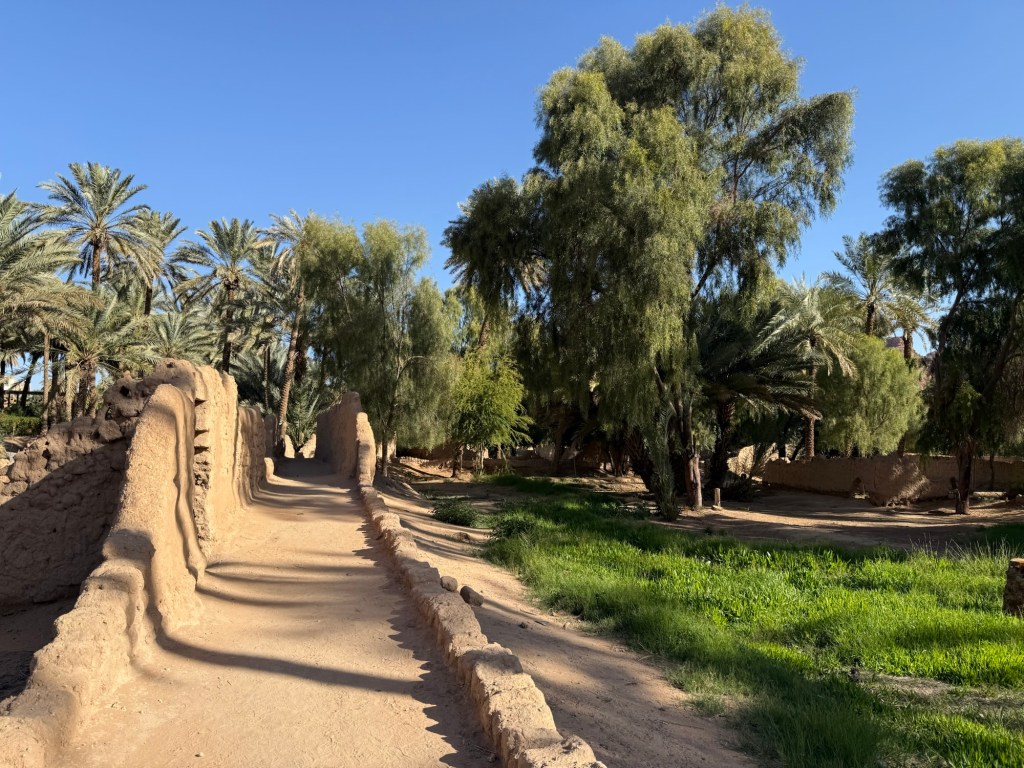
to unique limestone shapes, like the one coined Elephant Rock:

Interestingly, Muslims are discouraged from visiting AlUla. In the 7th century, the prophet Muhammad passed through and cursed it because its inhabitants were idolatrous. Due to this, it is said to be haunted.
And so ended my time in Saudi Arabia. What did I think? Mixed feelings. Everyone was very nice, English is widely spoken in the tourist areas and travelling was easy; Ubers, credit cards, the internet all worked easily. I loved the vastness of the AlUla landscapes and learning about Saudi history in the museum.
Yet, I never felt completely comfortable except in the security of my hotel room. Maybe it was my inability to read Arabic signs, maybe being the only Westerner in a sea of black abayas, maybe just the feeling that the Saudis had their own rule book and I was never sure if I was breaking them.
I’m glad I went, but was very happy to land in Addis Ababa, Ethiopia and have a glass of wine. It felt comfortable.
Next up: my lesser known countries of Southern Africa tour.
 travelsnearlyeverywhere.com
Wow! Interesting travels, Naomi. The closest I got to Saudi Arabia was the United Arab Emirates in 2000. At the resort where we stayed, a number of Americans were on holidays from Saudi Arabia and complaining about how restrictive it is!
I am enjoying your posts. Keep them coming!
Karen
LikeLike
Hi Naomi
This is Madeleine writing. I really enjoy your blog! I read it on one of Henry’s old emails. I will be closing it down soon and I was wondering if you wouldn’t mind sending your blog posts to a different email address that Henry and I shared so that I can keep enjoying them!
mpchag@gmail.com
best, Madeleine
LikeLike