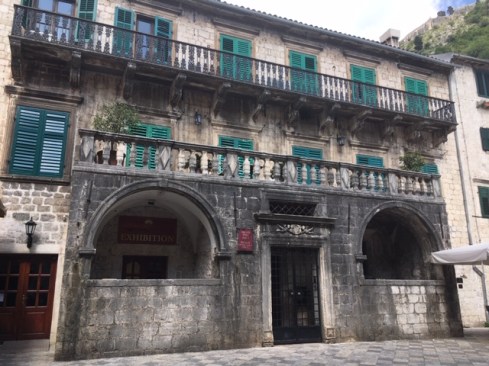
Auvergne-Rhone-Alps: Valence, Annecy and Lyon

It is probably obvious that if one wants to spend a month tootling around Provence, one should double check to ensure the cities where non-refundable hotels have been booked are in Provence. It is likely equally obvious, from the title or if you have read this far, to realize I failed miserably in this task. It wasn’t until I passed a road sign declaring Auvergne-Rhone-Alps before I realized I was no longer in Provence, although the foothills of the Alps, the chalets and the fondue restaurants should all have provided a clue. A quick check on the map of France confirmed that none of my next 3 cities were in Provence, but there was no going back unless I wanted to lose those non-refundable charges.

In any event, the cities I had chosen each had their own attractions. Valence simply to break up the drive between Avignon and Annecy; Annecy as a highly recommended pretty Alpine city and Lyon, the second largest city in France (Marseille disputes this but no one had a definitive answer) and self-described culinary capital of the world.

Valence:

Everyone is entitled to their mistakes, and Valence was mine. It’s a pretty city with an historic old town, but when I googled Things to do in Valence, not a lot came up that didn’t involve a day trip to Lyon, Avignon or Annecy, cities already on my agenda. No walking tours were on offer and I had had my fill of historical museums. So I did what I always do when uncertain as to the sights. I looked up TripAdvisor, programmed its Top 10 things to do in Valence into my GoogleMaps walking application and started at # 1. It is a bandstand made famous in a French program I never heard of and was surrounded by fencing preparing for an evening rock concert. # 2 was Park Jouvet, conveniently located next to the bandstand. It was a nice park and I was enjoying the shade of a tree near a park bench until the band in attraction #1 started rehearsing, completely ruining the serenity of the park.

#3 was the Maison des Tetes, a 16th century house with Tetes or “head” carvings, hence the name and #4 was the Cathedral, closed for lunch:

The Things to do List wasn’t proving particularly engrossing. I gave up and walked down the two pedestrian streets, reminding me I had some shopping to do (replace Apple headphones I had lost) and laundry. Valence was as good a place as any to get those things done, so I did.

Annecy:

Nestled in the Alps around a lake (Lake Annecy, what else?) lies the city of Annecy. It calls itself the Venice of the Alps, thanks to canals that run from the lake through the old city. Venice has little to fear as competition; Annecy has only two canals, they are only a few hundred meters each and neither gondolas nor gondoliers are present. What Annecy’s canals have are pretty as punch bridges, cobblestone paths on either side of the canals for walking and restaurant patios and the Palace d’Ille, formerly a prison, now a museum.
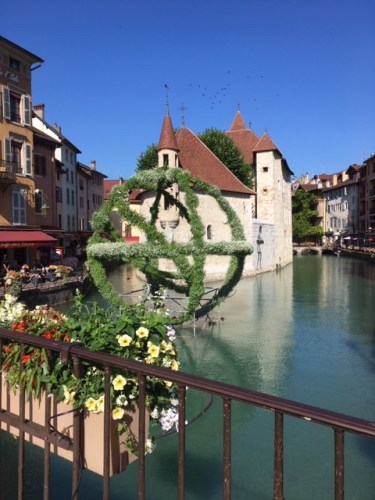
IMG_9776
Annecy Palace d’ Ille

Three days a week, local farmers and merchants set up a market on the cobblestones, slowing pedestrian traffic to a shuffle. Food of every sort is available, including my go-to lunch, roasted chicken, and my newest favourite, white peaches so juicy and sweet you’d think sugar was added.

Twice a year, Annecy gets inundated with tourists flocking to its annual fireworks festival – the biggest in France- and its Animation Film Festival. Neither were on when I was there, so Annecy was just very crowded with mostly French tourists coming for their week at the lake vacation.

On a hill overlooking the old town is Chateau d’Annecy, a 12th century fortress and chateau used by the counts of Geneva for protection and a residence. The buildings are a museum, but I entered the main one to be greeted by an exhibition on the woodcarving techniques used for making flat bottom boats that plied Lake Annecy, complete with a life size replica. As shipbuilding is not something I find fascinating, I quickly exited and went to the real attraction of the Chateau, its panoramic view of the city and lake.

IMG_9802
Annecy view from the Chateau

The lake itself is emerald green. Measuring about 42 kilometers in circumference, it is home to Annecy at one end and thousands of holiday homes perched in the foothills around the lake. A bike path circles the lake, but the gentleman in the bike rental store warned me to go only halfway to avoid the hills at the other end. I took his advice and had a lovely 15 kilometer bike ride (each way), passing through farms where the tingling sound of cowbells announced the presence of cows, cottages, tents and caravan parks all filled with people enjoying the beach and every manner of water sport, from paddle boats to canoes to water-skiing.

I spent an idyllic 3 days in Annecy, going for bike rides each day, walking along the lake and dining in the restaurants along the canal.

Car versus Public Transit

I was debating whether having a car was preferable to using public transit. For a single person, it was much more expensive after car rental, gas and tolls, but it allowed me more freedom to see the countryside and visit small villages which would have been near impossible to reach by public transit.

It wasn’t all positive. As I needed hotels with parking, I wasn’t able to stay in or near the old, car free, city centres, my usual preference. I had made peace with GoogleMaps, so getting lost was not a problem and the French are relatively courteous drivers (in comparison to, eg, the Albanians). I was even starting to appreciate the ubiquitous roundabouts.

I was going back and forth on this issue as I drove from Annecy to Lyon. To save money and to enjoy the countryside, I turned on the “Avoid Tolls” feature in GoogleMaps and was rewarded with picturesque villages, fields of grapes and sunflowers and an absence of trucks. At one point, I exited a tiny village and started up a high mountain on a single lane road with a thick fence made of stone to protect the cars from the precipitous cliffs. At the top. I passed through a rock tunnel and emerged into the sunlight to be greeted by the most fabulous view, the  lake of St. Germaine la Chambotte far below in the valley. As I wasn’t able to stop at the top of the mountain, the photo was taken in a turn out about 1/3 the way down.
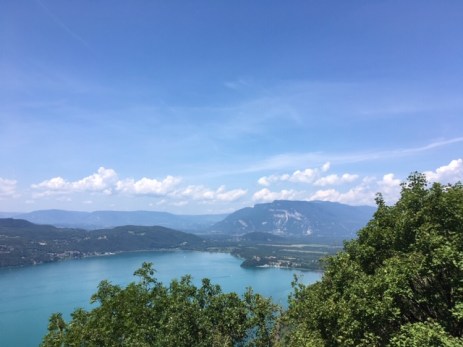
IMG_9825
St. Germaine la Chambotte

After this view, renting a car won hands down!

Lyon:

Lyon, like many other cities, is shaped by its geography. Its highest hill, the Fourvière, was first inhabited as a colony during the Roman period. Below the hill is the oldest part of the city, the areas of St. John and St. George, which boast more Renaissance buildings than any other city except Venice. Next is the River Saone and between the island separating the Saone from the Rhone River is the typical neo-classical French city with wide boulevards, Haussmann style buildings, parks and squares and a main pedestrian street called Rue de la Republic. On the other side of the Rhone is the new city, with 20th century high rises and parking lots and a large immigrant community.
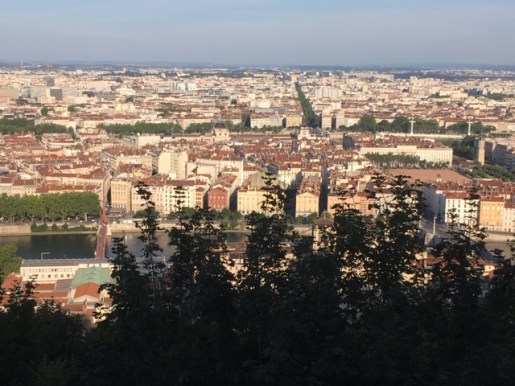
IMG_9874
Lyon Panoramic with rivers visible if you look closely

Lyon’s early fortune as the capital of Gaul floundered with the collapse of the Roman Empire. Always a trading hub as a result of its rivers and closeness to both Italy and Switzerland, it regained its earlier prominence in the Middle Ages as the center of silk weaving. Francois Jacquard, of the Jacquard weave, used punch cards on his looms to replicate tapestry patterns, the precursor to the punch cards used by computers in the 1960’s and 1970’s. The silk industry disappeared from Lyon with the import of cheap Chinese silk, but a few shops still demonstrate the looms and resulting silks.

Also during this time, the aqueducts which had supplied Roman Lyon dried up. People living in the town needed easy access to the rivers, made difficult because the houses were built right next to each other, with no roads leading to or from the rivers. To solve this problem, over 600 tunnels or passageways were built under, between or through buildings, providing direct paths to the waterways. These passageways, or traboules as they are called, still exist today and many are open to the public.
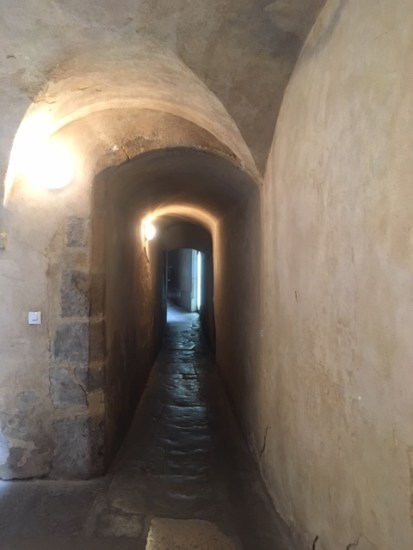
IMG_9848(1)
One of Lyon’s many traboules

During WW2, the traboules proved useful to both the French resistance and fleeing refugees, as the locals knew of their location but the Nazis did not. This also gave rise to one of Lyon’s darkest chapters, the tyranny of Klaus Barber, the Butcher of Lyon, who as head of the Gestapo in Lyons was responsible for clearing the passages, torturing and murdering thousands of French citizens along the way. Despite this, the US counter-intelligence agency recruited him and later assisted in relocating him to Bolivia. He was finally extradited back to France in 1984 to stand trial for crimes against humanity. His trial was held in the Appeals Court in Lyon, where he was convicted. He died in custody in 1991.

Lyon boasts it has 21 Michelin starred restaurants, but obtaining a dinner reservation for one on short notice proved impossible, so I did the next best thing. I signed up for a gourmet food tour, accompanied by 8 Americans and our guide, Olivier, a native Lyonnais. We started at a cheese store, where we sampled numerous cheeses including goat and sheep cheeses and those made from unpasteurized milk. Our next stop was at a Lyon institution, the Bouchon. Bouchons originally began in the 16th century as cheap eating houses for the silk workers. The wealthy Lyonnaise used the best parts of animals, thus typical Bouchon fare is heavy on chicharrons (pork rinds), offal and intestines, all considered waste by the upper crust. We sampled all three along with copious amounts of local red wine. The third and fourth stop featured similar foods, with the addition of beans and my favourite, saucisson brioche, a sausage cooked in a brioche pastry. We finished with ice cream and a very sweet praline cake, a fitting end to a 4 hour gourmet journey.

Next: More problems staying in Provence
Avignon: Popes, Lavender and Wine

After months of bus and train trips, group tours and trotting, suitcase in tow, from hotel to hotel, I was looking forward to 10 days in an Airbnb in Avignon, France, about 100 kilometers north of Marseille. I picked up my rental car, after enduring an hour long line at the Avis/Budget hut at the train station, and drove to my apartment. It was still hot in Provence – between 35 and 39 every day – but I had air conditioning and a pool so everything was tolerable.

Of Popes:

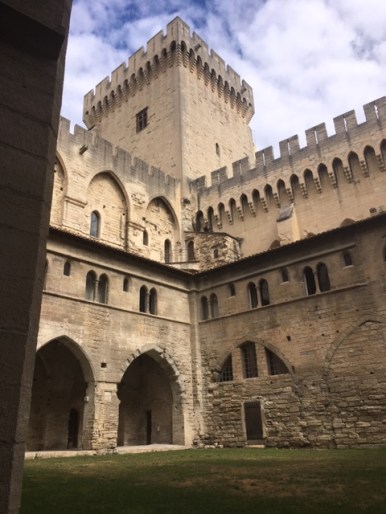
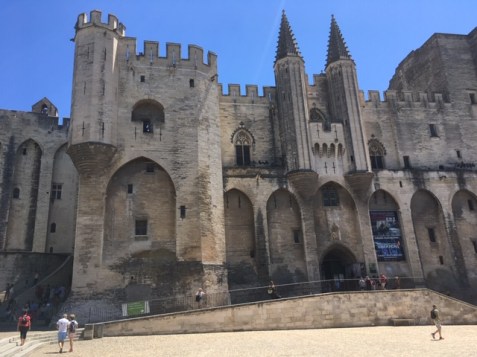
Avignon served as the papal seat between 1309 and 1376 when 7 popes, all French, decided Rome wasn’t good enough for them and moved the papacy to Avignon, in the south of France. Granted, it was a bit more complicated than that, but the result was the same. Avignon became the hotbed of Roman Catholicism and built a palace fit for a pope, the Palais des Popes. Although begun in 1252, it was renovated and added to until 1364.

IMG_9673
The Palace des Popes

Today, it stands as the largest Gothic structure in the world. I went in, with hundreds of others, beginning in the courtyard which was filled with ugly movable bleachers. A children’s assembly was taking place and us mere tourists were sheperded under the bleachers through makeshift aisle ways into the palace proper. We were outfitted with IPads, which, when pointed at the appropriate apparatus in each room, played a brief video about what the room looked like back in the 14th century. So in, for example, the mammoth dining hall, the video demonstrated foods and cooking techniques popular 600 years ago. The IPad was a nice touch, providing additional information and visual aids, but it also masked the fact that, other than the outstanding architecture, the palace was mostly bare, except for the tour groups. We walked from empty room to room – this was the chapel, that was the library- with little more than the size, the ceiling beams and the fireplaces distinguishing one from another.

IMG_9685
An inner courtyard (without bleachers)

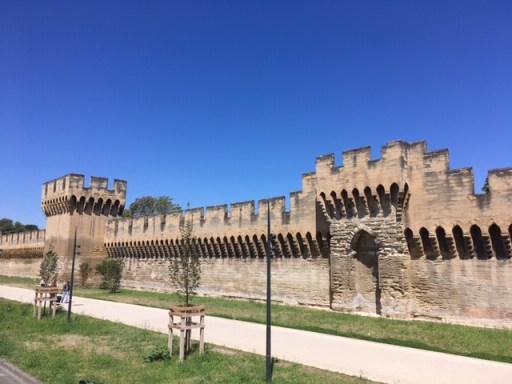
An hour later, I exited the palace and walked, literally, around the old city’s ramparts. Begun as far back as in Roman times, they were doubled and heightened to 8 meters to protect the popes. Some are original, others reconstructed, but they frame the old city, circling it for 4.3 kilometres with 7 gates offering entrance. Next to it, on the Rhone, dozens of riverboats beginning their Rhone river cruise were ferrying their passengers into the city.

IMG_9657
A small portion of Avignon’s walls

Not only did the walls protect the Popes from all sorts of invaders, they currently act as a natural (or government issued) barrier to modern excesses like high rises and fast food restaurants. Inside the walls, a medieval feeling may still be invoked. Many of the roads were cobblestone, numerous palaces built to house the cardinals still line the streets and churches galore stand to be admired.

Regrettably, my timing was not conducive to aimless wandering down the pretty streets. It was Avignon Festival time, with the main streets blocked to traffic and occupied instead by booksellers and artists and pop-up restaurants. The Festival is also a French fringe extravaganza, so erstwhile artists handed out fliers to their plays and pasted thousands of them on every available inch of wall, fence or post, thereby completely ruining most photo opportunities. Not unexpectedly, the Festival drew massive numbers of people to the old city, in addition to the regular tourists and school kids. It was crowded and in the +35 degree heat, not too pleasant for meandering.

Of Lavenders:

One of Provence’s attractions is the annual blossoming of lavenders, an event I was hoping to enjoy. To date, roses in Bulgaria and tulips in Holland had bloomed unseasonably early so I had missed the best of both. Lavenders are considered to be at their prime between June and August in Provence, giving me a wide window of opportunity.

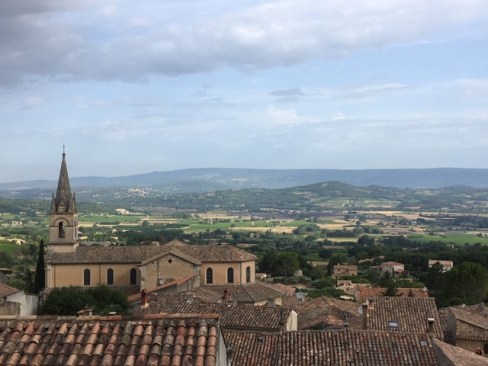
I duly checked Google for the location of the best fields – they are not everywhere – and set off in my rental car for Luberon, one of the premier places for lavenders. On my way, I passed a few fields and took some photos; a preview for what was coming I hoped. But when GoogleMaps led me to the Luberon park, it failed to take into account a barrier blocking cars from entering the park and from me proceeding to the Luberon fields. I contented myself with returning to the fields I had already passed near the town of Bonnieux – they were marvellous – before carrying on to Gordes, one of the 15 or 20 prettiest towns in France according to Fodors and The Guardian. Yes it is pretty, but I was mostly interested in its Lavender Museum.

IMG_9618
Bonnieux

I entered the museum to find a line-up to buy tickets, which I patiently stood in for 10 minutes before paying and being directed to the demonstration outside. A young man standing next to a still waited for a large enough group before giving a 10 minute explanation how lavender essence is obtained, in both English and French. It was remarkedly similar to how rose oil, which I had learned about in Bulgaria, is obtained: put kilos of the flower into a pot, add steaming hot water, allow to seep, drain the liquid and separate the oil from the water.

The brief explanation identified the difference between lavendin and lavender. The former is the more common plant, grows at low altitudes and doesn’t have the advertised health benefits of real lavender – curing insomnia, assisting indigestion, reducing blood pressure, eliminating hot flashes, etc. – it is used exclusively in the perfume industry. With the explanation done, we were directed to return to the ticket seller to obtain our audio phones for the museum visit. Another wait ensued before the single person at the ticket area gave me some headphones and I entered the museum.

Unless you have an interest in various stills, which I don’t, the museum is a bit of a bust. It consisted of a room containing between 40-50 different kinds of stills, with an explanation as to the history and special features of each. I walked through it in 30 seconds, into a giant shop selling everything lavender-related. The one thing missing was lavender plants. For those, I was told I would need to go back towards Bonnieux to see the plants I had already admired or, if I wanted to see the real lavender plants,  to drive an hour into the hills near Sault.

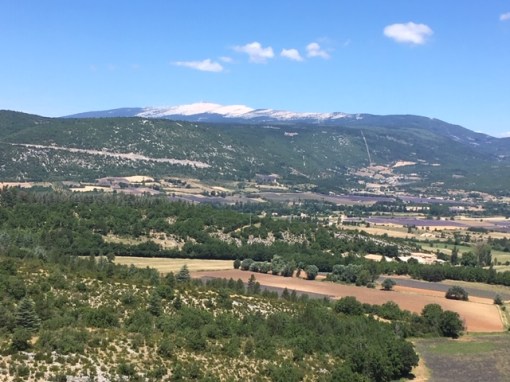
So I drove to Sault, along a winding, mountainous road, past grape vines and stone houses until I arrived in the Sault Valley and was greeted with a view of patchwork fields, some green and others the telltale purple of lavender. I stopped, took photos, walked along the side of the road and enjoyed the majestic beauty of the lavenders.

IMG_9748

Châteauneuf-du-Pape:

The popes left another enduring legacy besides the palace in Avignon. About 12 kilometers from Avignon lies Châteauneuf-du-Pape, a region and a town famous for its wines; I’ve been drinking them for years. Begun as a summer residence for the popes, the popes also planted the first vineyards in the region. Today, the Provence and Cotes Du Rhone areas produce some of Frances most beloved wines.

Châteauneuf-du-Pape is another hopelessly pretty French town, with beige stone houses roofed with sienna coloured clay tiles, crowned by the ruins of the castle of Châteauneuf-du-Pape. Every second building was a wine tasting cellar or store. I stopped at the Brotte Wine Museum, only to find it closed between noon and 2:00PM for lunch. This is France after all. Since I was driving, I resisted the urge to indulge in a wine tasting and contented myself with a salad at one of the many patios in the town.

Next: Driving around France


Surviving Ryanair and Marseille

Surviving Ryanair:

Having decided to spend July in Provence, France, the first challenge was how to get there from Bucharest, Romania. A few search engines later, the best answer was a non-stop flight from Bucharest to Marseille, but on Ryanair, a low cost carrier notorious for its penny pinching, At one time it had proposed charging for going to the bathroom, but had backtracked on this particular idea amidst widespread condemnation.

I mentioned my possible Ryanair flight to my son, who had flown it extensively on his European jaunt. His initial reaction was hesitant:

“ You know there is no business class on Ryanair?” he prodded.

“Yes, but I’m not such a princess that I need business class for a 2 1/2 hour flight. Besides, it’s intra-Europe so all business class is crap. Even Lufthansa uses regular seats and just blocks off the middle one.”

“Okay, but they will nickel and dime you and you know how much you hate that. Best to buy every upgrade possible so there will be no surprises. And beware, they try and sell you lottery tickets.”

I took my son’s advice to heart and bought priority boarding, extra legroom in seat 1A, a checked bag to avoid issues about whether mine was too big and the whole one-way flight totaled  $175, far less than a flight from Toronto to Winnipeg. How bad could it be?

If you don’t like rants, it is probably best to skip the next part, but here goes:

First issue, the check-in counter in Bucharest doesn’t open until a miserly 2 hours before the flight. My ride had dropped me at the airport at 5:30PM and the flight wasn’t scheduled to leave until 9:50 PM, meaning I had 2 1/2 hours to hang around the check-in counters at Bucharest airport. It was not the most thrilling of times, but I wasn’t mugged, there were bathrooms and the Brioche Doree shop sold both tuna sandwiches and small bottles of wine. Needless to say, there was no lounge access.

Check-in finally came, security was quick with nothing confiscated, followed by too many stores selling perfume and liquor, although why anyone would buy alcohol in Romania when they are heading to France is beyond me.  I arrived at the empty gate and waited, and waited, and waited….

The area filled up, the 9:50 departure time came and went and still, nothing. I checked the “FlightTracker” app, which told me the flight was now scheduled to leave a 10:25. No word from Ryanair. Then FlightTracker said 10:50. Still silence from Ryanair. Finally, at 11:00 PM, a plane arrived at the gate, two Ryanair employees showed up and we slowly began the boarding process, Our plane took off at 11:30, meaning I would arrive at 1:00AM Marseille time, definitely not my preferred time of arrival. I checked Google, which told me a cab to my hotel would cost 60 Euros (about $100), but I decided it had been a long day and I felt in need of a splurge.

The flight itself was full, but fairly pleasant, meaning no turbulence. After the obligatory safety demonstration and take-off, the flight crew only used French on the PA system, so when they came around with a cart and I asked for a bottle of white wine, the attendant apologized and said they were doing snacks first but he would be right back with drinks. True to his word, he was back with the bottle of wine within 10 minutes and it cost only 6 Euros, about $9. For reasons I cannot explain, he took a liking to me, and offered me wine, snacks and English translations of the only in French PA announcements every few minutes, completely the opposite of what I was expecting.  I think they tried to sell lottery tickets, but I had completely tuned them out as I didn’t want to make the effort to understand the French sales pitch. The flight passed quickly, uneventful and we landed in Marseille.

Being in seat 1A, I was first at customs/immigration and the officer could not get me through fast enough. He glanced at my passport, then at me and waived me through in about 10 seconds. No stamp, no swiping my passport through a machine, just complete indifference or very tired. So much for my Schengen concerns. Unfortunately, another Ryanair flight had landed just before us, so a 20 minute wait for my bag ensued, during which I felt fully the heatwave which had been engulfing the south of France for the last week. It was 1:20 AM and still 37 degrees Celsius and the baggage area in Marseilles was not air-conditioned.

My bag eventually showed up and I made my way to the taxi area, only to find no taxis there. I used the Uber app. on my phone, just to be told no cars were available. Despondent, I looked around and saw a line of people mounting a bus, so I went, got on, paid the 8 euro fare, sat down and asked the lady in front of me where we were going. I probably should have checked this out before committing to the bus, but it was now 2:30 AM Bucharest time and I was not rational. But all was good; the bus was going to the main bus/train station in Marseille, it was air conditioned and I would figure out my next move once I got to the station.

This should be the end, but sadly, it wasn’t. We arrived at a blackened station, closed until 4:30AM, so my option of sleeping in the station evaporated. It was, according to Google Maps just a 13 minute walk to my hotel but Marseille is not the safest city (more about this later) and I didn’t think this would be a good choice. I walked around the station, looking for a well lit, populated area to hunker down for a few hours, when I saw it, a solitary taxicab with a light on. I walked over, he said he would take me to my hotel and I hopped in.

I had been forewarned by the internet that all taxicabs in Marseille belong to the Union of Thieves, so I was expecting the worst. I calculated that I had been prepared to pay 60 Euros from the airport for a taxi so, having already spent 8 Euros on the bus, anything under 50 Euros for the 6 minute ride would be acceptable. I had obviously spent too much time in Romania, where every cab driver I encountered was a crook, because this guy took me as close as he could to my hotel – the street was blocked with construction- walked me and my bag to my locked hotel, waited until the sleeping receptionist let me in and charged me the grand total of 6 Euros. He looked at me incredulously as I gave him 10 and told him to keep the rest. Thus ended my saga with Ryanair, not a total disaster since I got to my destination eventually, albeit 2 hours late at 2:00AM.

Alas, my troubles continued. As I hit the pillow at 2:30am, the loud rat-a-tat of a jackhammer began and continued non-stop until 6AM. As I discovered in the morning, the city had given permission for construction right outside the hotel to be done in the wee hours of the morning, to spare the workers from the excessive heat, hotel guests be damned. Welcome to France!

Surviving Marseille: 

Marseille is the second largest port in the Mediterranean, after Alexandria in Egypt. It was first colonized by the Greeks 2500 years ago and has the fairly typical Mediterranean history: Greek, Roman, captured by the Goths in the 6th century and eventually adopting Catholicism, Middle Ages, part of the Provence County before joining France permanently in 1482. All of this was on display at the Marseille History Museum, conveniently attached to a shopping mall and considerately free during extreme heat days to allow people to take advantage of its air conditioning. Unfortunately, the displays were mostly only in French and its high tech audio guide, in English, was finicky and thin on facts. As a museum giving a chronological retelling of the city of Marseille, it was fine but uninspiring.

Marseille’s more recent past is more unique. As a port city, it is also an immigrant city. At the turn of the last century, Italians crossed the sea and settled, bringing with them pasta and the mafia, with its skills in drug production and drug trafficking. In the 1930’s, Nazi money funded mafia controlled heroin manufacturing facilities in Marseille. Opium was smuggled in from Turkey, manufactured then the finished product shipped to Canada and the USA. Thus the French in The French Connection movie.I n the 1950’s and 1960’s, crime related to the drug trade proliferated, but was gradually reduced by aggressive law enforcement efforts by the French and US governments, although cynics claim this resulted from the drug manufacturers moving their factories to third world countries who, by the 1970’s, had developed their own proficiency in making heroin.

Following the Algerian civil war in 1962, Africans arrived in Marseille in droves, giving the city a multi-ethnic feel. It remains the jumping off point for immigrants from former French African colonies, Tunisians, Malians, etc. Needing to house the new migrants, ugly high rise apartments known as cite were built on the outskirts, creating ghettos but multiracial ones. Today, the drug traffickers are back, but instead of being Italian based, mostly African gangs from the cite control it. Gun violence has risen exponentially, attributable to the ease of weapon smuggling arising during the Arab Spring.

My walking tour went nowhere near the cites, but instead focused on the Vieux Port (old Port) at the centre of town. Fort St. Jean and Fort St. Nicholas, both built by Louis XIV in 1660, guard the entrance to the horseshoe shaped harbour, where hundreds of boats- all nice but hardly the mega yachts of Monaco or Nice – were moored, alongside a few tourist ships.

Surrounding the harbour were dozens of restaurants and ice-cream shops, all vying for tourist dollars. A few offered the regional specialty, bouillabaisse, a fish stew meaning, literally, to boil and simmer, at only 25 Euros ($40) a serving, but the guide warned us away from these obvious (to him) fakers. Real bouillabaisse costs in excess of 100 Euros per bowl and is served only by a few longtime establishments. I’m still not crazy about shellfish, so I contented myself with another local specialty, grilled sardines, a tasty bargain at a non-tourist restaurant at only 3.5 Euros a dish.

Marseille has been trying to remake itself and distance itself from its crime-ridden past. In 2013, it was a European Capital of Culture, an annual designation of two European cities, one from the East, the other from the West, designed to promote the culture richness of a city. In its honour, Marseille constructed two museums, the aforementioned Marseille History Museum and the Museum of European and Mediterranean Civilizations. The building housing the latter seeks to connect the city’s past with its present with a bridge between Fort St. Jean and the new square box covered in metal sculptures representing waves. I walked over the bridge and inspected the building, but passed on the interior, which exhibits had received only mediocre reviews.

IMG_9514
The bridge connecting Fort St. Jean to the Museum

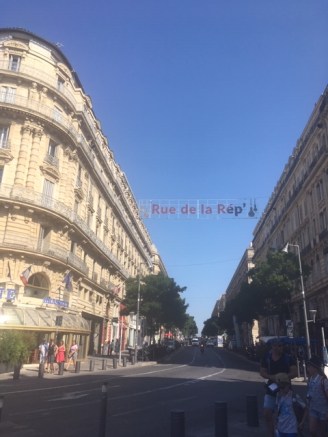
Instead, I walked along Rue de Republic, looking much like a Paris street which is unsurprising since it was designed by Georges Haussmann, the same Haussmann who is responsible for much of Paris. Marseille’s downtown is something of an anomaly. Worried about the bubonic plague beginning in the 14th century, the city established France’s first hospital and enacted strict quarantine regulations for the large number of ships docking there. But in its last significant outbreak, the plague struck Marseille in 1720, killing nearly half the population. Those who could afford to do so abandoned their palatial homes in the city centre for the suburbs, leaving a downtown largely filled by immigrants from abroad and the country. Sadly, the centre and Rue de Republic still look largely vacant. Despite high end stores like HMV and Zara relocating there in 2013, the area could not attract sufficient numbers and today, large swaths of storefronts are empty, only a couple of restaurants are open and the hotel receptionist strongly urged me not to walk down it after dark.

IMG_9585

Nearby, the National Park of Calanque beckons. Wikipedia defines a calanque as a narrow, steep walled inlet developed in limestone, dolomite or other rock existing along the Mediterranean coast. Taking a 3 hour cruise on one of the tourist boats in the harbour, we passed first the Chateau d’If, the fortress/prison where the Count of Monte Cristo was incarcerated, before enjoying the views of the calanques.

Final Thoughts:

I learned my lesson about Ryanair. I would fly it again, paying in advance for every possible item but will only take it if it is the first or second flight of the day. While my flight was uneventful, the unapologetic attitude of the airline at depositing us in a city at 1:00AM was unacceptable.

As for Marseille, I spent 6 nights there, which was probably 3 nights too many. No matter how much it promotes itself as a bastion of culture, haute cuisine and safe, for me it lacked a certain je ne sais quoi that makes a city special.

Transylvania: Castles, Fortresses and the Transfagarasan

After 4 days in Bucharest, observing its eclectic mix of architecture and hearing tales of the dangerous eccentricities of its former dictator, Nicolae Ceausescu, I was ready to leave Romania’s capital city, see its countryside and explore its non-communist past. I signed up for a 4 day tour titled Transylvania Castles with the Romanian company Rolandia, expecting to see lots of Romanian Orthodox churches, some medieval fortresses and hear too much about Dracula. The tour met all my expectations and provided a few surprises along the way.

Background and History:

Romania today is made up of 3 Romanian speaking regions: Moldavia, Wallacia and Transylvania. The first two regions united in 1859, then in 1867 Romania became independent from the Ottoman Empire. Transylvania was added in 1918; a victory prize to Romania for joining the Allies during WW1, taken from the losing Hungarian empire. Each region has distinct histories influenced by their neighbors: Moldavia is next to Poland and Russia, Transylvania was part of the Hungarian empire for 800 years and still has a large Hungarian speaking minority, and Wallacia was historically part of the Byzantine and Ottoman Empire. Bucharest is located in Wallacia.

Dracula and his castles:

Mention the word Transylvania and the word Dracula instantly springs to mind, so let’s get some things out of the way immediately. Dracula, the book by Irish author Braun Stoker, focuses on a vampire who lives in a castle high above a river valley in Transylvania, with a proclivity for drinking human blood. No such vampire existed in fact or in Romanian folklore. It was pure invention, popularized by Hollywood and stores wanting to sell Hallowe’en costumes.

The real Dracula was better known as Vlad the Impaler, a Romanian prince in the 15th century. His name was Vlad Dracula, translated from the Romanian meaning Vlad, son of the dragon. Raised as a hostage by the Ottomans, Vlad returned to Romania in 1456 and came in conflict with Transylvanian Saxons. After suppressing them, the Ottomans ordered him to pay tribute. He refused, causing the Ottomans to send an army against him. To repel the army, Vlad had 2000 Ottoman prisoners impaled, wrenching a pole through the body but avoiding piercing internal organs, ensuring the victim would take at least 48 hours to die. Vlad then burned the crops, killed all the livestock in the vicinity, poisoned the water and installed his 2,000 poles, with bodies hanging on them, beside the road where the Ottoman army could not miss them. The plan worked. The Ottomans, starving and thirsty by the time they got to Transylvania, saw their dead comrades and refused to fight, retreating back to Constantinople. Vlad the Impaler, despite his sadistic tendencies, is revered as a Romanian hero, victorious against the hated Ottomans and defender of the Christian faith.

Bran Castle, also known as Dracula’s castle, was given its moniker in the 1980’s by the Romanian government aiming to promote tourism to the region. Although it bears some resemblance to Dracula’s castle described in Stoker’s novel, rising steeply above the town of Bran, near Braslov, it was never owned by Dracula’s inspiration, Vlad the Impaler. He may have visited it, slept in it a few nights or been imprisoned there, but most of this is conjecture. Nonetheless, it is the top tourist attraction in Transylvania.

The Castle is accessed through a fairground of ice-cream and cotton candy vendors, booths selling t-shirts emblazoned with Dracula and other souvenirs stands ,everything to give it the air of a giant tourist trap, which it is. Despite trying to time our visit to avoid the worst of the crowds, the parking lot was filled with buses taking mostly Americans on 2 day excursions from the Danube river trips and Romanian school kids.

Bran Castle dates from 1438, built by Transylvanian Saxons to defend against the Ottomans and to guard the border between Transylvania and Wallachia. Its usefulness as a fortress was limited and it fell into disrepair. In the 1920’s it was given to Queen Marie (wife of the second king); it was most recently used by her daughter Ileana until the Communists took it over in 1948. The latter became a nun, which gives you an indication about the interior decor.

To say it was jam-packed with visitors is an understatement. We crawled along at a snail’s pace in a giant pack up the entry stairs, through a room giving the history of the castle, then waited in another line to gingerly make our way up a dark,  narrow, uneven stone staircase, the most frightening thing in the castle given the distinct possibility of someone tripping on the stairs, falling and breaking their neck.. In the main living quarters, the walls were white plaster, the ceilings covered in dark wooden beams and collections of armor, weapons, furniture and period costumes were on display. How exciting!

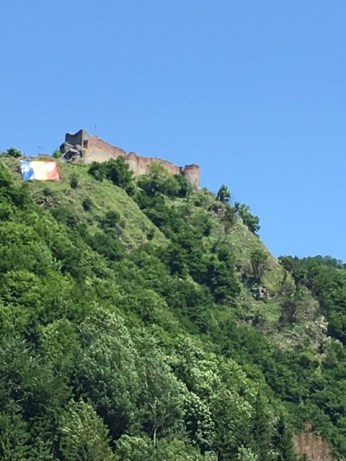
Ironically, the remnants of a real castle constructed by Vlad the Impaler exists. Poenari stands high on a cliff, overlooking the river valley below. Originally built in the 13th century, Vlad made it one of his principal residences. It can normally be visited by those foolhardy enough to climb the 1,000 steps up, but it was closed for renovations when I was there, sparing me making excuses for not climbing up:

IMG_9481
Vlad the Impaler’s Castle

Peles Castle:

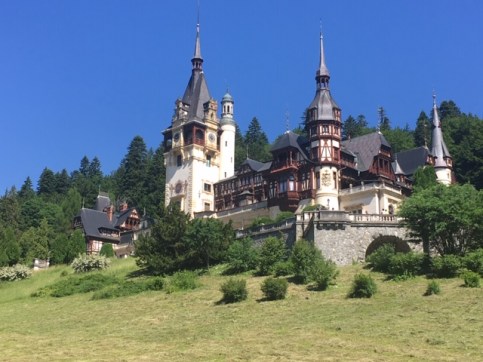
Nestled in the Carpathian Mountains close to Sinaia, Romania’s first modern king, Carol 1, built his summer residence, Peles Castle. As he was originally German, the castle is new-German Renaissance in style, half-timbers on the exterior and ornately decorated rooms panelled in carved wood inside. In the music room, stain glass windows depict scenes from fairy tales. There’s a complete theatre with room for an orchestra, a miniature hall of mirrors, 170 rooms and countless chandeliers made with Murano glass. During the communist period, the castle was expropriated by the state and used as, first a museum to show the decadence of the wealthy, then as a writers’ retreat for politically acceptable authors. Following the fall of Communism, the property reverted back to Carol 1’s family.

IMG_9074
Peles Castle

The German Settlements:

In the mid-12th century, the Hungarian king reigning over Transylvania invited German speakers to settle the area, both to defend against foreign aggressors (the Tartars) and to establish trading centres. Known as the German Saxons, the immigrants established cities still existing today: Sibiu, Brasov and Sighisoara, to name a few. These medieval cities have large, central squares surrounded by cobblestone roads, walls and gates, and bright, rainbow coloured houses and shops, with rich ornamentation and a refreshing absence of ugly social realism/communist style buildings that blot Bucharest.

The cities were spared the plight of many German cities that were destroyed during WW1 and WW2, making Transylvania a more intact representation of 16-18th century German architecture than Germany. Not so the ethnic Germans. Many left during and after the world wars and Ceausescu allowed thousands more to emigrate to West Germany in return for payment from that country. The death knoll was the fall of communism in 1989, when an estimated half million ethnic Germans left.

Today, their legacy remains in the architecture of the Transylvanian towns and in the Evangelical churches. No relation to the American evangelical movement, the Evangelical churches were fortified to provide refuge in case of attack. Over 200 stand today, most open to tourists but lacking congregations as there are fewer than 15,000 Germans remaining in Romania.

Romanian Orthodox Churches:

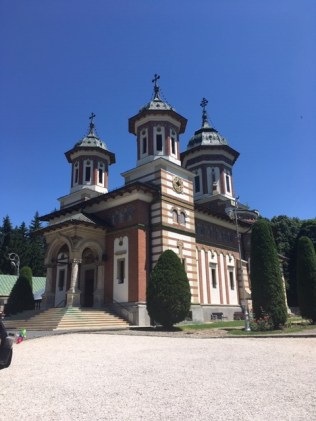
Despite their kings being Catholic and the communists, atheists, the Romanian Orthodox Church is thriving and new and old churches dot the country, including those at Sinaia, Alba lulia and Curtea de Arges, but also many new ones:

IMG_9084

Unlike in Bulgaria, photography is permitted inside. After 3 very lovely churches, I begged off visiting any more and walked in the gardens instead.

Fortresses:

Not to be confused with palaces, which serve only as residences with no defensive purpose, Romania has its fair share of fortresses, generally reachable only by climbing to the top of high hills. 

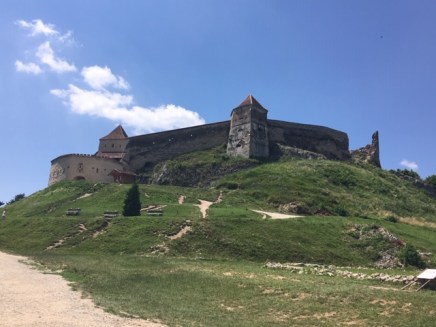
Râşnov Fortress was constructed by Teutonic Knights in the 12th century. Built both for defensive purposes and as a place of refuge, it contains 30 mostly reconstructed houses and shops inside the walls:

IMG_9092
The walls at Rasnov Fortress

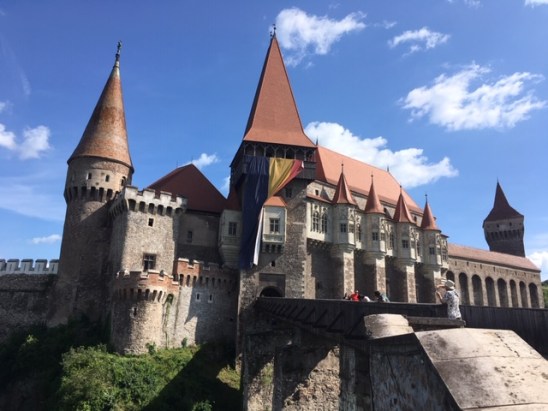
Hunedoara/Corvin fortress was constructed beginning in 1440, one of the few fortresses which also had an impressive palace inside:

IMG_9409
Corvin Castle

There were other castles and fortress, but listing them all would take a while. Needless to say, if you like medieval castles, Romania will be a delight as it is full of them.

Prince Charles, Gypsies and a Road:

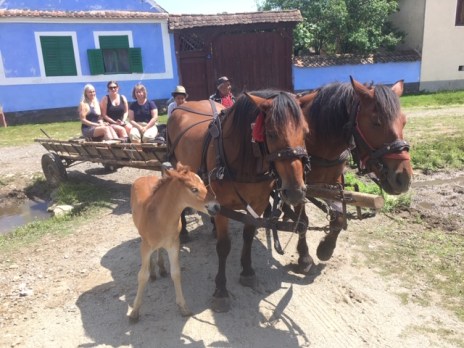
Just ss Kosovo has a love affair with Bill Clinton, Romania is enamoured with Prince Charles. This love affair is not proclaimed on gigantic billboards, but is most evident in the tiny village of Viscri, where the Prince owns a holiday house where he plays farmer (shades of Marie Antoinette?). We didn’t go there, but dined at another house in town. Our hostess was a local, our “restaurant” a table in a room off her courtyard filled with hay and chickens running around. Her pigs were in the back, the only sink was outside and the entire scene was rustic. Despite the primitive surroundings, she and her husband served us a wonderful meal. The bread was purchased from another local woman, the soup was made from homegrown vegetables, she had slaughtered the chicken in the main course earlier that day and baked the chocolate and walnut cake served for dessert. Homemade rakija was served, along with elderflower syrup and soda.

After lunch we indulged in as close as I wanted to get to a rural experience, a ride in a horse drawn cart. All through Romania, most farms are small and the farmers use carts rather than expensive, energy inefficient tractors and other motor powered contraptions. We had seen the carts all over the place and jumped at the opportunity to take a 30 minute ride around Viscri in one, but there was no sighting of Prince Charles or even a billboard with his picture.

IMG_9235

Throughout the Balkans, I kept hearing about the gypsies (no one called them Roma): in the former Yugoslav countries, we were repeatedly warned about the nimble fingers of the Roma pickpockets. In Bulgaria, our guide derisively referred to them as parasites and thieves, living off the wealth of hard working citizens while refusing to contribute or integrate into Bulgarian society. The attitude in Romania was softer; people spoke of the need to correct past discrimination and of affirmative action programs designed to attract gypsies to universities and provide them with government jobs.

We passed through city after city where gypsies and non-Gypsies lived beside each other, separate schools, separaate groceries, separate recreation centers, but all worshipped in the same church. The biggest surprise for me was the presence of humungous gypsy houses, ornately decorated in a style that immediately marked them as gypsy and often unfinished. Our guide explained that to the gypsies, size was the most important aspect of a house. They would rather have 20 unfinished rooms than 4 finished rooms. And so, all across Transylvania, were gigantic, shells of houses built by the gypsies.

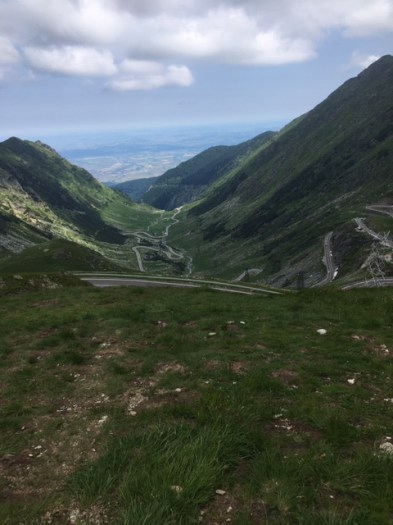
I cannot resist ending with another Ceausescu folly, the Transfagarasan. Built under his orders, it is a 147 kilometer road linking the region of Transylvania with Wallachia having absolutely no useful purpose except as a monument to Communist engineering prowess. Running over and through the Carpathian Mountains, it serves no industry, is a few hours longer than the more direct route, is prohibited to trucks and only opens between July and September, weather permitting. While not oblivious to the lives lost in constructing the road or the billions spent on it, the road is fun to drive and as goofy as can be. Driving it on the second day of the season, hundreds or thousands of Romanians also thought it worthy of a spin. People were picnicking, stopping for photos, even jumping into the freezing glacier-fed lakes beside it. We joined the revelry and duly admired the road:

IMG_9450
The Transfagarasan Road

Next: Back to France

Bucharest: Ceausescu and Architecture

Romania’s capital, Bucharest, with a population of about 2 million, is in many ways just another big, not particularly beautiful, former communist city struggling to find its way in a democratic world. Its attractions for me were twofold: to learn about yet another nutcase communist dictator, Nicolae Ceausescu (see About Albanian for its crazy, Enver Hoxha), and his architectural legacy.

Neo-Classism Architecture:

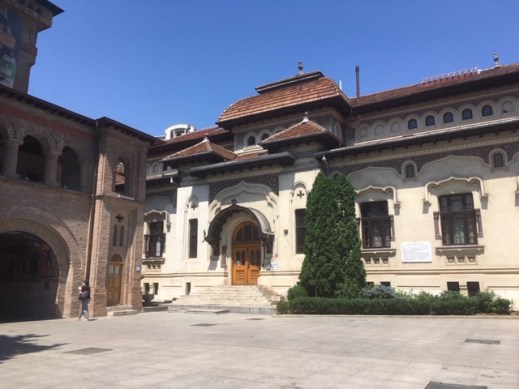
Bucharest styles itself the Paris of the East. It earned this title after two traditional areas that speak Romanian, Wallachia and Moldovia, were united into a single country in 1866 and ruled by a monarch, King Carol 1, a German ex-pat who was invited to be king since kings were the way to go in the mid-1800’s. This was a glorious period in Romanian history, with the king spearheading modernization programs and constructing buildings in his favourite style, French neo-classism. Many such buildings today remain scattered around Bucharest’s centre:

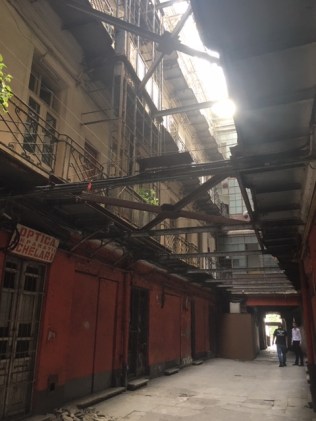
Other Parisienne influences include passageways, pedestrian walkways through buildings, some in good repair boasting French style bistros and hookah bars, but others less so. A former hotel/brothel passageway has seen much better days:

IMG_8612(1)
A not-so-nice passageway

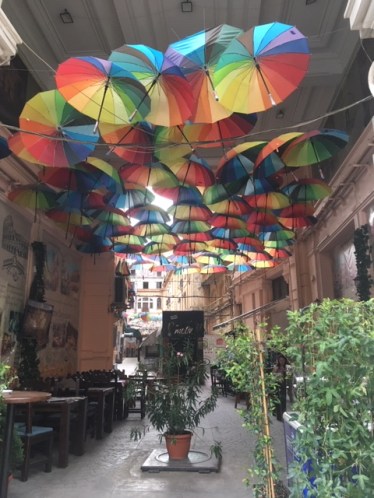
Colourful umbrellas decorate another passageway, disguising the hazardous nature of the building, which was severely damaged during a massive earthquake in 1977. Hundreds of such buildings exist, with telltale red circles on the outside indicating they are prone to falling down. Owners lack the funds to repair or demolish the buildings, so they await the next big earthquake in order to complete the tear down. Bucharest is in a seismic zone which traditionally experiences a major earthquake every 40 years, so it is 2 years overdue.

IMG_8642
A nicer looking, but condemned, passageway

The monarchy had a checkered history. While the first two kings were benevolent and conscientious, the third one, Carol II was a notorious womanizer who rubbed shoulders with Adolf Hitler and assisted Romania’s fascist general, Ion Antonescu, in seizing power. In 1944, the king’s son, Michael re-seized power, arrested Antonescu, switched sides in WW2 and joined the Allies. He ruled until 1948 when the communists took over and promptly invited King Michael and his family to flee the country.

Ceausescu:

Born in 1918 to a peasant family, Nicolae Ceausescu managed to complete 4 years of grade school before being apprenticed to a shoemaker in Bucharest. The shoemaker was a communist and Ceausescu helped out by delivering communist leaflets. He was caught and sentenced to jail. This turned out to be fortuitous as it spared him service during WW2, but more importantly, his cellmate was Gheorghe Gheorghiu-Dej, the communist leader who was installed as President by the USSR following the war.

Ceausescu was Gheorghui-Dej’s right-hand man and upon his death in 1965, ascended to the presidency. His first few years were standard communist dictatorship with farm collectives, a secret service (the Securitate) and a preference for atheism, but in 1968, he endeared himself to the Romanian people when he refused to commit Romanian troops to assisting the USSR’s suppression of the uprising in next-door-neighbor Hungary. That the USSR did not invite Romania to Hungary was overlooked by Ceausescu, but nonetheless marked the beginning of Romania’s attempt to divorce itself from Soviet domination. Ceausescu was not all bad. In his early years, Romania’s literacy rate increased exponentially, highways and metros were constructed and most of the people had jobs and food.

Ceausescu was less successful during this period in developing a unique architectural style. Much of Bucharest consists of social realism buildings, rectangular concrete blocks of differing sizes devoid of decoration or individuality. Ceausescu decreed that people needed living space of no more than 7 metres per person, so hundreds of apartments were built with units about 40-50 metres square, less than 500 square feet, for families of 4. He didn’t tear down buildings that exceeded this, but constructed communist style edifices in front of more attractive ones to hide them from view. The blocks still stand today, functional eyesores with deteriorating stucco, air conditioning units sticking out from the windows and laundry hanging on the balconies.

The People’s Palace:

The real craziness started in 1982, following Ceausescu’s visit to North Korea. Inspired by Kim II Sung’s character cult and his grandiose buildings, Ceausescu decided to remake Bucharest into a gigantic monument to himself. As he considered a house with 170 rooms too small for his family of 5, he commissioned the largest building in Europe, to be reached by the largest street in the world, with massive administration structures nearby.

A slight problem arose as the designated area, the centre of old Bucharest, was already heavily populated, but Ceausescu was undeterred. He gave the inhabitants 24 hours to vacate before bulldozing an area 7 square kilometers in size and displacing 40,000 inhabitants. Bucharest’s infamous stray dog problem came about as a result. Most of the dislocated people didn’t have the time or the ability to take their pets, so they were left to fend for themselves. Until 2012, packs of feral dogs roamed the city, but when a boy was killed by one, the government culled them.

Another problem was lack of funds. At about the same time Romania’s IMF international loans funding its infrastructure improvements became due, Ceausescu needed more money to rebuild Bucharest. Determined to pay back the IMF and construct his $3 billion palace, Ceausescu put Romania on an austerity path that saw extreme food rationing, electricity limited to an hour per day, hot water for only 2 hours a week and a substantial decrease in living standards. Borders were closed to imports, everything that could be exported was, including people. Ceausescu joked that Romania’s best exports were Germans (to West German) and Jews (to Israel) who were allowed to emigrate upon payment by the destination countries of between 4,000 and 13,000 Euros per person, depending on their education level. For those who remained, queuing in long lines at near empty food stores, hunger and freezing in the -20 degree winters became the norm. But in 1988, Romania became the only country ever to repay the IMF.

One architect, aghast by the wholesale destruction of Bucharest’s centre, managed to save 13 buildings, including 7 churches, by devising an ingenious solution. The structures were literally dug out of the land, put on railroad tracks and moved out of the demolition zone. Today, it is possible to see these buildings, all plopped down wherever they wouldn’t offend Ceausescu’s sight, such as the library building in the church courtyard, the heaviest building moved to escape the wrecking ball.

IMG_9053
The library in the church courtyard

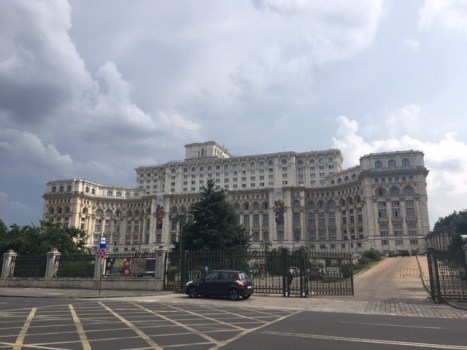
The centrepiece of the project, the People’s Palace, rises on a mound, also created, to reinforce Ceausescu’s prominence. One side looks out over Victoriei Street, a few centimetres or a few meters wider, depending on who is talking, than the Champ Élysées.

IMG_8597
The People’s Palace

Ceausescu never inhabited the place. On Christmas Day, 1989, he and his wife were subjected to a 2 hour showcase trial, found guilty of genocide, taken outside and executed. His right-hand man, Ion Illiescu, in a speedy about-face, disavowed communism and took over as president, subjecting Romania to 10 more years of dictatorship, equally if not more so, greedy, but not quite as crazy as Ceausescu.

The People’s Palace was unfinished in 1989, but Illiescu decided to complete it and use it as the country’s Parliament, thus its current name The Palace of the Parliament. It is normally open for guided tours, but the EU set up shop inside for 6 months and closed it to tourists while I was there. Considered the second largest administrative building in the world, behind the Pentagon, it has 8 stories underground, including a nuclear bomb shelter (Ceausescu was paranoid about the USSR attacking him), two motorway tunnels, one leading out of the city and the other to the airport so Ceausescu could escape if needed. Inside are 1100 rooms, some opulently decorated with chandeliers and extravagant carpets, but many unfurnished and unused. It is also sinking to the tune of 6 mm per year due to its weight.

Not so the neighboring Science Academy. Another humongous building, the Science Academy houses researchers and their administrators. Despite Ceausescu’s wife leaving school at 14, she fancied herself a chemist. A university in Romania bestowed a PH.D on her even though her thesis (which was later discovered to have been written by others) was delivered without an audience. Some of the building is currently used for administration and research, its front side an unkempt forest while its backside reveals the extent of the incomplete structure.

Final Thoughts:

Bucharest, French new-classicism, mixed with Art Deco, social realism and monuments to Ceausescu’s ego, some meticulously maintained, others falling to pieces, is a crazy hodgepodge of styles running in parallel with its equally crazy governments. Its history and architecture are intertwined with its governments, for better and for worse.

Next: 

Castles, Fortresses and Churches in Transylvania along with a brief mention of Dracula.

Bulgaria: Monasteries, Roses and Grannies

Although traveling through the Balkans solo had been easy, after 6 weeks I was ready to surrender myself to the ease of a tour group, where everything would be organized and all I would have to do is show up at the appointed place at the appointed time and hop on the bus.

Thus, on Saturday I attended at the lobby of the Budapest Hotel, in Bulgaria’s capital of Sofia, at 6:00PM to meet my group.

The Tour:

The organizer was Explore, a UK based travel company specializing in small group tours, which I have used before in Central America and the Baltics. This 8 day tour is called Best of Bulgaria, led by Toma, a Bulgarian national with over 25 years experience as a tour guide. Joining me were 2 Australians (Nick and Sybil) and 6 Brits (Mary, Tony, Dolcy, David, Allison and Judith), comprising 3 lawyers, 2 patent officers, 2 chemical engineers and a TV and film producer, but Nick turned out to have the most stories to tell. Born and raised in Bulgaria, he escaped in 1969 by walking (unauthorized) into Italy, staying in a detention camp there before being accepted as an immigrant to Australia. His Bulgarian was still pretty good and proved invaluable in interpreting Bulgarian menus and dealing with waitresses.

Our route was designed to showcase the best of Bulgaria (hence its title),  historical gems, exquisite beaches, monasteries, and, to my delight, the Rose Valley. We started in Sofia, then drove to the Rila Monastery and, from there, to Bansko. Next was the European city of culture for 2019, Plovdiv, before heading to see the Neolithic ruins, Thracian tombs and the heart of the Rose Valley in Kazablak. We went to the Black Sea coast before returning inland to the capital of the 2nd Bulgarian kingdom in Nesebar. The route made no sense from an historical chronology, but covered most of the major periods in Bulgarian history.

Geography:

Bulgaria’s history, culture and economy is tied up in its geography. Split into Northern and Southern Bulgaria by the Balkan Mountains, it is blessed by the Black Sea on its Eastern Coast. To the south lies Greece and Turkey; in the North is Romania. Serbia and North Macedonia are to its west. The country is small; twice the size of Ireland. Its capital, Sofia, is home to about 1.25 million of the country’s 7.25 million people.

History:

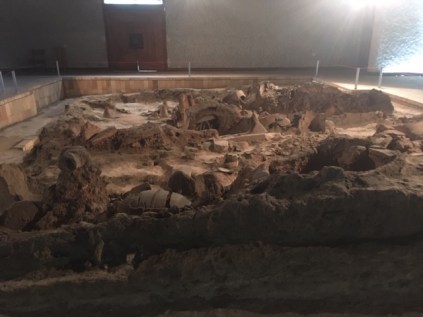
Bulgaria is old. Evidence of Neolithic settlements dating to 6000 BC have been found, excavated and preserved in a museum in the town of Stara Zagora.

IMG_8381
Remains of a neolithic house; difficult to photograph

Highly sophisticated towns and colonies of the Thracian plain from the 2nd millennium are referenced in the Iliad and the Odyssey. The Thracian tribes battled with and against Alexander the Great, ancient Greece and eventually became a Roman colony. Bulgaria’s most famous burial site, a Thracian tomb at Kazanlak, has been closed to the public but, like the Lascaux caves in France, a perfect reproduction open to visitors is nearby:

Rome colonized the area and Roman ruins are frequent, including the amphitheatre in Plovdiv, the mosaics from a wealthy house in Stara Zagora and one end of a stadium, discovered digging  a metro in Sofia and currently under glass beside the subway station.

Constantine brought Christianity to the region; it was further enhanced when the Slavs from the Russian steppes arrived in the 7th century. Also arriving were the Bulgar tribes from Eastern Europe or Asia. In 681AD, they displaced the ruling Byzantines and established the first Bulgarian empire, which lasted until 1018. During this period, the Bulgars, Slavs and Thracians assimilated, emerging with a common language, religion and alphabet which forms the basis for the Bulgarian heritage. Nesebar, a major city during this period, still retains over 40 churches, displaying Byzantine, Bulgar and Ottoman styles, none of which I entered, but I did photograph a few:

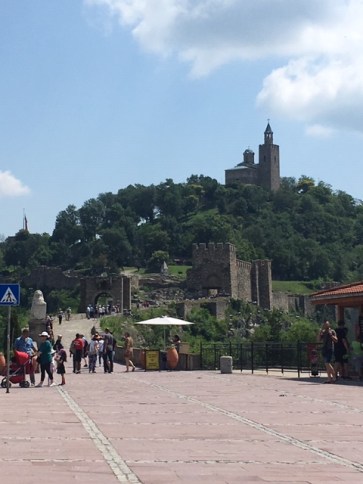
The Byzantines reconquered and ruled modern Bulgaria until 1185, when a local uprising overthrew the Byzantines and established the second Bulgarian empire. This empire lasted until the Ottomans arrived in 1396 and stayed for 500 years. Tarnovo,  the capital of the second Bulgar empire, contains more churches and a fortress high atop the city, a difficult climb in the heat wave sweeping the country:

IMG_8572
Fortress at Tarnovo

Revolts against the Ottomans started as early as the 17th century, but gathered steam in the 19th century, culminating in the Russian-Turkish war of 1877-1888. The effects of the extended Ottoman rule meant that Bulgaria was quite backwards. It had no railroads, little industry, no universities, widespread poverty and illiteracy. Cultural pursuits were also limited during this period. No great Bulgarian literature, art (other than religious iconography), composers or architecture emerged; a combination of Ottoman oppression, poverty and non-existent educational opportunities. Only folkloric items: dancing, singing, embroidery which could be passed down orally through the generations, kept alive the Bulgarian spirit.

The late 19th century saw the beginning of the 3rd Bulgarian Kingdom and  the start of the Bulgarian revival period. Fashions from France were imported, universities established, dancing balls were held. Houses built in Plovdiv revel in the new architectural style, with elaborate paintwork the defining mark:

Western ideas and goods soon arrived, electricity, ballrooms, public transit. The Bulgarian Orthodox Church, long submissive to the whims of the Muslim Ottomans, thrived with a flurry of new church buildings. War was not unknown; Bulgaria fought in the Balkan Wars in 1912, seeking to obtain lands in Macedonia from Serbia and Thessaloniki from Greece. During WW1, it declared war on Serbia, resulting in France, Britain and Italy declaring war on it.

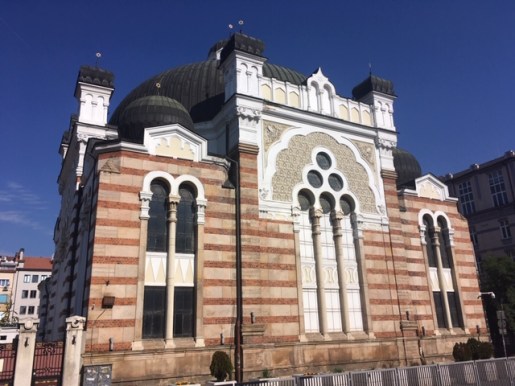
Bulgaria allied itself with the Nazi’s during WW2, but in a rare example of church opposition to Nazi policies, managed to avoid the wholesale slaughter of its Jewish population. Although it enacted anti-Semitic laws restricting the movement and employment of Jews, when the Nazis ordered the Tsar to transport 50,000 Bulgarian Jews to concentration camps, protests erupted, led by the Orthodox Christian bishop of Plovdiv. The Tsar backed down and refused to deport Bulgarian Jews., saving most of them. However, few Jews remain in Bulgaria today, most emigrating to Israel after the war. The Central Synagogue, completed in 1909, is Moorish revival in style and the third largest in Europe. I was only in Sofia on Saturday, when it is closed to visitors.

IMG_8112(1)
Central Synagogue, Sofia

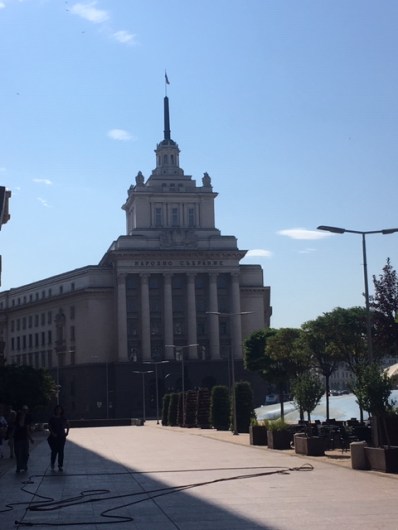
Bulgaria was “liberated” by the Russians in 1944. Following the end of the war, it became part of the Warsaw Pact and was closely allied with its communist brethren, suffering Soviet style economic planning, collective farms, 100% employment of people doing nothing etc. Most high rise apartments and government offices bear the trademark Soviet Realism architectural style, unattractive rectangular blocks with grey, rotting stucco facades. Central Sofia suffers from a glut of these buildings, like its current Parliament, but it is moving soon:

IMG_8123

Economy:  

Bulgaria is one of Europe’s poorest countries. Its lack of industrialization during the Ottoman period left it playing catch-up, but then it immediately endured what Toma referred to as “the messy period”, the time between independence, the Balkan Wars, WW1 and WW2, followed by 45 years of communism. Today, abandoned Soviet style factories litter cities and countryside, socialist style apartments are decaying, sidewalks, where they exist, are little more than rickety pieces of concrete between trees, lampposts and garbage.

Small farms, light manufacturing, forestry and tourism are the biggest industries. Education and medical care is free, but the latter is funded through a tax system paid only by those who are employed. Tax is a flat 10% and there is a 20% VAT, leaving the government woefully underfunded, limited infrastructure improvements and inadequate social programs.

One of the biggest problems facing the economy is widespread corruption amongst government figures. A recent article in The Economist exposed a story where high ranking government officials were being sold luxury apartments at ridiculously low prices then reselling them very quickly at their fair market value. The article also noted the recently appointed anti-corruption minister is being investigated for corruption.

But the largest issue, according to Toma, is Bulgaria’s complete dependence on Russian oil & gas for its energy needs. In January, 2009, Russia stopped imports to Bulgaria during the Russia/Ukraine conflict. For 2 weeks, Bulgaria was without power to heat or light its schools, hospitals and factories and completely powerless (sorry for the pun) to do anything about it. Despite some advances in obtaining resources from elsewhere, Bulgaria still relies on Russia for 75% of its energy needs.

The Monasteries:

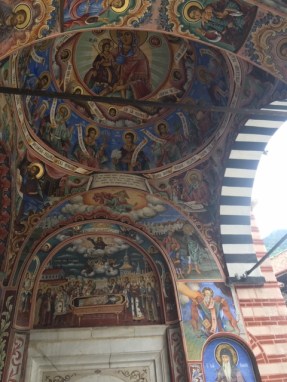
During the Ottoman period, severe limitations were placed on churches if they hadn’t been converted to mosques or destroyed . When construction was permitted, they had to be lower than the lowest minaret, so no towering steeples or soaring cupolas topped with onion shaped domes. In order not to attract the attention of Muslims, the exteriors had to be plain, which explains both the lack of outdoor decoration and the plethora of colourful icon paintings inside. No photos are allowed inside Bulgarian churches, but the refractory at the Rila Monastery didn’t count as a church and photos were allowed, as were photos of the outside paintings:

IMG_8190
Outside paintings at Rila

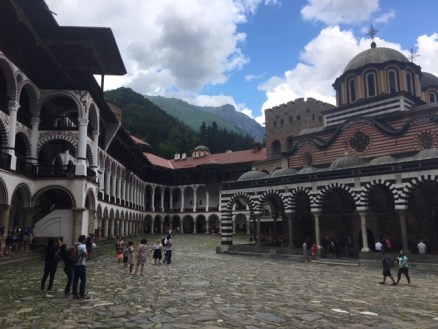
Rila Monastery is the country’s most famous and deservedly so. Its courtyard contains an ornately decorated (inside) church and is surrounded by former monks’ dormitories but  today primarily house pilgrims as the monk population is rapidly dwindling.

IMG_8184
Rila Monastery

Flowers:

Bulgaria is awash in flowers, a pleasant surprise to me, although if I had read the tour’s trip notes beforehand, I would have learned that Bulgaria’s Rose Valley, is responsible for 70% of the world’s rose oil. As is becoming an annoying habit, we were a week late for the best blooms (just like the tulips in Holland) which occur in mid-June, but a few fields still had roses on the vines. Stores selling rose oil related products – lotions, soap, liqueurs – proliferate as do demonstrations on how to extract the oil (pour petals in a vat with steaming water, press, take the resulting liquid and separate the water from the oil). There’s a Rose Museum in Kazanlak and a weird ethnological village nearby with roses and a grotesque Statue of Liberty (the owner’s take on capitalism):

Bulgaria was not only about the roses. Throughout the country, fields of sunflowers stretched towards the sun. And just in case I arrive a week too late for the lavenders in Provence (even with a 6 week window), Bulgaria has those as well, in full bloom.

The Grannies:

In Plovdiv and again in Kazanlak, we attended folk shows at dinner. Excellent as both were, the highlight of the trip was our “brunch with the grannies,” some ladies of grandparent age who invite tourists into their restaurant/museum/gift shop and entertain them first, with the Bulgarian drink, rakija. Made from grapes (in other countries rakija can be made from plums), it is between 40 and 50% proof, sipped slowly from a shot glass with food and a bit hard to take at 10:00AM. But not for the grannies, who managed 3-4 shots each over the 2 hours we spent there.

We began with the grannies showing us how to roll the dough for the traditional bread, Tutmanik (it has other names), to which eggs and cheese are added, baked and comes out delicious. As it was baking, the grannies dressed some of our tour group in traditional Bulgarian costumes (I declined), serenaded us, acapella, with folk songs, then invited us  to dance their dances with them (I declined again). They were gracious hosts, despite not speaking a word of English, the food delicious and it was a welcome reprieve from all the ruins and churches. I suspect the rakija contributed to my enjoyment.

Etcetera

We did and saw a lot more: the Black Sea resorts of Varna and Burgas with their overdeveloped coastlines and all-inclusive guests, mostly Brits, Germans and Scandinavians, seeking cheap holidays, rode on a narrow gauge railway, visited the Russian Orthodox Church and memorial at Shipka, saw what is considered to be the most exquisitely painted church at Arbanasi and ate lots of good Bulgarian food.

Final Thoughts:

I thoroughly enjoyed our tour; Toma was a good guide, our group “jelled” and Bulgaria proved interesting, but maybe a few too many churches and monasteries for my liking. There were pleasant surprises: the flowers, the fresh vegetables, the good, cheap local wine, but these virtues could not mask the poverty in the country. While everywhere I went had roads, air conditioning, reliable electricity and wifi, it was hard to ignore the potholes, the beggars, the Roma problem (10% of the population) and the lack of historical art and literature.  Nowhere have I been has brought home so forcefully the negative effects of 500 years of Ottoman and then communist rule. Bulgaria is doing its best to overcome its history, but it has a long way to go.


North Macedonia: Architecturally Amusing

The Republic of Macedonia became independent from the former Yugoslavia in 1991, but because of disputes with Greece over the name “Macedonia”, it changed its name in 2018 to the Republic of Northern Macedonia or North Macedonia for short. It was the 6th of 7 countries of the former Yugoslavia I visited. I began in the lakeside town of Ohrid, before heading to its capital, Skopje. Ohrid’s architecture is primarily Ottoman, but I’m struggling to find the words to describe Skopje, so I will settle on Las Vegas meets Ancient Greece.

History:

North Macedonia’s history begins with the usual Balkan inhabitants. Neolithic settlements have been found, as have Bronze and Iron Age ones. Illyrian tribes settled the nation, but the world first took notice of the area when a distinct tribe, the Macedonians, led by Phillip II defeated Athens in 338BC and paved the way for his son, Alexander the Great, to conquer a good part of the known world.

Following Alexander’s death, the Macedonia kingdom weakened. Eventually, Northern Macedonia and Ohrid became Roman colonies and remained thus until 395AD, when the Byzantines incorporated it into their empire. Slavs invaded in the 7th century and were conquered and became part of the Bulgarian empire in 842. Although they integrated with the locals, Macedonians remained a distinct group and, in the 10th century, Macedonia briefly established its own kingdom. After 1042, it changed hands between the Bulgarians and the Byzantines, with a small interlude as part of Serbia until the Ottomans captured it in 1395, keeping it through to 1912 when it was lost again to the Serbians.

The Kingdom of Bulgaria occupied Macedonia between 1915 and 1918. After WW1, the newly formed Kingdom of Serbs, Croats and Slovenes incorporated Macedonia. During WW2, it was occupied first by Italian ruled Albania, but in 1941,  pro-Germany Bulgaria took over. Following WW2, it was part of Yugoslavia. In 1990, the government peacefully transitioned from communism to social democracy. It declared independence in 1991 and avoided becoming embroiled in the wars engulfing the region, although it did suffer economically when 350,000 Kosovars sought refuge in the country in 1999 during the Serbian-Kosovo conflict.
Ohrid:

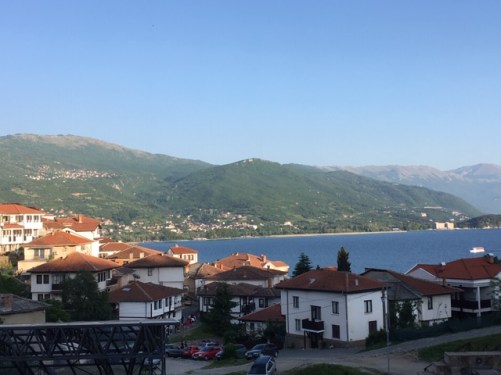
Ohrid has all the trappings of a modern resort town on Lake Ohrid, including a pedestrian walkway bustling with ice cream vendors, stores selling bright flotation devices, buckets and pails, beachwear and book stores. Along the lake were restaurants and coffee shops and ticket booths selling half day and full day trips around the lake. Beginning at the lake and rising high on the hill is the old city of Ohrid, a UNESCO world heritage site, a history buff’s dream and my destination for the night.

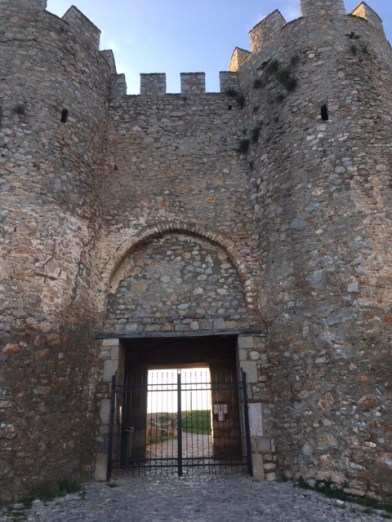
Standing proud over the city is Tsar Samuel’s Fortress, named after the emporer Samuel who ruled the first state of Macedonian Slavs between 976 and 1014 and to whose era the current fortress, towers and ramparts are attributed. But archeology reveals that the foundations date back to Phillip II.

IMG_7858
Tsar Samuel’s Fortress Gate

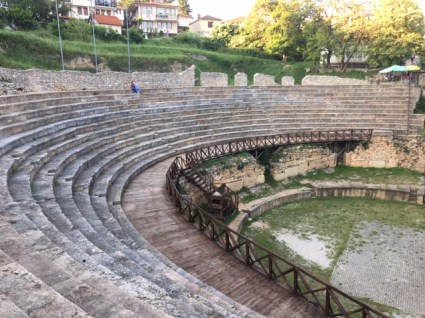
Also Greek in architecture is the Ancient Theatre, dated to 200 BC, but still used today for opera and concerts.

IMG_7848
Ancient Theatre in Ohrid

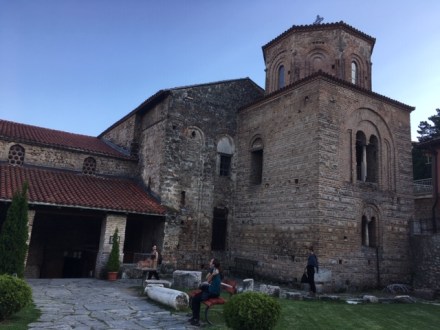
The Church of St. Sophia was built during Byzantine times between 852 and 889. Converted to a mosque during Ottoman times, it still retains many Christian frescoes:

IMG_7843(1)

Nearby, the remains, and particularly the mosaics, of a 4th century basilica are protected by roofs. A few feet away are the best views of the lake.

IMG_7852

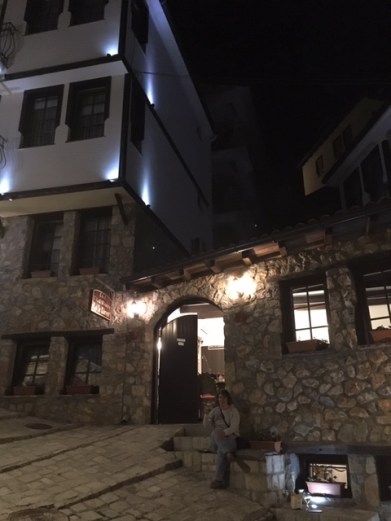
Of all the sites, my favourite was the one right outside my hotel, Small Saint Clements Church, a 14th century Byzantine gem. My hotel, the Villa & Winery Mal Sveti Kliment was also unique; it was both a hotel and wine tasting room housed in stones buildings hundreds of years old. After dining at a restaurant on the lake, I returned to the Winery. Only the two people working there, both named Elena, were present. The cook had been ill so there was no diners. They poured me a glass of white wine, from the rkaciteli grape (“the only good thing Stalin ever did for Macedonia,” said Elena#1, one of 2 Elenas working there). The Elenas and I went outside and sat on the ancient steps, on a beautiful, hot June evening, stars twinkling in the sky, drank wine and talked. Elena #2 had worked as a cruise ship photographer for 7 years, had a Macedonian boyfriend living in Toronto and just left the cruise industry to be closer to her mother. Elena #1 explained Macedonia was a bit backwards; people had old fashioned ideas. I asked for an example. Elena#2 piped up “my mother doesn’t like my 7 tattoos.” I told her I agreed with her mother. It kind of killed the discussion.

IMG_7879
Outside the Winery

Skopje:

Having been to a half dozen Balkan capitals already, I figured I knew what to expect in Skopje: a city built across a river encircled by high mountains, a fortress atop a hill, an Ottoman bazaar, an Ottoman stone arch bridge, maybe a Greek Orthodox Church or two and a Cathedral. Skopje has all those.

And certainly there were statues of its most famous citizen, Alexander the Great:

But there were surprises. It had its own Arc de Triumphe:

IMG_7917
Porta Macedonia

And a Brandenburg Gate lookalike:

IMG_7920

Along the river and in the main square, buildings were constructed along classical Greek lines, including the round one on the right, which serves as the government water management headquarters:


All the buildings are relatively new as 80% of Skopje’s buildings were heavily damaged by an earthquake in 1963. The former railway station was left standing as a memorial. If you look closely, the remains of the former left wing are visible hanging from the building’s central hall.

IMG_7926

When the government embarked on rebuilding and adding statues around the river and main squares, my walking tour guide explained its 3 goals:

  • to provide office space for government workers;
  • to instill a sense of pride amongst Macedonians about their heritage; and
  • to attract tourists.

He said the first objective had been achieved.

The Archeological Museum had the suitable antiquity elements, as did most of the other buildings around. A walking bridge was adorned by statues of notable Macedonians. As for three large, permanent boats on the river, our guide just shrugged and said “go figure. Macedonia is landlocked and never had a navy.”

IMG_7935

It was all a little kooky, maybe a little unbelievable and quite amusing to walk around the city, spotting all the nods to ancient Macedonia.

IMG_7913

The Holocaust Memorial Center for the Jews of Macedonia:

The only building in the main square rightfully devoid of any reference to antiquity is the Holocaust Memorial Centre. Opened in 2011, it was built on the grounds of the old Jewish quarter and contains 3 sections. The first details Jewish history in North Macedonia, starting with the Romaniote Jews fleeing Romans in then Palestine and constructing the oldest synagogue outside of Constantinople in nearby Stobi in 163CE, which remnants still stand. Crusaders passing through in the 10th to 13th century mention the Jewish community, destroyed parts of it, but in 1366, Skopje got its first synagogue.

IMG_8076(1)
The Holocaust Memorial Center

The next section exhibits the ballooning Jewish population in Macedonia following the Spanish Inquisition and their expulsion from Spain in 1492. The Ottomans welcomed the fleeing Jews, allowing them to settle in Skopje, govern themselves and speak their own language, Ladino. Numbering about 10,000, they were an integral part of the trading, legal and medical community in the country.

The final section is about the Holocaust and how it devastated the community. Bulgaria, a Nazi ally, occupied the area in 1941 and enacted strict anti-Semitic laws. In 1943, Bulgarian forces, acting on orders from Germany, rounded up all the Jews and placed them in Monopol, the former tobacco warehouse in Skopje. There, 4 managed to escape, those with foreign passports were released and a few medical professionals were allowed to stay in order to ensure there was not a shortage of doctors in Skopje. Everyone else, all 7,215 people, were put into cattle cars, transported to the Treblinka concentration camp and killed. Not one person who was transported survived.

Today, there are only a few hundred Jews in Macedonia, mostly descendants from Jews who had escaped Treblinka by joining the partisan forces battling the Nazis.

Final Thoughts:

North Macedonia was a treat to visit. Small, scenic and modern, it has historical characters, ruins and stories spanning from the 4th century BC to the current day. Ohrid is picturesque, Skopje is unabashedly Ancient Greece with a touch of Disney and thoroughly inviting.


Revisiting Bill Clinton: Kosovo

My reason for visiting Kosovo was not particularly noble – it would be the last of the 7 countries that made up the former Yugoslavia to check off – and I was curious since most of what I knew about the country (more about its status later) came from biased Serbian guides and negative YouTube videos that described it as the black hole of Europe, governed by the Albanian mafia, best known for disseminating drugs to the rest of Europe, human trafficking and selling organs from unwilling donors.
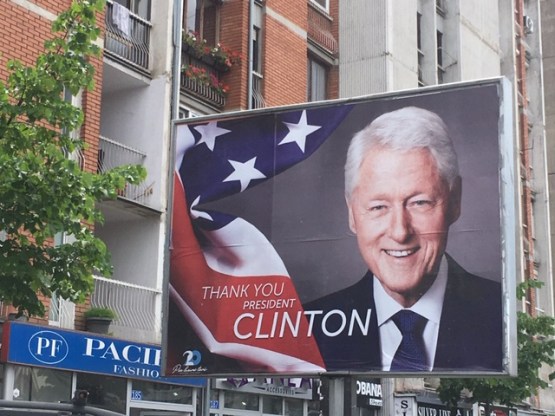
As I walked the 15 minutes from my hotel to the city center of Pristina, the capital, I kept a look-out for Don Corleone like characters, druggies and women screaming to be set free. Instead, I noticed large numbers of people cutting lawns, cleaning up garbage and planting flowers. Then, this is what greeted me:

IMG_8034

A few feet away, another sign and a nearby ladies clothing store:

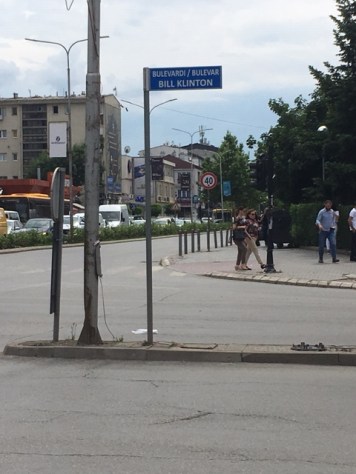
I looked around and noticed I was on Bill Klinton (with a K) Boulevard.

IMG_8031

And there, standing proudly, 11 feet tall, was good, old Bill himself. To be honest, it wasn’t the strongest likeness of Clinton, but the sign behind made no mistake about who it was:

Now, I had come to Kosovo expecting to hear about its history and after 7 former Yugoslav countries, I was getting pretty good: Illyrian tribes, Roman colonies, Byzantines followed by Slavs bringing Christianity, 7th to 12th centuries saw local tribes create different empires in different regions at different times (Serbian, Croat, Albanian, Macedonian, Bosnian, etc.) before the Ottomans conquered everything and moved Islam into the neighborhood. Nationalism erupted in the 19th century, with rebellions against the Ottomans who suffered their ultimate defeat after WW1. Enter the Kingdom of Yugoslavia, then WW2 followed by the Republic of Yugoslavia until Tito’s death in 1985 when the whole area fell apart and erupted into various wars.

My walking tour guide glossed over the history and moved right into Bill Clinton. The reason soon became clear. It was June 11th and tomorrow, June 12th, was the 20th anniversary of Serbia’s withdrawal from Kosovo, encouraged by 78 days of NATO air strikes bombing the heck out of Serbian strongholds in Kosovo and military targets in Serbia, including some in its capital city of Belgrade.

Bill Clinton was the US president who had authorized the NATO air strikes, despite the UN’s refusal to do so (Russia, a friend of Serbia, vetoed UN air strikes), along with the then US Secretary of State Madeline Albright. Both are regarded as heroes in Kosovo. Clinton had been thanked with the boulevard name, the statue and, tomorrow, he would receive Kosovo’s Order of Freedom. Madeline was also in town; her statue would be unveiled tomorrow. George W. Bush had been also honoured, but just with a street name, for his willingness to recognize Kosovo when it declared independence in 2008, something that Russia, China and Serbia have refused to do so far. Though there are flare-ups between the mostly Albanian Kosovars and the Serbian Kosovars that tests a normal relationship between Serbia and Kosov, the oft-heard rumour is that Serbia’s recognition of Kosovo will be made a pre-condition of its entry into the EU, something it desperately desires.

Back to Bill. Not everyone reveres him as a hero. My guide in Belgrade said Clinton’s decision to bomb Serbia in 1999 was completely self centred – he believed that Clinton was a major shareholder in Kosovo entities owning its vast mineral rights; the chance for personal gain motivated Clinton to order the air strikes. A YouTube video by Graham Phillips is titled Bill Clinton, A Hero for War Criminals and is decidedly anti-Clinton. My understanding was that the West had been embarrassed by allowing the ethnic cleansing by Serbs in Bosnia Herzegovina right under the noses of UN troops, as well as for standing idle when the Rwandan genocide happened. Clinton was determined not to let another massacre occur; which all signs pointed to when Kosovo declared independence from Serbia.  I don’t disagree with most of Clinton’s politics, but he will forever in my mind be a sexual predator who abused his position of power with a vulnerable young intern and then proclaimed “I did not have sexual relations with that woman.”
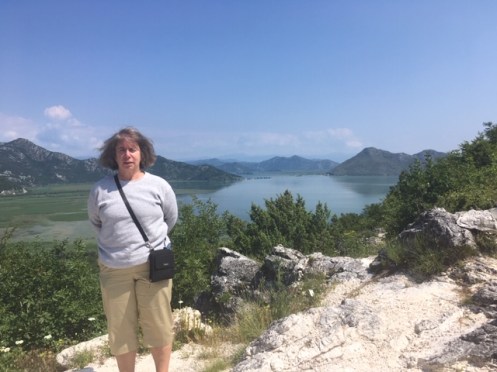
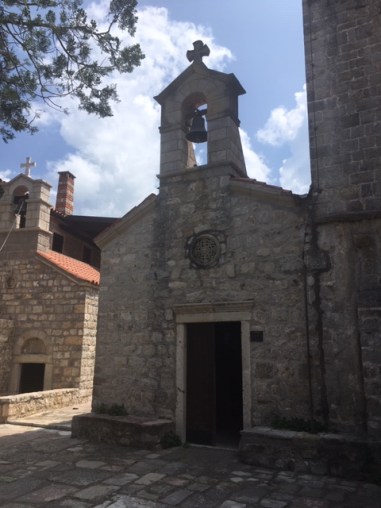
Astrit, our guide, managed to steer the group away from Bill Clinton and towards Pristina’s other highlights. A statute of Skanderbeg graces the central square – the same man who stood up to the Ottomans in the 15th century and who has a similarly impressive statue in Tirana’s main square. Also, just as in Tirana, Mother Teresa, an ethnic Albanian, is honoured, but in Pristina by a recently built Cathedral in the town centre completely out of proportion to the number of Catholics in the country.

IMG_8051(2)
Mother Teresa Cathedra

Remnants of the old Ottoman district with a few Ottoman houses and mosques remain standing, but the old Turkish bazaar is now made up of umbrellas. More impressive bazaars, mosques and houses are visible in Albania and Skopje, Macedonia.

A sign, NEWBORN, stands outside a sports complex. Originally unveiled on the first day of Kosovo’s independence on February 17, 2008 to mark its birth as the newest country (South Sudan has since taken that honour), it is recovered every year on the anniversary with new, symbolic motifs. Its current incarnation contains the faces of 99 Kosovar women, designed to showcase their individual struggles in making Kosovo a nation.

IMG_8062

The National Library is, for better or worse, a unique architectural creation. My first impression was, ugggghh, but once Astrit explained it, it started to make sense. Supposed to represent Kosovo, the cubes are a throwback to Roman times, the white domed roofs are reminiscent of Byzantine church roofs and the strange wire mesh is shaped like honeycombs, emblematic of the country’s bees. As Astrit said, beauty is in the eye of the beholder.

IMG_8025

Which brings me back to Bill Clinton. On June 12th, I walked back to the center square where Clinton would be speaking later in the day. The pedestrian walkway was partially blocked off, with hundreds of police officers lining the path. Vendors sold American flags, people’s faces were painted red, white and blue and crowds were starting to form near the viewing area.

Even if I had wanted to get a glimpse of Bill (which I didn’t), I had a bus to catch.  As I was checking out of my hotel, the 30 year old hotel clerk expressed surprise that I wasn’t going to stay to hear Bill Clinton.

“I’m not a fan of his,” I explained. “Do you know what he did to that girl?”

“Yes,” he said, “but he was a hero for us. If he hadn’t authorized the bombing, Kosovo would not exist.”

“But that doesn’t excuse what he did to Monica Lewinsky. I cannot forgive him for that.”

“Yes, that is a fact. But it is also a fact that without him, I would not be here today.”

Hero, war criminal, sexual fiend? All are sort of correct, none are completely wrong.

Which, at the end of 6 weeks traveling though the Balkans, seems to sum everything up. The basic facts are not in dispute, but the reasons, the motives, the slant, are all subject to widely differing interpretations depending on which side you are on and the perspectives of the news outlets you watch. It has been a great learning experience, especially the realization that absolute truths I held for decades are more fluid than I imagined, shaped largely be my pro-Western, slightly lopsided, upbringing.

Next: Backtracking to Macedonia


Next: Backtracking to Macedonia

About Albania

In 1979, when I back-packed around Europe, Albania was strictly off-limits. Its Communist regime, considered the most radical of all governments, closed its borders, imprisoned its citizens and deterred any foreign contaminants, including tourists. Those few who were permitted to enter underwent rigid border controls to ensure no improper looking visitors might corrupt the locals. Men were required to have short hair, no facial hair and no sideburns. Women could not dress in mini-skirts or maxi-dresses; even the hijab and abaya were banned in this country where half the population was Muslim. For those foreigners who failed to pass muster, there were barbershops and clothing stores at the border from which a suitable haircut could be had and appropriate dress could be bought.

I encountered no such scrutiny. As my bus from Kotor, Montenegro approached the border, the conductor (all Balkan buses have both a driver and conductor) gathered everyone’s passport and, once at the border, he hopped off and went inside a booth. We sat inside the bus for about 20 minutes, he returned and the bus resumed its journey, with the conductor handing the stack of passports to the first passenger, who took hers and handed the stack back to the next person. That was it; welcome to Albania, without so much as a glance or scowl in my direction from the once most feared border guards in Europe.

Tirana, First Impressions:

As soon as we neared the capital city, Tirana, traffic became increasingly worse, until only turtles proceeded slower on the overcrowded main road. This was not surprising. Tirana’s road system was built when the city had less than 200,000 people and none were expected, or allowed, to own cars, save for the chauffeurs of a few party officials. Today, Tirana has close to 1 million inhabitants, many of whom drive cars which would not have passed a safety test in Canada.

The bus drew into a large parking lot which doubled as the international bus terminal. As was becoming the norm, the instant I stepped off the bus, I was singled out as a foreigner by a dozen taxi drivers, all eager to take me wherever I wanted to go. This happened in every bus station in the Balkans and never ceased to amaze me. I understand in Africa or South America or India where my clothes and skin colour make me stand out, but why in the Balkans before I open my mouth to reveal my lack of local language skills or retrieve my obvious non-Balkan suitcase (Samsonite, which are for sale in the Balkans, but are too expensive for the average person) am I so easily marked as a tourist?

Perhaps it is a necessary survival skill learned by taxi drivers in lieu of learning how to drive, since none of the taxi drivers I used exhibited any knowledge of the latter. I learned later that one of the consequences of the populace not being allowed to own cars until the fall of communism in 1991 was that no one knew how to drive. It took the new government a few years to institute a system of licensing drivers and, to this day, I doubt that driving lessons or passing a driving test are prerequisites to obtaining a license. The drivers were uniformly aggressive, ignored lanes, lights, pedestrians and anything else that hindered their single minded goal of getting to their destination as fast as possible. Three Canadian girls from northern Ontario whom I later met were driving through the country and confirmed the hazardous nature of being on the roads all over Albania.

In this poorest country in Europe, I chose to stay (yes, I am slightly embarrassed) in the Hilton. By way of explanation, it was only a year old and must have been struggling with occupancy as it was offering rooms for $50 a night. At that price, I upgraded and took a king room with a balcony at roughly the same cost a hostel bed goes for in Amsterdam or Paris. Clean, modern, with English speaking staff, it was hosting a conference of Israelis, who also seemed to be the only other guests there. A pleasant 30 minute walk down a river path took me to the city centre

History of Albania:

It was a relief, after 5 weeks in the Balkans, to not be in a country that was part of the former Yugoslavia, with all the conflicts created in its breakup, but the history of Albania is even more frightening.

Three to four thousand years ago, two tribes, the Hellenes and the Illyrians made their way to the region, The Hellenes settled in Greece; the Illyrians in the Balkans. A busy area in antiquity, Albania was visited, not always peacefully, by Greeks, Romans and the Byzantines, all of whom left their mark. The southern area was generally associated with the East and Byzantine empires while the north was more influenced by the Holy Roman Empire. In the 7th century, Slavs from the Russian steppes invaded and settled the area, reducing the influence of Rome, while in the south, the Sicilian Normans battled the Byzantine empire. Whether the Albanians are descendants from the Illyrians or Slavic is open to debate; what is certain is that the Albanian language, Shqip, is one of the oldest languages still in use and unlike any other.

Albania was predominantly Orthodox Christian after the Slavs settled in the region. Albania first emerged as a distinct entity in the 10th century, but remained part of Byzantium until captured, at various times and in different areas, in the ensuing centuries by Bulgarians, Venetians and the Serbian Kingdom. When the Ottomans subdued Serbia in the 15th century, they also became the overlord of Albania, converting many native Albanians to Islam and settling other Muslims in the region. The greatest Albanian warrior, Skanderbeg, rebelled against the Ottomans beginning in 1443, enjoying numerous victories and earning Albania de facto independence. Upon his death, the Ottomans reasserted their authority over Albania.

The 19th century was marked by frequent Albanian rebellions against their Ottoman authorities, with independence finally achieved in 1912 following the Balkan Wars. WW1 saw the population’s support split along religious grounds, with the Muslims supporting the Axis powers and Ottomans and the Christians rallying to the Allies’ cause. Italy overran most of the territory with Serbia also occupying part of it. Despite secret deals and backroom shenanigans by the victors about how to divide Albania, it managed to emerge after WW1 as a single, independent entity although internal politics were chaotic.

In 1939, fascist Italy invaded and occupied Albania. When Italy surrendered to the Allies in 1943, Germany took over. Tirana was liberated by its partisans in 1944, led by the communists and its leader, Enver Hoxha. A side note, Albania was the only continental European country in which the Jewish population increased during WW2 as the Albanians refused to participate in the deportation of Jews. Many Jews made their way to the country as a place of refuge, but there are very few left today.

The Communist Period: 1944 to 1991

Hoxha quickly set himself up as dictator, executing political enemies, stifling the media and rounding up intellectuals. Estimates for the number of people killed vary between 5,000 and 25,000. In 1945, elections were held with all the candidates nominated from the Democratic Front (Communist) party. Guess who won?

Hoxha hugely admired Joseph Stalin. His short-lived alliance with Tito in neighboring Yugoslavia fell apart in 1948 when Hoxha accused Tito of being too liberal. Relations with the USSR broke off in 1961, following Stalin’s death and Khrushchev’s ascendancy, for “not being enough like Stalin.” Hoxha, needing foreign aid, wooed China, which wanted a foothold in Europe and Albania was the best it could do. However, Nixon’s visit to China in 1972 infuriated Hoxha, who again broke off relations with China, lost all sources of foreign funds and plunged his country into a terrible economic crisis.

Hoxha decreed that Albania would be entirely self-sufficient, importing very little, but exporting natural resources and electricity. Rationing, everything from food to cars to electricity, was pervasive. No one was allowed to own private property; farms were collectivized, full employment was guaranteed. People were hungry, clothing was mundane, productivity sank and things we take for granted, like banks, credit cards, insurance, were unknown to the populace.

Differences were not allowed. Ethnic Greeks suffered discrimination and could not be educated in Greek. When ethnic Albanians fled Kosovo to Albania, they were returned for fear they would pollute the country with western ideas. Religion was banned; Hoxha proudly proclaiming Albania to be the first atheist country. Mosques and churches were demolished; some priests burned or otherwise executed. Even today, the country remains fairly non-observant. Although 50% of the population is Muslim, 90% of those are non-practicing.

One of my guides told me the story of the symbols of the fall of communism. The first companies into Albania were Coca Cola and Mercedes Benz. The red Coca Cola logo became synonymous with capitalism. Mercedes was quick in because the Communist rulers all had Mercedes cars and, even today, a large number of vehicles are Mercedes, albeit 20-30 years old. But the biggest emblem of freedom from Hoxha is the banana. As the climate of Albania does not support banana trees, none were grown in, or imported to, Albania, until after 1991. An entire generation grew up not knowing what a banana looked like or how one tasted. Today, the supermarkets and fruit stalls all sell bananas in a nod to the country’s freedom.

Albanians were not allowed to travel. The border force’s mandate was to ensure Albanian citizens stayed in Albania. At Bunker Art2, a museum dedicated to showcasing the state agencies employed during the Hoxha regime, the weapons, uniforms, listening devices and other paraphernalia used by the elite Border Force are on display. My recollection is about 9,000 people tried to escape the country in the 40 years of Hoxha; of those 1,000 were killed in the process. Brutal labour camps were set up for the prisoners and for the families, the wives and children, of those who tried to escape, a huge deterrent. The Museum of Secret Surveillance, housed in the former Sigurmi headquarters, showcases the technology and methods used by the Sigurimi, the brutal interior police modelled after East Germany’s Stasi.

About those bunkers… In addition to his other faults, Hoxha took paranoia to an extreme. Convinced that a Russian invasion was imminent, he embarked upon a scheme of building concrete bunkers, 170,000 in total, between 1967 and 1986, estimated to cost 2% of the country’s GDP. Varying in size from tiny 2 person cells to nuclear fallout shelters with over 100 rooms, their grey, mushroom shaped entrances dotted the landscape. When one of Hoxha’s generals suggested they might not be too effective, he was executed. Today most of the bunkers have been removed, to where no one is sure, but a few remain around Tirana as reminders and as entrances to museums, tearooms and mushroom farms.

IMG_7772
Me at a bunker’s entrance

Following Hoxha’s death in 1985, Ramiz Alia took over. He realized the winds were changing. He initiated trade with with Italy and Greece and allowed people to travel abroad. Elections in 1991 kept the communists in power, but non-communists were also in the cabinet. In the 1992 election, the Democratic Party won, ending communist rule in Albania. Today, it is a member of NATO and is seeking admission to the EU.

Tirana Walking Tour:

Eriv (pronounced like Eric without the “c”) guided me and 15 others through the sites of central Tirana, in addition to providing much of the history and the stories here. Meeting in the central square, Eriv pointed out the National History Museum with its communist inspired mural depicting Albanians throughout the centuries, from Illyrians to the 3 communists marching victoriously in the centre. Painted in 1981, the only change to the mural has been the deletion of a star on the flag.

IMG_7779
National History Museum with Mural

Eriv walked us to the Arts Museum to see a a collection of statues. Stalin is there twice, Lenin once and the white bust with the missing nose is Hoxha. Although they previously stood in the main square, they were toppled by crowds in 199O and 1991 and put out to pasture behind the Museum.

IMG_7752
The Statues

A statue of Mother Teresa graces the podium outside the Cathedral of St. Paul. Although Catholica make up only about 10% of the population, Mother Teresa is admired by all, as the only Albanian Nobel prize winner and as a representative of Albanian tolerance and kindness.

IMG_7753
Statue of Mother Teresa

We walked to another quirky monument to communism, the Pyramid. Originally built as a mausoleum for Hoxha’s remains by his daughter, it never served that purpose. Today, it remains derelict, graffiti laden,  its windows broken, behind wire while the country figures out what to do with it.

IMG_7761
The Albanian Pyramid

During the communist period, senior government officials lived in Blloku, a community gated to keep the population out. Today, the walls are gone and coffee shops, bars and night clubs welcome all. Hoxha’s house still stands, Closed to the public, it is now subjected to a delicious irony. Across the street from the residence of the world’s strictest communist is that symbol of capitalism, Colonel Saunders, grinning from a KFC into the windows of Haxha’s home. In case you are curious, Albania doesn’t have a MacDonalds, but one is scheduled to open later this year.

Berat:

Albania has far more to offer than a communist past. Across the countryside rests ancient ruins from dozens of civilizations, many in excellent shape. Apollonia has extensive and well preserved Roman ruins; Durres has one of the largest existing amphitheatres. Albania’s Adriatic coast is as beautiful as can be, but has suffered recently from overbuilding of cheap beachside hotels catering to Poles, Germans and Russians.

I visited the city of Berat, a UNSECO world heritage site often called the city of 1,000 windows. One of the very few downsides of visiting a less touristed country is many tours offered only proceed if minimum numbers are met, so despite TripAdvisor and GetYourGuide promoting dozens of day trips to Berat, none were going when I was there or only if a horrific single only price was paid. I chose instead to try the local bus system, which cost the equivalent of $5 for a one-way, two hour bus ride to Berat.

High atop the hill is Berat castle. Mostly constructed in Byzantine and Ottoman times, but some of its walls date to the Roman period. Inside, little remains of the palaces, but like Diocletian’s Palace in Split, locals have constructed houses inside the walls and lived there since the 13th century. Also inside are 20 churches, again most from the 13th century.

It stands atop a hill overlooking the Berat, also called the white city and the city of 1,000 windows, after the Ottoman architecture. Sadly, most of the houses have been abandoned, too expensive to fit to modern standards.

IMG_7820
Many of the 1,000 windows in Berat

Final Thoughts:

Albania was one of those countries I always wanted to visit and it didn’t disappoint. Tirana is fascinating, not for its beauty or architecture, but for its role as the epicenter of Albanian communism which I would describe as quirky and radical but for the reality that the Hoxha regime was brutal, crushing all opposition and inhibiting individuality. I didn’t spend long enough in Albania to enjoy its plentiful archeological wonders, but that is a good reason to return.

Next: Kosovo and Bill Clinton

Meandering through Montenegro

Montenegro is a new country, declaring independence, and amicably divorcing itself, from Serbia in 2006. A third of its 600,000 inhabitants live in the capital, Podgorica. It is small (about 400 kilometers long), but contains rugged mountain peaks, forests, waterfalls, lakes and 295 kilometers of Adriatic coastline. As it neighbors Serbia, Bosnia Herzegovina, Albania and Croatia,  it has had its shares of troubles over the centuries.

History:

Montenegrians are Serbian speaking Slavs, who emigrated to the Balkans in the 7th century. They became part of the Byzantine empire, but in 1042 revolted and achieved an independent kingdom. The kingdom existed until the mid-15th century, when Montenegro was captured by the Ottomans. It managed to regain independence in 1692 and remained more or less a self-governing state until the aftermath of WW1, when it became part of the Kingdom of Yugoslavia and, post-WW2, part of the Yugoslavian Republic. Following the break-up of Yugoslavia in 1990, it stayed as part of Serbia, thus experiencing  the global embargoes and economic crises that plagued Serbia in the 1990’s, but luckily sustained little damage from the NATO air strikes in 1999.

Podgorica:

A dramatic train ride from Belgrade, through high mountain passes and hundreds of tunnels, until the train slowly descended into the valley brought me to my destination, the capital city of Podgorica. Although founded in the 10th century and occupied by just about everyone, it was heavily bombed during WW2 and retains little of historical architectural interest.

My walking tour of Podgorica was cancelled for lack of the minimum participants. The city is not heavily touristed, a much welcome change from Dubrovnik, but not great for group tours. Undeterred, I grabbed a map and walked towards the city centre. Fifteen minutes later, I came to the football stadium, which my map indicated was on the other side of downtown. I had walked through it and completely missed it. As I said, not too much of interest. I crossed the newly constructed Millenium Bridge, which looked very similar to other millenium bridges in Belgrade and Novi Sad in Serbia, walked back across another bridge, then walked to the old Ribnica bridge and couldn’t figure out what else to do. I went to the mall, which had lots of shoe stores, a few telephone carriers, some toy stores and food kiosks. The walk around the mall took 15 minutes. So I walked 45 minutes to the nearest laundromat, did my laundry and had a pedicure on the way back.


And so it went. My 3 days in Podgorica were pleasant, but unexciting.

From Podgorica to Kotor:

Podgorica is inland about 55 kilometers, but a slow drive to the coast reveals spectacular scenery and architecture that spans thousands of years. I arranged a private transfer/tour with Tanya, a local Podgorician who along with 2 friends started a travel agency. Out first stop was Lake Skadar, a mountain lake that straddles Montenegro and Albania. Popular for picnics and lazy boat rides, we instead went high into the mountains for a bird’s eye view.

IMG_7656
Me and Lake Skadar

The next stop was Budva,  a coastal town with an ancient centre, dating from the 9th century, with Venetian inspired buildings and Ottoman era Orthodox churches.

IMG_7667
Budva Church

Our last city was Tivat, modern and  notable for its tricky-to-land-in airport due to the nearby mountains. Its harbour is routinely filled with mega-yachts and high-end retail stores abound. I found the whole place pretentious.

Kotor:

Kotor is Montenegro’s jewel and deservedly so. Its bay stretches from the Adriatic inland for 30 kilometers and is often, wrongly, referred to as Europe’s most southern fjord. It can be reached by a short tunnel under the mountains or a long drive along coastal towns before snaking around the bay on a single lane, curvy road following the water. We chose the latter. Tanya was underwhelmed by the towns. The first we passed, she said, was occupied mostly by Russians, laundering their money and driving up prices all over the coast. Another town was predominantly Turkish, “a safety net from Erdogan” Tanya offered. Nestled in the mouth of the bay are two islands, the natural Sveti Dorde and Gospa od Skrpijela.

IMG_7671
An island just before Kotor Bay containing an exclusive hotel

We entered the walled city of Kotor. Inside are 17 churches, some right across from each other, ranging in age from the 10th century to the 20th century, mostly Orthodox. Palaces, former homes belonging to wealthy Kotor citizens, are signposted. Most resemble Venetian constuction, built at the height of Kotor’s prosperity in the 16th and 17th centuried. The inevitable souvenir shops, ice cream vendors and banks were present, along with touts offering speed boat tours of the bay. That seemed like a waste to me; the harbour should be savoured slowly, not raced past in a flurry trying to get from island to cave as quick as possible.

IMG_7702
One of the Palaces inside Kotor

Above the town, a fortified wall rises steeply upwards to first, the church of St. Nikola, then to St. John’s fortress. 1450 steps lead up to the fortress and Tanya warned me it was a demanding, 2 hour climb, Unfortunately, it was the only way to see the Bay from above as the driveable Serpentine way to the view site was closed for go-cart races. I pondered the climb for about a second before deciding I could just as happily enjoy someone else’s picture of the the view on Instagram. Needless to say, I didn’t do the climb.

IMG_7699(1)
The Church and Fortress above Kotor

My pension was a peaceful 30 minute walk along the sea from Kotor centre. Not only did I not contend with the crowds and noise in the center, but my room had a balcony with a view of the bay. I spent joyous hours sitting there, watching the sunset and sunrise. On my last day in Montenegro, 2 cruise ships sailed up the bay to dock in Kotor to dump thousands of passengers on shore excursions into the city. I was not unhappy to leave.

IMG_7719
View of Kotor Bay

Next: Albania