Driving Germany’s Romantic Road

The Romantic Road was a term dreamed up by PR types trying to entice tourists back to post-war Germany. It’s a pretty enough route, but I failed to find any love interest on my week long journey around it.

After picking up a rental car in Munich, my friend Cathy and I drove to our first town, Rothenburg ob der Tauber, one of the best preserved medieval towns in Europe, replete with timber framed houses and an old town square fronted by the Town Hall:
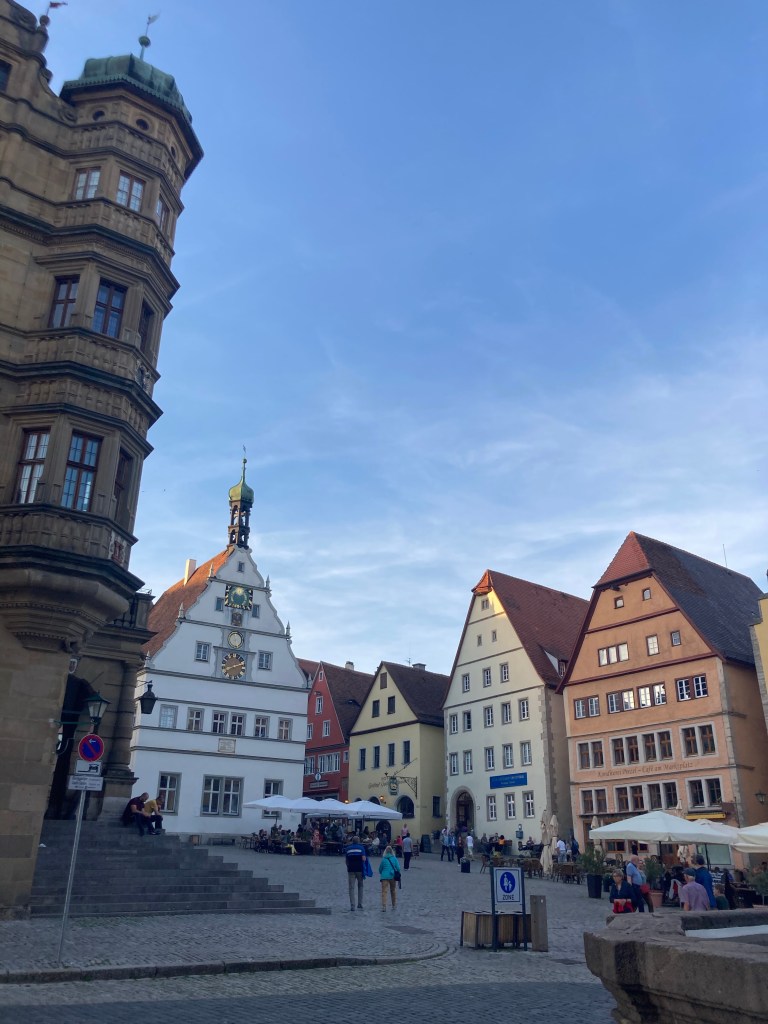
It’s one of three walled towns still existing and wall walking is a common pastime, so we indulged:
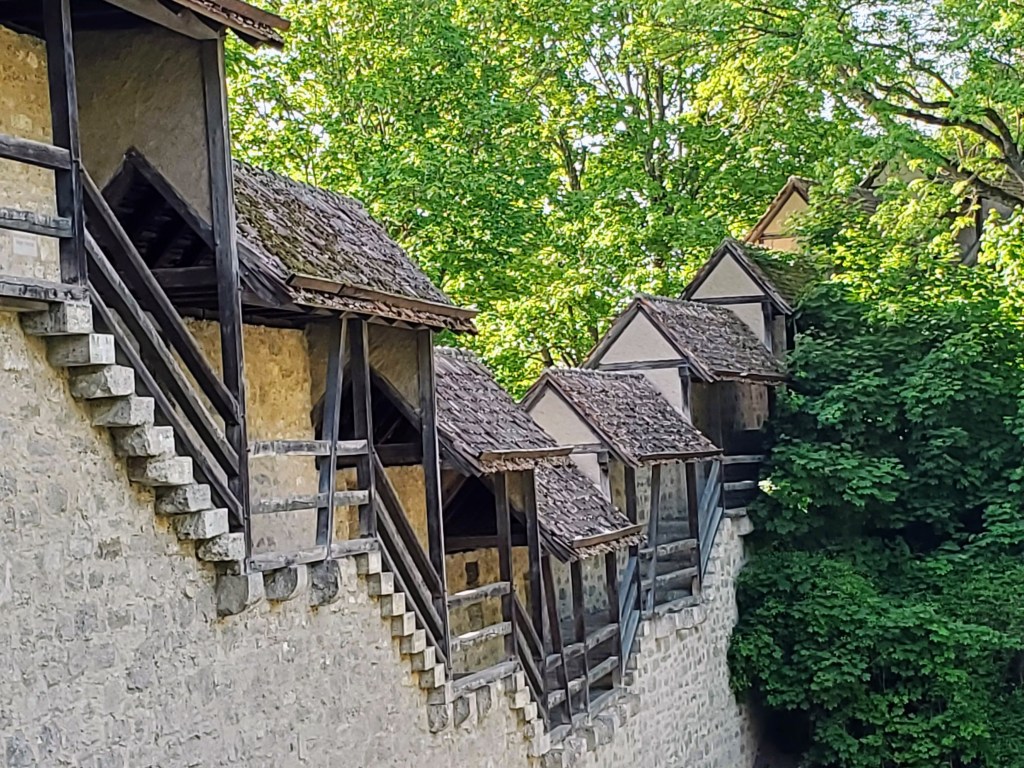
A must-do is to take a walk with the Night Watchman, who regaled us with stories of life in medieval Germany. Then, the place stank due to lack of plumbing, plague and other diseases ran rampant and the church controlled every aspect of one’s life. Hardly a paradise;

The Night Watchman

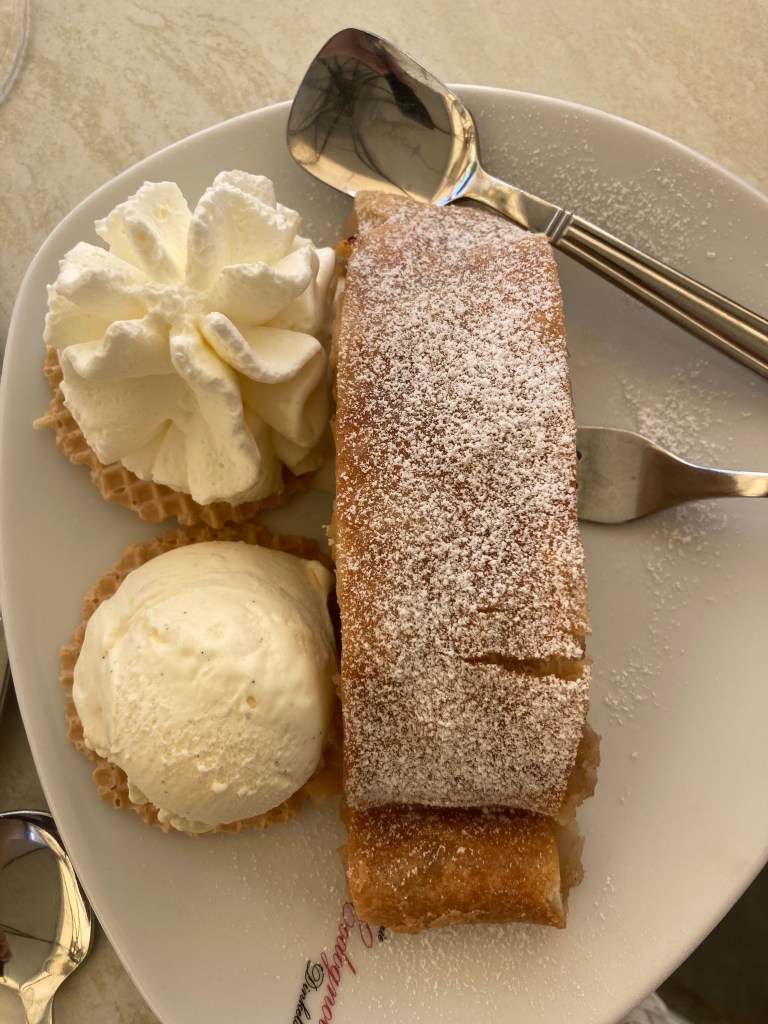
For a change of scenery, we drove 35 miles to the second walled town of Dinkelsbuhl. It too had timber framed houses, ramparts and a town square. Rather than repeat our Rathenberg ob der Tauber experience, we started on our second quest, eating lots of good German food. Thus, we sat in a cafe near the Cathedral and ate a delicious piece of Apple Strudel:
The third of the trio of walled towns is Nordlingen, which has the usual medieval attractions but also the Ries Crater Museum, which as its name suggests, is about craters and more specifically about the 25 kilometre wide crater where Nordlingen rests, created when a meteor crashed into the earth about 15 million years ago. The museum was a welcome change from all things medieval, focusing on how the universe and earth were formed.

Another diversion from the 15th century was a detour to Stuttgart and the Mercedes Benz Museum. Housed in an elliptical building, the museum whisked us to the 8th floor in a pod like elevator. From there, we slowly walked down, with exhibits about Mercedes Benz intertwined with world events. Daimler patented the first motor car in 1885, but it wasn’t until the Paris World Fair in 1889 that his car really took off; it being one of the main attractions there after the Eiffel Tower:
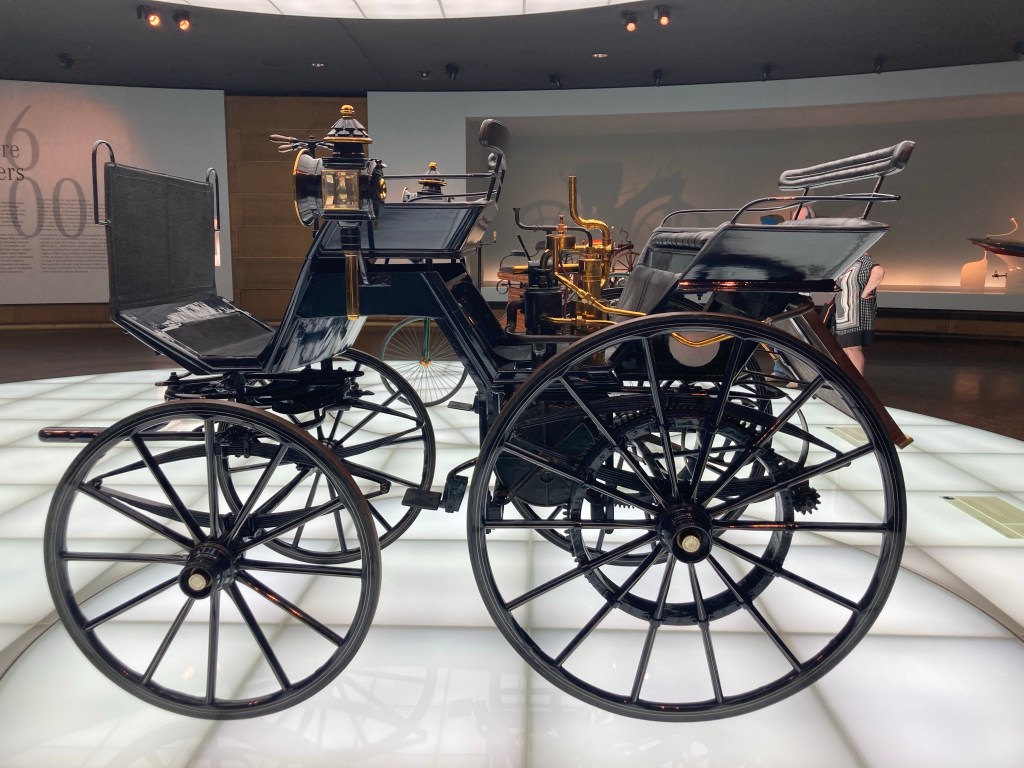
The Museum was full of interesting tidbits. The name “Mercedes’” was adopted when one of Daimler’s engineers christened his race car after his daughter “Mercedes”. Benz and Daimler never met; financiers forced the two companies to merge in the wake of the financial crisis in Germany in the 1920’s. During WW2, Mercedes Benz used over 30,000 forced labourers, mostly prisoners of war and concentration camp victims. It has apologized for this but no mention was made of reparations.

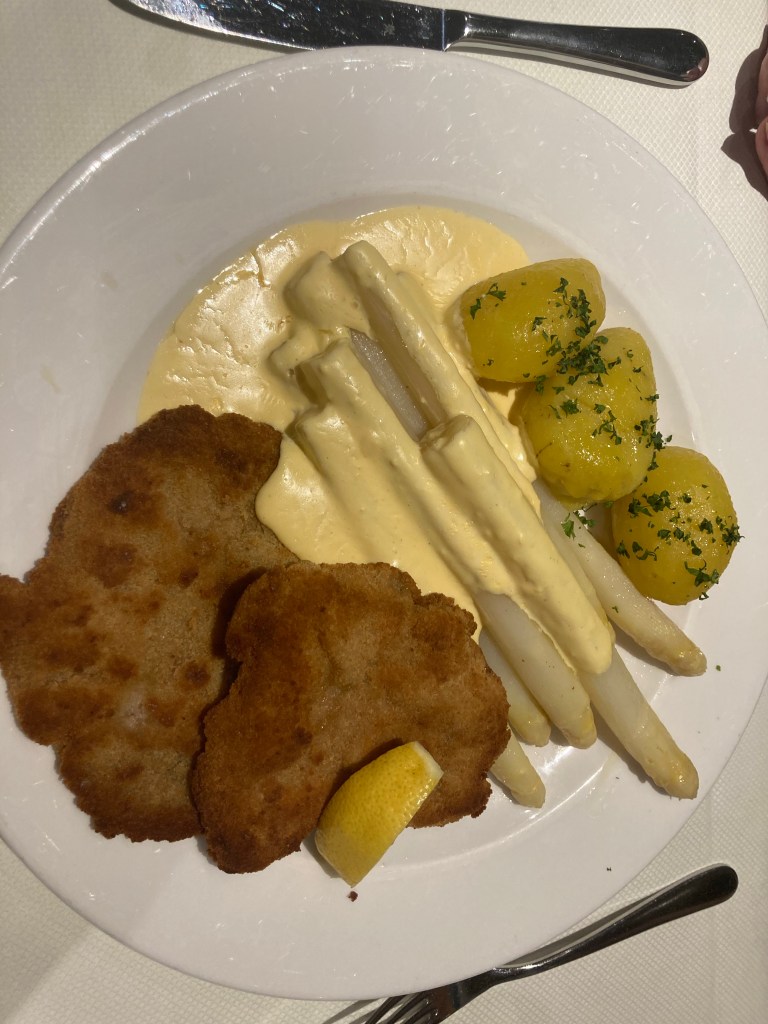
In furtherance of our food hunts, I finally was able to enjoy white asparagus, loved in France and Germany every spring. It’s white because it is grown completely underground so it lacks chlorophyll but served with Hollandaise sauce and weiner schneitzal makes for a very hearty meal:
Part of the romance part of the Romantic Road is the plethora of pretty castles. We visited Hohenzollern Castle, an 18th century Gothic Revival castle built by Crown Prince Frederick William IV of Prussia on the remains of a much older castle:
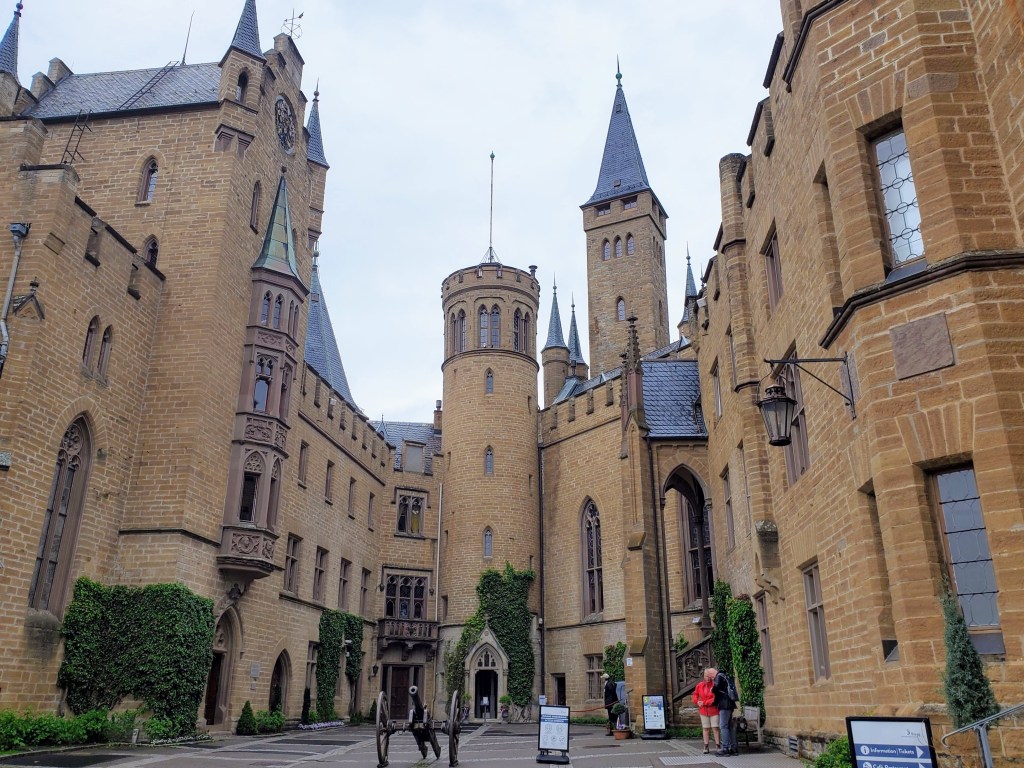
Inside, it was as opulent as one would expect a palace to be. Unfortunately due to a mix up in castle names causing me to buy tickets for Hohenschwagua not Hohenzollern castle, the only tour available was in German and the only thing I understood was “stay on the carpet” so my information is a little thin.

On our way to our final castle, we passed through the Bavarian Alps, beautiful in their thick forests, lush green grass and glacier fed lakes:
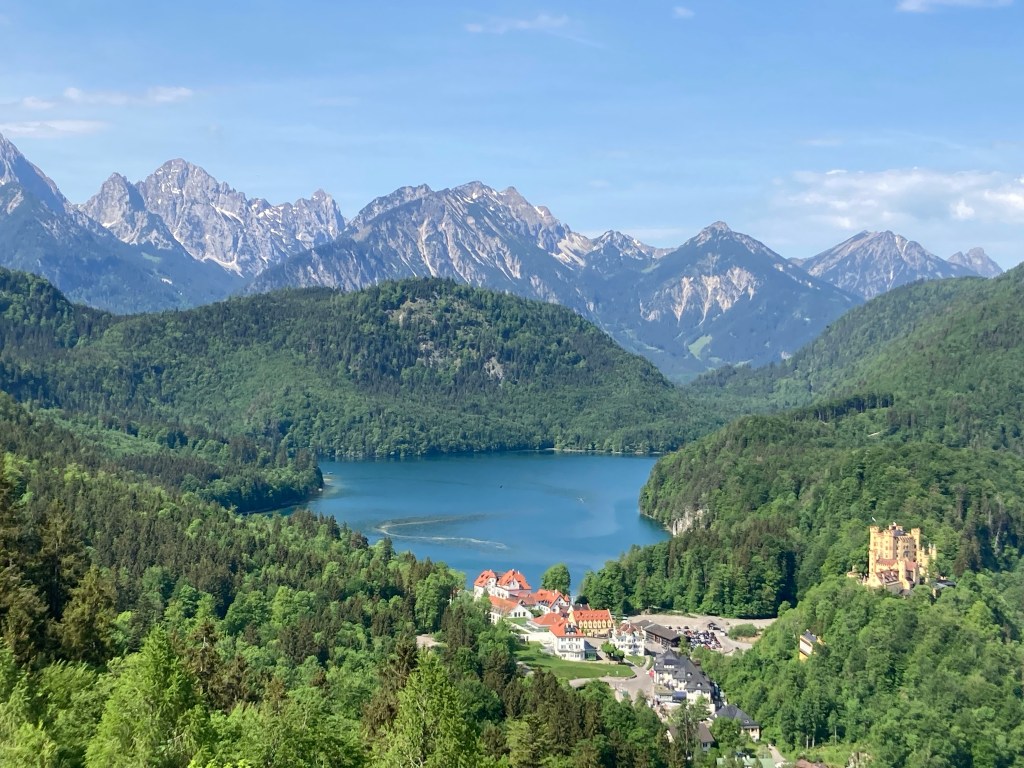
If you look closely in the picture above, you’ll see Hohenschwagua castle on the right, which we did eventually find on route to Neuschwanstein Castle but having already shelled out 30€ to try and visit it earlier but went to the wrong castle, we didn’t try and visit it again. The tickets had very strict date and time entries and we’d missed both.

So on to the ultimate castle, Neuschwanstein Castle. Conceived by King Ludwig II of Bavaria in the 19th century as his version of a medieval castle, its setting is spectacular:
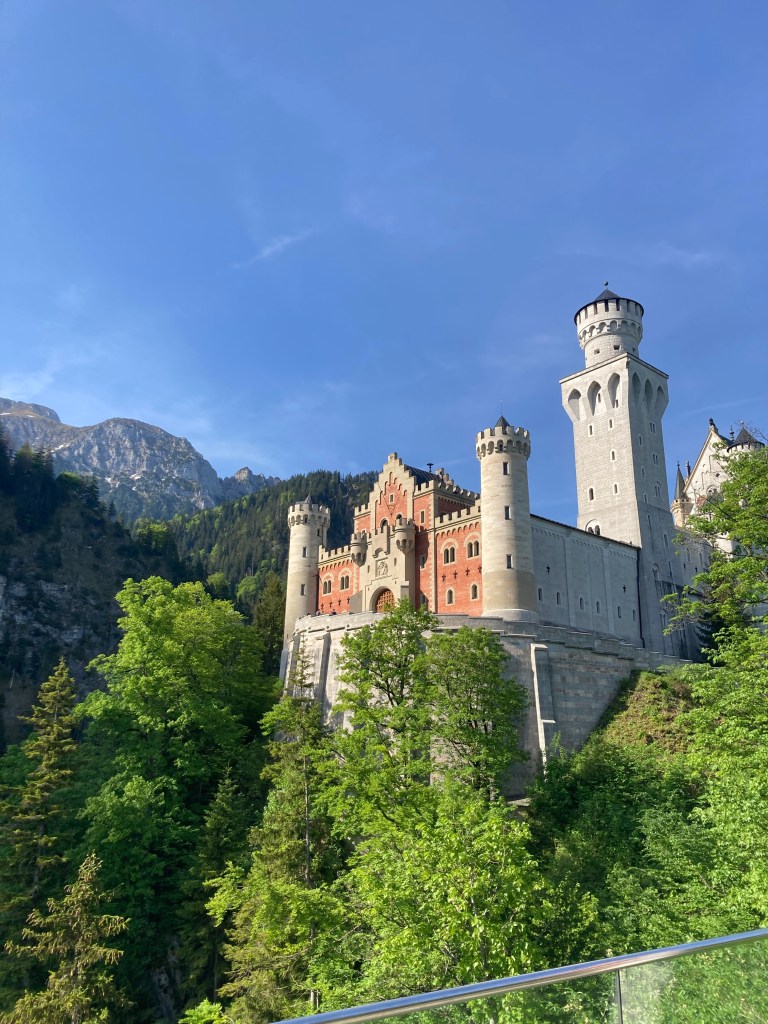
We managed to buy the correct tickets for the English tour and were led through the castle by the guide who explained King Ludwig’s masterpiece. Frustrated by his limited constitutional powers, Neuschwanstein was built so King Ludwig could engage in his vision of a medieval king; omnipotent, a brave warrior, etc. To this end, he had a room that looked like a cave and another one pained with scenes of his favourite stories of Parzaval and Lohengrin. Alas, no pictures were allowed inside.

The castle is the subject of many rumours, most of which were ignored by the guide. It is said to have inspired Disney’s Sleeping Beauty’s Castle. It was also said to have been built for the German composer Richard Wagner. King Ludwig was also supposed to be mad, which our guide did address, but his take was that King Ludwig just liked to visit an alternative reality, no different than today’s kids playing video games. So rather than being mad, the king was just ahead of his times.
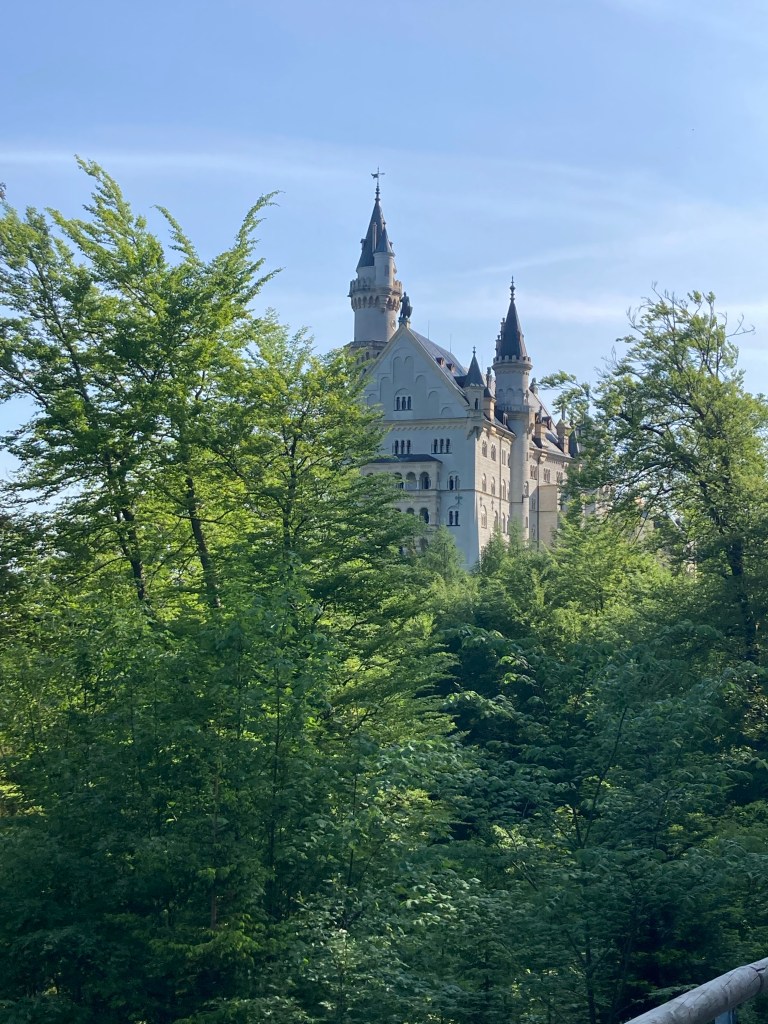
Believe what you like, I found the castle enchanting, a monument to one man’s dreams. And thus ended our Romantic Road journey.
Armenia: The Third Caucasus Country

The problem with doing a 3 country tour is that once you get to the last one, you feel like you’ve seen it all before and the prospect of visiting yet another medieval church or seeing another stunning mountain vista becomes more of a chore rather than something to look forward to.

Thus, I entered Armenia after visiting Azerbaijan and Georgia a little tired, a little jaded, planning to go through the motions rather than truly embracing it. Of course, I was wrong. Armenia has plenty of novel attractions to satisfy my quest for unique and interesting.

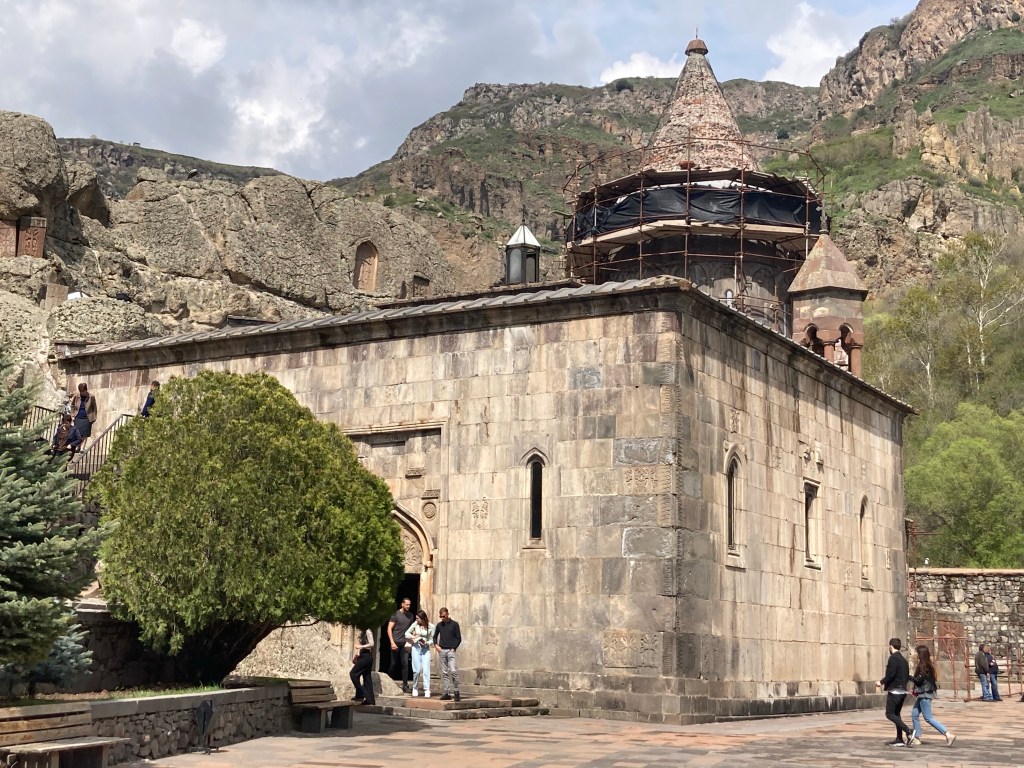
To be sure, my tour stopped at quite a few churches, not surprising as Armenia had been the first country to adopt Christianity in 301. The man responsible, St. Grigor the Illuminator, is remembered in a monastery partially carved out of a cave and set against the Caucasus mountains:

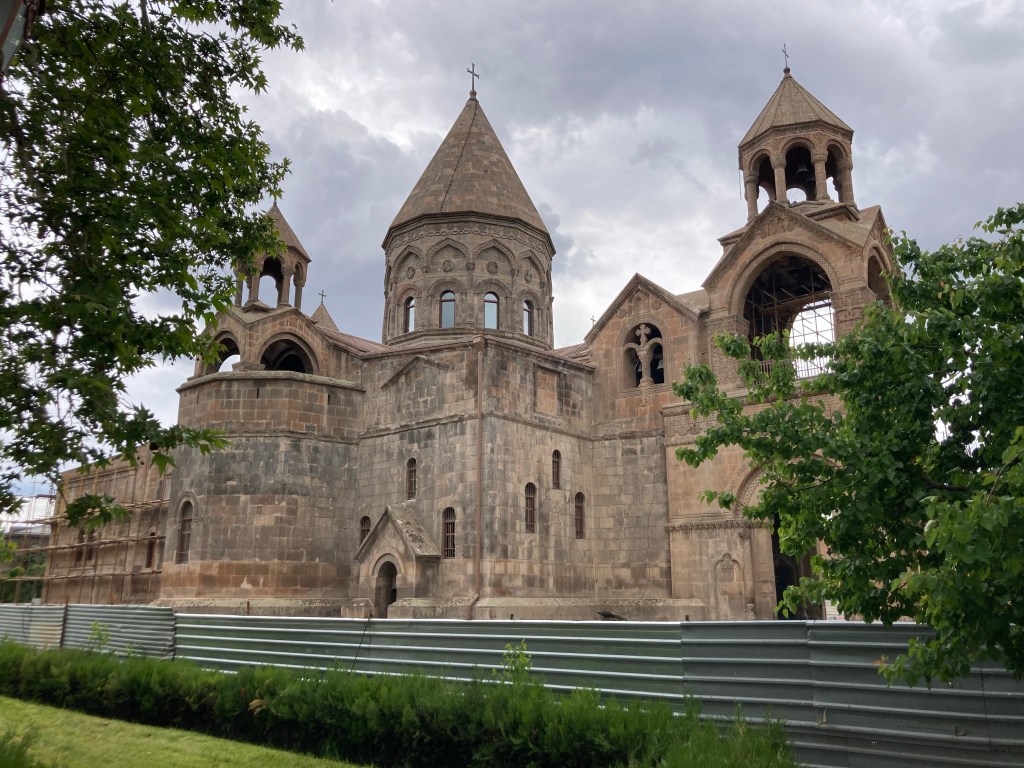
I also visited the Mother See of Holy Etchmiadzin, the seat of the Armenian Orthodox Church and generally considered the first Cathedral in Europe, dating to 301. Unfortunately it was under renovation and scaffolding so we could not enter.

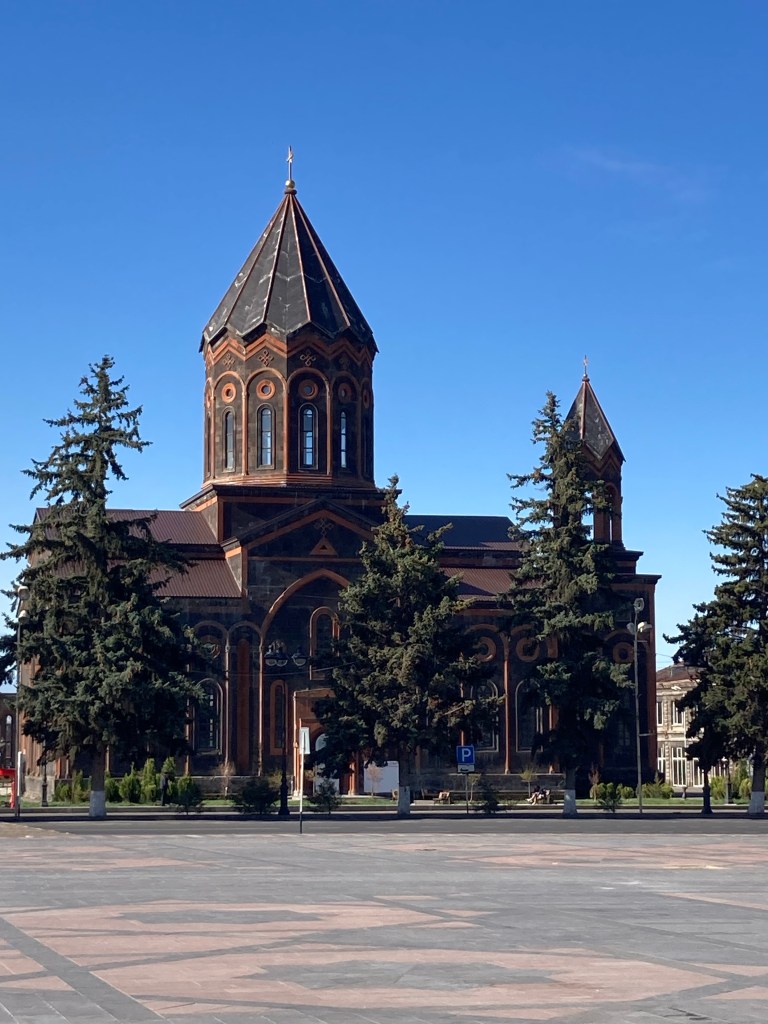
But Armenia offered plenty else. Many of its buildings are constructed from tufa, a limestone formed by lava with lovely hues. In the second city of Gyumri, most of the center’s buildings are tufa, including the still under construction main church:

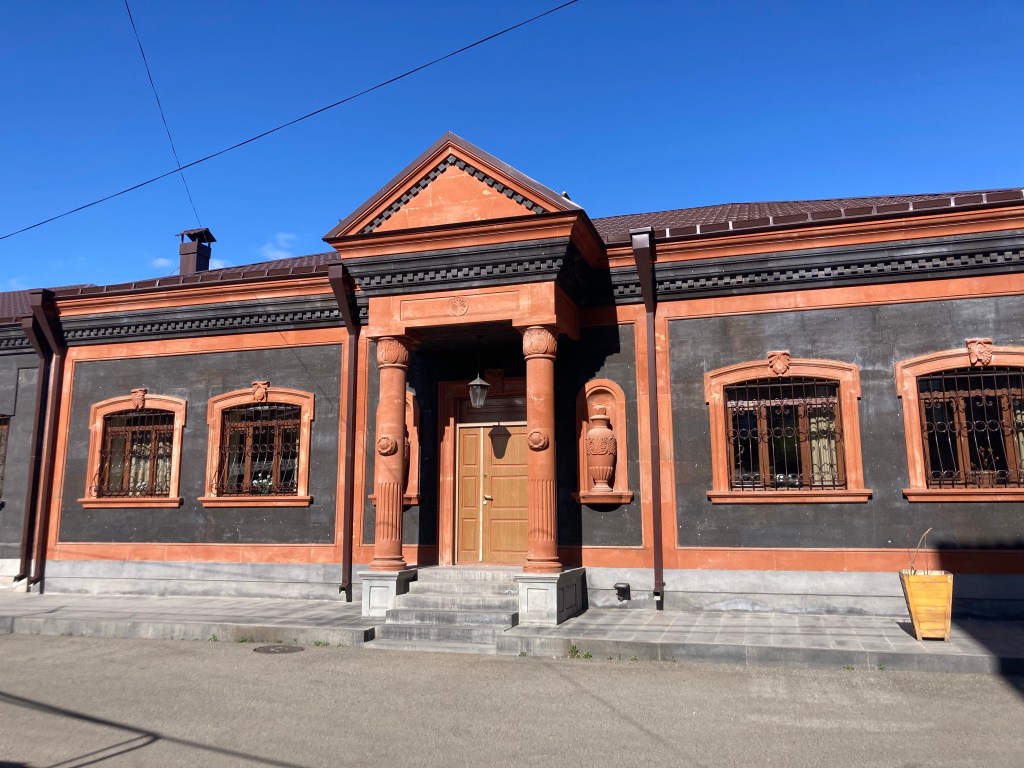
Gyumri was close to the epicentre of the 1988 earthquake which devastated the country, killing 25,000, leaving 500,000 homeless and levelling 60% of Gyumri. Most of the buildings destroyed were of the bland, Soviet era variety, while the replacements are the Armenian tufa style:

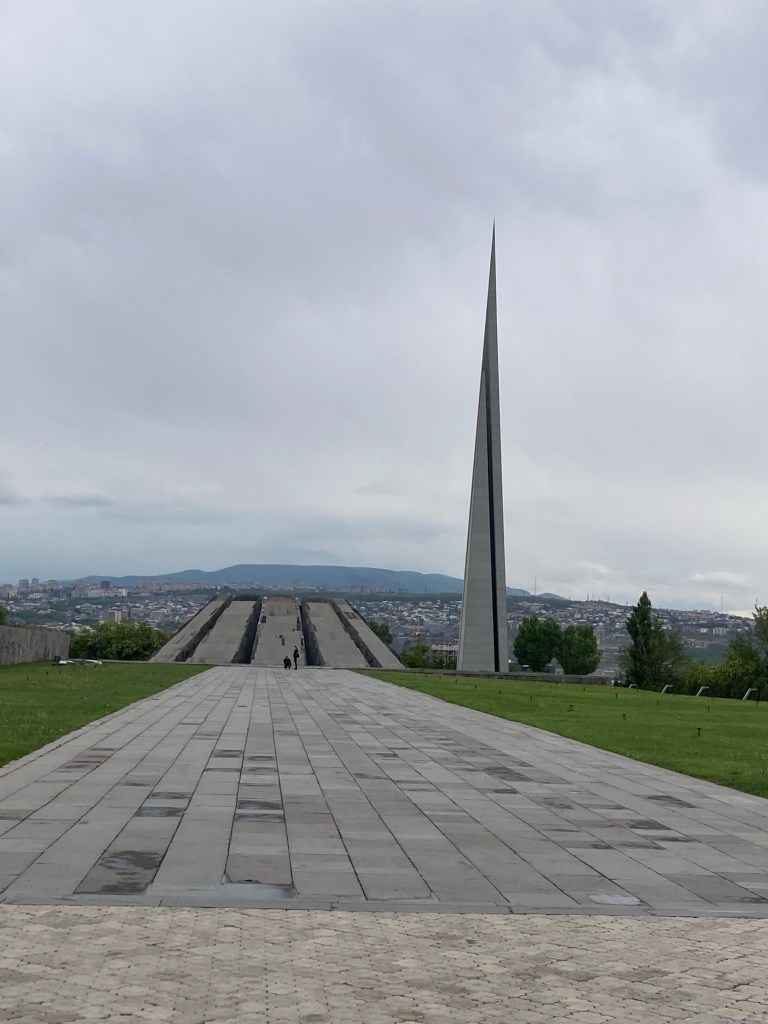
In the capital city of Yerevan, I visited the Genocide Memorial, commemorating the 1.5 million Armenians living in nearby Turkey who were killed between 1895 and 1925.

The archeological museum contains treasures from Armenia’s golden period, from the 9th to the 4th century BC when it stretched 400,000 kilometres, covering parts of modern Turkey, Iran, Georgia and Azerbaijan. A 20th century nationalistic movement seeking to regain part of Greater Armenia was exploited by Stalin and his mass relocation of different ethnic groups and is the root of the territorial dispute with Azerbaijan over the Nagorno-Karabakh region which has seen three wars between Armenia and Azerbaijan since 1991.

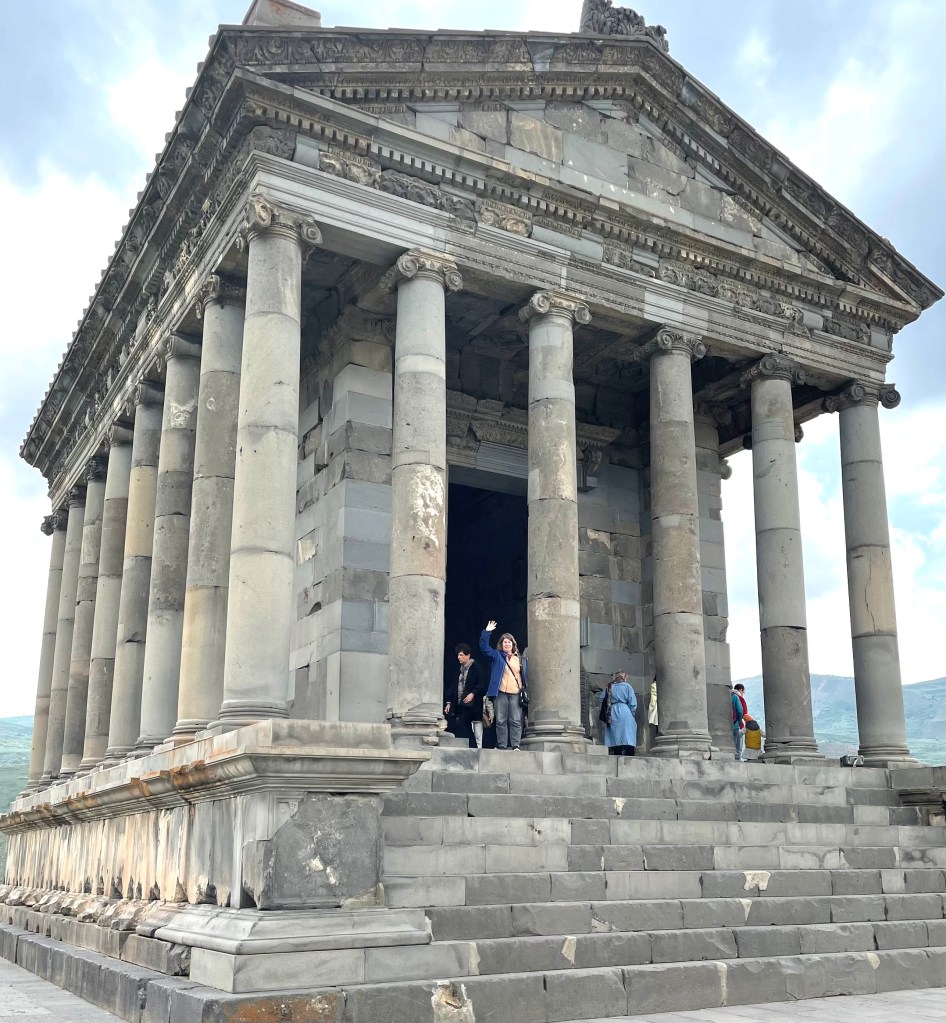
To satisfy the need to visit something quirky, I went to the Temple of Garni, a Soviet era reconstruction of the Greco-Roman temple to the sun king Mihr. It’s a sign of pre-Christian pagan Armenia, which might explain why the Soviets rebuilt it, the original having been destroyed in an earthquake in 1679.

The Matenadaren, or Manuscripts Museum, is the largest depository of Armenian manuscripts, many dating to the 4th century. Painstakingly translated and drawn by Armenian monks, the western world has these translations to thank for preserving many famous works by the ancient Greeks and Latins after the originals were destroyed at the Great Library at Alexandria in one of its purges. Alas, no photos were allowed inside.

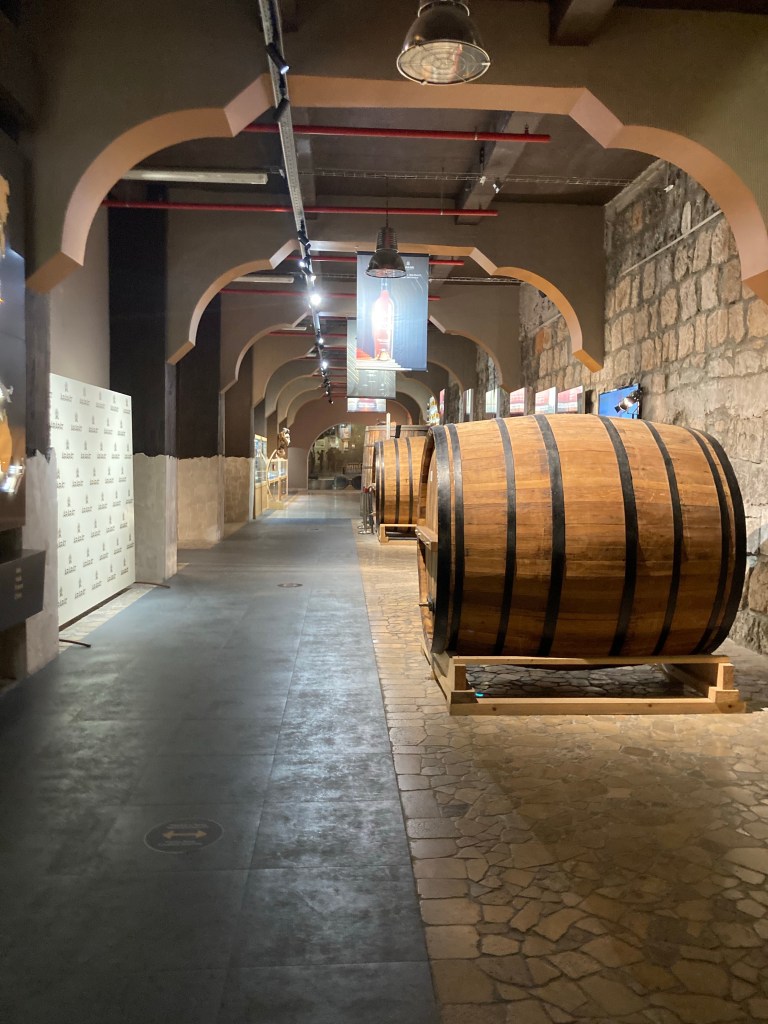
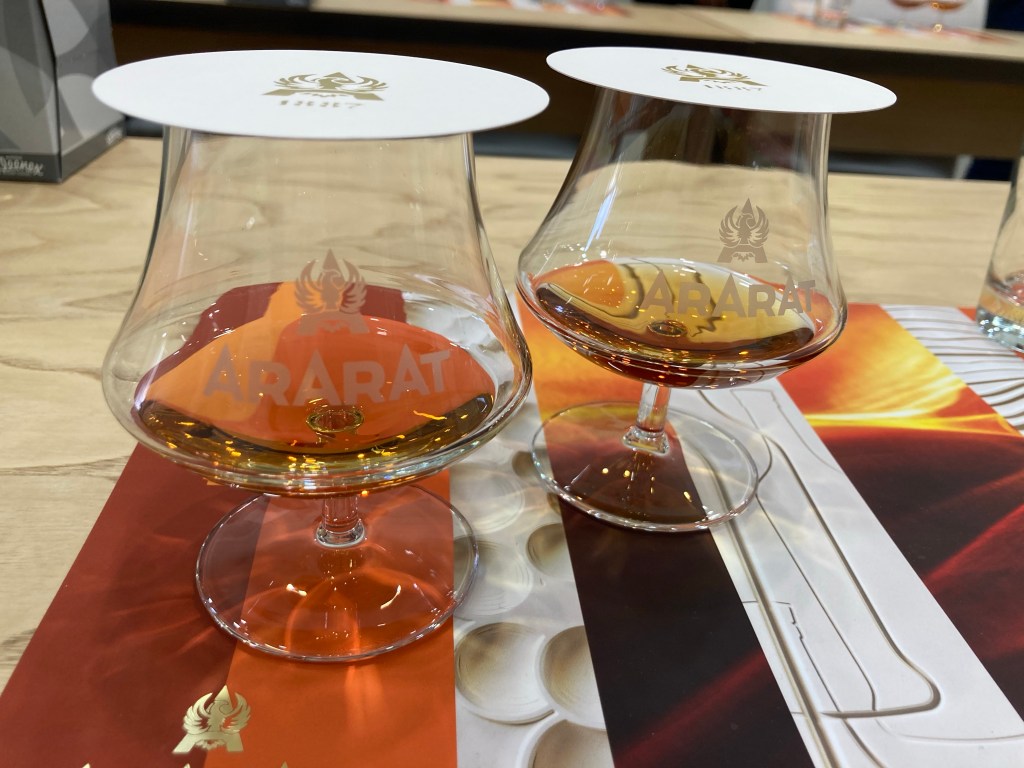
Like Georgia, Armenia is a grape growing region with delicious wines. However, it was its brandy (or cognac) which our tour focused on at the Ararat Brandy facility. A brandy tasting followed the facility tour. My favourite? A 7 year old vintage sipped after slowly eating a piece of dark chocolate:

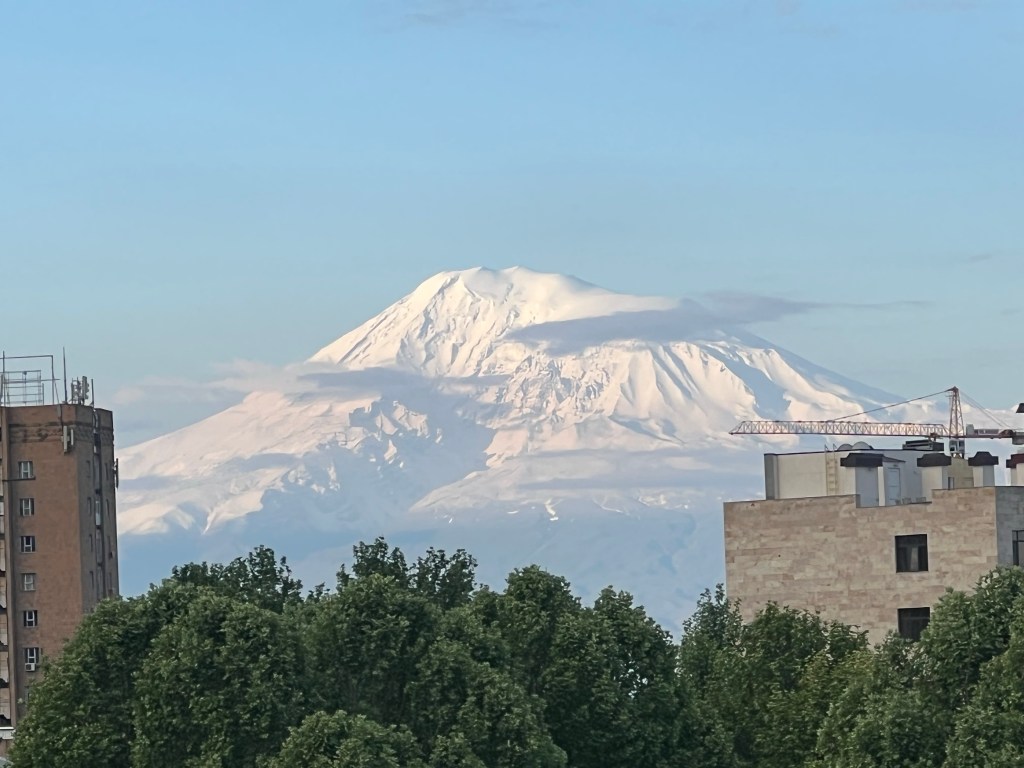
Although located in Turkey, Mount Ararat, of Noah’s Ark fame, is visible on a good day from the capital. It’s only 40 kilometres away. So important is it to the psyche of the Armenians that all of Yerevan was designed so the mountain would be visible from everywhere in the city. We had mostly cloudy days, but managed one clear early morning sighting:

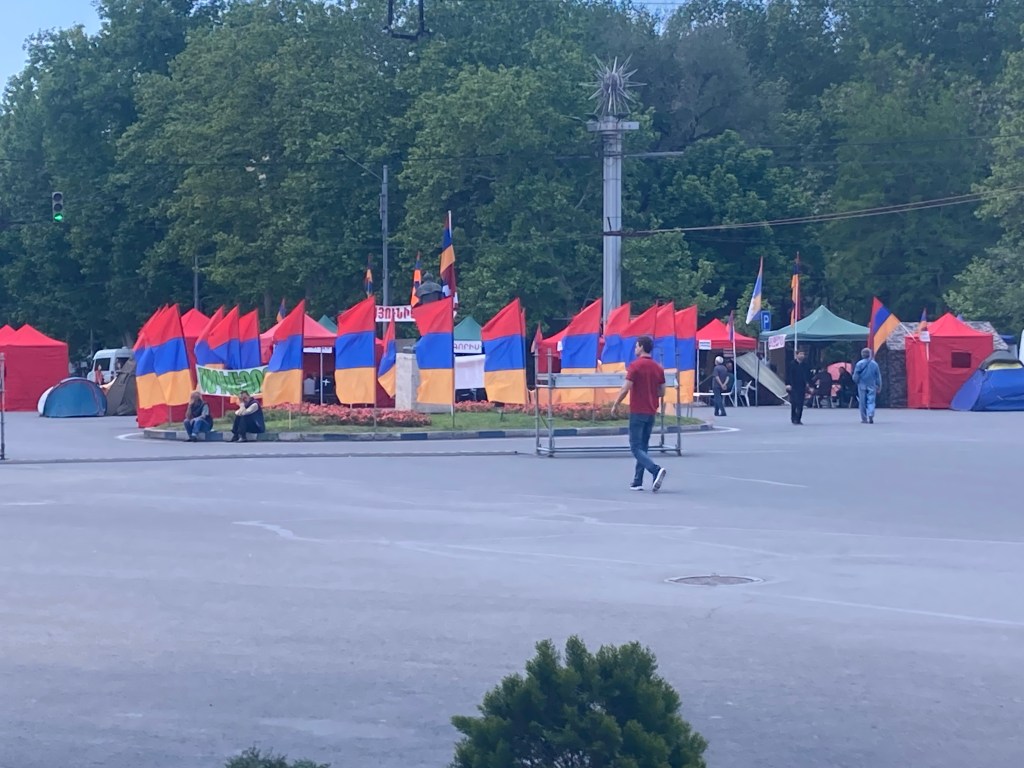
Mention must be made of the current political climate. Armenia is a close ally of Russia, so I didn’t see any Ukrainian flags. Of more importance to many Armenians was the signing of the Russian brokered treaty with Azerbaijan whereby Armenia was giving up its rights to the Nagorno-Kharabakh region. Protests in opposition to this treaty erupted everyday in Yerevan, snarling traffic and making access to some points difficult. But, so far, the protests have been peaceful and the protesters’ tent city almost had a carnival atmosphere:

After 4 days I left Armenia. A short visit but one which gave me a taste of the country. Next up, something more romantic.

Georgia: Wine, Monasteries and the Russians

Georgia is known for its wines and, as if to prove the point, our group was met on arrival at the Tblisi airport by our tour guide, whose first act after introducing herself was to hand out small bottles of Georgian wine to enjoy on the bus. This country was off to a good start.

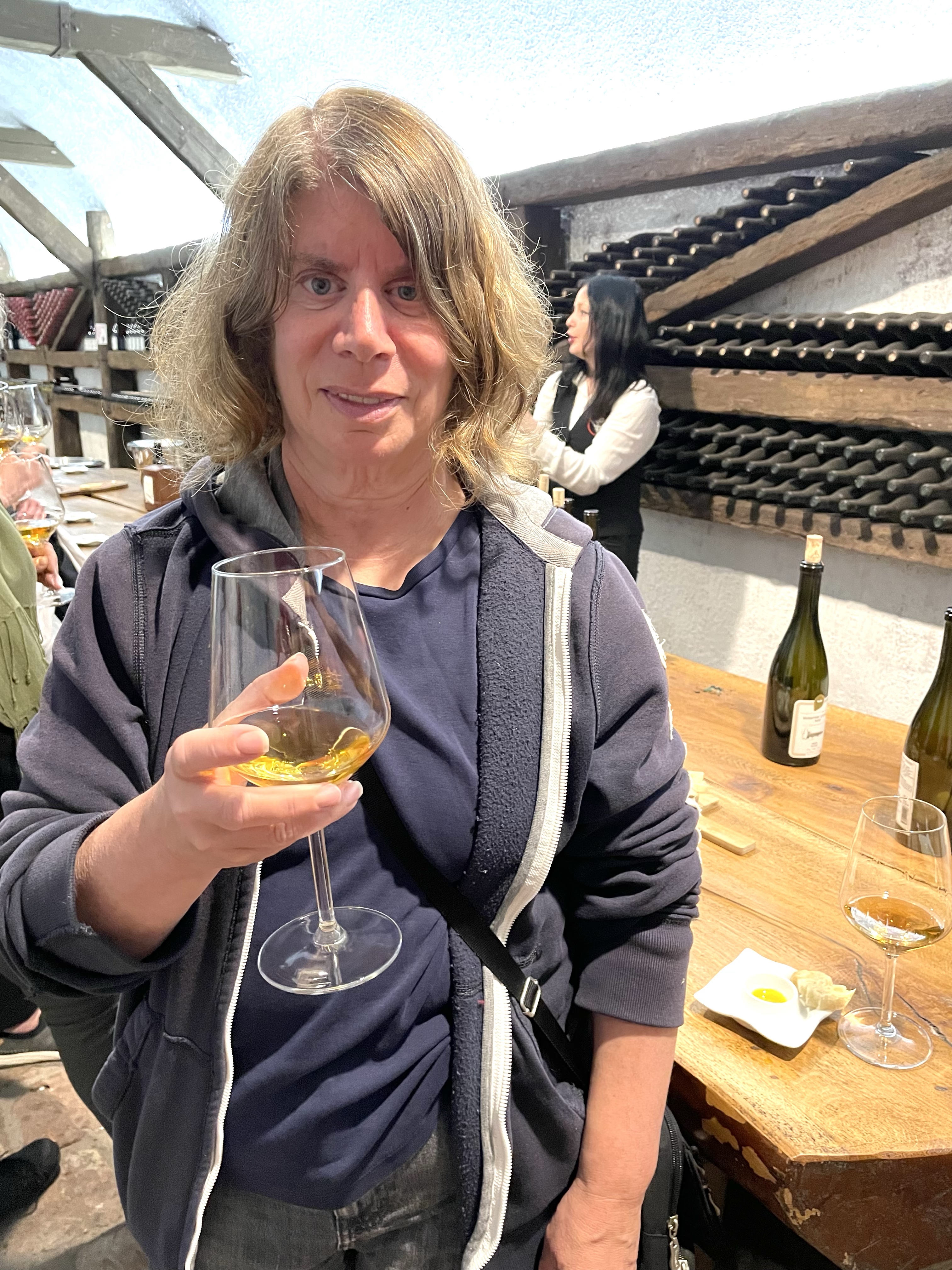
Georgia is considered the birthplace of wine, with some wine resins dating back 8,000 years. Just outside of Tblisi, we began to see vineyards where some of the 500 different varieties of grapes in Georgia are grown. We enjoyed a wine tasting at the Khareba Winery, deep in one of the 13 kilometres of tunnels, learned about the difference between Georgian wine making technique (the skin and seeds remain throughout the fermentation process) and the European technique. And of course, we sampled many of the local wines at all of our meals in Georgia.

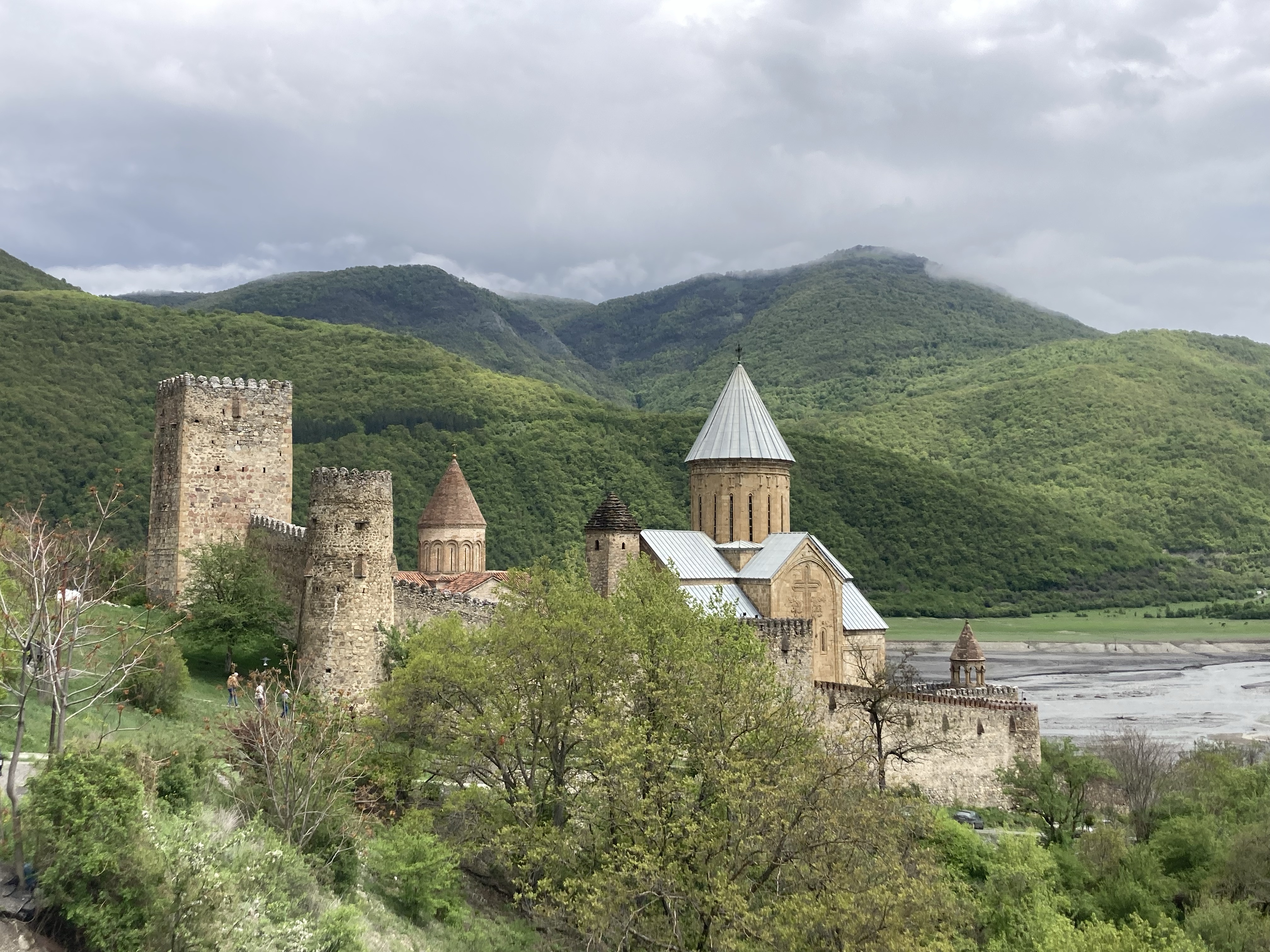
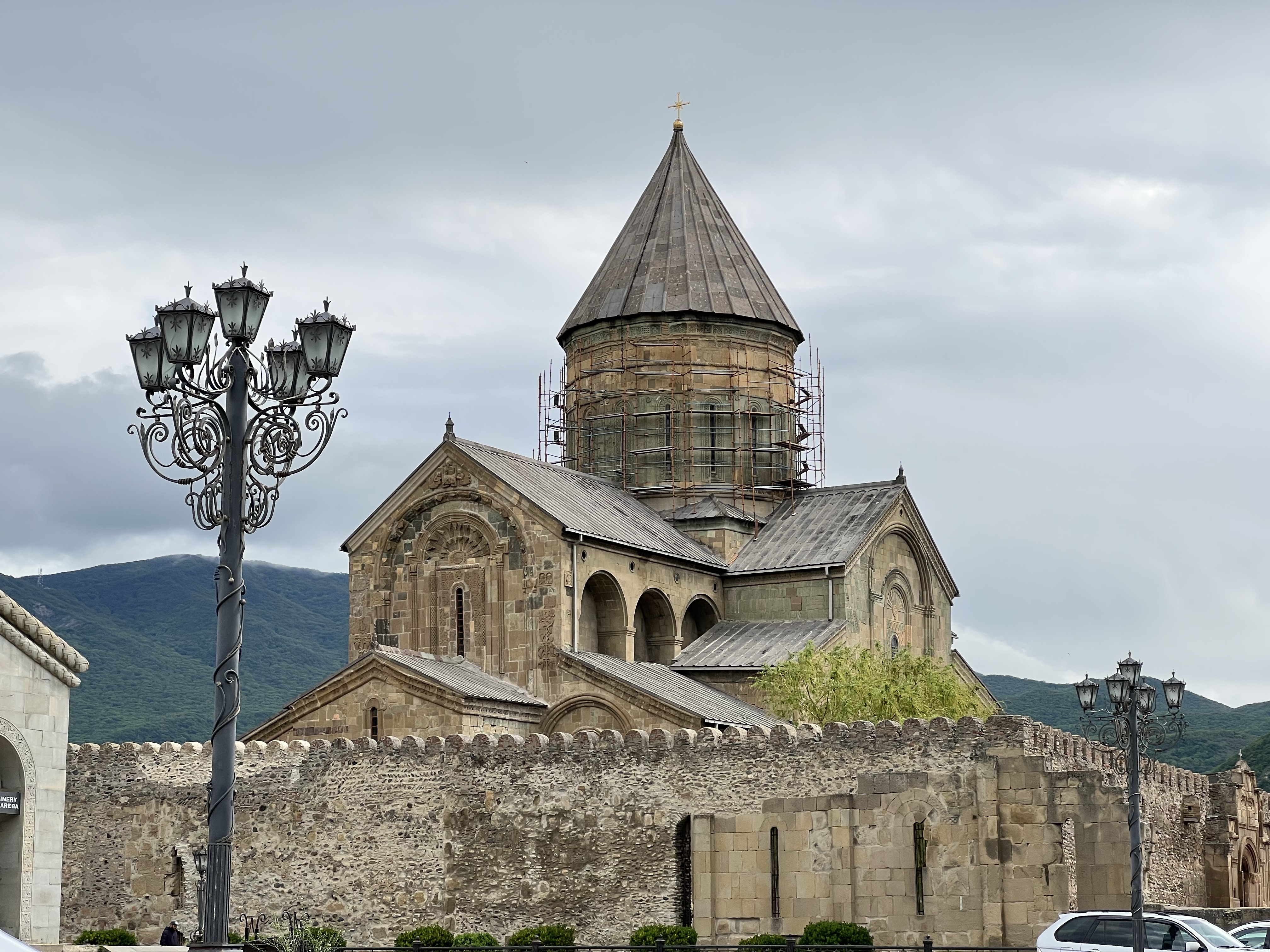
Georgia was the second country to adopt Christianity as its state religion in 326, after St. Nino cured the Queen of ill health. Many churches/monasteries date from this 4th century, but Georgia’s glory period, between the 10th and 14th centuries saw the construction of some glorious churches by such monarchs as David the Builder and Queen Tamar. Many of the churches escaped destruction by various invaders – Persians, Mongols, Turks, Russians- unlike other grand palaces and universities, which were uniformly razed.

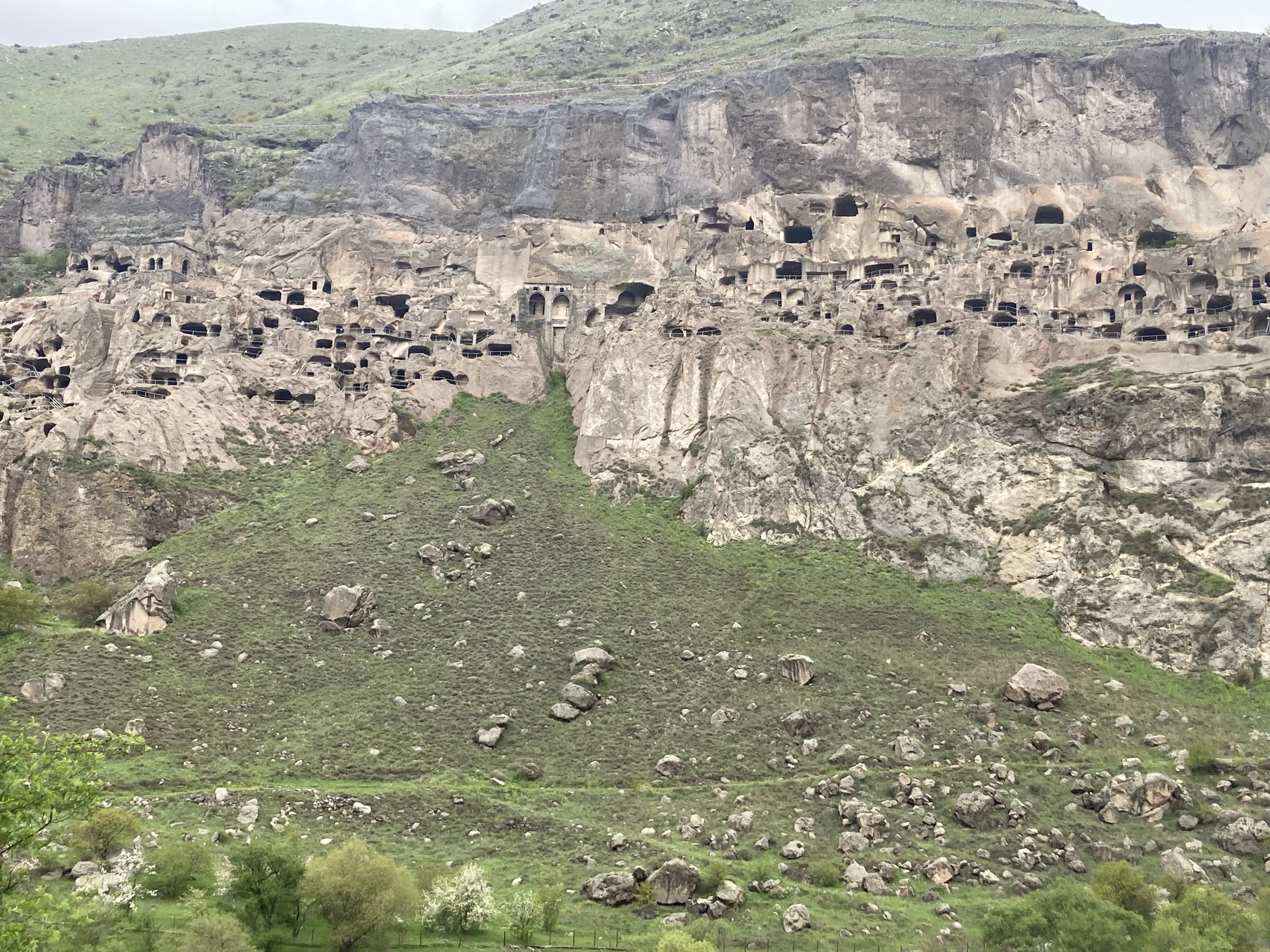
If I had a favourite, it was the modest church in the Vardzia cave city. Originally carved by monks in the 12th century, the 13 story high cave city expanded to house up to 50,000 inhabitants and contained amenities such as stables, water pipes, stores and a church, everything needed to hide out for a few years:

An earthquake struck in the 13th century, leaving much of the cave fronts open, but the city was reinforced and used for another two centuries. During the Soviet period, it was a museum but off-limits to most people.

Now, about the Russians. Situated right above Georgia, Russia has had its eyes on Georgia for centuries as a buffer between it and the Persians/Ottomans. In 1783, it signed a treaty with the Georgian King in which Russia took over Georgia’s foreign policy. A few years later, in 1803, Russia invaded the country and occupied it until 1918. In the chaos of the Bolshevik revolution, Georgia declared independence, but it was short-lived when Russia again invaded in 1920, brutally put down the independence movement and annexed the country, making it a republic of the USSR.

In the capital Tblisi, the National Museum dedicates a floor to the Soviet occupation, with graphic illustrations of executions, the gulags and the repression of free speech and political parties. The great purge of 1937 saw aristocrats, intelligentsia, political prisoners and rich peasants tortured and killed.

Independence movements began in the 1980’s; it was declared initially in 1989, suppressed but finally granted in 1991. Nonetheless, it remains precarious with Russia arming two breakaway republics, both of which have declared independence, recognized by nobody except Russia.

As a result, over 20% of Georgia territory is currently occupied by Russian forces and people fear that Russia will turn its sights on Georgia next after Ukraine. Its strategic position, along with rumoured reserves of oil and gas and rare earth minerals and Putin’s desire to return Russia to the glory days of the USSR, make it a tempting target.

I’d be remiss if I didn’t mention the invasion of Ukraine on Georgia; its effects were all around. Although the country’s largely ceremonial president has spoken out in favour of Ukraine, it’s prime-minister prefers Russia. And little wonder as his biggest supporter, and former prime minister, is a major shareholder in the Russian petrol-giant Gazprom.

So Georgia walks a tightrope. Flags supporting Ukraine are everywhere:

Large numbers of Russians and Belarusians, unable to remain in their home countries, have fled to Georgia, where they await visas for Western Europe or North America. Two whom I met both proclaimed they would return home “when Putin is dead. ”

But not all Georgians welcome these Russian dissidents. There is great dislike and distrust of all Russians, regardless of political persuasion.

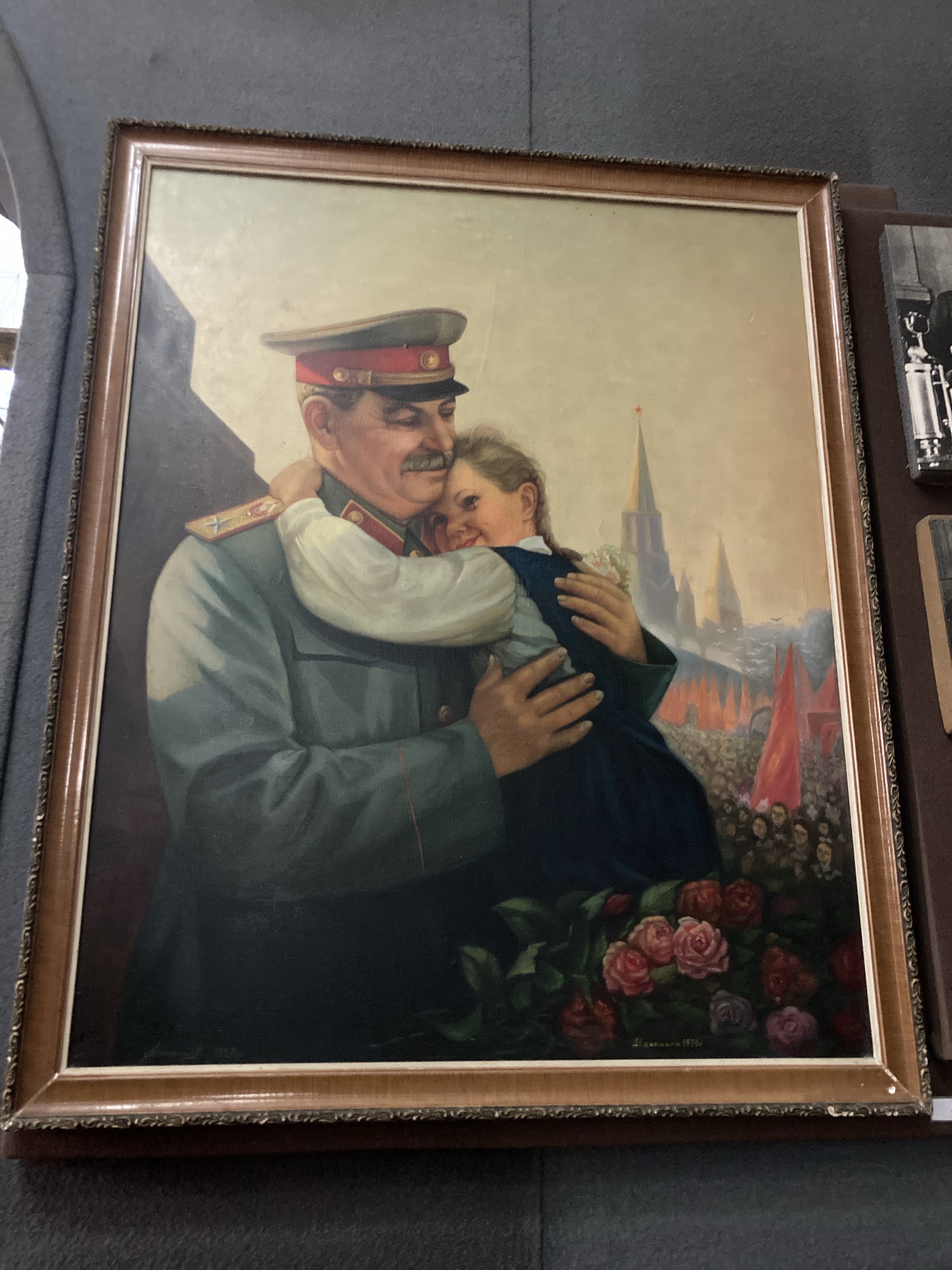
A controversial exception, but only to some, is Georgia’s most infamous citizen, Joseph Stalin. Born in a rented two room house in Georgia’s second city of Gori, he initially studied to be a priest but failed to finish likely due to his political dissent activities. He was arrested 7 times and was sent to Siberia, where he managed to escape 6 times. Eventually, he befriended Lenin and Trotsky and rose through the ranks to become the Soviet leader until his death in 1953.

All this and much more is documented in the Stalin Museum in Gori. I toured it with an English speaking guide, who delivered a matter-of-fact commentary about Stalin, neither flattering him nor referencing his atrocities.

She focused on his ” damaged arm”, always out of sight in official pictures, his refusal to exchange his prisoner of war son (who was executed) and his personal possessions, like his pipes.

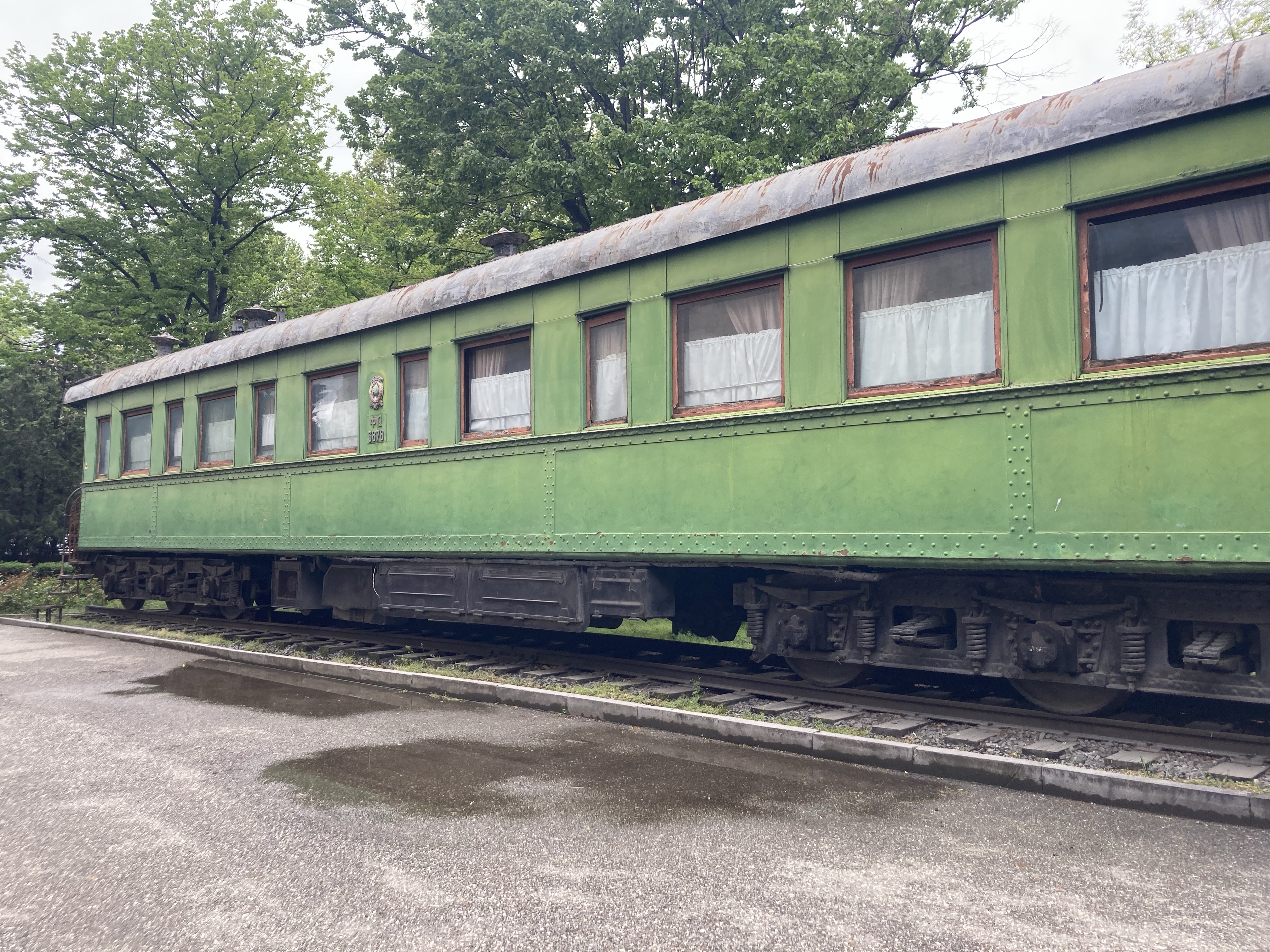
The museum has his birth house on its grounds and his refurbished train. Apparently Stalin was afraid to fly. Inside are his meeting room, security office, bedroom and bathroom, all furnished in a mock Art Deco style. I wonder how he would feel having loads of western tourists snapping photos of his toilet. I did but I’ll show the whole train instead:

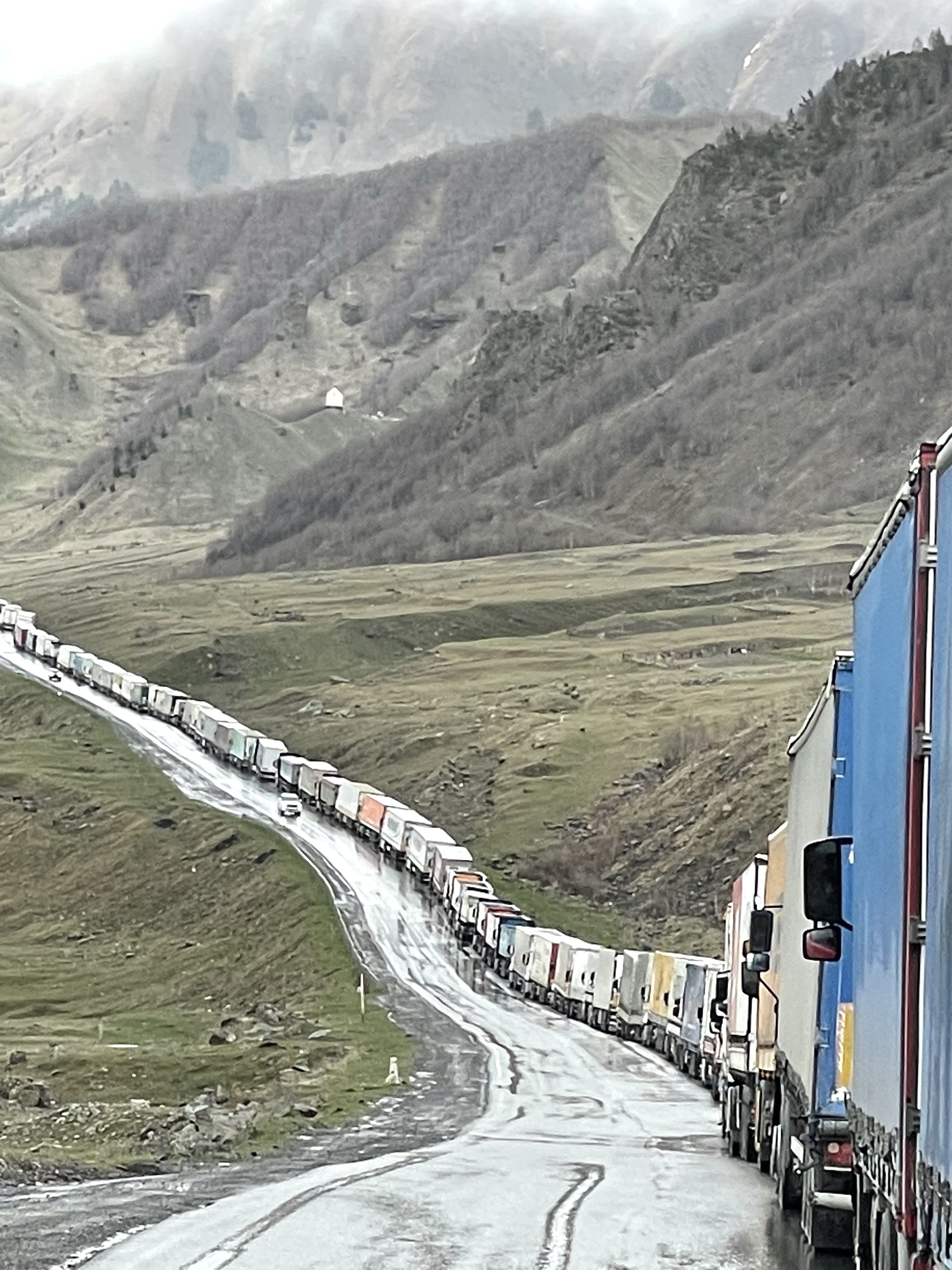
Another inescapable consequence of the Ukrainian/Russian war is the plethora of trucks on the Georgian highways. As soon as Russia invaded, all surrounding countries except Georgia closed their land borders. Thus, the single open border into Russia has a line- up of trucks over 150 kilometres long. It takes a minimum of 4 days to cross:

Thankfully, I was not in a truck trying to cross into Russia.

Next stop, Armenia.

On the Road Again: Baku, Azerbaijan

After two years of limited travel (two weeks in Madrid and Portugal, a crazy drive across Northern Canada to pick up a puppy and six weeks in Florida), I’m finally on an extended trip, starting in Baku, the capital of Azerbaijan. I’ve joined a tour offered by Adventures Abroad of the Caucasus; Azerbaijan, Armenia and Georgia.

Let’s start with the geography. The Caucasus is a mountain range bordered by Russia to the North and Iran and Turkey to the south. In the west is Georgia and the Black Sea; to the east is Azerbaijan and the Caspian Sea. Its neither in Asia or Europe or in both, depending who you ask. And despite its name, the Caspian Sea is not a sea, but the largest lake in the world.

I could give a long dissertation on the history of the region, but there are great documentaries on YouTube if you’re interested. Suffice to say, the region has been fought over by Persians, Christians, Muslims, Mongols, Ottoman Turks and Orthodox Russians for centuries. The countries first declared independence in the 1920’s, but Russia brutally annexed them after 23 months and made them each republics of the USSR. The Soviets displaced hundreds of thousands of ethnic Armenians and Azerbaijani and created artificial borders, resulting in the tension and war between the countries that still exists today. Independence from the USSR occurred in 1991, despite a bloody crackdown by the USSR in Azerbaijan in 1990 resulting in massive fatalities.

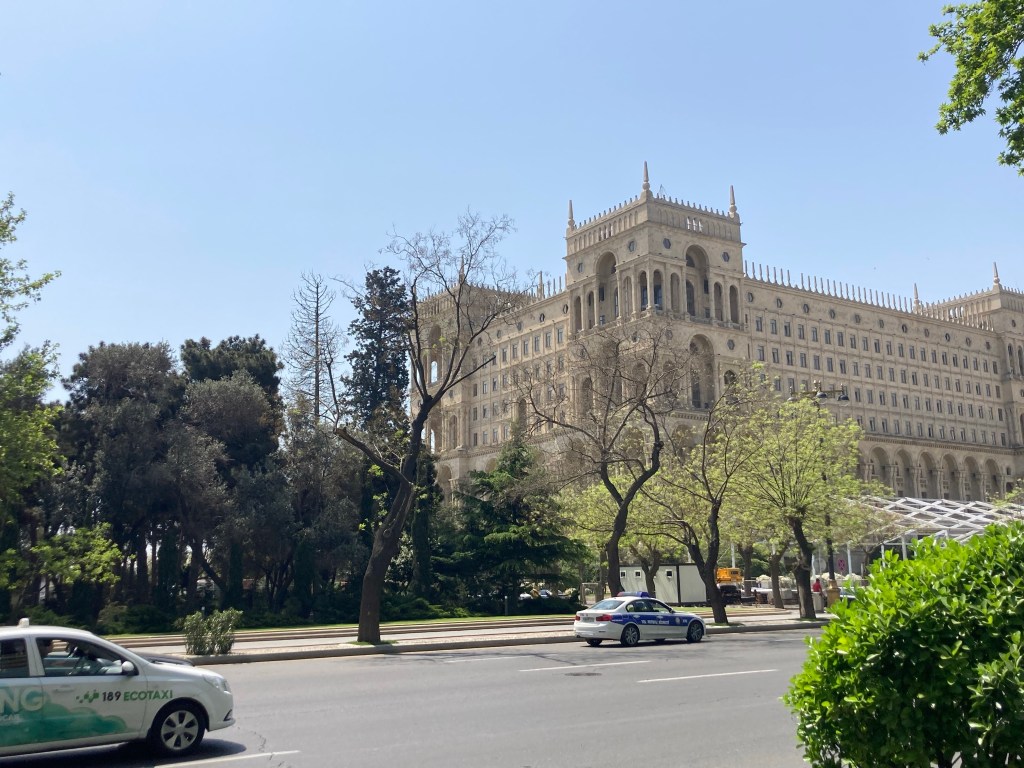
I would like to tell you that Azerbaijan is filled with fascinating architectural and archeological sites dating from time immemorial but that wouldn’t be correct. Invading armies, earthquakes and Soviet policy left little intact. Instead, the current regime has embarked on a massive reconstruction of past buildings in an effort to create a glorious Azerbaijani past. Thus, we visited reconstructed fire temples, mosques and palaces, all dating from 2000 or later. To erase the Soviet Realism style of high rise buildings, many of the facades have been refaced in a more Azerbaijani style, like government house:

Government House

Now about the government. Two year after independence, in 1993, Heydar Aliyev, former KGB and former Communist Party member became president. He was succeeded by his son, the current president, whose wife is vice-president and his son is the heir apparent. There are “elections” which the opposition alleges are fraudulent, a dictatorship disguised as a democracy. Freedom of expression is not allowed; opponents to the regime are either jailed or living in exile. We were warned not to discuss politics with locals.

However, the government is wealthy, owning the expansive oil & gas reserves that make the country rich. Ostensibly, it spends its money on public works; the streets are broad and well cared for, cranes dot the city skyline erecting modern high rises, water, power and internet are reliable. Education and health care are free.

But it’s somewhat of an illusion. The vast amounts spent on public works do little to benefit the majority of the population who struggle to survive on meagre wages. Preparations for a Formula 1 car race inconvenience the entire city for six weeks prior to the race. Corruption is rife. Ill paid doctors, teachers and police officers demand bribes to do their jobs. As if to prove the point, our tour bus was stopped by a police officer “ seeking dinner money” before allowing us to resume our journey.

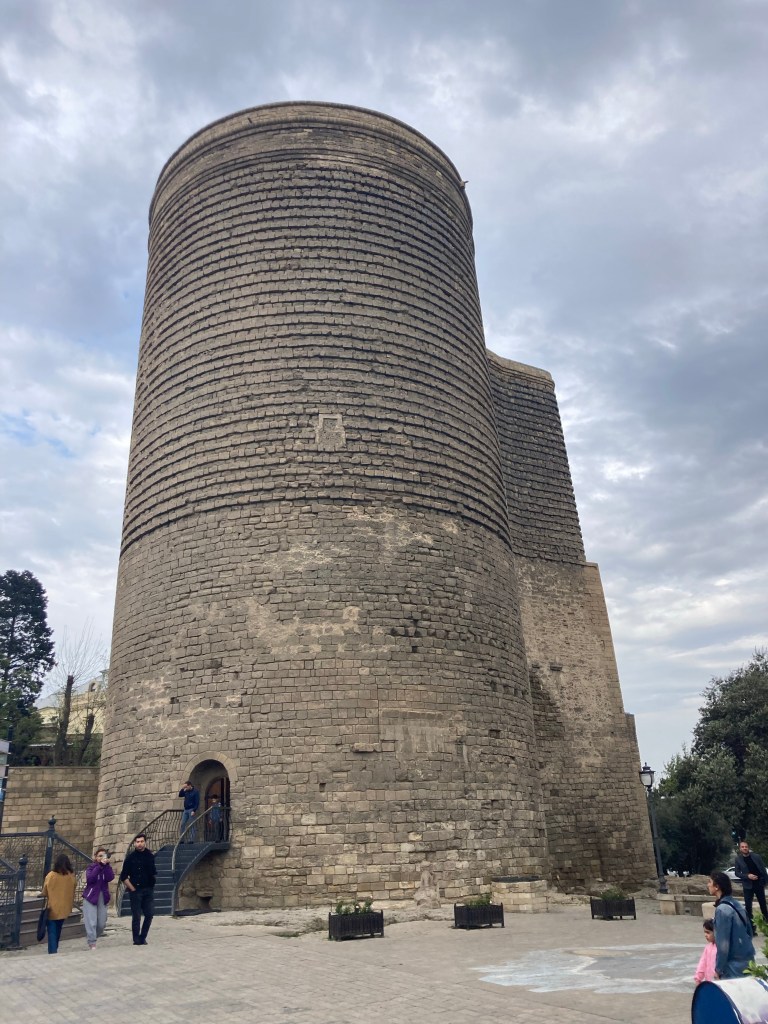
We visited some of the main sights in Baku, like the Maiden Tower, one of the few non-reconstructed towers, which no one can accurately date and whose purpose is unknown:

Maiden Tower

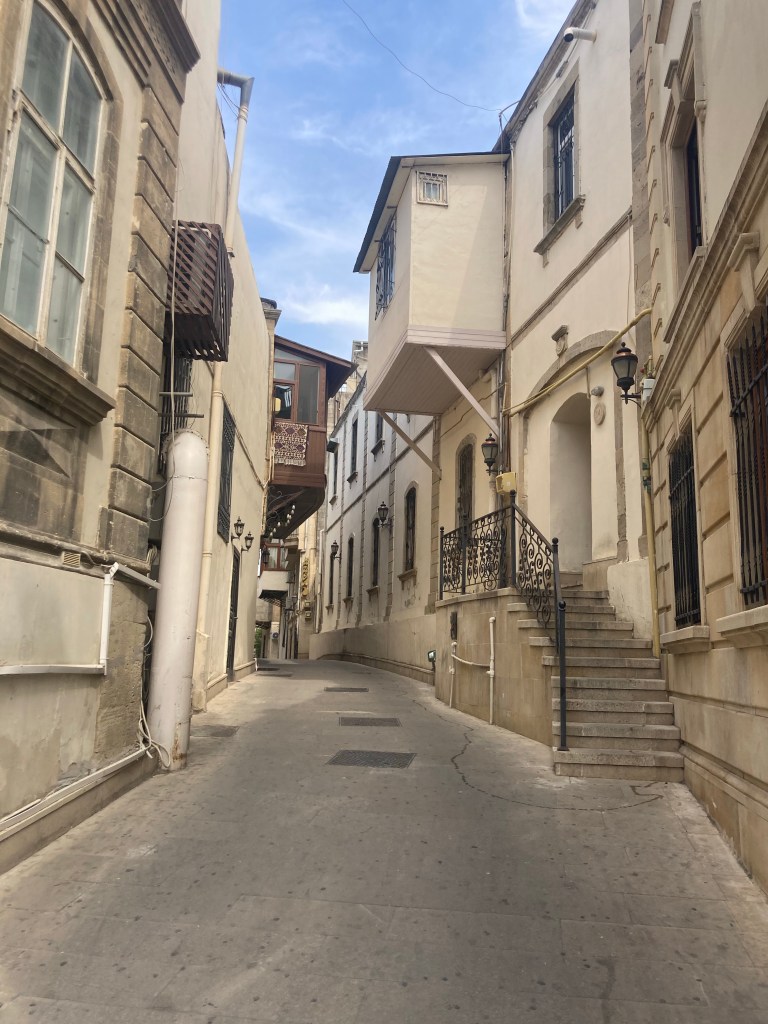
And walked through the attractive but mostly reconstructed Old Town:

Old Town

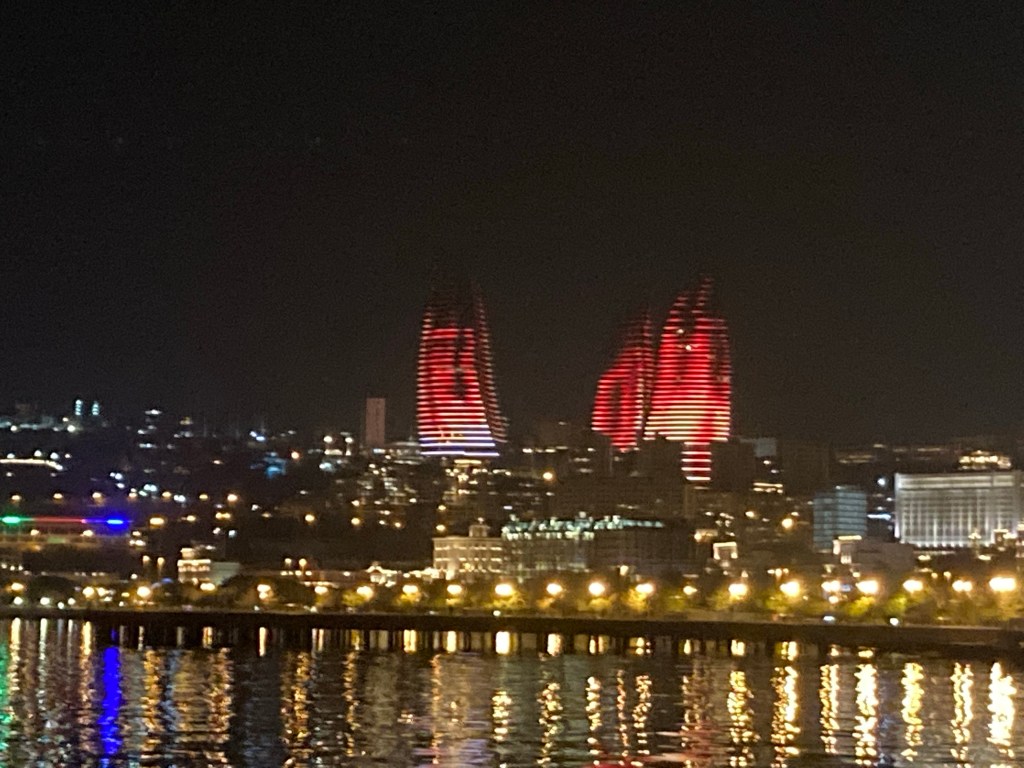
Wonderful new buildings line the Caspian Sea waterfront, including the Flame Towers, so named because in the night, their lights resemble flames:

Our tour travelled to the old capital of Shaki, stopping along the way at more reconstructed buildings – a mosque, a Zoroastrian fire temple, a palace- all rebuilt in the last few decades following destruction by Mongols, earthquakes or the Soviets, take your pick.

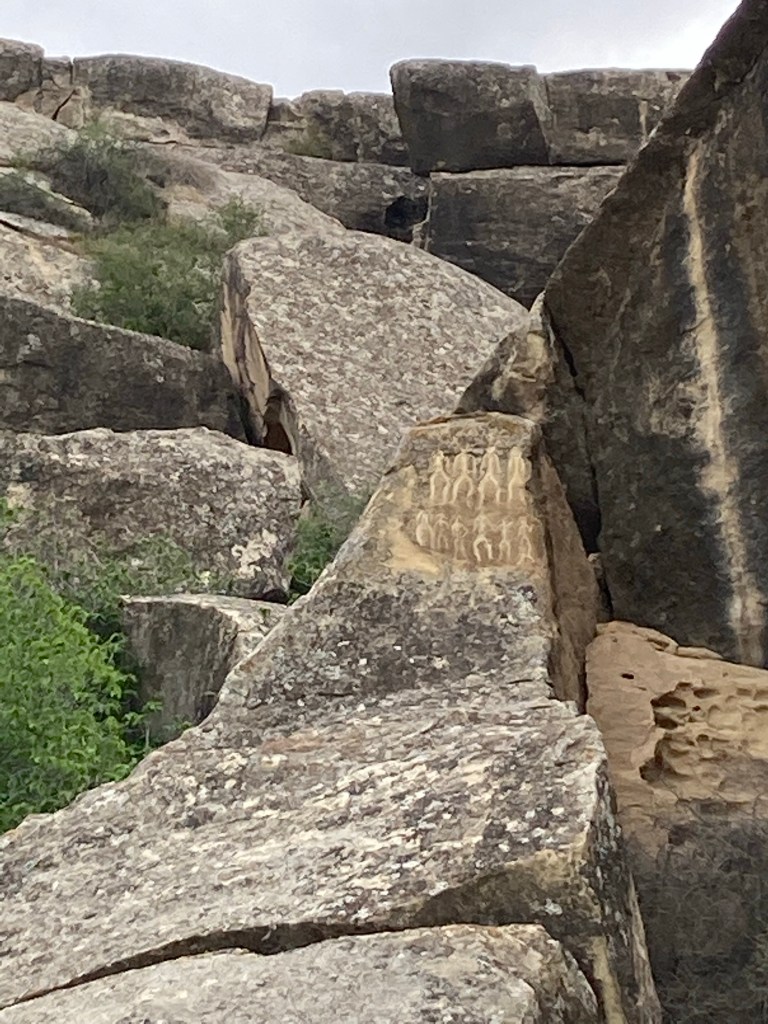
The single original sight is the petroglyphs in the Gobustan National Park, where a large number of cave art paintings dating back to Palaeolithic times (10,000 BC) are visible, including the dancing women:

I spent a pleasant 5 days in Azerbaijan. The country is clean, safe, with modern roads and good food, but lacks the eye-catching historical sights that I love. What it does have is an interesting political history with Russia and Turkey fighting a proxy war in the area for territorial supremacy and Caspian Sea access. Azerbaijani people we met were divided over the current war in Ukraine. While some expressed displeasure at the Russian invasion and decried Russian aggression, we also saw signs supporting the Russian fighters.

I was happy to have visited Azerbaijan but was equally happy to move on to a new country. Next up, Georgia.