Cowboys, cowboys and more cowboys: Oklahoma City

To me, Oklahoma has only 4 claims to fame: oil wells, cowboys, the Rodgers and Hammerstein film of the same name and the horrific 1995 bombing of the Alfred P. Murrah Federal Building by now executed Timothy McVeigh. I didn’t want to relive the bombing by visiting the memorial to its victims, there was nothing that I could locate that focused on the oil industry, no Oklahoma the Movie tours were on offer (not surprising since Oklahoma was filmed mostly in Arizona), so cowboys it would be at the National Cowboy & Heritage Museum. As I had just spent the last two months driving around the west, watching shoot-out reenactments at Tombstone, learning all about Buffalo Bill and passing through  hundreds of “western” towns selling Stetson hats, cowboy boots and real and fake guns, I was feeling slightly jaded about yet, another homage to the cowboy, and even more so to another museum which boasted an extensive art collection. I hesitated.

But I have a self-imposed, arbitrary rule that I cannot consider myself as having been to a US state unless I have done something more than spend the night there. I do have as one of my 300 things to do in retirement to visit all 50 US states, so I needed something to do to justify saying I had visited Oklahoma. There’s also the problem of not having any photographs to put in my USA scrapbook, (organized by state) if I don’t actually do something in the state. Since I don’t consider a picture of me standing outside a Comfort Inn or pumping gas at the Chevron station as scrapbook worthy, I reluctantly drove to the museum and easily found a spot in the nearly empty parking lot.

I paid the relatively cheap ($12.50) admission fee and was greeted by a volunteer who told me how to skip most of the art, but he did take my photo at one of the most powerful pieces in the museum The End of The Trail, a giant plaster statue of a forlorn looking Indian that greeted me in the mammoth lobby.

I planned to rush through the art exhibits I couldn’t avoid, but after a few minutes, I became engrossed in the art and the commentary accompanying each piece. The first gallery showcases photographs from the 19th century, of cowboys and pioneers, prospectors and Indians, their faces universally lined by the hardships of living in the West. Next came one of many art galleries featuring Western landscapes with short biographies of the artists and their love for the West. Paintings of people followed, including an exhibit showing the Indians first as subjects of art, then as creators.

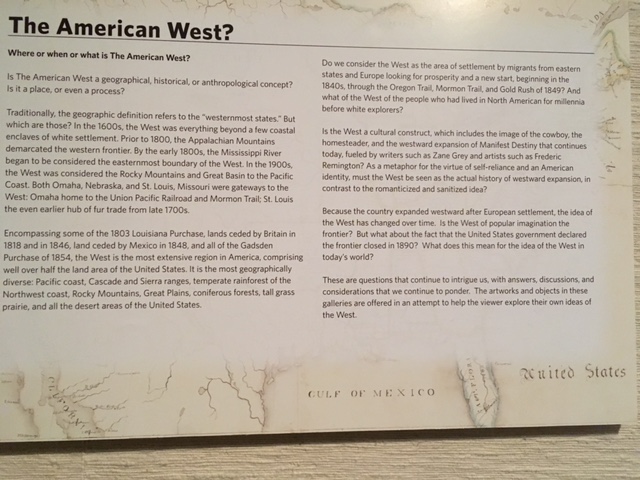
As I left the art galleries for the remainder of the museum, the first board greeted me with ”What is the West?” a good question with an interesting answer: just about anything west of the Mississippi. Different galleries followed, focusing on the discrete waves of inhabitants, beginning with the Indians, then the Spanish Conquistadors in the south and the fur hunters in the north. Shortly after the War of Independence, the new US country sent its army to the west, mostly to ensure the land was clear of buffalo and Indians so the white people could settle without interference. Model forts and artifacts from the period illustrated the difficulties of life in the West in the 1800’s.

IMG_1131

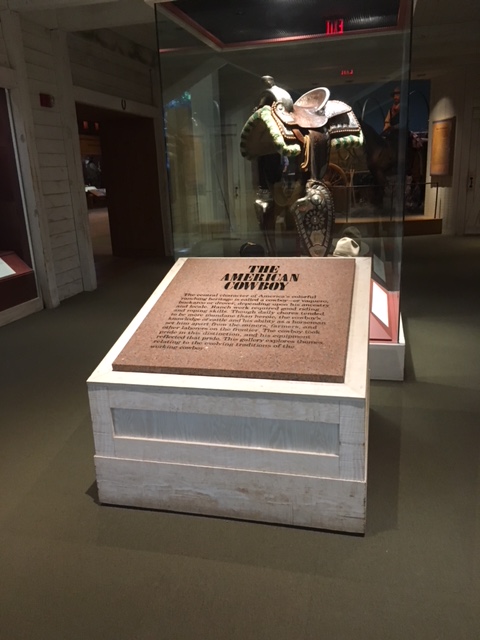
Once the army had cleared the Indians and the buffalo from the land, railroads and ranches predominated, with the cowboy culture a mainstay of the West. The museum is something of an Everything you every wanted to know about cowboys but were afraid to ask (okay, there is nothing about how they went to the bathroom with those chaps on, but that’s a minor point). A full scale reproduction of a bunkhouse adorns one wall, another very large room is dedicated to saddles, a different room to the art of braiding reins and a history of cowboy boots (they must be heeled to keep the boot in the stirrup) is presented. Different cowboy hats are on display, along with explanations of the differences (some are more Spanish influenced than others), but all attain to shield the cowboy from the elements. Chaps, stirrups, sleeping arrangements are all discussed, everything but… here I go again, bathroom issues. Mention is made of cowgirls and black cowboys, just to make everything politically correct, although the museum is silent on LGBT issues and cowboys (cowits?).

IMG_1133

If real life cowboys weren’t enough, a wonderful gallery explains and explores Hollywood’s love affair with the cowboys, showing an excellent video with clips from favourite Westerns. Not to give it all away, but the hypothesis is that Westerns made great silent films because the costumes left no doubt as to who were the good and bad guys and it was easy to film a train robbery, gun fight or lady being rescued without words.

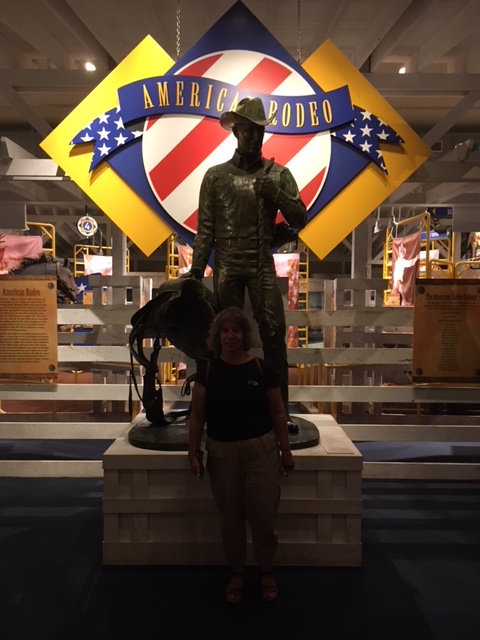
For the true cowboy fan, the Rodeo Hall of Fame occupies a corner of the museum, but I skipped this except for the picture.

IMG_1136

I finished my tour in Prosperity Junction, a life size replica of a fairly well-to-do Western town at the turn of the 1900’s. Electric lights were installed, along with the Livery Stable, the Blacksmith, the Western Union telegraph in the railroad station, the Post Office, the General Store, the Feed & Seed vendor, a school, a church, a doctor’s office and house, a saloon, hotel, newspaper and a few stagecoaches. The only things missing were the women with floor length skirts covering multiple layers of petticoats and their cowboys sporting Stetsons, boots and chaps.

I don’t like admitting I am wrong, but I was wrong about this museum. It is a gem and, dare I say it, almost worth a visit to Oklahoma City in, and of, itself. After 3 hours, I tore myself away and hit the road.

The Atomic City: Los Alamos, New Mexico

Once upon a time, in a land far, far away, a very wise man wrote to his king with a warning: “an evil empire is trying to take over the world and they are building a bomb that will kill lots of people”. The king, being no fool, listened to the wise man and decided to build the bomb quicker. The king recruited the best physicists in the land, swore them to secrecy and herded them all to a former boy’s school in the mountains where they toiled endlessly through the nights, solving vexing scientific questions, overcoming clandestine meetings with the Russians, but finally succeeding in building two highly destructive bombs. And everyone lived happily ever after except for the 100,000 or so citizens of Hiroshima and Nagasaki who were obliterated by the bombs and Julius and Ethel Rosenberg, who were executed for their roles in passing secrets to the Russians (is there a reason Donald Trump Jr. cannot be similarly executed)?

Of course, this is all true and told in various degrees of details in 3 separate  museums located in Los Alamos, aka The Atomic City. Why 3 I ask,  but there is no obvious answer and, in reality, it is 4 if I include the exhibit at the New Mexico History Museum in Santa Fe. But I digress.

The wise man is Albert Einstein, the President is F.D. Roosevelt and the evil empire is the Nazis. Upon realizing the seriousness of the threat (which took FDR 2 years), the US Army Corps. of Engineers (primarily Lieutenant General L.R. Groves Jr. who had just finished the Pentagon) started developing a nuclear weapon. The operation became known as the Manhattan Project, after  Manhattan in New York where some early work had been undertaken on nuclear fission. Einstein himself was not allowed to work on the bomb since he lacked the necessary US security clearance (more echoes of Trump here). Instead, that task was given to Robert Oppenheimer, a physicist professor at Berkley, California. Oppenheimer fondly recalled the summers he had spent as a youth in the mountains near Santa Fe and thought the location would be ideal for building a bomb. There was slightly more  to it – it was away from either coast (the less likely to be attacked), fairly remote and had decent infrastructure. The only problem was there was no town there.

IMG_1093
The hills near Los Alamos

Enter the army, which created Los Alamos out of an expropriated boy’s school (The Los Alamos Ranch School) and hundreds of temporary houses, laboratories and warehouses. It was all top secret – people were transported to Santa Fe, then disappeared. The people in Santa Fe knew something was going on up in the hills, but not exactly what. For those living in Los Alamos, it was akin to being in a prison. Security gates marked the entrances, mail was heavily censured and leaving the town was not permitted. People worked long days, all with a single -minded devotion to creating THE BOMB.

IMG_1086
Exhibit showing one security gate

There were, in fact, two bombs. The smaller, less destructive uranium bomb called Little Boy was dropped on Hiroshima. Fat Man was the more powerful bomb dropped on Nagasaki. Fat Man relied on plutonium and, since plutonium is less stable than uranium, implosion technology rather than explosion technology was necessary. Implosion was first tested on July 16, 1945 at the Alamogordo Bombing and Gunnery Range in southern New Mexico, providing videos of the mushroom cloud shown at every Los Alamos sight. While we had driven through Alamogordo, visitors to the detonation sight are permitted only on a single day per year (usually in April) which was not the day we were there.

The problem for Los Alamos is, shortly after the end of World War II, the army dismantled and destroyed most of the city, leaving only the Ranch School. What remained of the town was largely abandoned until 1963, although the Los Alamos National Laboratory continued research on the hydrogen bomb and the stockpiling nuclear weapons.

Today, Los Alamos is a pretty town of about 12,000 people, most of whom are engaged in either scientific research or tourism. Three museums there are devoted to retelling the story of the creation of the atomic bomb: the Bradbury Science Museum, the Los Alamos Historical Museum and the National Parks Manhattan Project Memorial. Each recounts the same history with similar videos, exhibits and commentary.

IMG_1084
Me with statute of Oppenheimer and Army LG Groves,, overseer of Los Alamos

The narrative is told in an informative, just the facts, sort of way. There is little to no debate about the moral propriety of the project and, other than reciting the number of people the bombs killed, no mention of the victims with a single exception. A US physicist, Harry Daghlian, accidently put his hand into a stack of radioactive tungsten at Los Alamos in August 1945 and radiated himself, dying a month later. Photos of the devastation in Japan or mention of the suffering of the Japanese victims is noticeably absent. Trump would likely declare is fake news.

Twwo last pieces of trivia learned at Los Alamos. The largest spill of radioactive material did not occur at the Three Mile Island nuclear plant in 1979. That honour belongs to the rupture of a dam on a Navajo reservation in New Mexico a few months after the Three Mile Island spill. But the press largely ignored it. Similarly there was another catastrophic explosion at the New Mexico underground nuclear waste dumping facility in 2014. Estimates of the clean up for that spill are about $2 billion but scant media attention was paid to this disaster.

Finally, the spy part. Julius Rosenberg was a US engineer and member of the communist party. As a communist party sympathizer, he recruited other Americans with access to classified information. One of those was David Greenglass, Julius’ wife Ethel’s brother, who was working on the Manhattan Project in Los Alamos in 1944. Greenglass testifed against his sister and brother-in-law at their 1951 trial in return for a reduced prison sentence. The Rosenbergs were found guilty and executed in 1955.

My visit to Los Alamos left me with ambiguous feelings.  There is an interesting story to tell, but the multiple museums suggest some backstage infighting about who will tell it. Also, while I am not immune to the logic that it was necessary to develop, test and drop the bombs, I was  disappointed at the complete lack of discussion about the consequences of building the bombs. Similarly, although the deterrent effect of maintaining a nuclear arsenal is mentioned briefly in one of the museum, the impact the test explosion had on the people of New Mexico and the future of nuclear bomb research is ignored. If Donald Trump was visiting, he would probably rightly come away thinking  “Los Alamos’s legacy is very, very good and made America great.”


Memories of New Mexico: Caves, Guns and Aliens

I just spent a week driving around New Mexico, enjoying its varied sights, sounds and quirky history.

The Caves at Carlsbad Caverns:

Driving through the flatlands of the Chihuahuan Desert, just north of Mexico, I couldn’t imagine there were extensive caves nearby, but the Guadaloupe Mountains appear out of nowhere.  We wound our way upwards to the visitor center for Carlsbad Caverns National Park. Exhibits explained the desert fauna and ecosystem, but the attraction here is the caves – over 300 of them. The big 3 are entered via the visitor center, where you can walk down to a cave aptly named The Big Room, 1.25 miles and 1500 feet down on a well lit, fairly flat pathway.

IMG_1003

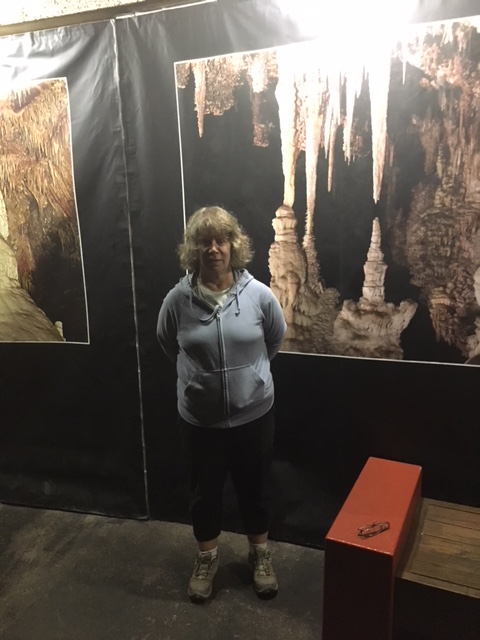
However, we took the easy route, an elevator ride, where we met Andy the Ranger, for a guided tour of the King’s Palace cave. Andy led us through some huge caverns, all well lit  with wide paths and railings, never feeling claustrophobic. Andy explained the formation and discovery of the caves, how each chamber was named and the length of time it takes stalagmites to grow (an inch every hundred years). At one point, Andy instructed us to turn off all cell phones, keep quiet and sit still. He turned off the electric lights and we all tried to see our hands – an impossible task. Andy said he was always surprised at how far people would drive to see absolute nothingness, but that is how dark the caves are without light of any sort. To give you an idea of the size, this is Andy in shadow and some of the stalagmites:

Following the hour and a half tour, we opted out of another hike through another cave and returned to the town of Carlsbad.

The Guns:

As a Canadian, I am endlessly fascinated by how common guns are in the US and was bound and determined to see a gun show. New Mexico, an open carry state, had plenty of gun shops and seemingly hundreds of  shows every weekend. We saw a sign for one and turned into a parking lot filled with pick-up trucks, all attending The Carlsbad Gun and Knives Show. I suspect I was the only foreign made car there.

Before we entered the main hall, we were confronted with a huge “Vote Republican” sign above a 20 foot long table. Lining the edge were photos of the Republican candidates for a variety of posts-congress, sheriff, judge, etc. I picked up a card that succinctly explained the party’s position:

IMG_1219


There was no Democratic Party table.

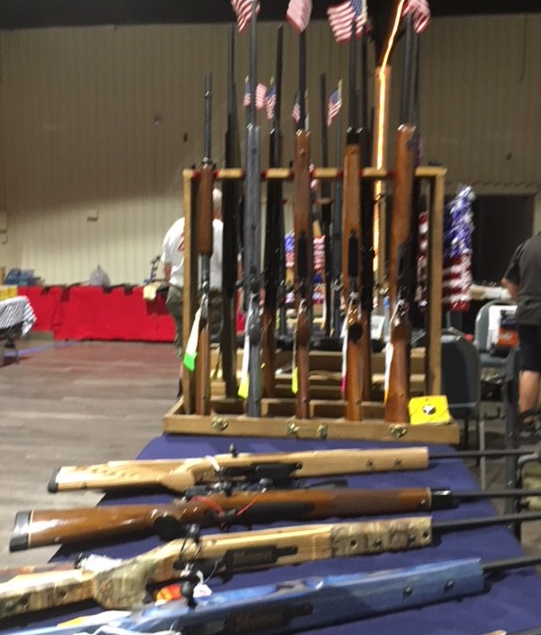
Inside the gun show (admission $6 with in and out privileges) were more guns than I had ever seen in one place. There were little handguns ideal for the beginner, pink guns for ladies, semi-automatics for who knows what, rifles, and a lot of other gun related stuff that I know nothing about.

The people were talking in English, but I didn’t understand much of it- torque and ammo and RPM and loading speed. A large booth along the back sold ammunition for just about any kind of gun.

IMG_1043

One vendor I spoke with was happy to sell me a gun and the ammo so long as my visa card approved the transaction. Another was less willing. She could only sell guns to people with in-state driver’s licenses unless I wanted a long gun (whatever that is), then I would need a driver’s license from any US state. No mention of age or background checks or criminal backgrounds, just a driver’s license. Tempted as I was to see how closely they would look at my Ontario driver’s license, I decided to pass on purchasing a gun. I didn’t think I could bring it back to Canada.

The Aliens: Roswell

In the summer of 1947, a local farmer saw a flash in the sky. A few days later, he passed by a large crater filled with tin-foil like matter and other odd pieces. The farmer picked up some of the debris and drove it to the Roswell air force base, where he left it with the military. Shortly thereafter, the military issued a press release, indicating that one of its weather balloons had crashed. End of story. Or was it?

In the 1970’s, ufologists (that really is a word that means the study of reports, visual records, physical evidence and other phenomena relating to unidentified flying objects) reviewed the Roswell reports, interviewed alleged eyewitnesses, was the subject of a probing National Inquirer report, all of whom concluded that it was not a weather balloon that fell near Roswell that night in 1947, but a spaceship carrying 3 aliens who died in the crash. They state the air force carried out secret autopsies on the aliens and classified the information relating to it and the flying saucer. Conspiracy theories abound about the Roswell sighting, with the latest claim being that neither a weather balloon nor a flying saucer crashed, but rather it was a nuclear monitoring device which the air force did not want the world to know about; hence the cover up.

Whichever version one chooses to believe, Roswell has embraced the alien culture. Every store on the main street (with the exception of the Scrapbooking store which I would have visited but it was closed on Sundays) pays homage to aliens. The toy store offers stuffed aliens, the ice cream shop has zombie sundaes, the art gallery displays portraits of the aliens.

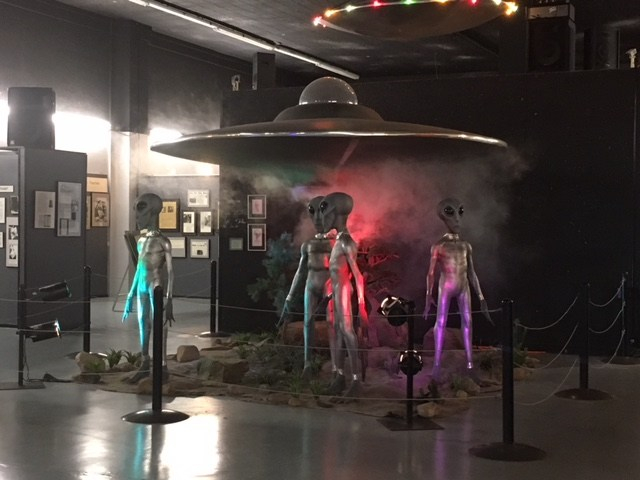
The academically named International UFO Museum and Research Center contains news clippings, photos, military letters and sworn affidavits documenting the UFO sighting and autopsy, along with displays detailing the official government position. Whether one believes in UFO’s or not, credit must be given to the town of Roswell for exploiting public curiosity about UFO’s. The grand finale in the Museum says it all:

img_1054.jpg

More Uses for Cockroaches: Queen Copper Mine in Bisbee, Arizona

Tombstone’s approach to avoiding its inevitable ghost town status was to turn itself into a tourist attraction, lovingly restoring buildings to 1880 décor and having the local townsfolk dress in period costumes. Bisbee, 30 miles southeast, took an entirely different approach. It tried to recreate itself as an artist’s paradise, enticing artists and galleries, fanciful murals and, for reasons that escape me, zombie culture. It succeeded somewhat, reversing the population decline from the mid-1970’s to become one of those towns whose website describes itself as “having a thriving arts/music/hospitality scene”.

IMG_0958

The single throwback to Bisbee’s bygone era is the Queen Mine, a copper mine dating  from the 1880’s. It operated underground until after World War II, when it became an open put mine, the remnants of which are still visible today:

IMG_0995

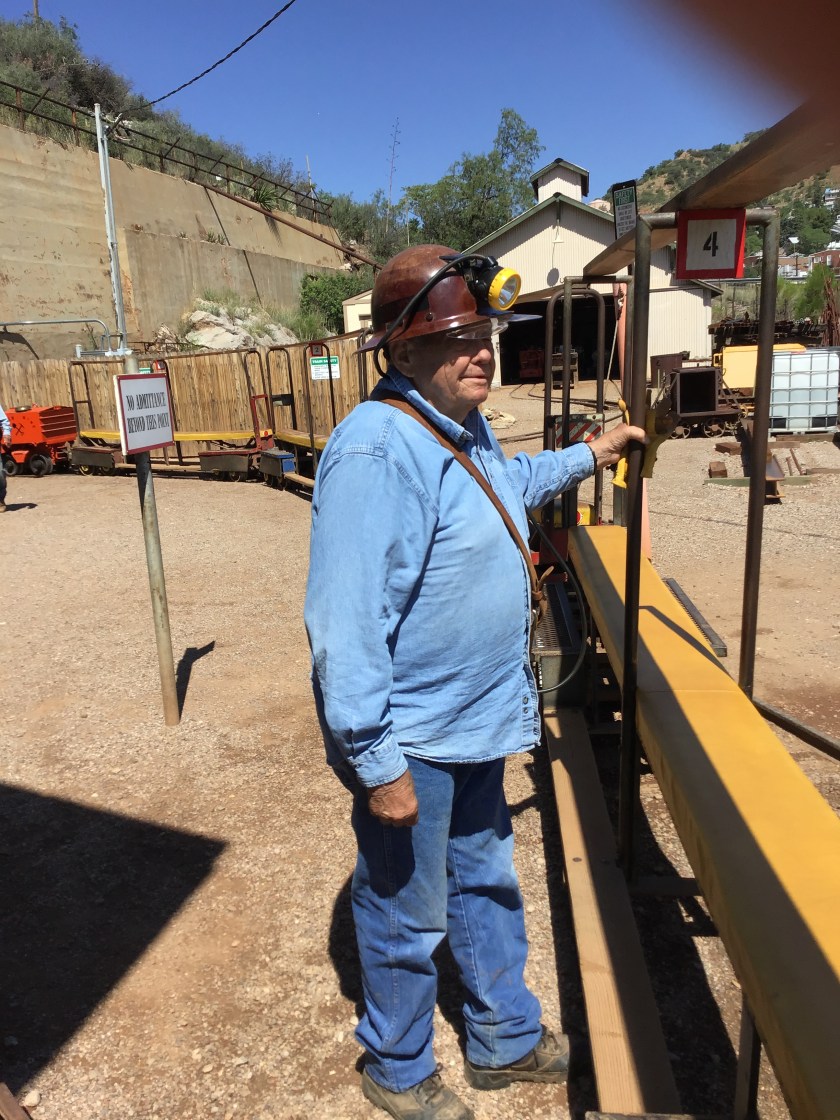
The mine closed in 1975, but tours are offered daily, which is where I found myself at 9:00AM. My travel companion and I first watched an informative film about copper mining, then were fitted with appropriate attire: a vest, a hard hat and a flashlight. We signed a waiver, indicating we fully understood and accepted all of the dangers inherent in going into an underground mine and met our guide, Benny, and the train that would take us into the mine.

image1(5)

Benny was a former miner at the Queen Mine. He started  in 1957, after finishing high school ,and stayed until the mine closed. The mining company offered to send him to school after he lost his job so he went into law enforcement and was a police detective for 27 years. He was also elected to the Bisbee town council before coming to the mine to lead tours 8 years ago. As a miner, he mostly laid railway tracks in the mine (depending on what site you look at, there are between 350 and 5,000 miles of railroad under Bisbee), but he also did search and rescue in the mine (there were 3 deaths-1 heart attack victim, the other 2 mine accidents) and set dynamite. Needless to say, he was a wealth of information about mining.

We were the only 2 on the  tour, so we hopped on the train- reminiscent of the Disney World mine ride except there was no water and we straddled the padded yellow posts on the train. We entered the mine and were thrust into near darkness, tootling about 1500 feet into the mine.

IMG_0967

Our flashlights showed the path-endless rail lines and rough cut tunnels. We made a few stops. At the first one, Benny showed us the shafts through which ore was shunted from level to level – sort of an ore laundry chute.

IMG_0975

At the next stop, timbers provided support to the rock walls and created doors that acted as firewalls. Benny explained that only douglas fir and pine trees were used in mines since they audibly creak if the earth is moving, a sure sign of a mine cave-in. The other sure sign (hence the title of this post), is mice and cockroaches scurrying out the of a tunnel. According to Benny, cockroaches (and mice) have a symbiotic relationship with the earth that allows them to know in advance when it is moving. When cockroaches are racing away from a tunnel, that is advance warning  a cave-in is about to happen.

I will digress somewhat here. I do not like little things like cockroaches or geckos that scuttle about, scaring the crap out of me when they show up near pools or sidewalks. I have learned to tolerate geckos by repeating the mantra “they are my friends; they eat mosquitoes.” Having lived in Winnipeg for 10 years, I know the benefits of limiting mosquitoes, not that I ever saw a single gecko in Winnipeg. But I never knew of any use for cockroaches until, twice, in the last 48 hours, have learned of 2 valuable services they provide.  In the Biosphere2, I was told  cockroaches aerate the rainforest by eating dead leaves. Now, in the mine, I learn they forecast cave-ins. Useful information I suppose, but since I tend to be in rainforests and mines only once a decade,  I am not convinced the world would be better off without cockroaches.

Back to the mine tour. Benny demonstrated how to properly install dynamite in a mine. It is never a single stick, but up to 26 sticks arranged in a circle. The fuses are each an inch longer than the last, so there is not a single blast, but 26 blasts starting from the center and moving outward. The miners listen for 26 blasts, If they only hear 25, they know they have a problem.


Benny showed us various tools and contraptions used by the miners, including the sanitation device for –use your imagination- but there are no bathrooms in a mine. The miners were paid $45 per day, with the ability to earn a lot more if they exceeded their daily quotas. Benny often laid more railroad tracks than required (14 feet per day with a partner), so some weeks he made a fortune – up to $2000 a week.

An hour and a half later, we re-emerged into the sunlight and the warmth of an Arizona summer,  with increased  knowledge of mining, much more respect for the miners and maybe a tiny bit of tolerance for cockroaches.


Gunfight at the O.K. Corral: Tombstone, Arizona

Some places demand you put logic aside, close your eyes and enjoy the experience. DisneyWorld and Colonial Williamsburg are two such places; Tombstone, Arizona is another.

Tombstone’s History:

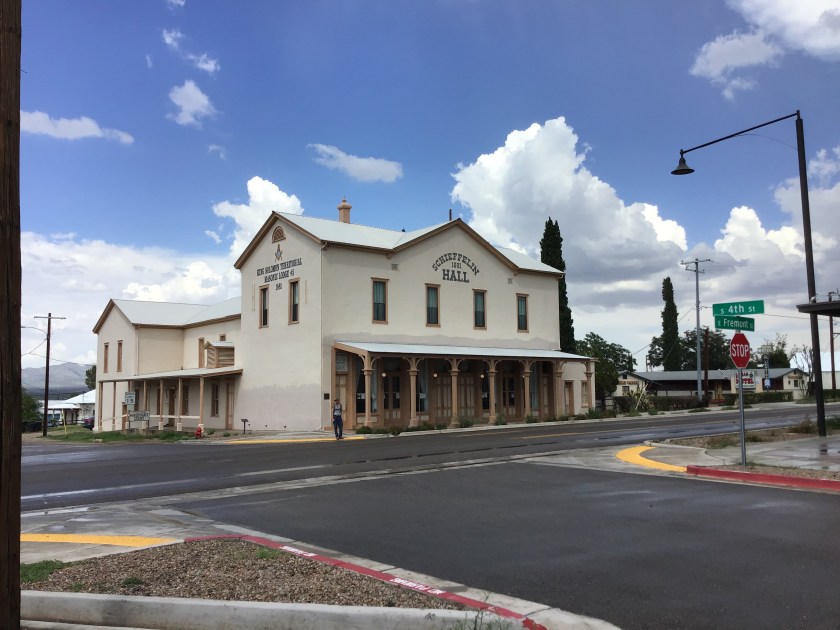
Located about 90 miles south east of Tucson, Tombstone was founded by a prospector named Ed Schieffelin in 1879. It was one of many boom towns supported by a nearby silver mine, boasting a population of over 14,000 by 1885.  4 churches, a bowling alley, a school, 2 banks, 3 newspapers and an opera house frequented by the respected folks (the Schieffelin theatre), a theatre for the not so respectful miners and cowboys (the Bird Cage) along with hundreds of saloons, some brothels and gambling halls lined the main streets.

image1(4)

The population was split between the miners and the “cowboys”, but that term was used negatively to refer to the outlaws who rustled cows and smuggled them over the nearby (30 miles) Mexican border. Near Tombstone, some cowboys attempted to rob a US stagecoach in March, 1881, killing a passenger and a popular driver. Deputy US Marshal, Virgil Earp, his two temporary deputies and brothers, Wyatt and Morgan, along with a dentist, Doc Holliday, set off in search of the perpetrators. This started a feud which culminated in the fight at the O.K. Corral on October 26, 1881, in which 3 cowboys (Tom McLaury, Frank McLaury and Billy Clanton) were killed.

After the original fight, Morgan Earp was ambushed and killed. Wyatt and Virgil were run out of town in 1882 by citizens tired of the gunfights. Wyatt traveled to a number of western boom towns, including one in Alaska, before settling in Hollywood in the 1920’s and befriending actors. Doc Holliday died in Colorado of tuberculosis at the age of 36, after escaping extradition proceedings in New Mexico for his role in the O.K. Corral battle and another posse that killed more cowboys in 1882.

Tombstone suffered an equally unglamourous demise. The main pumping plant servicing the silver mine burned in 1886 and, shortly thereafter, the price of silver slumped. People left in droves. By 1890, only 1900 residents remained, dwindling to under 1000 in 1900.

Tombstone Today:

Tombstone was revived as a tourism spot, in large part due to its well -preserved buildings. Today, one can visit the Birdcage Theatre, complete with appropriately clad ticket takers, stroll along the boardwalks where photographers offer to dress you up in period costumes and produce sepia coloured photos or enter a saloon for a bite to eat or a wine tasting which I am not sure was popular in the 1880’s. The main street is packed with red dirt, becoming a slush pond on rainy days.

Stagecoach rides are offered for $10, with a driver who provides commentary through electric speakers and seats far more padded than the originals.

IMG_0938

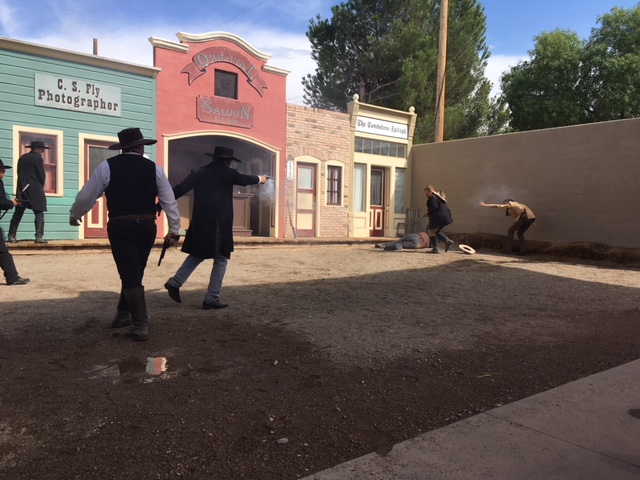
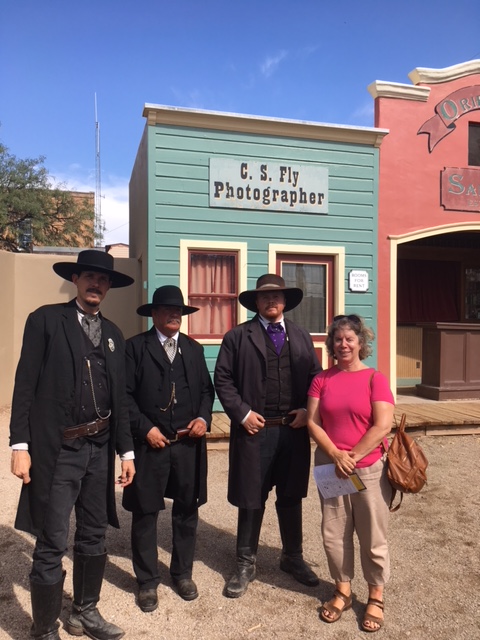
A diorama shows a 25 minute movie about Tombstone and the gunfight. That gunfight is reenacted 3 times daily around town and at the actual sight of the gun battle, which was a vacant lot next to the photography studio of C.S. Fly.

IMG_0924

The audience is encouraged to clap for the good guys and boo the bad guys. The climax is the 30 seconds of gunfire, during which 30 bullets are fired, just like in 1881. Two of the bad guys die; another staggers around for a few minutes. At the conclusion, the lawmen graciously pose for pictures and ask for donations to the starving actors fund.

IMG_0929

The former newspaper office of the Tombstone Epitaph is part newspaper museum and part tribute to its founder, John Clum. Originally from the east, he fell in love with the west when he became an Indian agent, maintaining order on a nearby Indian Reservation. He counted, as one of his triumphs, the capture of Geronimo (who was freed by Clum’s successor, leading to 15 years of bloodshed and Indian wars until he was recaptured). Clum was elected mayor of Tombstone in 1881 on a platform of ending the lawlessness, despite beign good friends with Doc Holliday and Wyatt Earp. For a while, he succeeded, making carrying guns in Tombstone illegal. That was short-lived – Arizona is now an open carry state.

Hokey as it is, Tombstone is fun to visit. It is lovingly preserved (although purists argue some of the restorations are recreations gone too far), the town folks friendly without being pushy and the downtown large enough to wander through without being bothered by throngs of tourists. It doesn’t take itself too seriously and in contrast to places like Cody, Wyoming, doesn’t present an idealized version of the Wild, Wild West. Streets get muddy, towns burn, mines come and go, people die in gunfights.

Weird Science: Biosphere2

My favourite attractions leave me feeling satisfied, having learned something new or made me think about an issue in a different light or provided the pleasure of seeing a beautiful sight. My visit to Biosphere2 failed on most accounts, making me feel that I had been enticed to see one thing and was shown something completely different.

Biosphere2’s claim to fame

In 1991 a Texan billionaire named Ed Bass teamed up with an ex-cult figure called John Allen to create a completely self-sustaining environment, with an indoor 3 acre farm to plant crops and 5 enclosed biospheres each containing a different ecological system: an ocean with coral reefs, a rainforest, mangrove wetlands, a fog desert and savannah grasslands. The technosphere was a 3 mile underground conglomerate of pipes, energy supplies and air regeneration equipment. Biosphere2 also had living quarters for 8 biospherians, a select group of idealistic men and women who agreed to spend 2 years in the Biosphere 2, relying only on the materials inside for their survival. The experiment was named Biosphere2, The Closed Mission. It is located about 45 minutes from Tucson, Arizona:

IMG_0887

The ostensible purpose of the experiment was to prove that humans could survive for long periods of time in a closed environment, perhaps on Mars, perhaps in outer space. The biospherians, clad in their Star Trek inspired designer outfits, were paraded before the world media as they entered their airtight cocoon for two years in September, 1991 to begin their experiment.

Problems surfaced quickly. One of the biospherians had to leave the Biosphere following an injury to her hand which the medical doctor inside was unable to remedy. She returned carrying a duffle bag of materials, which the media declared amounted to cheating on the experiment. The crops inside failed to achieve their targets, leading to considerable malnutrition and weight loss of the inhabitants.

Most significantly, the plants inside the biosphere failed to photosynthesize as quickly as needed, leading to an abundance of carbon dioxide inside. The biospherians were slowly being suffocated, leading to lethargy and other ills. To resolve the lack of oxygen, outside management decided to allow external air into the biosphere, compromising the self-sufficiency aspect of the entire experiment.


Nonetheless, two years later, the biospherians emerged from their bubble and declared it a success. Time Magazine was not so enthusiastic, declaring it one of the Worst 100 Ideas of the 20th century. Current analysis of its value is split into two camps. Those who considered it as an experiment to determine if people could live in a self-sufficient environment for an extended period view it as a failure, pointing to the outside assistance needed to sustain the project. The other camp recharacterizes the purpose of the Biosphere2 as an opportunity to determine how people could live in a self-sustaining system, regarding all the problems encountered as lessons learned. They note some of those lessons are currently being applied on the Space Station and in Antarctica research stations.

The Tour:

However, one regards the Biosphere2 experiment, very little of it is mentioned on the current tour. Our docent, Carol, met us and ushered us into a theatre for a short video about the current Biosphere2. After the original biospherians left in 1993, a second group of 8 entered the domes, but emerged just 6 months later amid infighting amongst the management, a raid by law enforcement officials and somehow, Steve Bannon’s (the former Trump advisor) involvement. None of this was mentioned by Carol. Instead, she advised that Columbia University took over Biosphere2 initially but currently, the University of Arizona manages it.

Nor was there reference to the length of time the original biospherians spent in the Biosphere2. Carol did drop a few tidbits about the Closed Mission:

  • Because of the bean failure, coffee was rationed to a single cup every two weeks;
  • Ants and cockroaches thrived, with the cockroaches becoming coworkers by aerating the dead leaves in the rainforest;
  • The biospherians took to eating their grain seeds to off ward off hunger.

But mostly,  the tour focused on the current or anticipated scientific experiments that the University would carry out,  relating to the effects of climate change on the ocean and rainforest, matters I suspect are of less than overwhelming concern in the middle of the Mojave desert.

(The mock ocean and rainforest).

This is a missed opportunity., in my opinion. If the University of Arizona wants to exploit Biosphere2 and turn it into a tourist attraction, it should focus on the Closed Mission, its goals, successes or failures It could have a gift shop selling T-shirts and coffee mugs declaring “I survived the Biosphere2” and have videos of the biospherians entering and exiting. Maybe it could invite back some of the biospherians or do a sequel “where are they now.”  In any event,  I shouldn’t have to survey the internet to find out what happened to the Closed Mission at Biosphere2.

Instead, the current tour just tries to sweep the whole thing under the rug like a bad memory, an experiment poorly conceived and badly implemented. Whatever its merit, the Biosphere2 Closed Mission deserves more than passing mention on a tour of the Biosphere2.

No Bones About It: Pima Boneyard Tour

There are no bones on a Pima boneyard tour. It doesn’t involve a cemetery or a medical school anatomy class or even a skeleton. What it does have are airplanes, lots of them. A boneyard is where old planes go to live out the remainder of their useful lives, either as back-up planes or for spare parts, until they are deemed completely obsolete and are shredded (sold for scrap). One of the largest boneyards in the world, and the only one available for public tours, is located at the Pima Air and Space Museum near Tucson, Arizona.

Being allowed on the tour is no mean feat. Since getting to the boneyard requires going through the active Davis – Monthan Air Force Base, precautions are taken to ensure no undesirables are on board the tour bus. Pre-approval 2 weeks in advance is absolutely necessary. Ever so cautious, I had applied 4 weeks before providing all requested information, but heard nothing in the promised response time of 3 days. I sent another application and still heard nothing. “Maybe I was no longer a good security risk?” I wondered. Was it because I no longer had a job? Maybe I shouldn’t have told the customs officer I didn’t have an address when he asked where I lived.

Beginning to panic, I started to leave voice mail messages at the museum, but was never able to connect. Finally, 4 frantic phone messages later and 2 days before the deadline, I received a confirmation email. I was cleared to take a 5 minute bus ride across the Air Force base as long as I didn’t carry firearms, knives or backpacks and promised to obey all commands regarding photographs.

On the day of the boneyard tour, I arrived with an hour to spare at Pima. Although the boneyard  was my primary objective, the Air and Space Museum has plenty of other historic aircraft. Despite the heat being 43 degrees, I walked outside and looked at some of the planes. An Air Force One which had ferried Presidents Kennedy and Johnson was there, along with a B-36, a Blue Angel and some crazy looking NASA contraption.

The Museum was staffed by lots of volunteers – all pilots or persons with connections to the Air Force. Each was eager to share their flying stories with everybody. As I was looking at an early model Learjet, Mark approached me. He was in his 70s. He had contracted polio as a youth and been left with a bad leg (he was in a wheelchair). He had been rejected by the military, but still learned to fly and had been doing so for nearly 50 years. He asked if I wanted to fly, but I admitted my nervousness of flying. He said flying was the second best thing one can ever do. Suckered in, I asked him what was the best. He looked at me with a twinkle in his eyes, like he had probably done hundreds of times before, then replied: “landing.”

We boarded the bus for the boneyard tour with our confirmations and a 2nd show of our passports and purses (to make sure there were no guns in them), then drove to the base where we all dismounted and gave our passports (3rd time) over to an air force person. We waited in a hot, dark shed for about 10 minutes before he returned, gave us our passports back and reboarded the bus.

Our docent, Thomas, was a former air force pilot who had originally trained at the Davis-Monthan Air Force Base. Once he left the military, he had continued to fly for a state national guard. As the bus drove, he delivered a treasure trove of information. The boneyard contains 3400 mostly military aircraft, down from a high of 6,000. Upon arrival at the boneyard, each aircraft is inventoried by a specialized parts manager, then readied for its stay. It is first covered with a black sealant, then its windows, engine faces and nose sprayed with a white sealant, giving all the planes a ghostlike appearance.

IMG_0845

The white seals have the effect of maintaining the interior temperature 15 degrees cooler than the Tucson desert. The interior instruments can be damaged at about 120 degrees Fahrenheit, so the seals give the necessary cushion if it gets over 130 degrees.

One plane, of course, did not need the seals. It was the Stealth, which as everyone knows, is invisible. Here it is:

IMG_0852(1)

A little boneyard humour (courtesy of Thomas).

As we drove through the boneyard, seeing plane upon plane, Thomas narrated information about each plane. A common naming system meant the starting letter of each plane indicates its function, so an A plane is an Attack plane, a B (like in B-52) is a Bomber, C (as in C-36) is Cargo. The F-18 is a Fighter and Thomas added that he hoped when the sequel to Top Gun is made, Tom Cruise would play the grandfather.

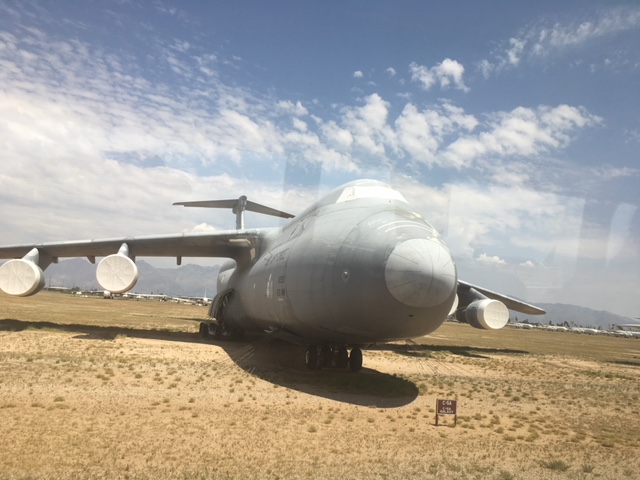
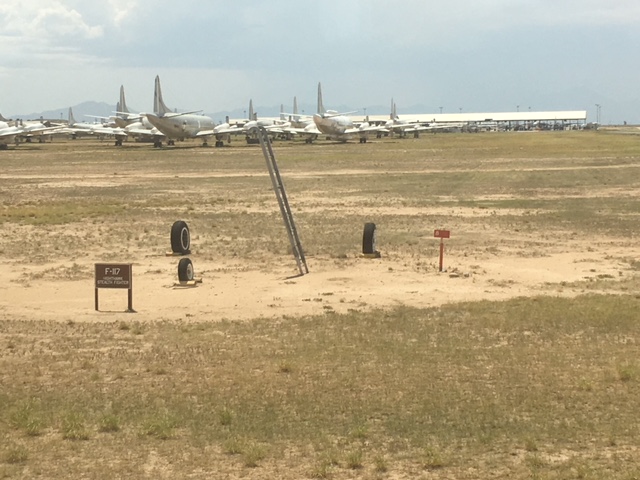
Words cannot adequately describe the sight of thousands of planes sitting in the Arizona sun, so I shall end with pictures.

Probably hundreds of billions of dollars worth of planes lined up like toy cars in a store window. It was quite a sight.


A ghost town with ghosts: Rhyolite, Nevada

Numerous ghost towns dot the area near Death Valley, mostly abandoned mining towns. Rhyolite ( an igneous volcanic rock), is no different. It started as a two man mining camp in 1905, then quickly grew to be the largest town in the area due to its proximity to a nearby goldmine. By the end of 1905, its population had swollen to 2500 people, with 50 saloons, 35 gambling tables, a brothel, 19 lodging houses, 16 restaurants, half a dozen barbers, a public bath house, and a weekly newspaper, the Rhyolite Herald.

It was soon served by three different railways, ferrying passengers and borax from a nearby mine to Las Vegas. It had electricity, running water and concrete sidewalks. By 1907, a hospital, a school, a fire and police department, 3 banks, a public swimming pool and 2 churches served its 4000 inhabitants. The most prominent building was the 3 story Bank Building on its main street.

Its decline began soon after. Following the San Francisco earthquake in 1906, capital was diverted to other projects, limiting  funds for mine development and interrupting rail service. By 1910, all 3 banks closed and only 675 residents remained. The mine closed in 1911, the post office in 1913 and the train station in 1914. Electricity was shut off in 1916 and the rail tracks torn up and used in the war effort. Some buildings were moved to other locations. The town was all but abandoned.

My choice in visiting it was twofold. First, it is accessible from a paved road, no small consideration when not driving a 4 wheel drive in the middle of the day in Death Valley. Second, it has real ghosts.

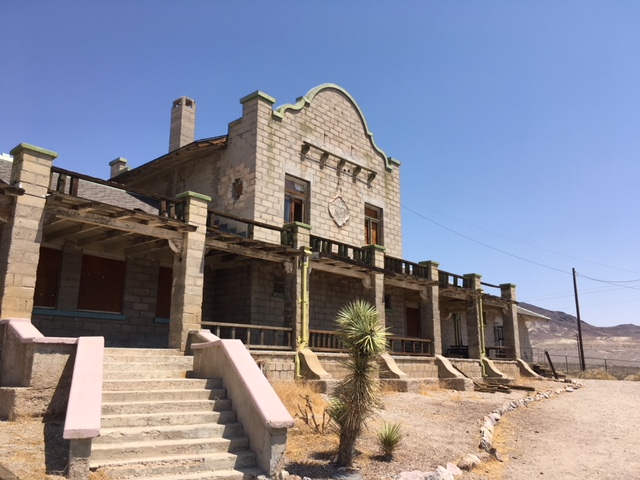
I arrived shortly after noon and parked near the former railway depot. It is the best preserved building in the town.

IMG_0808

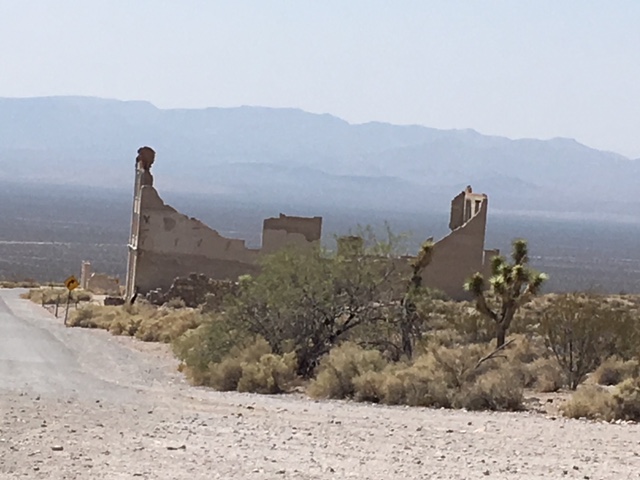
All that is left of the former star attraction, the 3 story bank building, was a few stones.

IMG_0811

Rusted out pieces of metal and dirt roads marking the once bustling streets reminded one of its former glory. A single house remained.

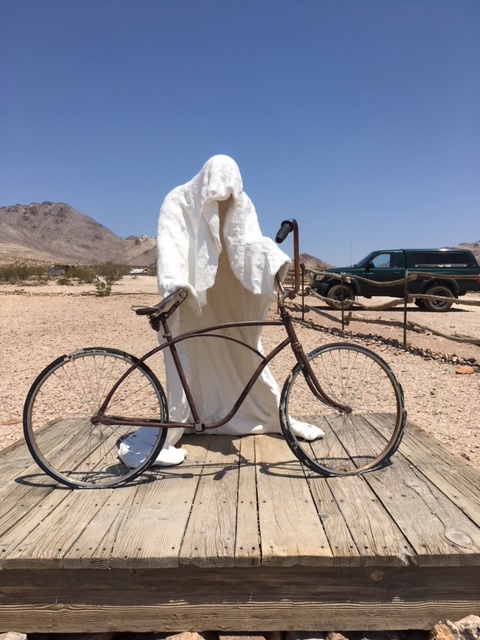
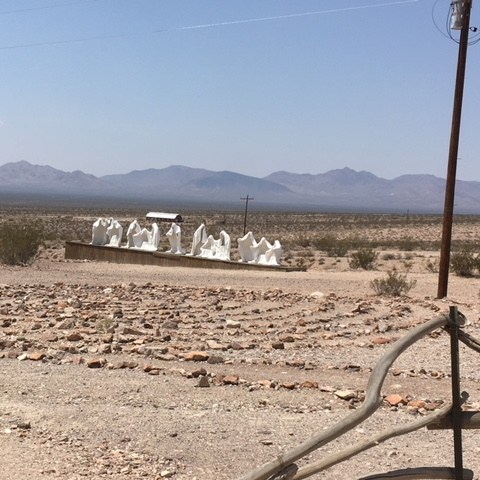
The ghosts are intact, however, in the form of sculptures by a Belgian artist.

IMG_0815

In 1984, Albert Szukalski created his sculpture The Last Supper on Golden Street near the entrance to the town. Death Valley was chosen by the sculpture due to its resemblance to the Middle East deserts.

IMG_0814

However, as the signage in the one room museum points out, the town that was intended to endure forever lasted a mere 10 years. The ghosts, intended to last only 2 years, have remained to this day, far longer than the town.

A Question of Degrees: Death Valley

Having tired of the lack of parking spaces in Yellowstone and Lake Louise, the large crowds of tourists in San Francisco and the cool weather that accompanied me from Oregon to San Simeon on the Pacific Coast Highway, I headed to the perfect antidote: Death Valley. In July….. During a heatwave……Temperatures were forecast to reach 50 degrees celcius (122 degrees Fahrenheit) at Furnace Creek, the main station in the park,   population 24.   I came to understand the furnace part, but no creek was visible anywhere near that I could see unless one counts the much appreciated flush toilets at the Visitor Center.

Let’s back up a little. I like hot weather. I also like deserts, so Death Valley National Park seemed like a perfect destination. Granted, travel there was not advised in the heat of the summer, but I followed all of the recommendations. I had extra water (a four litre jug in my car), sunscreen, sunglasses, a wide brim hat, sturdy walking shoes and a paper map, since GPS tends to lead one to the shortest route and going on non-paved shortcuts through the desert was a definite no-no. Google maps and most other cellular service were iffy at best. My car appeared in good shape – no warnings to check my tire pressure had occurred recently- and it was air conditioned. In any event, I would do as the literature said, if your car breaks down, stay in it and wait for help.

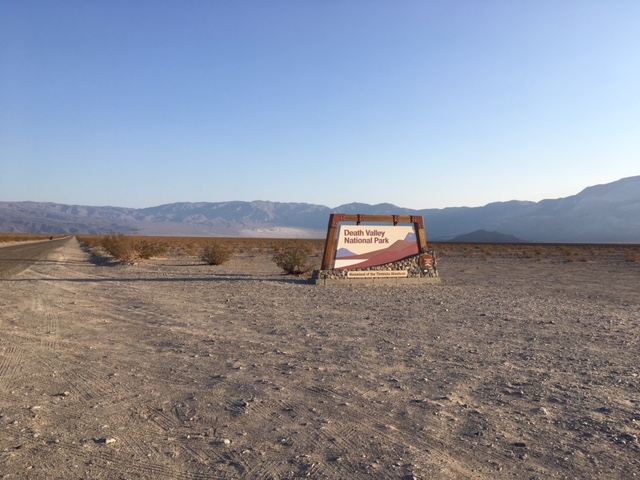
I left my hotel in Ridgecrest at 5:30AM, just as the sun was rising. Although Death Valley is supposed to have wonderful sunrises, the prospect of driving 90 miles on an isolated desert road to the park’s entrance at 4:00AM did not appeal. As it was, I did not meet another vehicle until well after I arrived at the park.

IMG_0769

Death Valley had been inhabited by native American Indians for over 10,000 years (and still is today), but the first white men to visit were miners eager to get to California in 1849 to join the gold rush.. They were stranded in Salt Lake City and warned not to go further west during the winter months (remember the Donner party). Impatient, 125 pioneer wagons set off for the south, seeking a short cut to California. Arriving at an impassible cliff in Nevada, most of the wagons gave up, but some continued on, reaching Death Valley in December, 1849. They wandered aimlessly through the desert for three months,  eventually sighting the Sierra Mountains, where they headed south before finally arriving at civilization. Upon leaving the desert, one miner turned back and said “good-bye death valley” to the place he thought would be his final resting place. The name stuck.

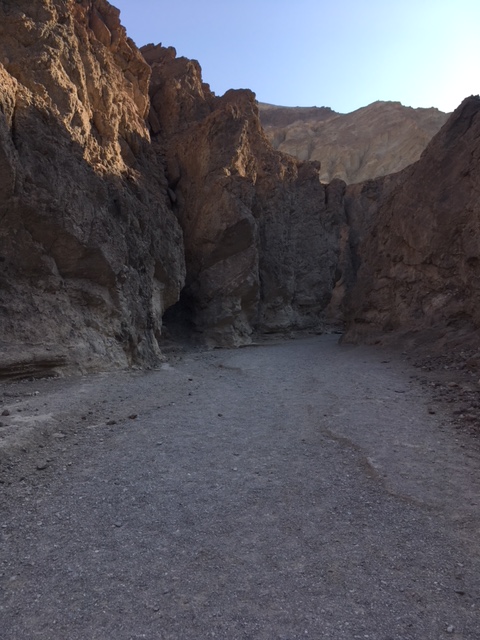
Death Valley is as intimidating today as it must have been in 1849, but at least air conditioning in commonplace and there are well marked pave roads leading through the park to the major sites. I followed the route, stopping first at the Golden Canyon.

IMG_0775

The hiking trail was rated moderate, but at 5 miles it would take half a day, going well beyond the 10:00AM “Do not hike” warning time. Besides, no one else was in the parking lot. I decided against the hike, took a picture and carried on to the next highlight.

If the Golden Canyon looks familiar, it is because it and two other Death Valley landmarks (the Artist’s Drive and Dante’s Peak, a viewpoint overlooking the valley) were locations used as Tatoonie, Luke Skywalker’s home planet in the original 1977 Star Wars and four subsequent Star Wars films, along with other locations in Tunisia.  To think, I walked the same ground as R2D2 and C-3PO!

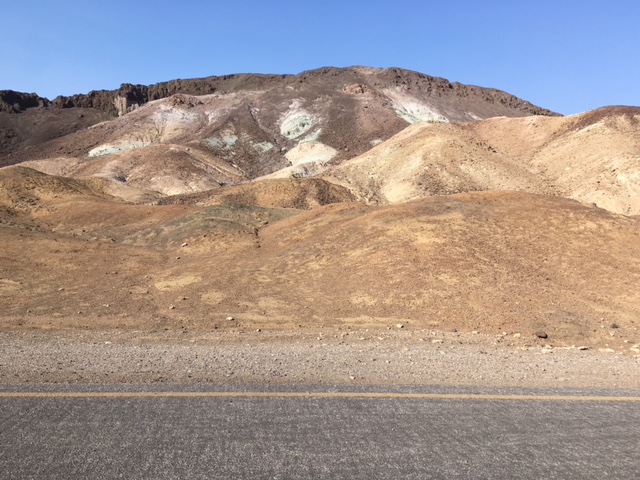
The Artist’s Drive is described in the brochure as a “dipping, diving, curving, one-way road that weaves through striking ravines and colorful rock formations. The highlight of the nine mile loop occurs at the Artist’s Palette, where sea green, lemon yellow, periwinkle blue and salmon pink mineral deposits are splashed across the barren background like brilliant dabs of paint…The effect is most intense during the evening…” It wasn’t evening and, although it was a bright sunny day, the heat created a blanket of haze that covered the valley. The Artist’s Drive did dip and dive and curve, but it looked mostly brown to me.

IMG_0785

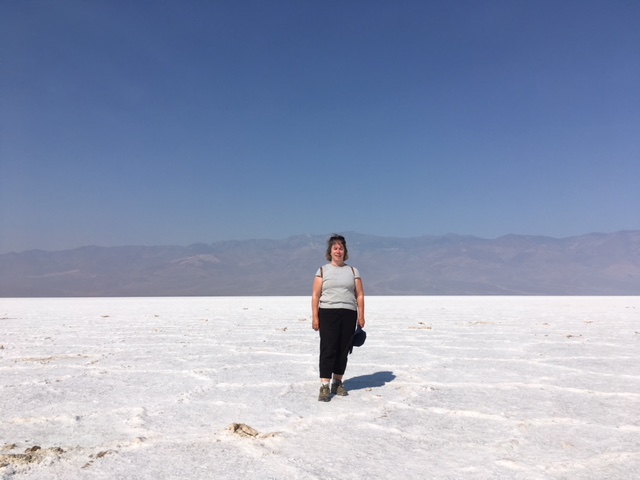
The highlight, or rather lowlight, of Death Valley is Badwater Basin, the lowest point in North America at 282 feet below sea level. By comparison, the lowest place on this planet is the Dead Sea, straddling Israel and Jordan, at about 1450 feet below sea level. In bygone years, the Badwater Basin was a salt water lake which had long since evaporated, leaving a layer of salt 1 to 5 feet thick.

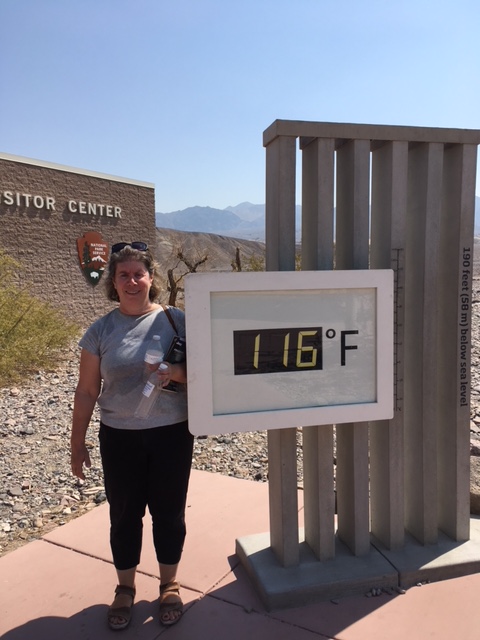
Badwater Basin is also the hottest place on earth, having registered a temperature of 56.7 (134 degrees Fahrenheit) early in this century. On the day I visited, the temperature was a cool 50 degrees and only 116 degrees at the Visitor’s Center.


IMG_0801

I arrived at Badwater Basin shortly after 9:00AM. The salt flats were about a mile from the boardwalk. As I walked out, the few tourists who had been there earlier returned to their cars. I was along except for a teenage boy. He took my picture, then I turned around to gaze at the vast, salt lake. There was complete silence. No other tourists, no hawkers trying to sell t-shirts or bike rides. Just me, the salt and miles of desert as far as the eye could see. Much as I would have loved to stand there admiring the vista before me, it was 50 degrees, the sun was beating down and I was hot as hell. Death Valley had lived up to its reputation.

IMG_0793

Warring with GPS: The Pacific Coast Highway

This post was supposed to be about the drive from Crescent City to San Francisco along the Pacific Coast Highway, with gorgeous photos of white, ocean waves smashing into the vertigo inducing cliffs hugging the coast. But it is not. “Why?” you ask. Let me tell you.

First, while everyone warns one should get to the USA National Parks early to beat the crowds, I have never read anywhere that one should start the journey on the Pacific Coast late to beat the fog. So I left Crescent City about 8:00 AM and encountered 5 straight hours of fog.

The one redeeming feature was another opportunity to drive through a redwood forest at yet another State or National Park with redwood in its name. Fortunately, it lived up to the hype.

IMG_0686

Second, despite one of my talents being the ability to read maps and generally navigate by the sun, I had been convinced that maps and compasses are passé and I needed a GPS to get me through the USA. I had reluctantly bought a Garmin GPS and my son had installed it for our trip to Florida in February. He set it to the proper British accent (we christened it James) and it got us to Florida and back, although how difficult can it be to go due south and return straight north, especially since my car has a compass embedded in the rear view mirror. Nonetheless, I resolved to test James on my extended USA road trip.

James worked okay generally, but there were some flaws. While James directed me to Henderson, Nevada after a long drive from Sedona, he inexplicably quit about 10 miles from the destination on the middle of a newly named interstate. I was driving in the dark, doing about 80 miles an hour (the legal speed limit) when James advised he could not configure and turned himself off. Period. No reconfiguring, no telling me the Interstate had just recently changed from a different highway. Nothing. Just a black screen. So I took the nearest exit, turned on Google Maps on my phone and Siri (the voice on my I-phone) guided me to the hotel.

I ceased relying on James, but would check him out occasionally. He was useless in Edmonton;  its street and avenue numbers instead of names being impossible for James to locate, but he was okay in Banff and Vancouver.

However, the Pacific Coast Highway was a complete bust for James. He kept trying to send me along Highway 101 – the quickest route- but I wanted to drive Highway#1 along the ocean. I ignored him and did not get lost once. Admittedly, this was not a difficult achievement since all I had to do was keep the Pacific Ocean on my right.

Once the fog lifted, the scenery was spectacular.IMG_0745

But James continued to disappoint. I gave him one last try- get me to my hotel in San Francisco -which was actually near the Oakland airport. James led me off the Highway  to Richmond, then Berkley and next, in his perfect butler voice, directed me to veer right. This was the most useless command imaginable, since I was on a 6 lane highway, each of which veered right and led to 3 separate ramps-one to Alameda, one to the Oakland Airport and another to San Francisco. Since I was staying near the Oakland airport, I thought I would veer right, then take the middle exit, but James insisted that I veer right and stay in the right lane. I stupidly trusted technology, stayed in the right lane and found myself on the Oakland/San Francisco toll bridge to San Francisco. $6.00 (US) later and 4 miles down the highway, James directed me to “when possible, make a U-turn.” The nearest exit was at Treasure Island, which has only dead ends and construction zones and no possible way of getting back on the San Francisco toll bridge heading west. I gave up on James, shut the damn thing off and pulled out my I-phone and Google Maps.

Siri directed me back onto the bridge for two miles, then make a left turn at the Embarcadero in downtown San Francisco, guiding  me back on to the bridge the way I needed to go and, eventually, over an hour later than necessary, to my hotel in Oakland. ,

I spent 2 days touring  San Francisco. I had been there previously in 1978, seeing most of the main tourist sites then. This time, my first stop was at the Tourist Information Center, where I picked up a paper map. Using it, San Francisco was remarkably easy to navigate. I took a free walking tour (I tipped $20) of Chinatown and the financial district, where two other participants asked where I got the paper map. After the tour, I walked to the most crooked street in the world, Lombard Street, followed by North Beach, , Ghiradelli Square and Fisherman’s Wharf. Everything looked pretty much as I remembered it, but with many more tourists.


I left San Francisco with James relegated to the glove compartment. I would rely on Google Maps for the next part of my trip. I continued down the Pacific Coast Highway for about 300 kilometers. As I had arrived at the Pacific Coast Highway much later in the day, the fog was mostly gone and the scenery spectacular.

Six hours later, guided by Siri and Google Maps, I turned east towards Bakersfield . Eventually, the signs and Siri directed me off the Interstate 15. I took the exit and came to a T-road. The sign pointed Bakersfield right. Siri said “go left.” Left was west; east was right but I foolishly gave technology one more try and turned left. A mile later with no guidance from Siri, I made a u-turn. I turned off the phone, and followed the signs. Bakersfield arrived, on the right, shortly afterwards. Relying on more street signs, my car compass and the setting sun and totally ignoring Siri and James, I arrived in RidgeCrest without incident an hour later.