Estonian Escapades

My 3 country Baltic tour began in Tallinn, the capital of Estonia. I was touring with a British based tour company called Explore, which focuses on small group travel for the over 30’s crowd. My tour mates included an American, 2 other Canadians and 12 Brits, along with our Estonian tour leader, Tounal. Aside from Tounal, our average age was about 65, contained 2 smokers, a rocket engineer, 2 Toronto lawyers, a bunch of teachers, a former banker and a lot of IT people, none of whom were able to explain how to use the Fongo phone app. which theoretically allows you to keep your local phone number.

We started our tour in the wonderfully preserved medieval city of Tallinn, with its imposing walls and watch towers which both provided protection from foreign invaders and divided the city into the High Town and the Low Town. Some history is needed to appreciate the significance of High vs. Low in Tallinn, so let me give an abbreviated version:

After the Ice Age (circa 10,000 BC), the ice receded, leaving the Baltics fertile and inhabitable by early hunters/farmers. These people enjoyed a happy, pagan life until 1227 when  German crusaders invaded, forced Christianity on the locals, grabbed the best land and made themselves nobles. These Germans occupied the high land in Tallinn; the locals had the low land. Hence the need for walls. The Germans and the Estonians, who were reduced to serfdom, lived more or less together until Estonia declared Independence in 1917 (from Russia) and took back the land held by the German nobles. In 1939, the last of the Germans were expelled.
IMG_1633
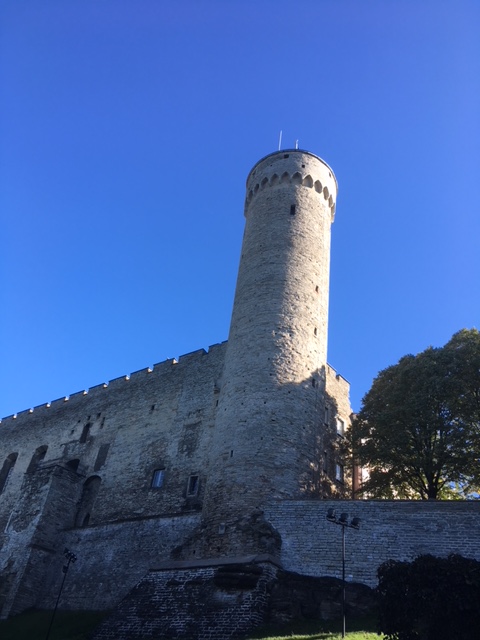
Tallinn City Wall and Tower

Of course, plenty of others invaded Estonia. It occupies a strategically important place in the Baltics, bridging east and west, its lands are fertile (rye, flax and wheat) and forested and its seas swarming with fish. It was, at various times, overrun by Swedes, Danes, Poles, more Germans and Russians. Russia seized control of Estonia from Sweden during the Great Northern War between 1700 and 1721 and retained it until the events of the Russian Revolution allowed Estonia to declare independence in August, 1917, whereupon it was promptly invaded by Germany. Following WWI, it was granted independence until the Nazis invaded. The Russians “liberated” it from the Nazis, annexed it into the Soviet Union and didn’t leave until 1991.

The attitude of Estonians to their former Russian occupiers (as they are always referred to) is extremely negative. Notwithstanding the dislike of the Russians, of the 1.3 million people in Estonia, nearly 1/3 are “the Russian minority.” When Russia departed, it left Estonia without social services, insurance, pensions or a currency. It banned all fish from Estonia, since the fish had, overnight, gone bad. Estonians need visas to go to Russia, even though a river dissects the city of eastern Estonian city of Narva from Russia.

Against this backdrop, in Tallinn, we saw the medieval walls of the city (built by Germans), Lutheran churches, Orthodox churches ( for the Russian minority) and a Guild Hall, the 14th century equivalent of an old boys club/community center where important matters were decided and significant events performed, all under the watchful eyes of the married, male nobility. It is perfectly preserved and currently a museum of Estonian history.

Adorning the old market square are buildings of various centuries, numerous restaurants and souvenir shops. When I asked what the famous Estonian dishes are, the response was “rustic.” Most restaurants featured schnitzel, burgers, salmon and dark rye bread. Creamy mushroom sauces and butter grilled fish were ubiquitous, but nothing particularly Estonian. My two significant finds were September raspberries in the fruit market and a decent selection of not too expensive wines in the supermarkets from Europe, Australia and Chile. None from the USA and the 3 vineyards in Estonia did not produce wine in commercial quantities.

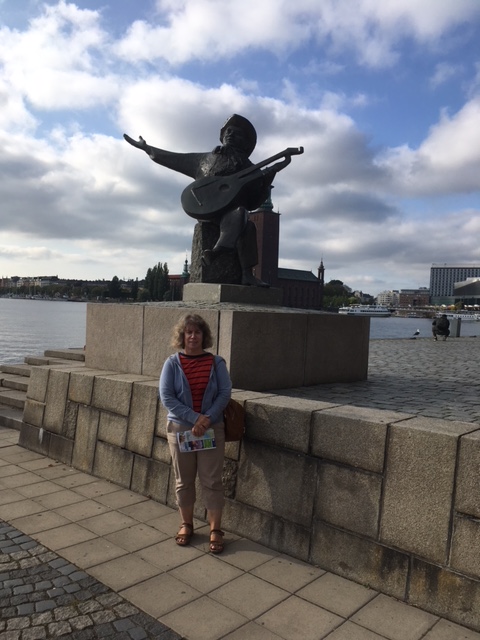
Estonia is famous for other things, notably folk singing festivals in every town, every season and marking every event (declare independence? let’s sing about it…). There is also a plethora of kooky statues, honouring everything from poets, scientists, the pig and fisher people:

From the main city of Tallinn, our tour proceeded to the Baltic island of Saaremaa, where we explored the well preserved/reconstructed Bishop’s Palace. It was built as early as 1380 by the German crusaders seeking to consolidate power, but Danes, Swedes and Russians occupied it over the centuries. As medieval castles go, it is fine, but the more offbeat exhibit is one of Soviet life in Estonia during the most recent occupation. The kitchen is miniscule, food is rare, the single bedroom has multiple beds, the bathroom has a toilet and a bucket to heat the water. On the stairs, were different jokes about the Soviets (Lenin was good, Stalin was bad, Gorbachov? We will get to know when he dies….). The exhibit was not a tongue in cheek look back at the Soviet occupation; it was a stark reminder of how difficult those times were.

We visited a fishing village on the island, learned the timetable of the airport (two flights weekly from Tallinn and charter flights from Finland) and other fascinating facts about the area. It was basically a former fishing area which could no longer sustain itself from fishing, so it promoted itself as a tourist destination –the lake country of Estonia. It boasted that hallmark of capitalism, the first golf course in Estonia, naturally constructed after the Russians departed. As a bit of trivia, the first golf course in Russia was not constructed until 1993.

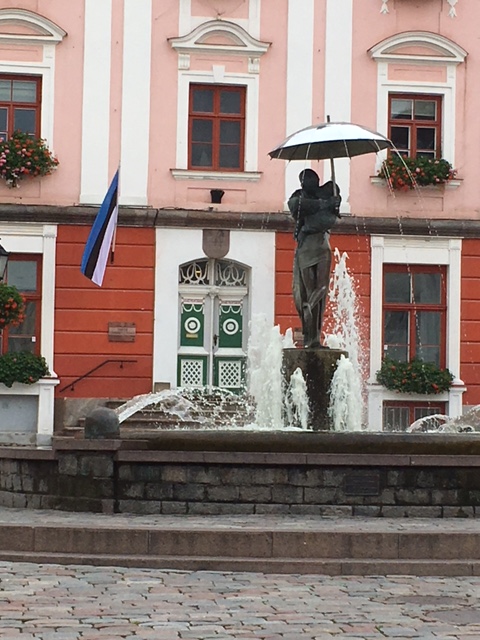
After two days in Saaramaa we returned to the mainland. We looked at the remains of another medieval castle at Viljander and some churches (Lutheran and Orthodox). Our last stop was in the second largest city in Estonia, Turtu, which has the remains of a medieval cathedral, some Lutheran churches and a pub in the old gun armory of the medieval castle, which hosts a weekly beerpong tournament. Naturally, there was a pretty market square, food markets and its symbol, the Fountain of the Kissing Students, reflecting its large student population.
IMG_1795

After a week in Estonia, I had my fill of medieval Castles, Orthodox churches, the former Russian occupation and schnitzel. It is a wonderful country- very clean (it is famous for its garbage clean-up campaigns) and lots of historical buildings, and a gentleness or naivete, depending on your point of view, from having true independence for less than 30 years. Time to move on.

Stockholm Sights

I began my sightseeing in Stockholm with a walking tour in the Gamla Stan or Old Town. The tour guide started with a succinct history of Sweden which went something like this: After the Iron Age came the Vikings. They disappeared during the Dark Ages. For 500 years, there were petty kings and lots of battles with Denmark. In 1523, a noble named Gustav consolidated power, made himself king and Sweden as we know it today was born. Gustav’s progeny ruled for a few hundred years, with their most notable legacy being making the Lutheran Church the national religion. This was more a land grab from the existing Catholic Church than a theological metamorphosis, but it stuck. In the early 19th century, the last of the Gustav line died without heir so the Swedes asked Napoleon what to do. Why Napoleon was never explained, but he proposed a wealthy Frenchman who had no royal blood and didn’t speak Swedish. The Swedes accepted and, to this day, his heirs are the Swedish royal family. They have since learned Swedish but their taste in marriage partners still runs toward the common- an American businessman and a reality TV star.

The tour walked us through some of the significant buildings where these events occurred – the Church where the Gustavs are buried, the Royal Palace, the main square which was the sight of a bloodbath of Swedish nobles by the Danes and the narrowest alleyway imaginable, constructed only 35 inches wide to discourage people from using it as a toilet. The streets were all cobblestone,  everything was pretty and the entire tour with the historical commentary took a grand total of an hour and a half.

I cycled to the Vasa Museum, a wonderful monument to total stupidity. There is even a syndrome called the Vasa Syndrome, which refers to a pigheaded ruler who doesn’t listen to anyone and fails to see disaster looming. The Vasa was a ship built quickly under orders from one of the King Gustavs to battle the Poles who were at war with Sweden at the time. King Gustav wanted to impress the Poles, so he ordered that there be two gun or cannon decks, rather than the usual one, but failed to make allowances for the extra weight the second gun deck added. Not surprisingly, on the day of its launch in August, 1628, it gloriously sailed 1300 meters (1400 yards) and sank.

The Vasa was raised in 1961 and carefully reconstructed (98% is original). It is now housed in a purpose built museum with ramps allowing visitors to view it from different levels, along with exhibits showing aspects of life in the city based on artifacts found on the ship. Raising and restoring the Vasa was a mammoth undertaking and it is a fabulous relic, but even I, with a limited knowledge of seaworthiness principles, could tell it was top heavy.

So I turned to a more seaworthy topic- the Vikings – at Vikingaliv, a museum devoted to  Vikings. There I learned that the Viking image as fierce sailors and warriors was not accurate; the museum portrayed them as simple farmers forced into occasional forays of plunder and murder along the coasts of England and Ireland. There were models of Viking ships and references to their extensive trading as far as Constantinople and China, but the focus was on their farm houses, their family life and their burial rites, with special attention paid to a 10th century Arab traveler who wrote of the Vikings practice of weekly baths and daily hair combing. Very enlightening.

Desirous to learn a little more about Swedish history, I went to the aptly named Swedish Museum of History. It told the same story as the tour guide and the Viking museum, with more artifacts but no more detail. I was beginning to understand why all my European history courses had failed to mention Sweden- after the Vikings it was not involved in much except local wars with the Danes, Russians and Poles.

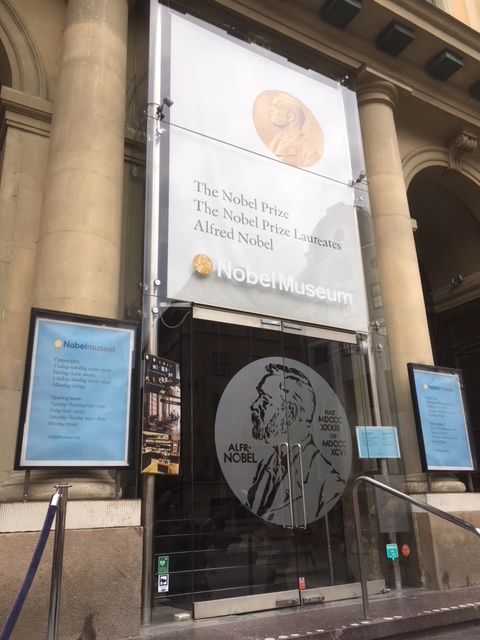
Sweden did produce one noteworthy individual – Alfred Nobel, of the Nobel prize fame and the subject of the Nobel Museum. Occupying a prominent place in the Main Square of the Old City, the Nobel Museum traces the life of Mr. Nobel – born in Sweden, invented dynamite and became stinking rich, lived in various places throughout Europe, died without heirs so bequeathed his entire fortune to the founding and funding of the 5 prizes (chemistry, physics, medicine, peace and literature) with the 6th prize in economics added in 1969. Each is awarded annually with great fanfare in Stockholm.

IMG_1520

However wonderful the concept of the Nobel prize or the achievements of its recipients, it does not make for a particularly fascinating museum. A tribute to the Literature Prize winners showcased each person’s name, country, famous works and the reason why he or she was chosen: “So and so was born in …..and raised ….He/she was greatly influenced by ……..The Academy chose so and so because……” Other than giving me ideas of some books to read, the whole thing was boring.

Seeking something more engaging, it was off to the Nobel theatre, which ran short films of 24 Nobel recipients, letting them speak of matters dear to their hearts. The Dahai Lama contributed a film as did Barbara McClintock for her work on corn genetics. Each short film provided appropriate tributes to the awardee, but the entertainment value of the films was fairly limited.

Hoping to see something more interesting, I turned to the artifacts exhibits, but seeing letters written by Einstein or a model of DNA did not excite me. I left shortly afterwards to visit the museum devoted to Sweden’s most famous citizens: ABBA.

ABBA was the iconic music group of the 1970’s. The two ladies (Agnetha and Anni-Frid) and two gents (Bjorn and Benny) were well known singers and song writers in Sweden in their own right, but shot to international stardom after winning the 1974 Eurovision song competition with Waterloo. Hit followed hit followed by movies, a Broadway show (Chess), marriages to each other ,then divorces and the gradual break up of the group.

IMG_1543

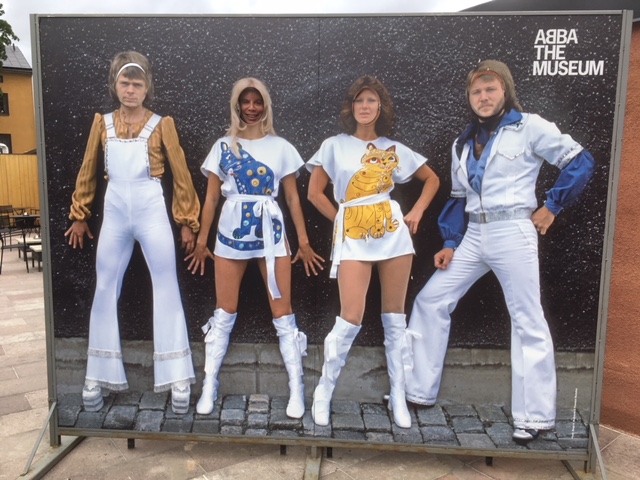
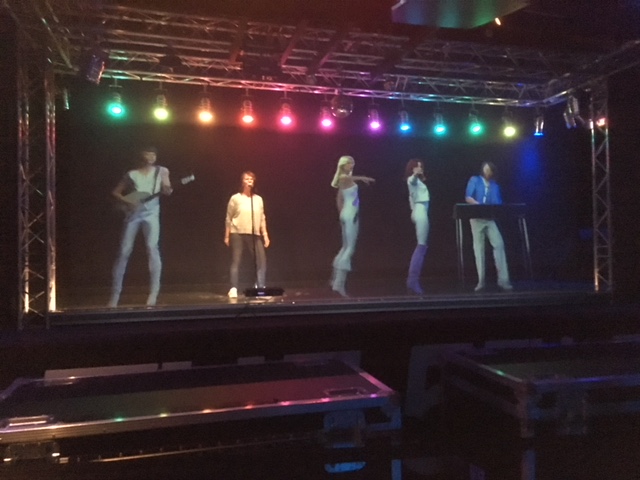
All is lovingly retold in the ABBA museum, complete with videos, an infectious soundtrack that follows you around, a frightening number of shiny bell bottom pants and the most interactive exhibits one could want. While I limited myself to having my picture taken in the cutouts, other tourists partook in photo sessions, karaoke and the ultimate dance- on stage with holograph ABBA singing and performing the moves to one’s choice of Dancing Queen or Mama Mia. I didn’t have enough hutzpah to get on stage and try, but others did.

IMG_1547

It was a fitting end to my time in Stockholm- a pleasant but not too serious museum. The price, as usual in Sweden, was outrageous to my Canadian sense of cost, but I left with positive vibes of Sweden and humming Supertrouper as a left.


Welcome to Europe: Stockholm

After spending a week in Toronto, I flew to Germany en route to Sweden. I arrived at the immigration booth and had the following conversation with the customs officer:

“Where are you going?”

“Sweden”

How long?” he inquired.

“Not sure.” I said.

“Welcome to Europe,” he replied, handing me back my passport and waving me through.

And that was that. Just a perfunctory question or two in Germany and I was in Europe for an indeterminate time with no probing whatsoever into my intentions, finances, or hotels. Nothing. I’m guessing that the profile of a middle-aged Caucasian woman speaking English with a Canadian passport doesn’t raise any red flags, but it does make me feel slightly privileged compared to the welcome I suspect awaited the thousands of recent would be refugees.

But on to Sweden. I don’t know if it was the contrast to 10 weeks of driving around the USA or memories of unfortunate first encounters with airport taxi drivers or the clean streets in Stockholm, but I am loving this country. The 5 minute late departure of the flight from Frankfurt was the subject of no less than 3 apologies from the pilot, no immigration awaited me  in Stockholm and the signs for the express train to downtown were in English and easy to follow. My credit card worked in the ticket machine, my seat mate on the train spoke perfect English and the directions to the hotel (go out of the station, turn left and walk for 250 meters) were accurate. Less than an hour after landing, I was happily ensconced in my downtown hotel.

Better yet, there was a bike share rack across the street. I hadn’t been on a bike most of the summer and was anxious to try Stockholm’s much vaunted cycling system.  I bought a bike card (conveniently on sale at my hotel), went to the bike rack and got a bike. It was that simple. No idiotic written cycling test (as in Mexico City) or wait for a code/fob/secret password (like Toronto). Just buy the card, get the bike and go. Which I did – there were bike paths all over the place – in pale red on the road, on sidewalks with different stones or asphalt to keep us apart from pedestrians, some paths raised off the street, other times with guardrails to separate cyclists from the buses. We had our own traffic lights,  crossings, passages under the bridges, even our own lane on roundabouts. Best of all, everyone – cars, pedestrian, other cyclists, even cab drivers – were kind and tolerant. No cars tried to kill me by turning right in front of me, pedestrians mostly respected the lines between bike paths and sidewalks and no crazy cyclists tried to recreate the Tour de France. Everyone was so relaxed, so non-aggressive, so kind. It becomes infectious. I started going around the idiot tourists who stood in the bike paths to get that great picture with an understanding smile. Cars stopped and gestured for me to cross the road even though there was no light or zebra stripes. I moved over for faster cyclists and waited for bike lights to turn green. Unlike Toronto, cycling here does not feel like a death defying act but an enjoyable experience.

Of course, I got lost. A lot. Stockholm is built on a series of islands, some of which are connected by ferries, other by bridges and most with unpronounceable names that were hard to decipher as I cycled over one bridge and onto another island. Google Maps was less than useful. Google Maps would tell me it was 12 minutes by bike away….just turn here, continue on ….street, then go left….etc., but the voice could not be heard on a bike and no cyclists had headphones on (or, for that matter, very few helmets) and once I spent more than an hour with no destination in sight, I turned to more traditional methods of finding my way. I asked people. Most of my conversations started with a polite:

“Hello, do you speak English?”

“Of course” would be the somewhat indignant retort.

After a few “of course” answers I changed tactics slightly. Instead of asking “do you speak English?” I switched to “Hi, can you help me in English?” which was met variously with “certainly”, “absolutely” and “for sure” but not once with “I don’t speak English.” As I said, everything was pretty easy here.

IMG_1478
Even the statues are happy

Food was the next order of business. Normally, liquor would also be high on the list, but my pre-trip readings had all warned of the extremely high price of wine. However, as a foreigner, I was entitled to bring in up to 4 liters of wine. Breaking my “no checked baggage” rule, I put a few bottles of Pellar Estates Pinot Grigio in my suitcase. Call me cheap, but the few times I ordered a single glass of mediocre wine in Stockholm, the cost was always over $20.

My principle foray into Scandinavian cuisine was a healthy indulgence at the hotel’s daily breakfast smorgasbord, including all I could eat smoked salmon, cured salmon, cooked salmon, pickled herring, liver pates and a variety of novel (to me) cheeses along with made more traditional omelets, bacon and breads. Good thing I like salmon.

My hotel’s flagship restaurant was Kitchen & Table, a concept by the Ethiopian born, Swedish raised and current Food Network expert chef, Marcus Samuelson, where local sourced vegetables are the stars and proteins ordered as sides. I treated myself to a Jerusalem artichoke served in a parsnip puree and caramelized onions, with braised lamb on the side. Delicious.

Within a few blocks of the hotel were numerous Indian, Italian and sushi restaurants, but nothing that served Swedish meatballs or reindeer. For those, I went to Ostermalm’s Market Hall, the main food hall. Both were available, but neither looked particularly appetizing. A food truck festival was happening nearby, so falafels won out.

IMG_1512
Saturday afternoon in downtown Stockholm

Greetings in Sweden took me a bit of getting used to. Everyone uniformly says “heh.” Not, “heh heh” or the current millennial’s favourite “hey” but a guttural, throat clearing “heh.” The first few times it was barked in my direction, it startled me, like someone had caught me doing something I shouldn’t, but after I looked up the English translation (hello) and proper spelling (hej), I warmed up to it. I could not bring myself to use it, preferring “hi” to announce my need for English. Everyone seemed okay with that, because the Swedes I met were generally okay with everything.

So, having mastered the local transportation, food, wine, greetings and my lack of Swedish, I felt ready to tackle the sights. Next up, some museums.