
Some places just evoke a sense of wonder and awe; Rapa Nui, in the middle of the Pacific Ocean, with its ancient statues standing guard over bygone villages, is one of them.
My friend, Cathy, and I literally plopped down here after an outrageously expensive flight from Santiago, Chile. We flew over the Pacific Ocean for 5 hours before landing on this isolated, small island in the middle of nowhere. Its nearest inhabited neighbor is Pitcairn, of Mutiny of the Bounty fame, some 2,000 kilometres away. Air Traffic Controllers don’t allow two flights at a time to be heading to the island; if one crashes and blocks the runway, the nearest diversion is 5 hours away in Santiago.
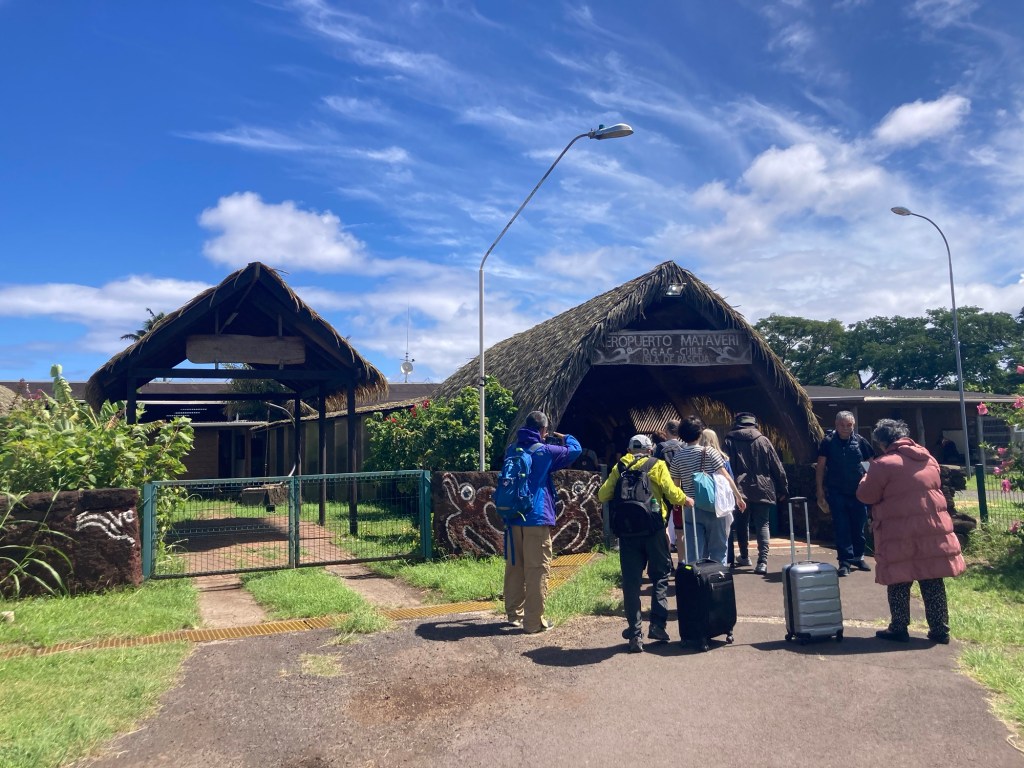
The airport is cosy, to say the least, although the runway is extra long, having been extended by the USA to act as an alternative landing spot for the space shuttle:
But enough about airports. Let’s talk about the Rapa Nui people. Originally from somewhere in Polynesia, perhaps Tahiti, they sailed here between 800 and 1200 AD, settled, farmed and constructed villages. Society was quite hierarchical and governed by a king, with 10 tribes, each descended from one of the king’s children, living fairly isolated. Although they were excellent sailors, there’s no evidence they traded with Polynesia and despite Thor Herydal’s theory that Polynesians could have originated in South America, there’s scant evidence of linkage between the two cultures save for one intriguing crop- sweet potato which is endemic to South America but the Polynesians somehow cultivated it also.
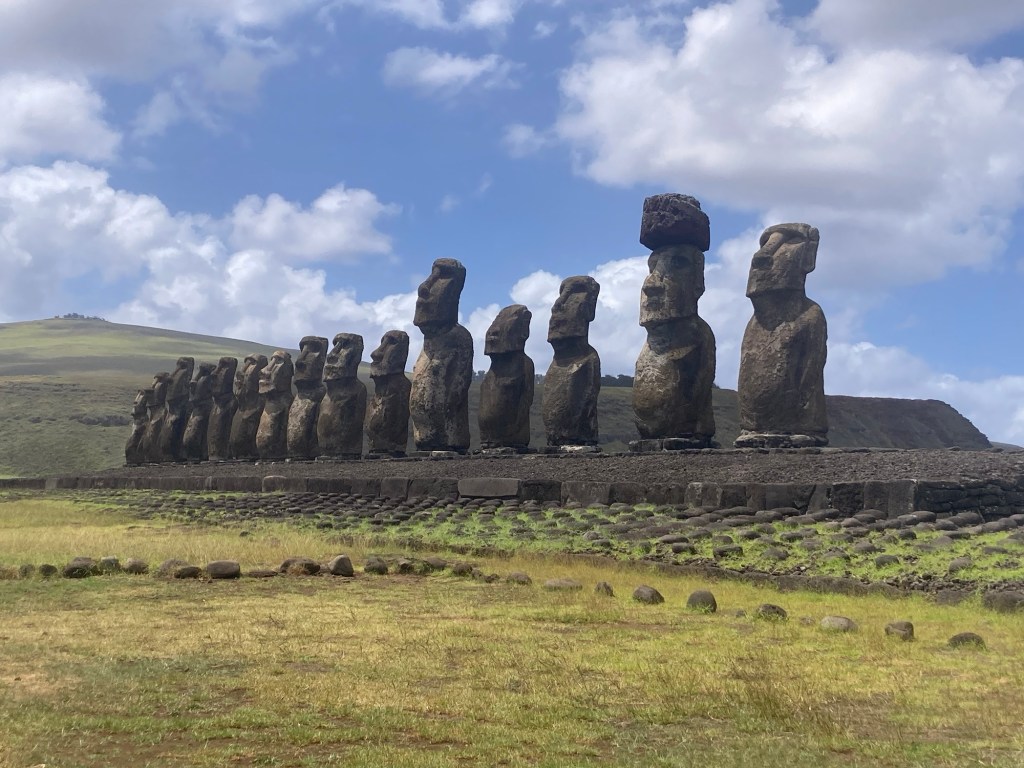
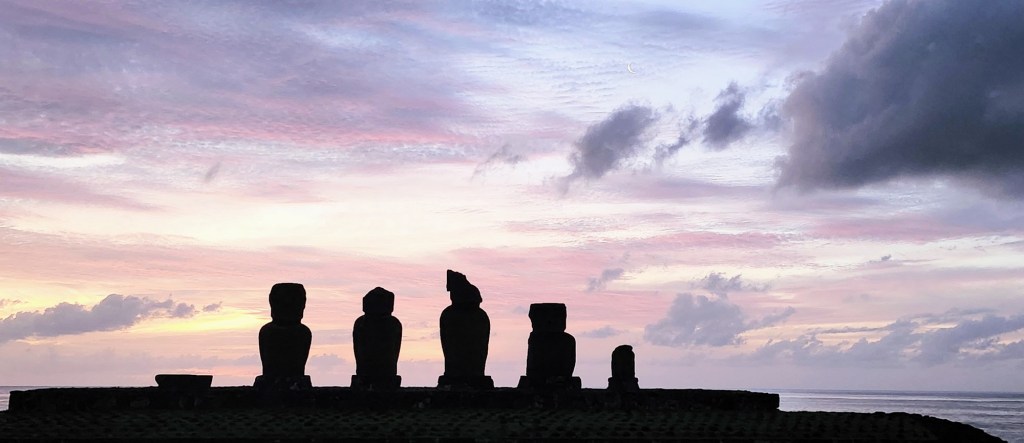
The Rapa Nui are most famous for the Moai they carved. Ranging from 1 meter to 20 meters high, they were carved from local tuff with features resembling a revered ancestor and placed on Ahus, or platforms facing the village to guide and protect the villagers:
The Moai were mostly carved from a single quarry; some which didn’t make it to an Ahu rest on the quarry’s slopes:

How they made it to the Ahu is hotly debated. Some suggest the Moai were rolled on logs, but the local legend is that they’ve “walked”, likely being rolled from side to side. The Moai on the quarry all have their eyes closed; it was only once the Moai made it to their resting place on the Ahu that their eyes were carved open and a piece of coral placed in the socket.
The golden age of Moai carving lasted until about 1700. Deforestation, caused by over logging, infestation by Polynesian rats and climate change wreaked havoc on the island. Agriculture became difficult, fishing was reduced by the smaller boats and water became scarce. The tribes started fighting over the limited resources, toppling their enemies’ Moai as a sign of disrespect for the villages’ ancestors.
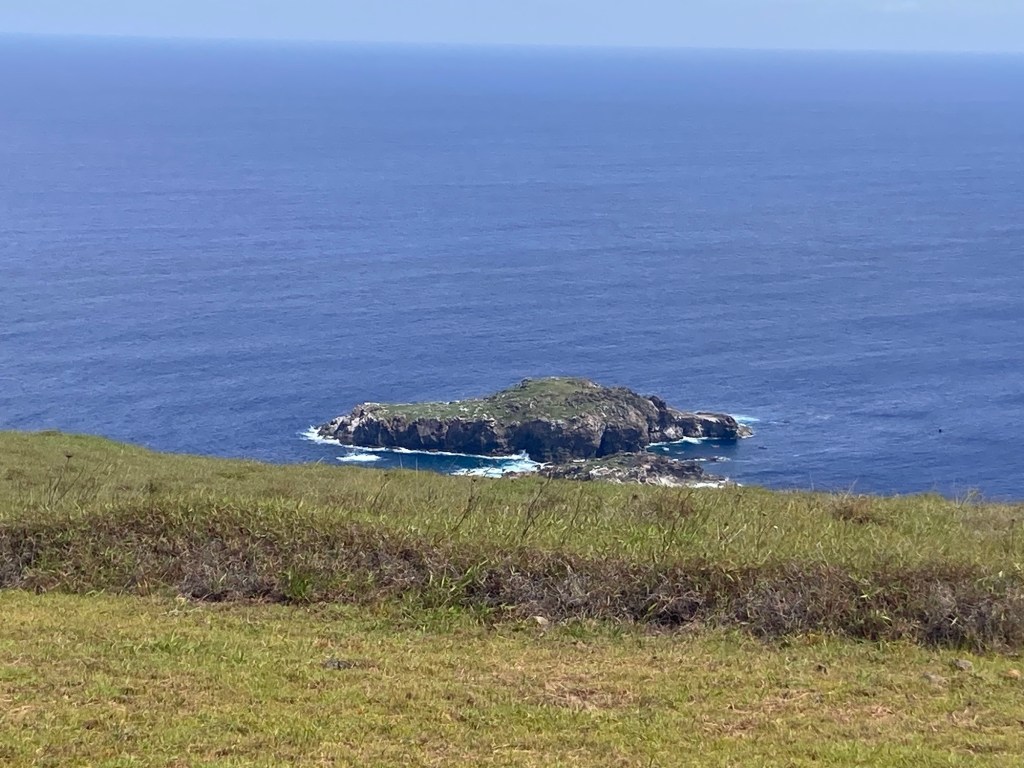
The religion manifested by the Moais ended abruptly ( and without explanation we know of) to be replaced by the Birdman cult in about 1700. Every spring, a man was chosen from each tribe to compete in a race requiring descending a high cliff, swimming about 1.5 kilometres to a nearby island, retrieving the egg of a term and returning back to Rapa Nui, egg intact. The winner’s tribe would select the religious and political leader for the year.
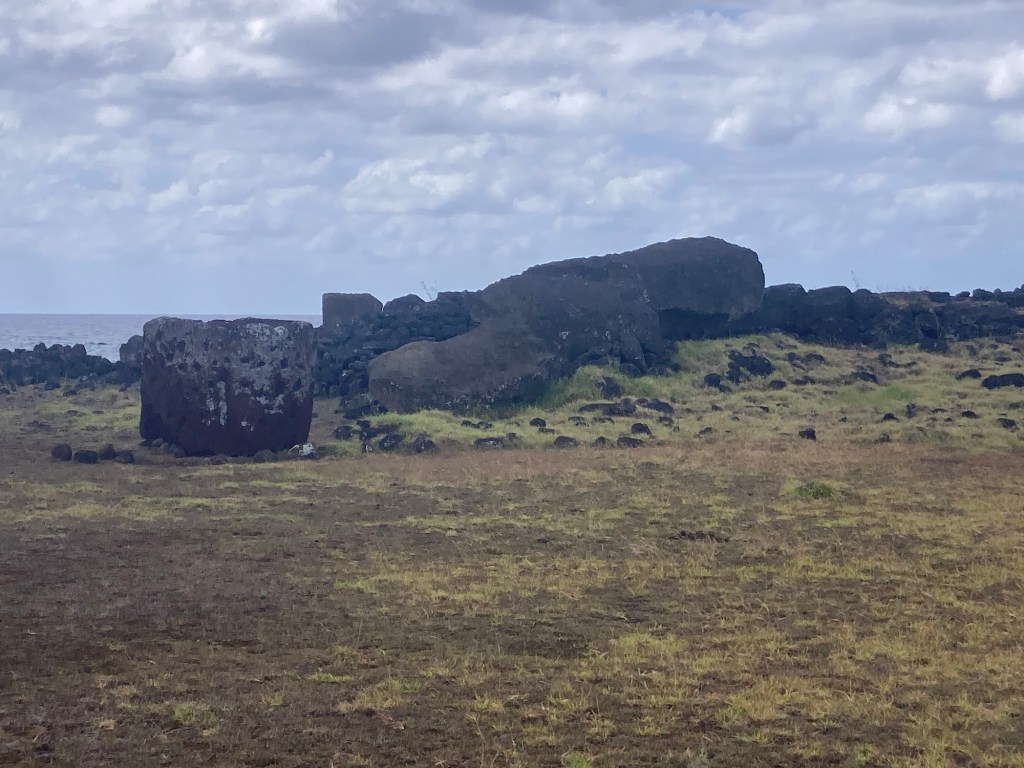
But the Birdman didn’t resolve all the issues. The Dutch sailed by in 1722 on Easter Day and Christened the place Easter Island. The Spanish dropped by and in 1782, Captain Cook stopped on the island. He noted that many of the Moai had been toppled, but not all. By 1822, the largest and last Moai was toppled:
In the 1860’s, missionaries arrived, christianizing the Rapa Nui, eliminating the Birdman and re-instating the king. Peruvian slave traders kidnapped hundreds of locals and introduced disease to the island. In 1888, the king signed a treaty with Chile, ceding the lands to Chile.
Over the next 75 years things went from bad to worse for the Rapa Nui. The Chileans leased most of the land to a commercial farming enterprise, with the result that all the Rapa Nui were confined to the single town on the island, Hanga Rua, and subjected to a permit system which prevented them from leaving the island.
Things started improving in the late 1950s. A runway provided for better connectivity, the people were granted Chilean citizenship in 1966 and the permit system abolished. Thor Heyerdahl came and started re-erecting many of the fallen Moai:
Tourism has become the main economic focus. Certified Rapa Nui guides are required to visit most of the archeological sites, only Rapa Nui are permitted to own land, Chileans May only stay up to 30 days on the island and the Rapa Nui language is taught as a second language in the primary schools.
It’s a fascinating place. While it may have started as a paradise where innovation and hard work overcame local resource and environmental issues, the self-destruction of the Moai by the warring tribes is a stark reminder of how easily man can destroy what he has built.
I was going to end by saying after 4 days, we flew back to Santiago but, alas, our return flight had problems ( your guess is as good as mine) and the Chilean airline company, LATAM, the only airline flying here, left most of its 300 passengers in a lurch, simply telling us to find our own accommodation on an island notorious for limited hotel options, and to come back the next day for another flight.
Luckily, some cajoling, lots of tears and a kind hearted lady who offered to room with her son saw us with a room back at our original hotel. This despite LATAM having booked all the rooms there 3 hours before officially cancelling the flight! Needless to say. LATAM is quickly becoming my least favourite airline.
But alls well that ends well and so, back to mainland Chile.
 travelsnearlyeverywhere.com
Wow!! An experience and adventure that you will always remember. Your description of the island’s history and landscape make me feel as if I joined you.
Ellen
LikeLike