
One of the things I love about retirement travel is my ability to add detours to itineraries just to see something of interest. My foray into Turkey, and my flight to Sanliurfa to see Gobleki Tepe fit the bill.
Let me begin by explaining the allure of Gobleki Tepe. For centuries, historians, archeologists, anthropologists, just about everyone, concluded that civilization (another controversial topic but let’s call it large settlements, stratification of work and classes and some sort of communal administration) only began after Homo sapiens discovered agriculture, settled and had food security so people could devote their time to other matters like religion, trade and inventing useful stuff like pottery. Timing for this agricultural revolution depended on the region but the earliest is considered about 8,500 BC.
Prior to this, the academics said, Homo sapiens were hunter gatherers, living nomadic lifestyles following the herds. Settlements were small, maybe 50 people, and might be huts or lean-tos, very primitive with no evidence of communal buildings. If there was a religion, it focused on animism, a connection with the natural world.
These “truths” were taught in schools; , it was what I learned in my history classes in university in the late 1970’s. They were logical, nothing existed to the contrary, so they must be correct.
And then, in 1994, Gobleki Tepe was discovered. Translated from Turkish as “pot-bellied mound”, the hill was known for years to contain ruins but assumed to be a Byzantine cemetery. A German archaeologist named Klaus Schmidt decided to explore the hill a little deeper and, to the world’s astonishment, unearthed giant monolithic structures that date to 10,000 -8,500 BC, at least 4,000 years before humans were supposed to be able to construct anything of this magnitude.
Not only that, but these builders were hunter gatherers who managed to organize hundreds if not thousands of people to quarry the limestone, move monoliths over 6 meters high and weighing 4-6 tons from nearby quarries without benefit of wheels, then create over 20 circular structures, ornately decorated, painted and perhaps roofed.
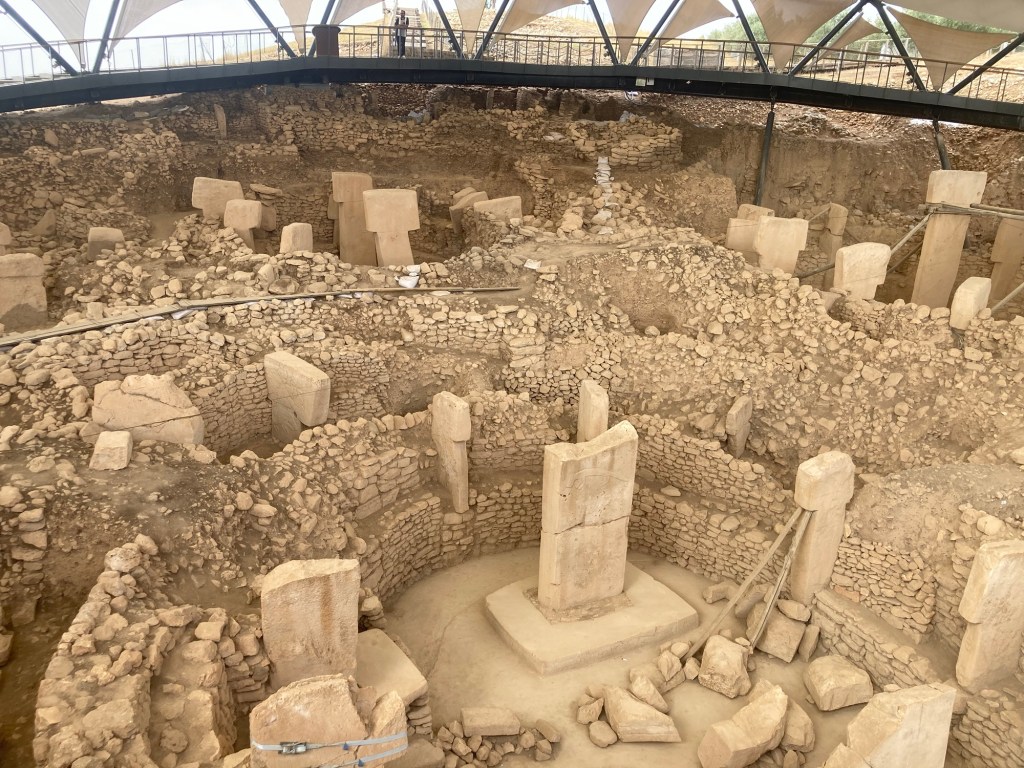
History had to be reconsidered in light of this discovery. Hunter-gatherers were capable of coming together and organizing large projects, capable of producing grand structures and for 1500 years, came in large numbers to Gobleki Tepe to gather, contrary to all accepted knowledge.
There are doubters. The most famous, a YouTuber named Graham Hancock, proposes that a long distant civilization, maybe Atlantis, survived the last ice age and either built Gobleki Tepe themselves or instructed the hunter- gatherers how to build the site. Others believe aliens came and built it. No one is really sure who built it but I don’t subscribe to the alien theory.
Nor is it known why. Some of the giant monoliths line up with the night stars, so perhaps it was an observatory of sorts. Many of the sculptures depict animals, so maybe it was a place of animism worship. Many of the human sculptures have outsized phallic elements, so it could have been a place where marriages were made. No one knows.
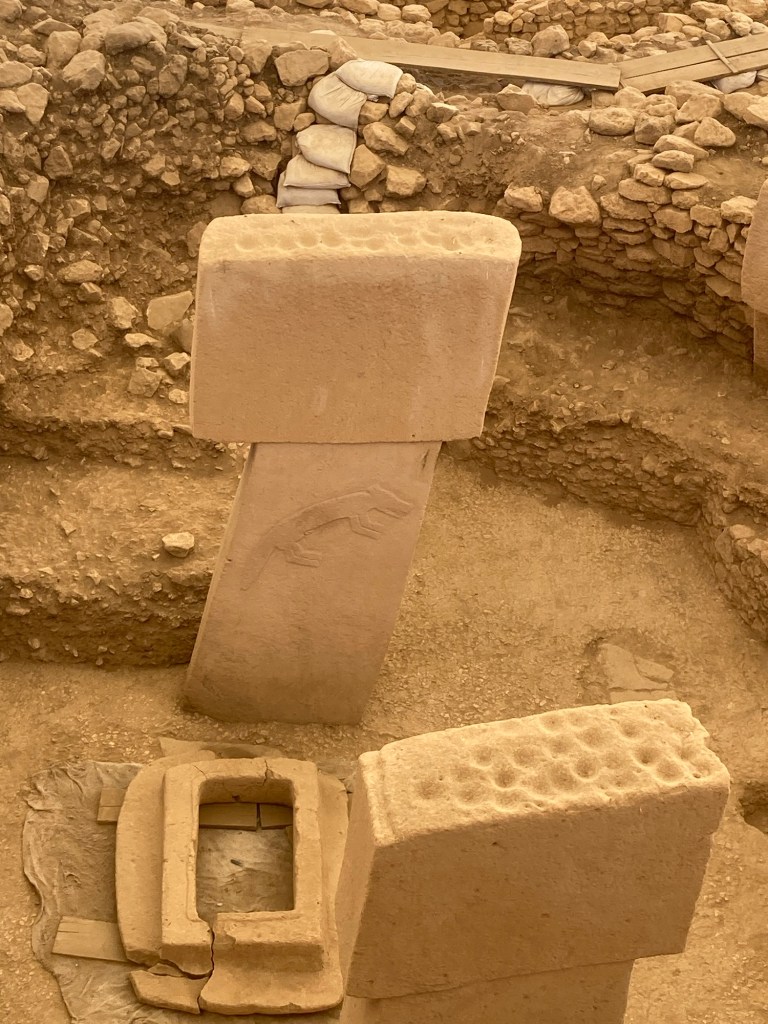
After Gobleki Tepe was excavated, archeologists discovered numerous more Palaeolithic settlements nearby, some with similar monolithic structures, some with residential buildings, some 1,000 years older. History must be rewritten again.
So I came to Gobleki Tepe to wonder what other “truths” are perhaps wrong. Maybe humans could fly 50,000 years ago. Maybe the Chinese discovered North America before the Vikings and Columbus. Maybe….well I could go on but you get the idea.
Sadly, my story of Gobleki Tepi ends on a discouraging note. Only 5% of the 120 acre site has been excavated. Underground radar has established at least 20 more megalithic circles still buried. But in 2020, the Turkish government turned over management of the site to a private group, who have prioritized profits over knowledge. To make the site more accessible to tourists, asphalt roads were constructed and a wooden walkway erected with metal poles indiscriminately stuck into the ground for support without regard to the damage caused to the structures below.
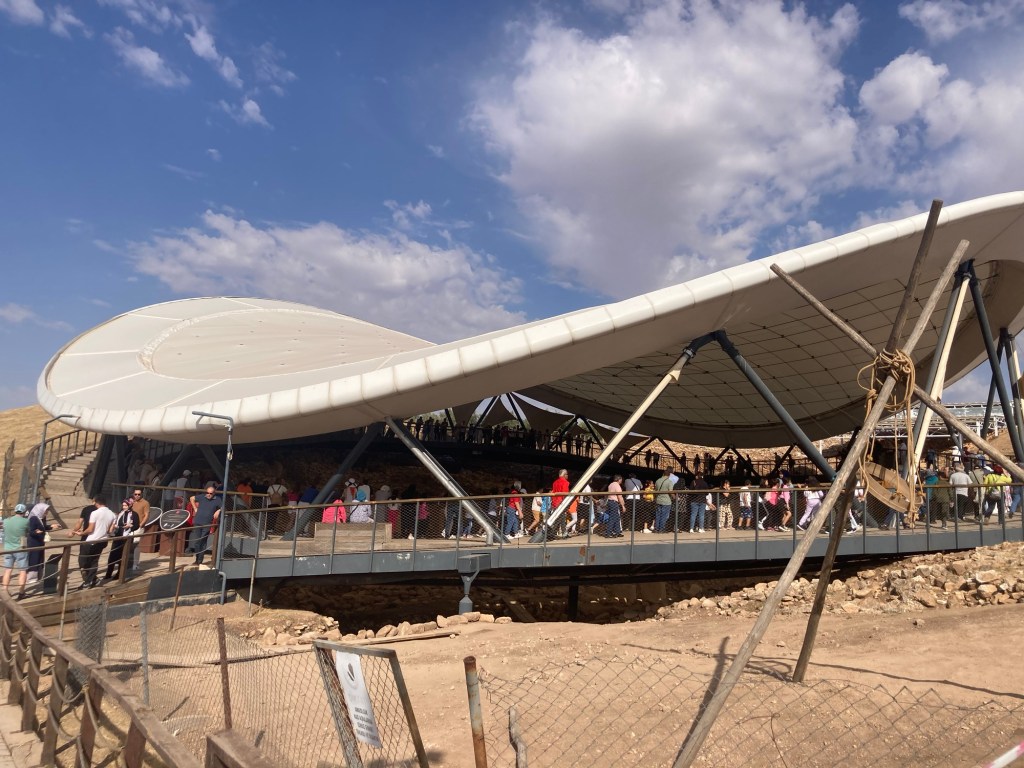
While I appreciate the ease of traversing the site the walkways and roads bring, I deplore that such conveniences for tourists are being done at the expense of destroying Gobleki Tepe and limiting the archeologists’ work. This place is an important part of human history, a rare treasure, not a paleolithic Disneyland.
Next: Balkan trains
 travelsnearlyeverywhere.com
I am ashamed to say that I had never heard of Gobleki and it sounds absolutely fantastic. From your description of the history it should be a Unesco site and compared to Pompei and Stone Henge. I am going to put this on my bucket list to visit. Do you think it could be developed into another site like the Terra Cotta Soldiers in China. I have been to Ephasus and am disappointed that Gobleki is not being restored by the Turks in the same manner.
LikeLike
glad you enjoyed the blog. I’m happy I went to Gobleki Tepe, but very mixed feelings about Turkey, mostly involving dishonest taxi drivers n
LikeLike