Who ever heard of Lesotho?

Those were the words uttered by US president Donald Trump as he criticized USA aid to this small African country in a speech to the Congress on March 6, 2025.

As I was in Lesotho at the time, I can say I had heard of it. I had arrived in the capital, Maseru, and was looking forward to a few relaxing days in nice, hot weather and learning a little bit about this not very often visited country.

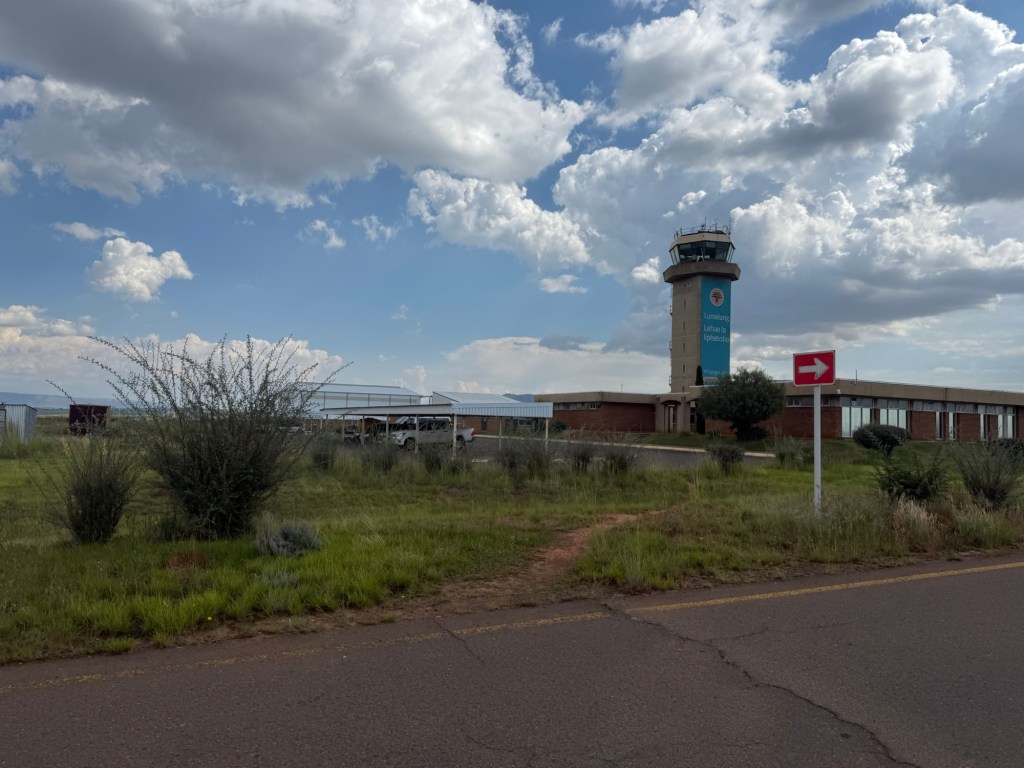
There’s only one international airport in the country, at its capital Maseru, and there’s usually only three Embraer flights a day coming from South Africa carrying 20 to 30 people each. The international airport has only one arrival and departure gate.

Going through immigration, I had to fill out paper forms, something I don’t think I have done in five years. But clearing immigration was quick, my bag arrived swiftly, and the single shuttle that would ferry passengers into town was waiting outside.

Maseru airport

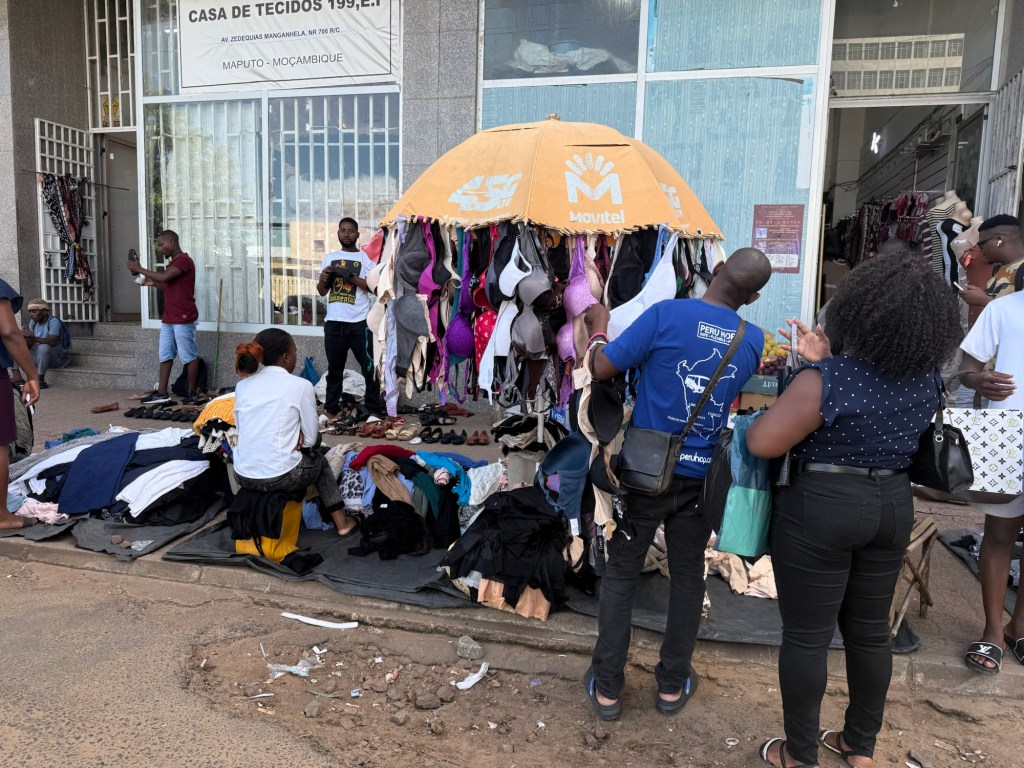
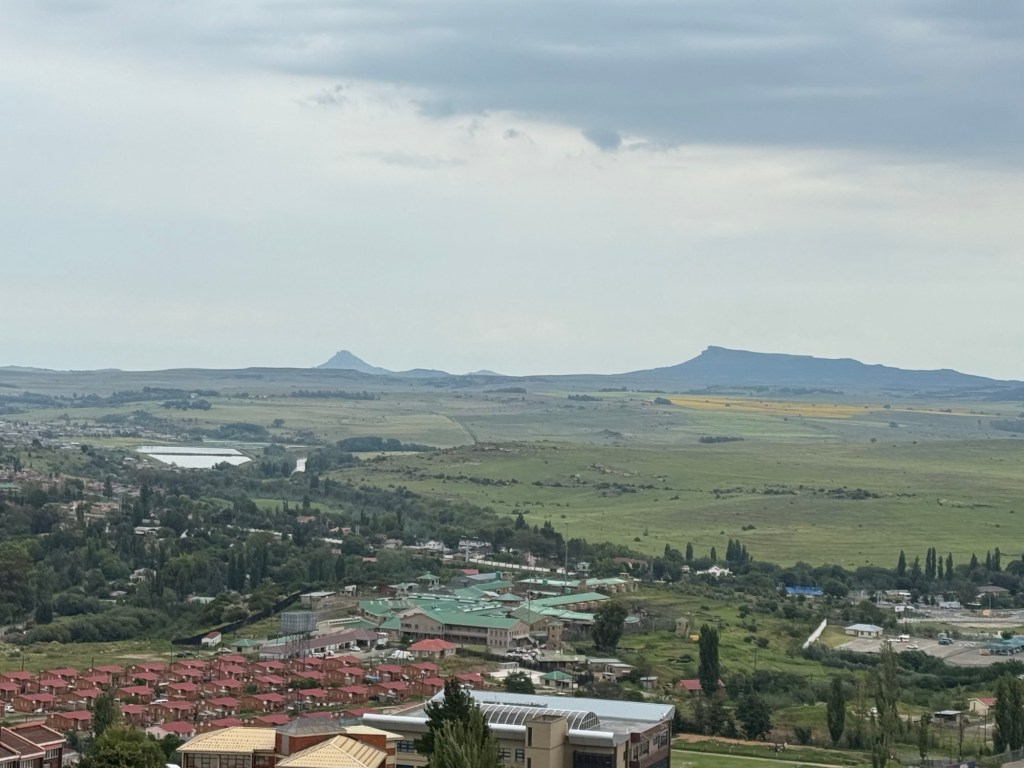
Mesero reminded me of any large African city, with people walking along roads lined with corrugated metal stalls selling all manner of goods and SIM card. Vendors were hawking corn, grapes, and bananas. Sheep and the occasional cattle herd crossed the road in front of us. But it was all very relaxed; the two traffic lights we encountered were not working, but everybody proceeded through in a very polite and orderly manner.

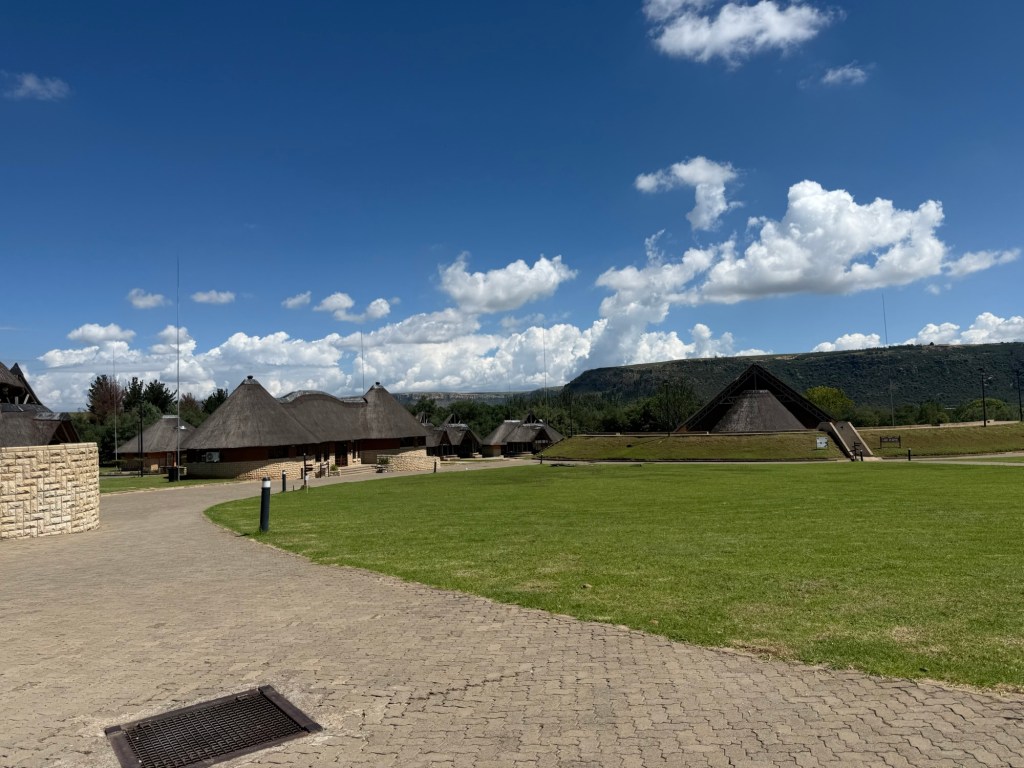
To learn more about the country, I visited the Thaba Bosiu cultural center, both a living museum and the site where the country’s greatest king settled.

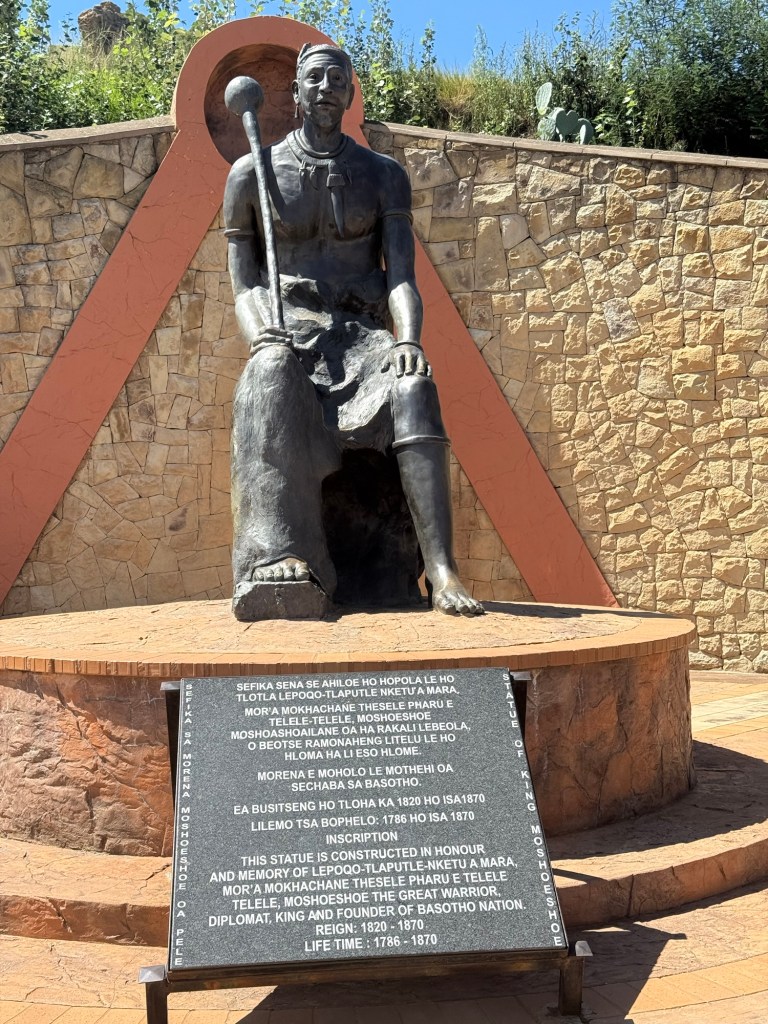
Statue of King Moshoeshoe

King Moshoeshoe is regarded as the first king. Born in the late 1780’s he gained notoriety for uniting the various Besotho tribes and, together, they repelled many of the Zulu tribes from Bosotho lands in the south of Africa. The Besotho then turned to harassing the Boer invaders who were trying to establish farms on traditional Besotho lands which, at the time, included much of the present day Cape in South Africa. To assist with their anti-Boer activities, King Moshoeshoe signed a treaty with the British in 1843 agreeing to combat the Boers.

More treaties with the British ensued, the upshot being that the Besotho gave up claims to much of their land, but became a British protectorate in 1868. King Moshoeshoe eventually settled on a plateau outside present day Mesero called Thaba Bosiu

. While nothing remains of the original city, its location has been repurposed as both a cultural center and where the country’s largest celebration of independence is held:

Thaba Bosiu

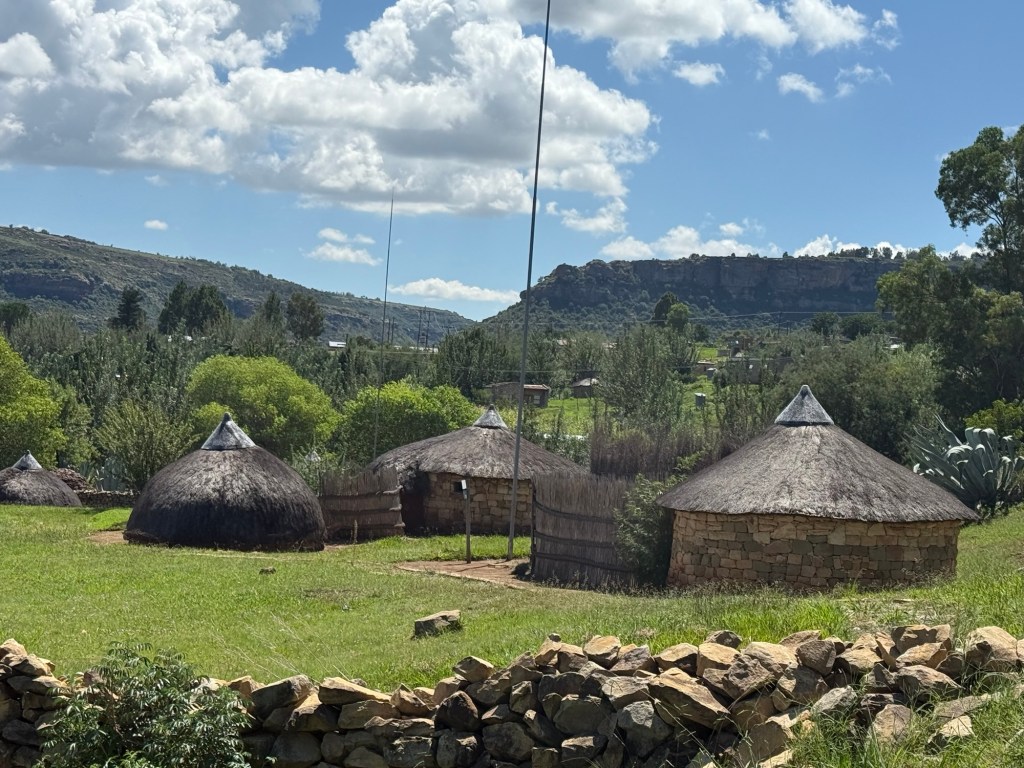
One of the features of Basotho society was polygamy. King Moshoeshoe had 140 wives, each having their own compound with a sleeping hut, a kitchen hut and a third one for the children. Polygamy was seen as necessary due to the high death rate of men during their numerous battles.

Wives’ Compounds

Lesotho gained independence from Britain in 1966 and has retained it status as a kingdom ever since. As it was never part of South Africa, it never endured the horrors of apartheid. Although notionally a constitutional monarchy, there were conflicts between the monarch, the government and the army since independence. During violent civil unrest and disputed elections in 1999, South Africa and Botswana defence forces were “invited in” and eventually restored peace, They withdrew a year later and peace, more or less, had endured since.

The majority of Lesotho’s 2 million inhabitants are subsistence farmers. Diamond mines provide good jobs, but are majority owned by foreigners with the Lesotho government maintaining only a 30% interest in all of the mines.

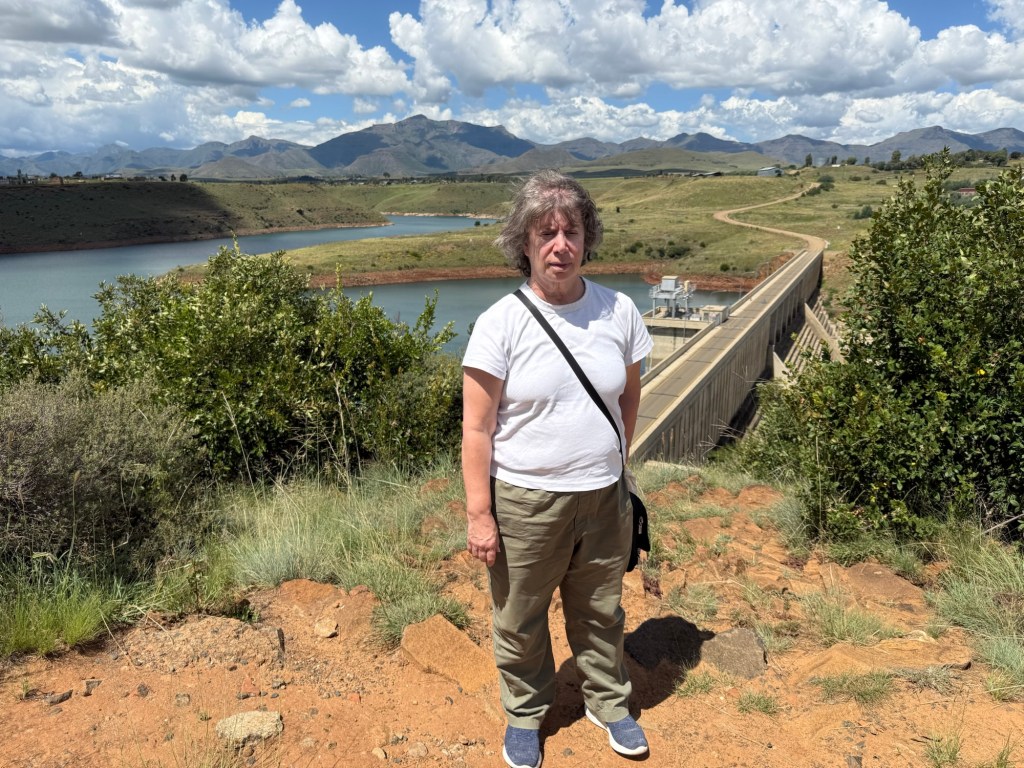
Another economic source are Lesotho rivers and giant hydroelectric dams, which provide both water and electricity to South Africa. I visited the Mohale dam, which is in the lowlands:

Mohale Dam

Lesotho is known as the Mountain Kingdom because its average altitude is 2000 metres or 7000 feet above sea level. A ski resort is in the mountains, but given my dislike of anything to do with snow, it was not on my list of things to see.
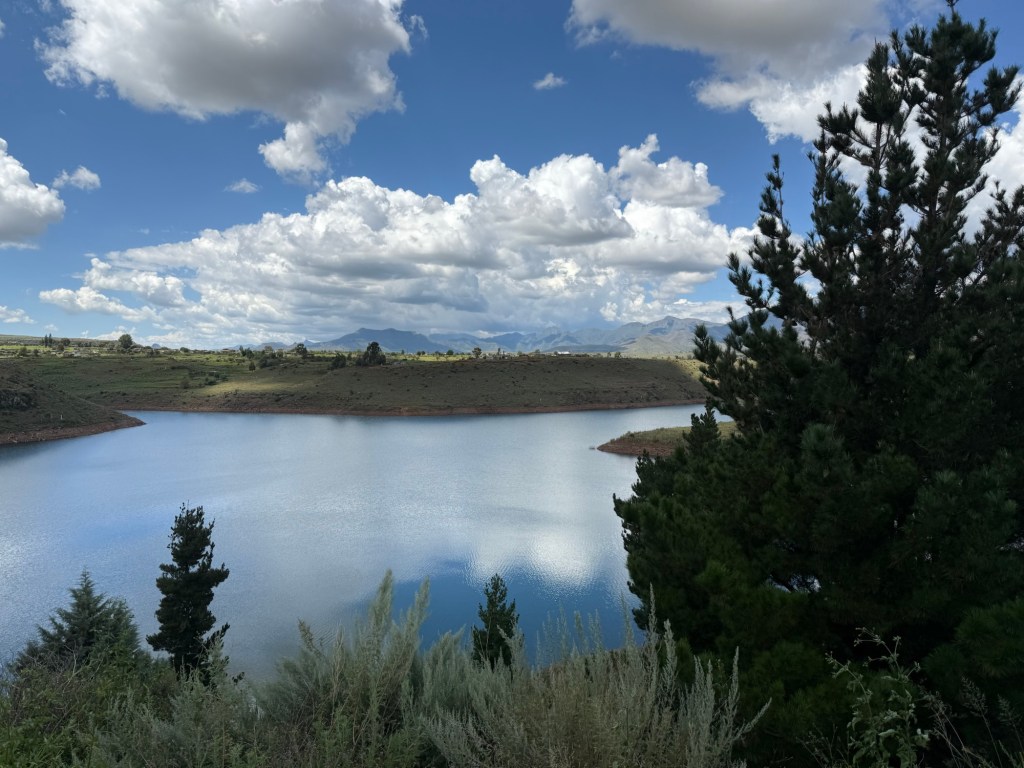
The few tourists who do come to Lesotho often come to hike in its stunning mountains, verdant forests and numerous waterfalls, but as I don’t really enjoy hiking, I was content to stay in the city. Even there, the greenery of the country was evident:

Lesotho

But it would be wrong to paint Lesotho as a garden paradise. It has one of the lowest life expectancy rates in the world, primarily due to the AIDS-HIV epidemic. As many as 25% of the population over 18 is infected, although that rate is going down, thanks in large part to extensive donations by the US government for education and medication. I do not know if Trump’s cuts to foreign aid will eliminate this source of funds but I’m sure he doesn’t care about a bunch of Africans in a country he doesn’t think most people have heard of.

I don’t want to end this blog on a down note, so I will relate my favourite memory of my time here. Like in France, it is considered rude to pass someone without an acknowledgment, a simple “hello, how are you”. Everywhere in Lesotho, this simple act of greeting people ( in elevators, in cabs, waiters in restaurants, guides) opened up conversations with so many people. As English is an official language, communication was easy. And talk I did, about people’s opinion of their country, of Trump, of the government ( corrupt), of business opportunities, best food to try ( trout from the rivers), etc. I know I’ve described lots of countries as having friendly people, but Lesotho was full of very friendly, kind people always eager to help or converse. It’s a shame nobody has ever heard of it, because it’s lovely.

Next: another under visited country in Africa.

Solo travelling in Saudi Arabia

Eight years ago, I would not have been able to travel to Saudia Arabia or, as a woman, drive a car in the country. But the rules have changed and Saudi Arabia is now welcoming tourists and permitting women to drive. Yes, advances have been made and travelling there is relatively simple, but Western tourism is still in its infancy and there’s room for improvement.

First, the prohibitions. No alcohol, period. The country is completely dry. My carry-on bags were inspected on entry to ensure I had no alcohol. But I’m not sure if my checked bag was somehow X-rayed. It didn’t matter; I had resigned myself to no alcohol for the duration.

Western women are permitted to have their hair and face exposed but must dress modestly; no skin showing below the neck. To prepare, I’d had a hip length tunic made, packed lightweight long pants and a scarf. They all turned out to be unnecessary as the temperatures were extremely cold- generally not exceeding 17 degrees- so I, like most everyone else, wore my parka and loose jeans, with no skin showing except my face, which was okay to not offend Saudi standards. As I didn’t visit any mosques, the scarf was not needed.

I was also there during Ramadan, the month when Muslims do not let anything, like food or water, pass their lips during daylight hours. Except in airplanes, airports and at Western tourist sites, I was strongly encouraged not to eat or drink in public, but it wasn’t much of a hardship. Bathroom stalls were useful for grabbing a sip of water and the hotels, whose restaurants were closed, offered room service throughout the day.

I started in Riyadh, the capital city with a population of about 15 million. Immigration was simple, especially with my e-visa acquired on-line, but slow as all foreigners were fingerprinted and photographed. As I had no pre-arranged transfer from the airport, I was met by a barrage of taxi drivers all vying for my custom even before I exited the airport. I eventually made my way to a pre-paid taxi booth, paid with a credit card and got into the taxi.

This was my first introduction to Riyadh traffic, which is terrible. The city of 15 million has traffic infrastructure for 1 million. An Uber ride to the At-Turaif UNESCO heritage site took 15 minutes going there, but 2 hours returning. The drivers are uniformly aggressive and impatient. Lanes and stop signs are routinely ignored. If a car actually stops at a red light, every car behind it starts honking as soon as the light turns green. It’s not for the faint- hearted, but at least Uber was available.

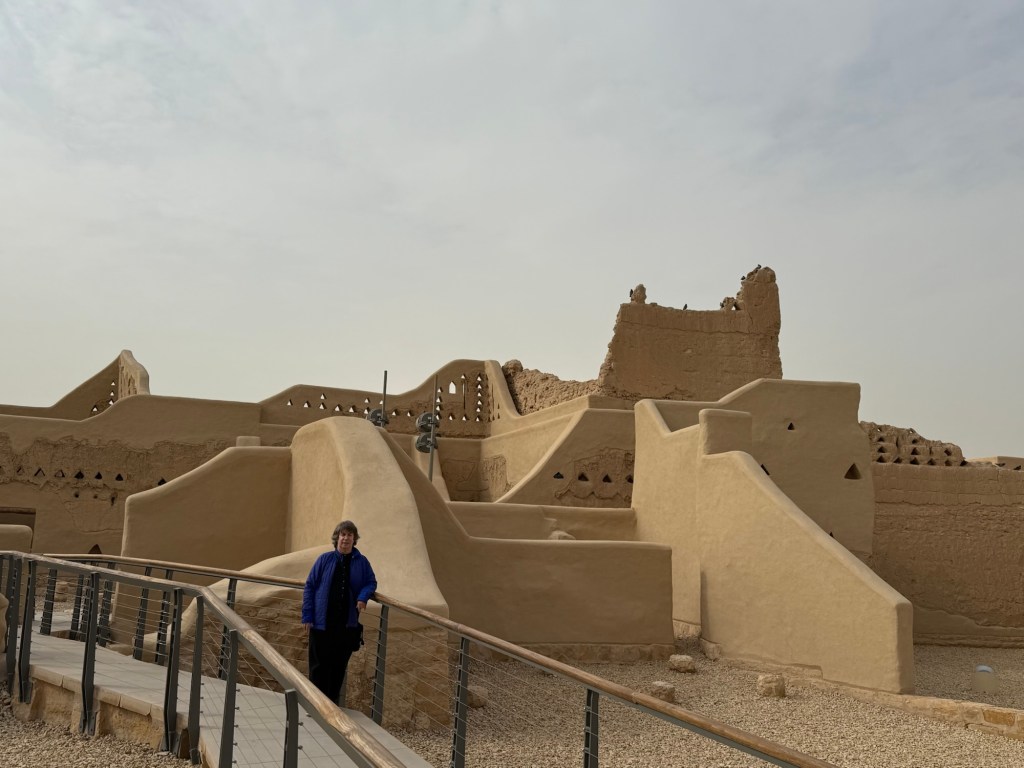
At-Turaif provides the origin story for Saudi Arabia. The Saudi’s were a tribe which settled in the southwest area in 1727 and built their capital in Al- Diriyah:

Former palace at Al-Diriyah

The first Saudi dynasty was born and captured most of the Arabian peninsula including Oman and Yemen. After a six year siege, in 1818, the Ottoman Turks, wanting possession of the holy cities of Mecca and Medina, took al-Diriyah, razed it to the ground and executed its King.

The second Saudi Dynasty ruled between 1824 and 1891, moving the capital to Riyadh, but beset by in-fighting, lasted only until 1891. The current dynasty began to rule in 1902, declared Saudi Arabia independent in 1932 and became very wealthy with the discovery of oil in 1938.

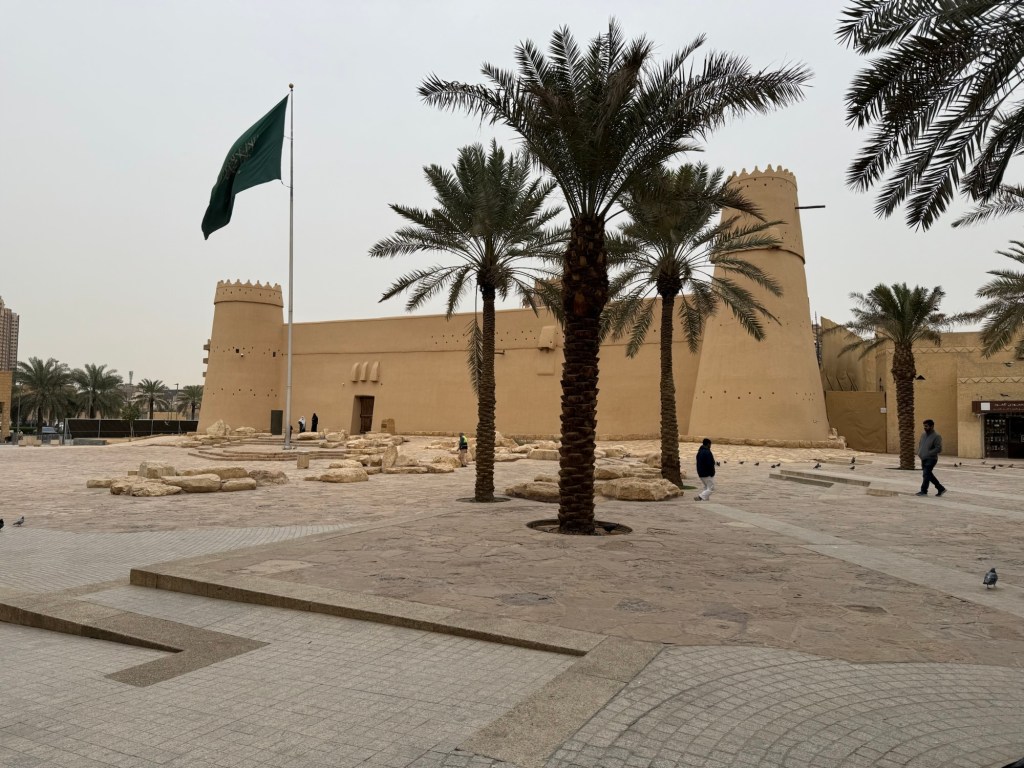
I tried to visit the historic Al Masmak fortress, whose website indicated it was open, but when I went there, it was firmly shut so the best I can do is provide a photo of its exterior:

Al Masmak fortress

Fortunately, for me, the Saudi National Museum was open. It contained informative exhibits about pre-Islamic Arabian civilizations who had inhabited the Peninsula and about the rise of Islam. However, if there were any exhibits post the rise of Islam, those exhibits were closed.

Riyadh has other sites appropriate for western tourist, like the Grand Mosque and the Boulevard Club, a sort of Epcot centre display of different cities from around the world and a dancing fountain, but I was hesitant to face Riyadh traffic again, so I passed on both.

AlUla is, to my mind, the gem of Saudi Arabia. It refers to both a desert area in the north east of the country and a city. I bravely arranged a rental car for myself, but the driving was easy as the roads are well maintained, and the drivers few and far between. Frustratingly, many of the road, signs, including the speed limits, are mostly all in Arabic, so I got lost a few times, but Google maps always led me eventually to the correct place.

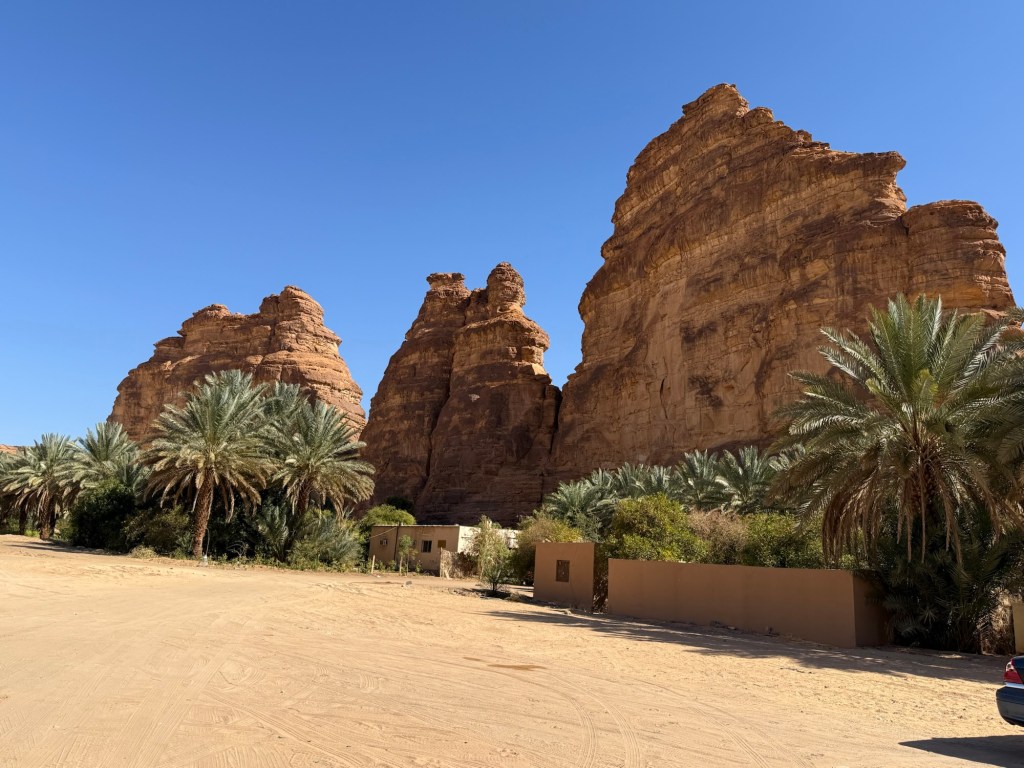
The area is nothing short of spectacular. Huge limestone mountains dot the landscape and date tree orchards are found near many of the oasis:

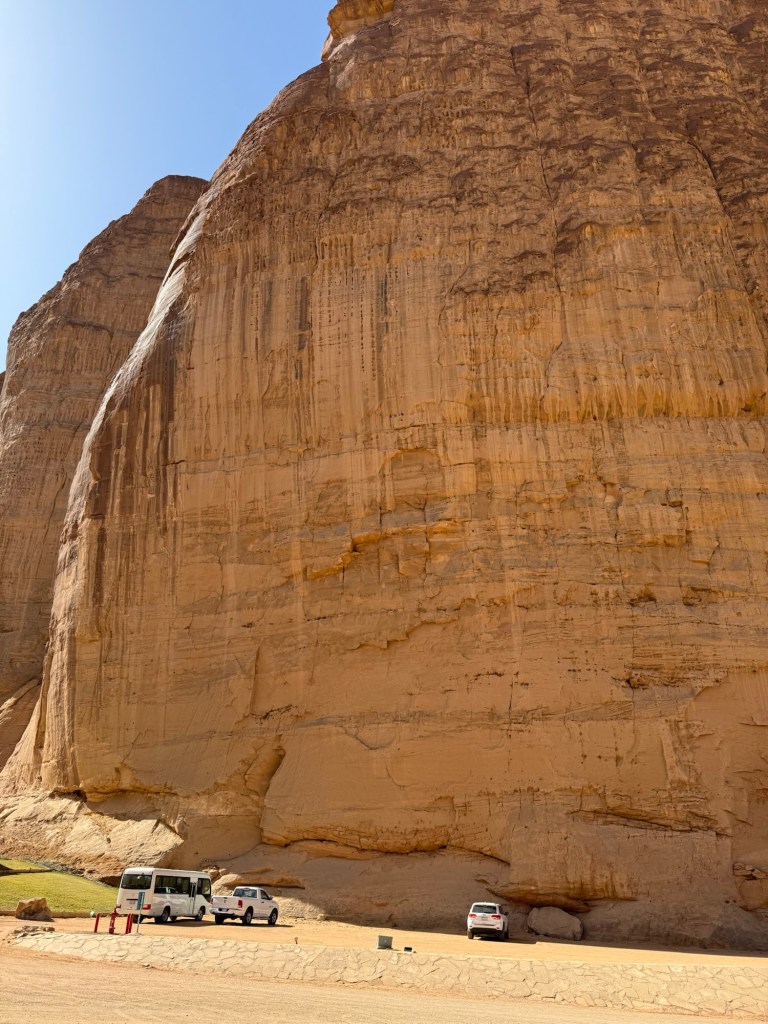
My hotel, the Shedan resort, is nestled amongst the limestone monoliths, with a parking lot adjacent to one of them:

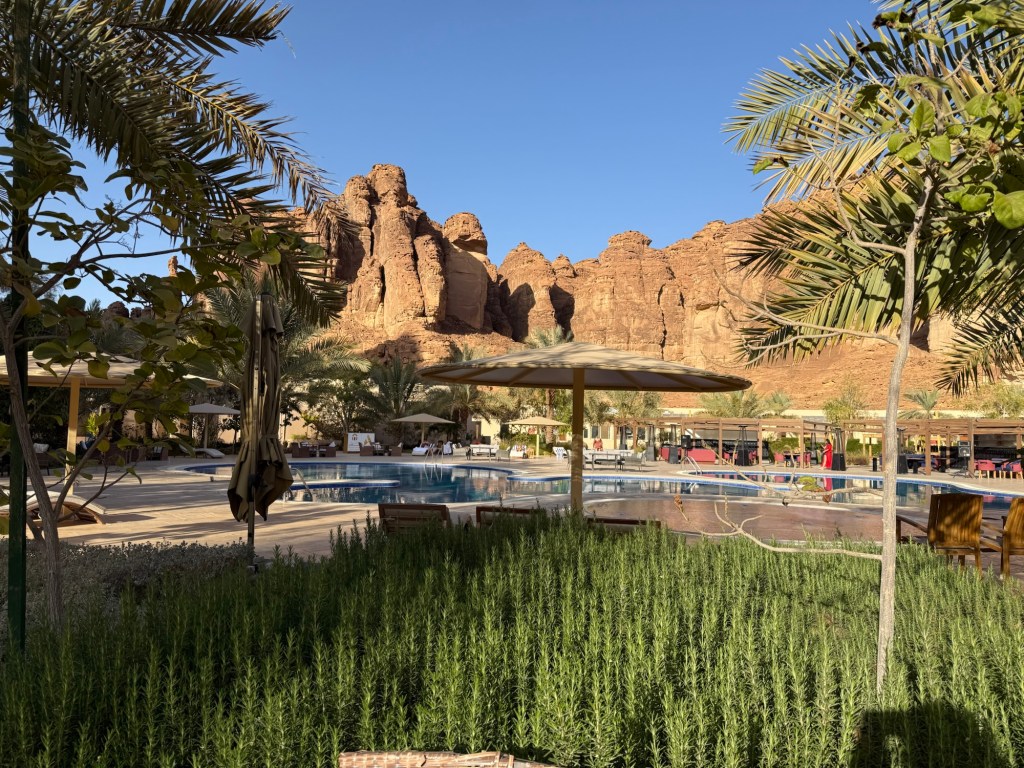
Alula attracts mostly western tourists. Although alcohol is not available, the rules are relaxed and women can freely wear bikinis if they so choose around the resort’s swimming pool:

Shedan swimming pool

I didn’t, not out of modesty, but because it was too cold, with the temperatures unseasonably cold – highs of 18 to 20° -with morning chills of only 8.

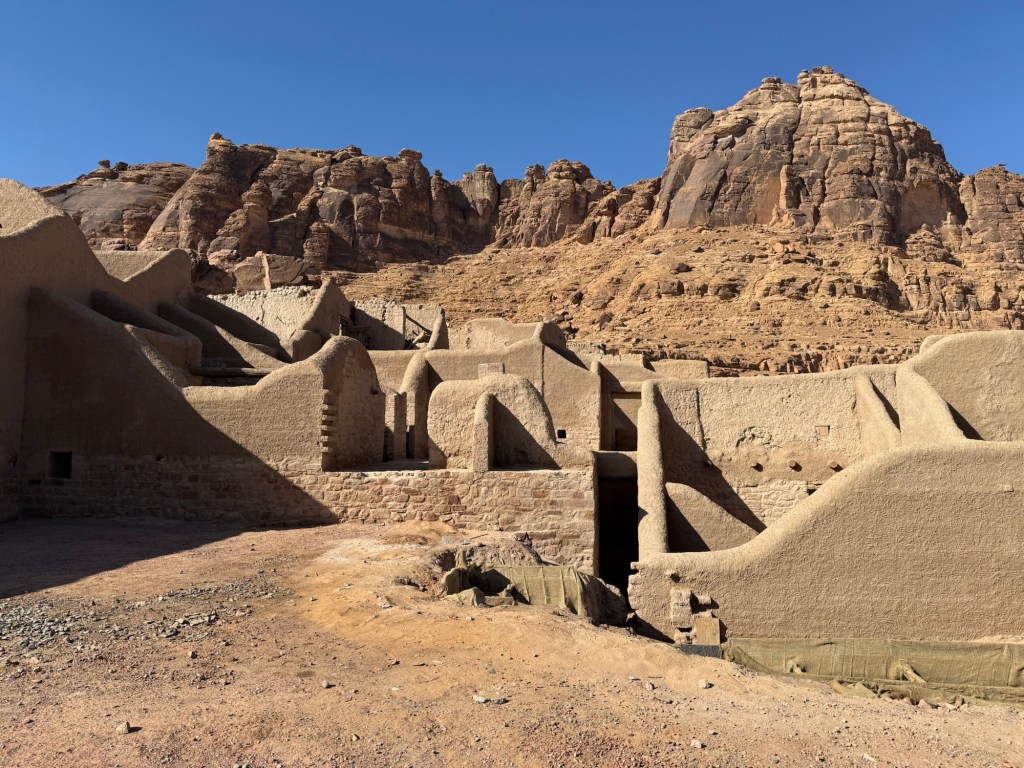
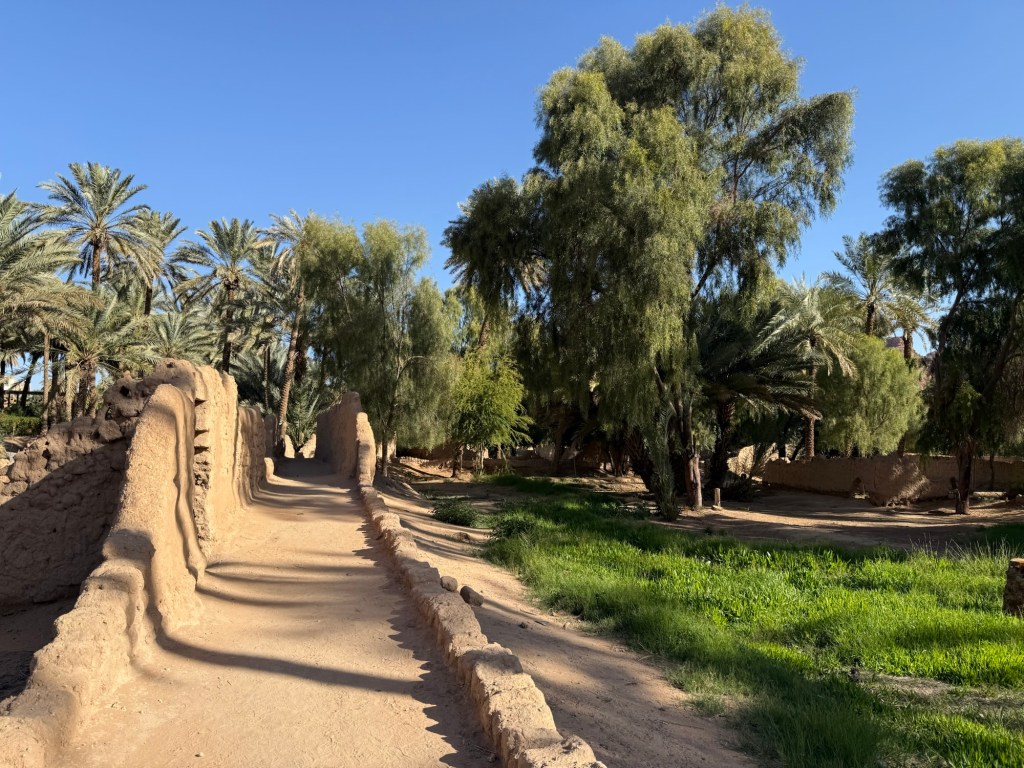
The old town of AlUla is a warren of mud brick houses, meandering alleyways, and a few public spaces with a mosque and a fort. It has been inhabited, mostly by Bedouin , for nearly 1000 years, but the Saudi government cleared out the last inhabitant in 1983.

AlUla old town

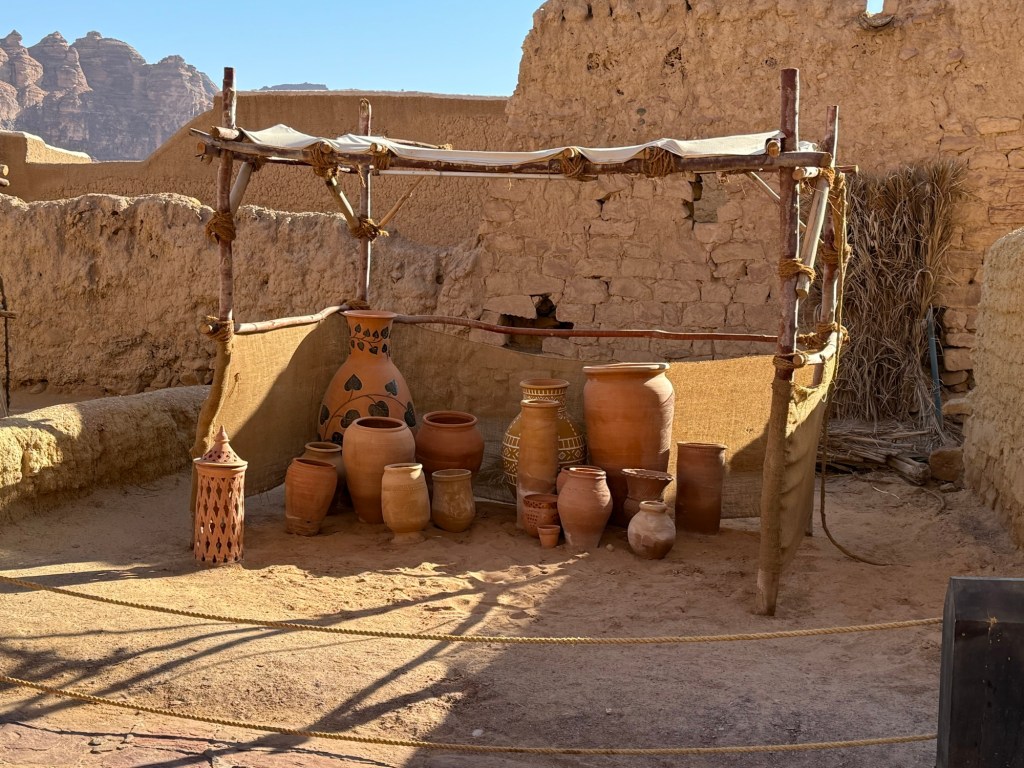
The Saudi government is renovating the area around the old town, with modern hotels, restaurants (Starbucks, Tim Hortons and a Dunkin’ Donut) and lots of souvenir shops showcasing local crafts:

AlUla

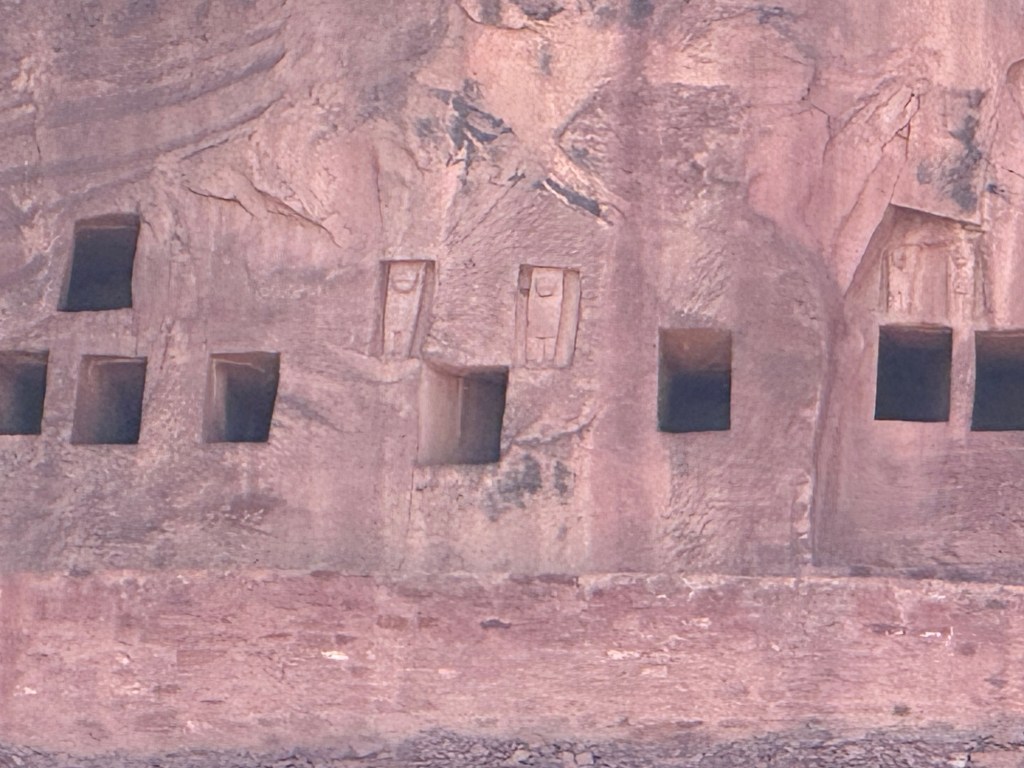
AlUla is located beside the ancient ruins of Daden, a civilization who occupied the area between the 8th and 1st century BC. The city is slowly being uncovered but over 100 rock carved tombs have been located in the mountains above:

Daden tombs

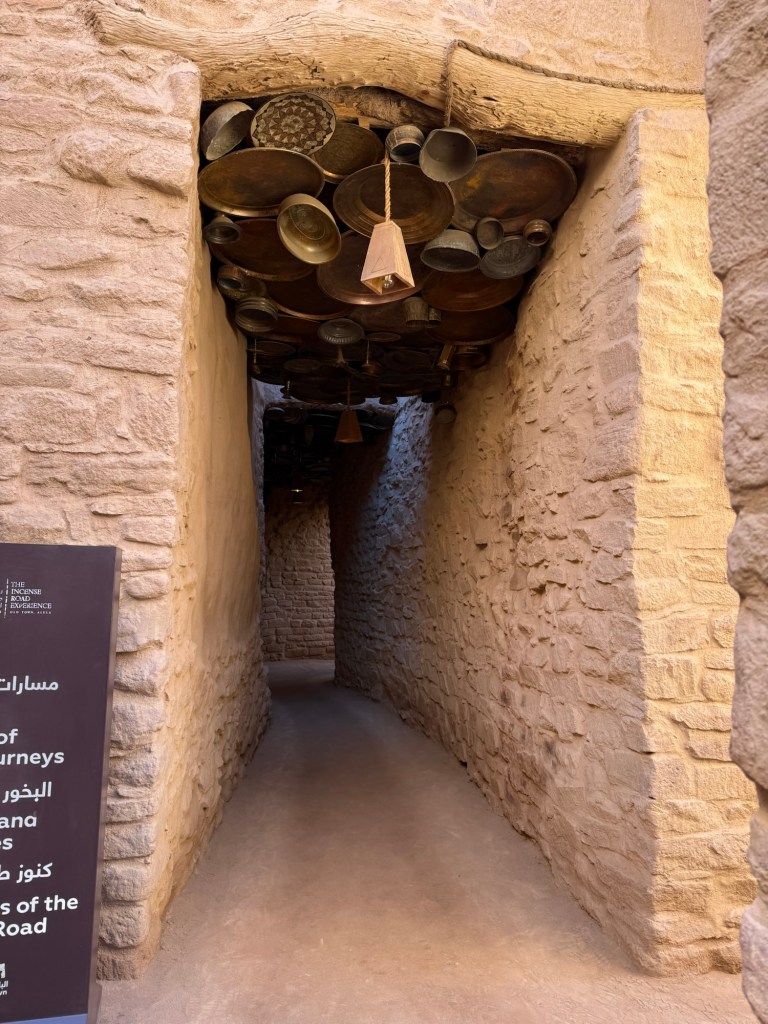
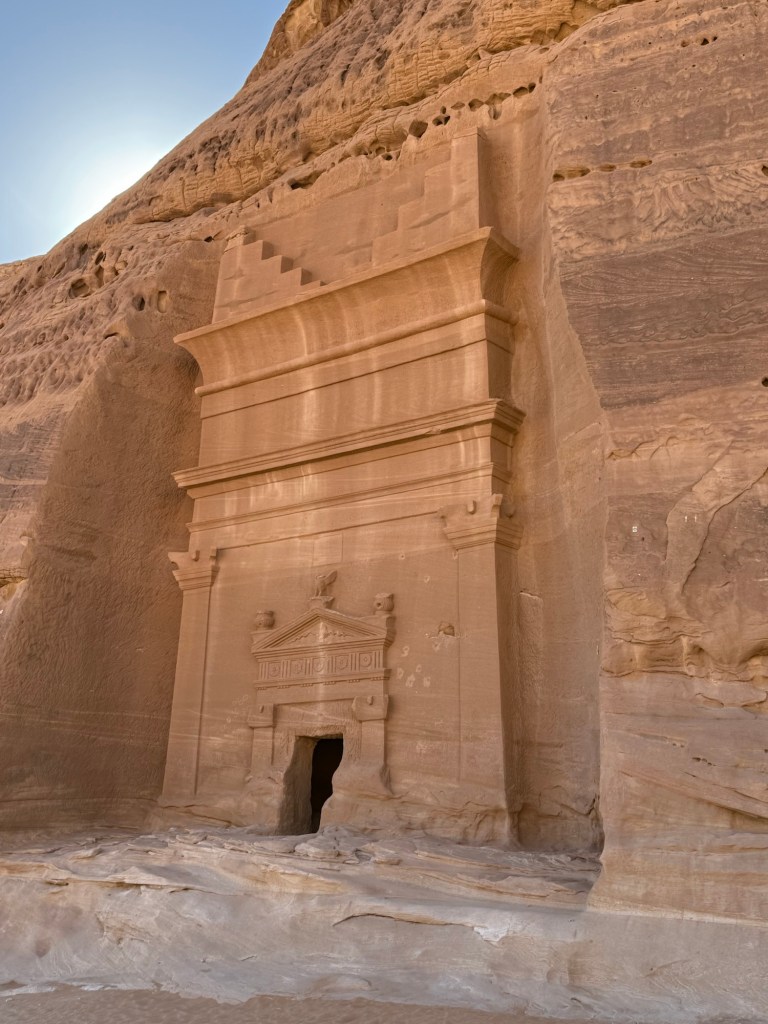
The real stars of the AlUla area are the Nabateans, a trading tribe more famous for its capital city of Petra in current day Jordan. They settled in the AlUla area because of its strategic location on the incense trading route and its plethora of spring water. Although their capital city of Hegra has been unearthed, it is underwhelming compared to its tombs:

Nabatean Tomb

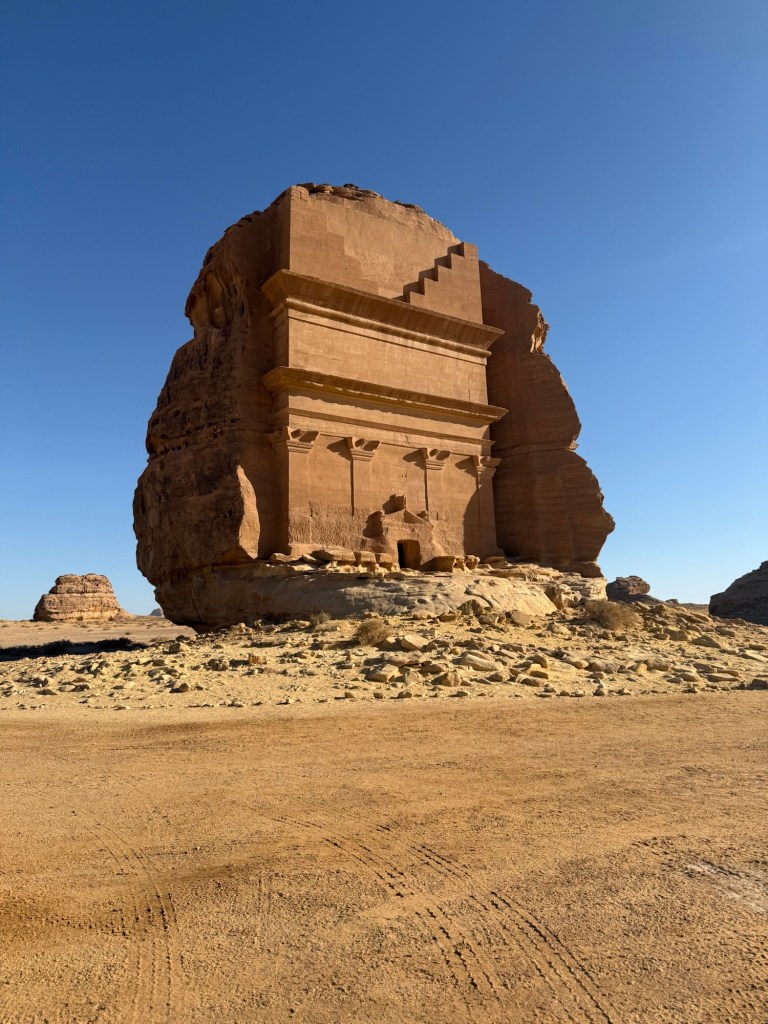
In Nabatean culture, the afterlife was far more important, so resources and energy were devoted to preparing for the afterlife rather than the current life. One of the most impressive tombs ( of over 100 discovered so far) is that named the Son of a Libyan King:

Nabatean Tomb

The whole area is wonderful, from fantastic rock formations:

to date oasis:

to unique limestone shapes, like the one coined Elephant Rock:

Elephant Rock

Interestingly, Muslims are discouraged from visiting AlUla. In the 7th century, the prophet Muhammad passed through and cursed it because its inhabitants were idolatrous. Due to this, it is said to be haunted.

And so ended my time in Saudi Arabia. What did I think? Mixed feelings. Everyone was very nice, English is widely spoken in the tourist areas and travelling was easy; Ubers, credit cards, the internet all worked easily. I loved the vastness of the AlUla landscapes and learning about Saudi history in the museum.

Yet, I never felt completely comfortable except in the security of my hotel room. Maybe it was my inability to read Arabic signs, maybe being the only Westerner in a sea of black abayas, maybe just the feeling that the Saudis had their own rule book and I was never sure if I was breaking them.

I’m glad I went, but was very happy to land in Addis Ababa, Ethiopia and have a glass of wine. It felt comfortable.

Next up: my lesser known countries of Southern Africa tour.

Bahrain Musings

I arrived in Bahrain one blustery afternoon, with everyone complaining about the bitter cold; the high was only 16 and it was rainy, not what I was expecting in this desert country.

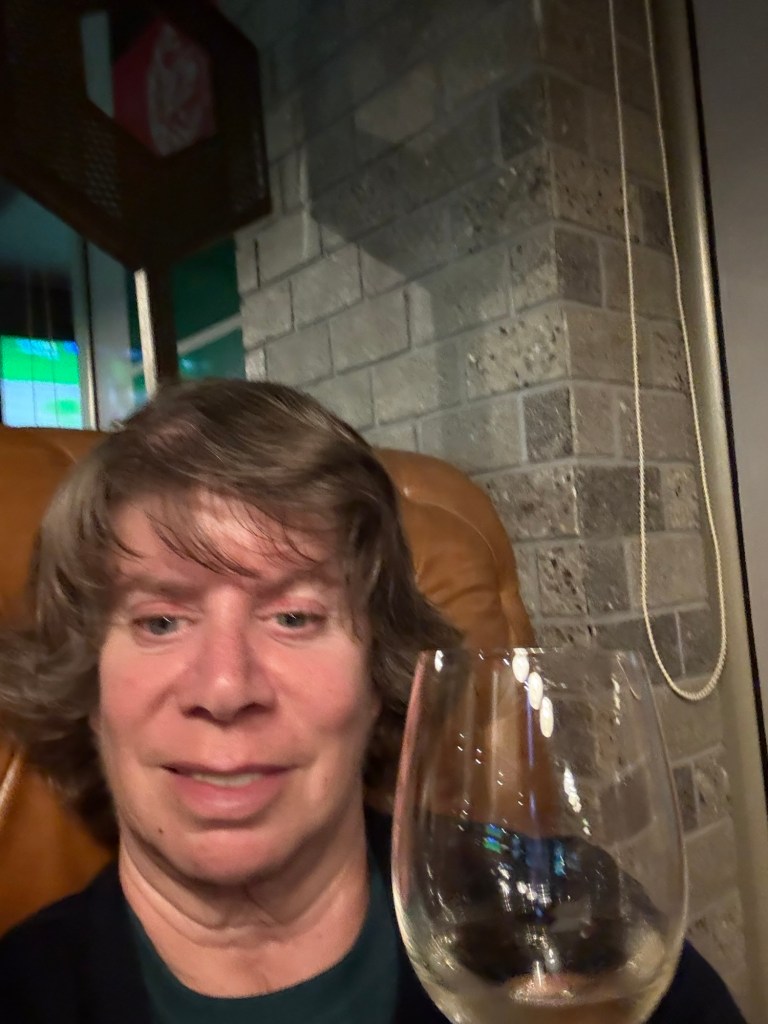
First stop, after 4 nights in alcohol free Kuwait, was a trip to the bar for a welcome glass of wine:

Alcohol is freely available in Bahrain, unlike neighboring Kuwait and Saudi Arabia. Another “sin” prevalent here is prostitution, perhaps attracted by the large US naval base situated on the islands. But apparently, 75% of all visitors to Bahrain are Saudis, anxious to relax in the more liberal laws.

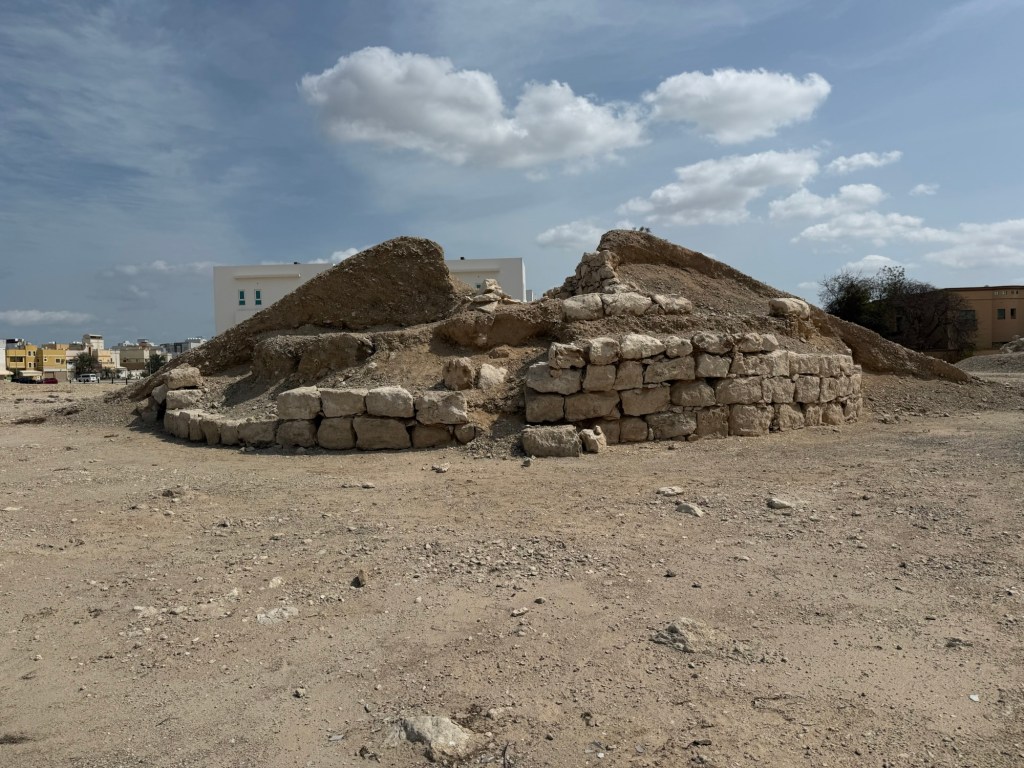
As always, I wanted to learn about Bahrain’s history and, to my surprise ( and total ignorance) learned that this island archipelago has been inhabited for over 7,000 years, with the Dilmun civilization constructing temples and large cities since the third millennium BC. I visited the Babar Temple complex, remnants of the second Dilmun temple circa 2,000BC:

Babar Temple

Located in the Arabian Gulf, Bahrain was a convenient stopping off point for traders between Mesopotamia and the Indus Valley civilization and Dilmun is mentioned in the Epic of Gilgamesh as perhaps the Garden of Eden. It had fresh water springs, agriculture, date trees and fish galore in addition to a pearling industry and copper mines. In later antiquity it became an important point for the incense coming from Ethiopia and Yemen north to Persia.

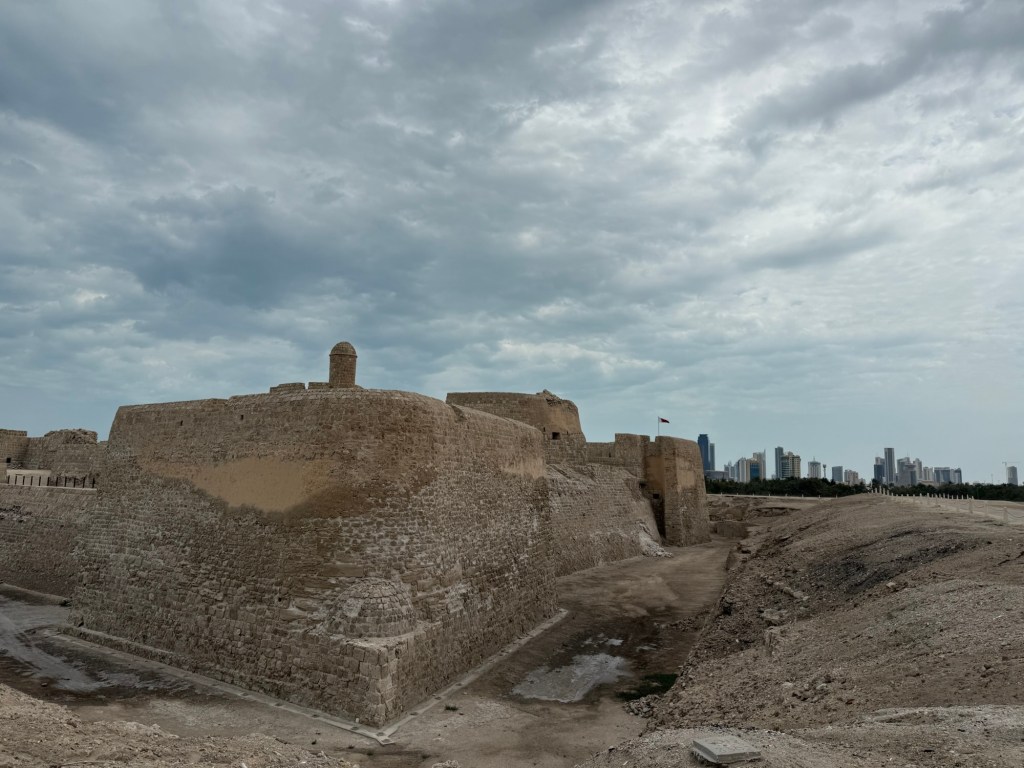
Alexander the Great marched by, the Romans set up shop and early Christians inhabited the island. Islam took hold in the 7th century and over the next 800 years different Arab entities ruled and fought over it. In 1485, the first Portuguese sailed by and eventually built the Bahrain fortress to guard its trade:

Bahrain Fort

Different Arab entities, the Ottomans, Qataris and Persians, ousted the Portuguese and ruled until 1845 when the sheik signed a treaty with Great Britain, creating a protectorate whereby Great Britain conducted all foreign affairs for the islands. In 1971, Bahrain was granted independence and Great Britain transferred its naval base to the Americans, who have used it since to house its 5th fleet.

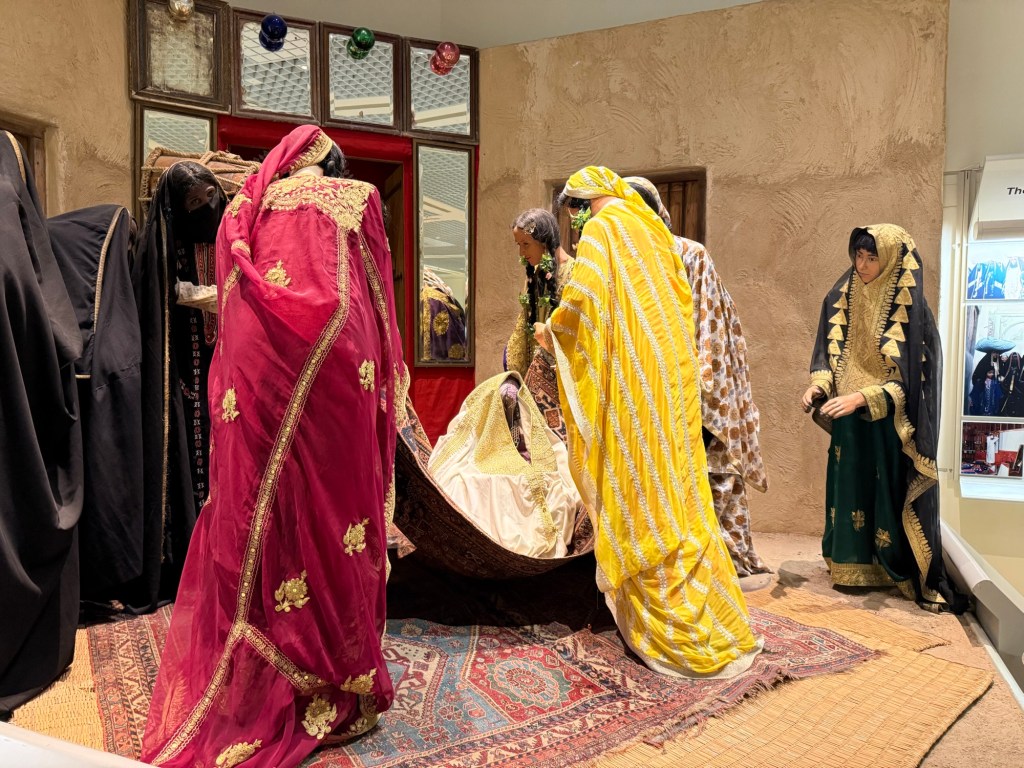
This history (minus the naval base stuff) is well articulated in the National Museum, a nicely curated introduction to both the history and culture of Bahrain. In its cultural section, it traces Bahrainian society from birth, through eduction, marriage, work and home life to death, with illustrative dioramas:

Women carrying the bride

A bit of trivia learned here: most Bahraniam marriages were arranged between cousins.

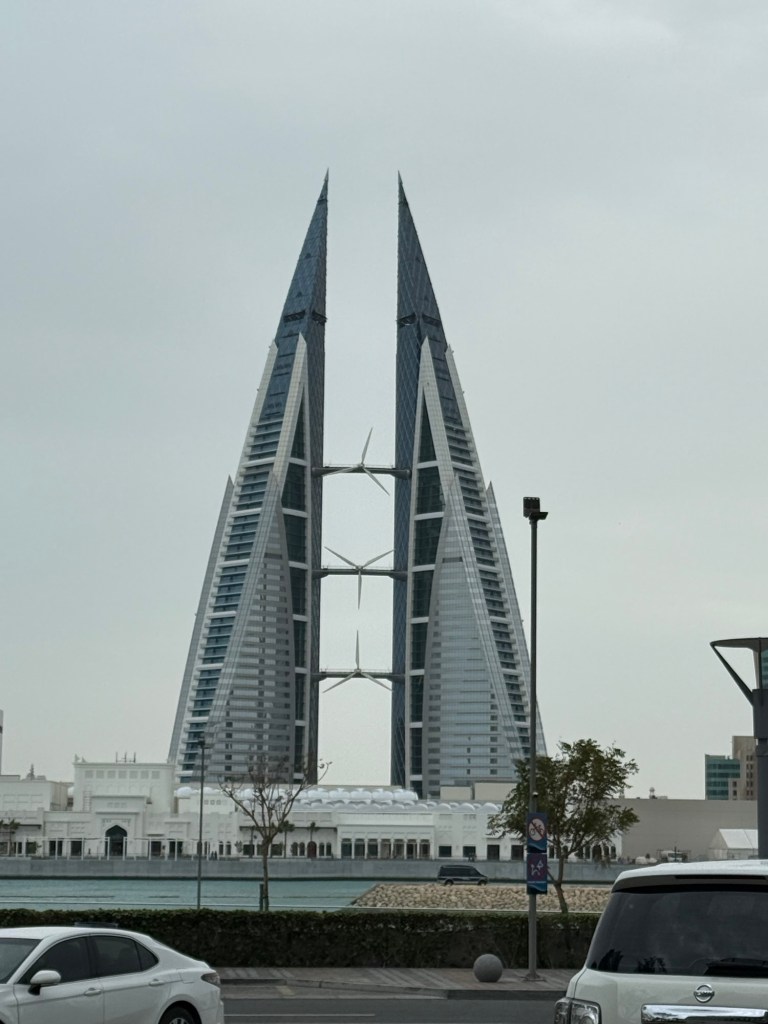
Oil was discovered in the 1930’s and like its neighbours, transformed Bahrain from a backward pearling center to a wealthy state. It doesn’t have the vast reserves of Kuwait or Qatar, so it has tried to diversify, with burgeoning banking and medical tourism industries. But like its neighbors, it has modern skyscrapers, the most impressive of which is the World Trade Center:

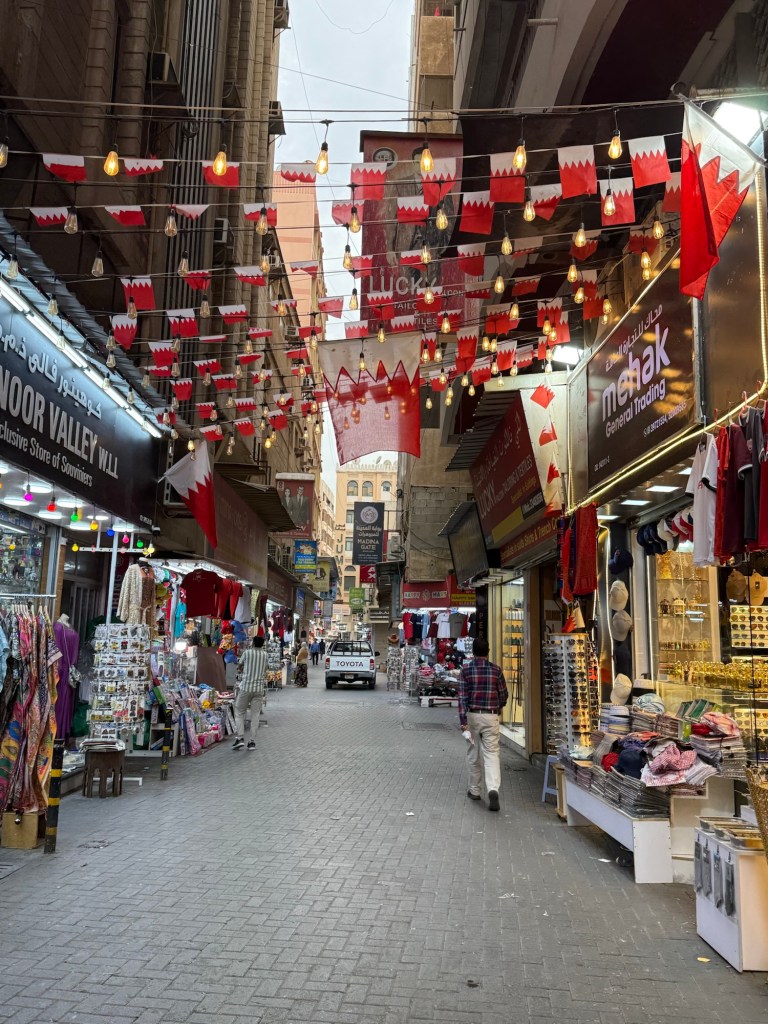
Given my fear of heights, I had no intention of going to its observatory. On much flatter ground is the Bab Al Bahrain, a souq selling a lot of Made in India/China goods and jewellery:

Bab Al Bahrain

A friend showed me through, identifying the Bahrainian handicrafts (sequinned embroidery, wooden benches and pearl jewellery) before stopping for a traditional meal consisting of chicken Biryani, hummus, pita and kebabs. The meat is soaked in lemons for a delicious, tender taste:

Part of the meal

Aside from horrible traffic, Bahrain was a pleasure to visit. With its more liberal rules, thousands of ex-pats calling it home and long and interesting history I quite enjoyed my time here.

Next; Back to conservatism in Saudi Arabia.

Kuwait

My trip to Kuwait started with a disaster; namely the crash of a Delta airplane at Toronto’s Pearson Airport. I wasn’t on the plane, but the closure of the runways meant that my later flight to New York was cancelled so I’d miss my flight to Istanbul and then onto Kuwait City. Luckily, after a 2 1/2 hour hold on the phone with Aeroplan, a sympathetic agent and Turkish Airlines booked me on a non-stop flight to Istanbul the next day, changed my flight to Kuwait City and didn’t charge a change fee!

I had tried to obtain an e-visa on-line in advance for Kuwait but the myriad of questions (religion, where were your parents born) and the request to upload a copy of my birth certificate frustrated me, so I decided to just get one on arrival. This was easier said than done. After locating the appropriate area, the Kuwaiti police officer barked at me to go get a number ( I was first in line). When I returned with a number, he directed me to a photocopy machine to make a copy of my passport, during which an entire plane load of Ethiopians came into the visa hall. I guess they didn’t have a number because I went straight to the front of the line and this time, the immigration policeman was friendly, smiled, took my visa fee and welcomed me to Kuwait.

Now about Kuwait. Kuwait City took shape in the 16th century when the Uteiba sect of a nomadic tribe settled in the area nestled between the current countries of Iraq and Saudi Arabia, attracted by its location as a trading post at the end of the Arabian desert and the start of the Arabian Gulf. It remained mostly a quiet trading center, with a pearling industry which dried up in the early part of the 20th century. It was governed by the Ottomans but backed the British in WW1. Britain ruled it as a colony and granted it Independence in 1961. It considers itself a constitutional monarchy, with an elected National Assembly with an hereditary monarch. Women were given the right to vote in 2005.

It went from a struggling colony to an immensely wealthy country with the discovery of oil in 1937. Today, Kuwait City is its only urban area, home to about 2.1 million Kuwaitis and 2 million foreign workers.

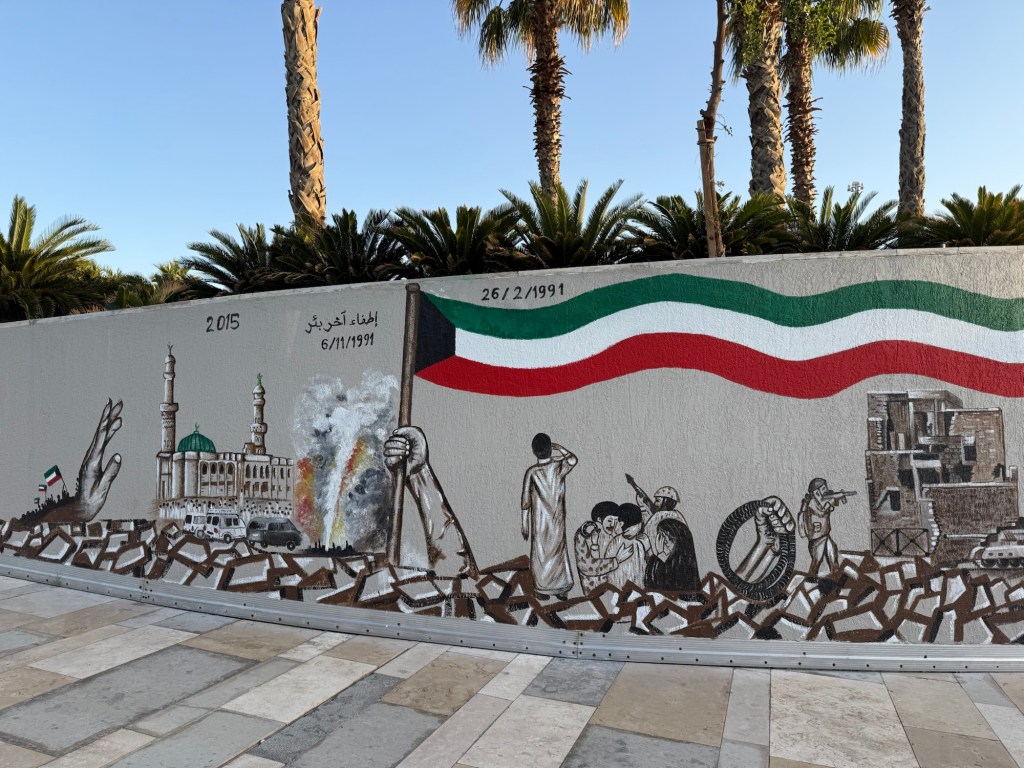
All of this information was freely available at the Memorial Museum, along with information about famous battles and the Iraqi invasion in 1990 when Sadaam Hussein sent his army in after Kuwait refused to increase the price of oil. In retreat after a Western-led coalition (Desert Storm), the Iraqis burned thousands of oil wells that took thousands of firefighters a year to extinguish. This is all commemorated on a wall leading to the museum:

Wall at the Memorial Museum

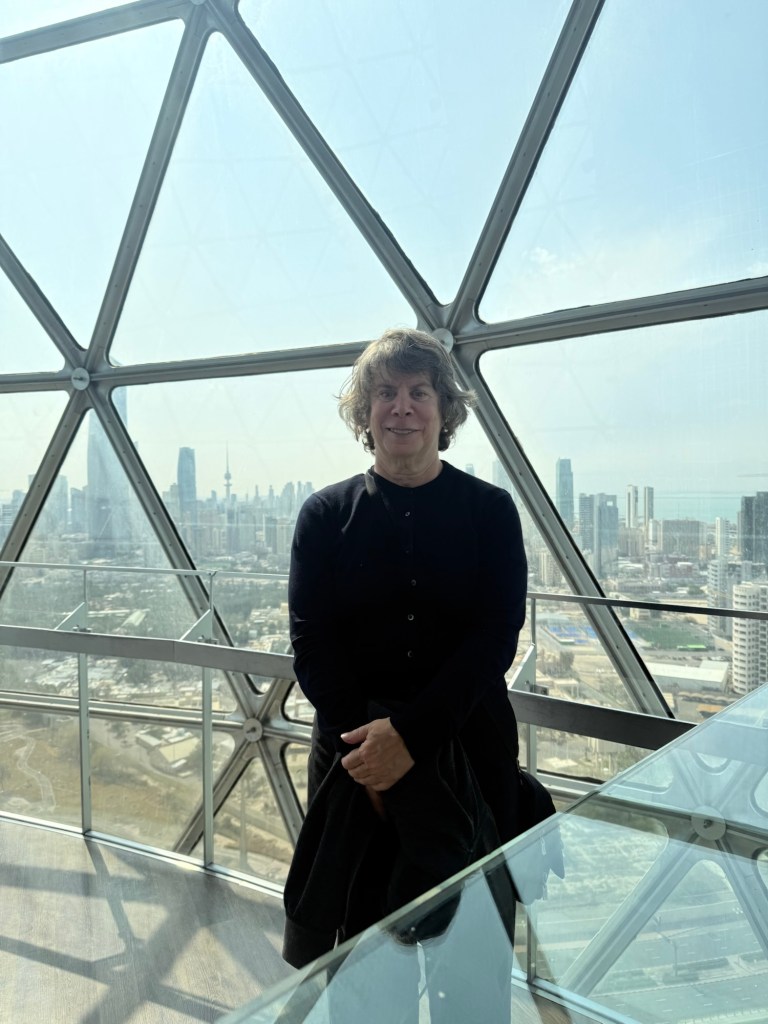
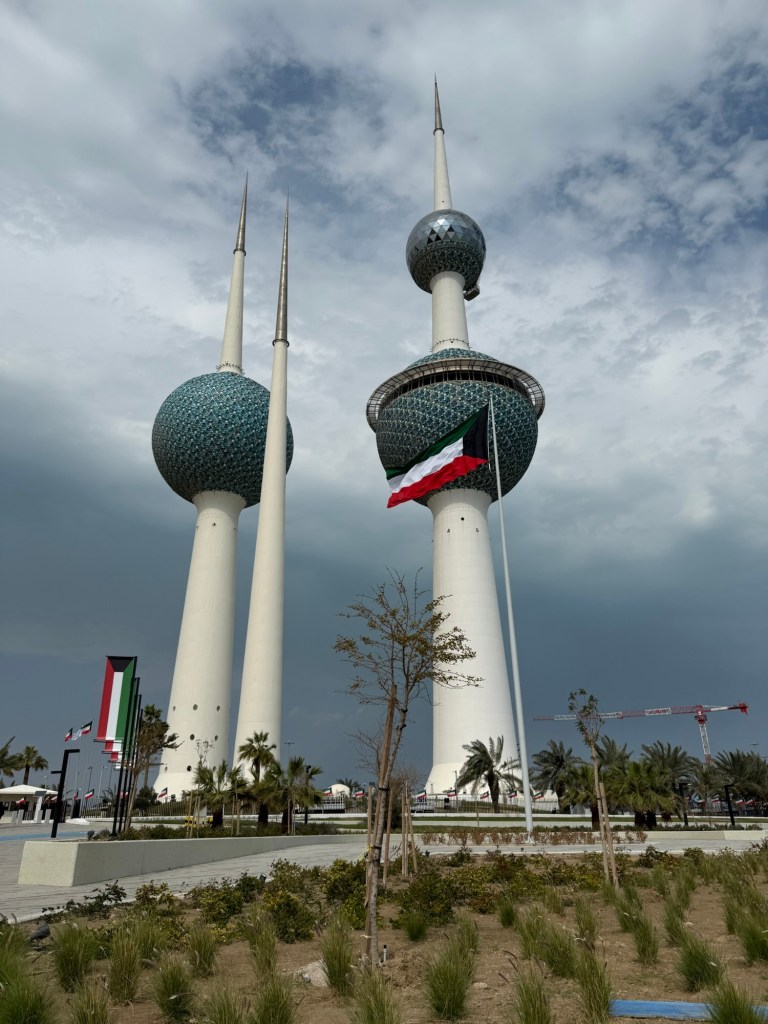
The iconic symbol of Kuwait is the Kuwait Towers, a series of 3 water towers opened in 1979. The one open to the public has an observatory and a floor which rotates every 30 minutes, allowing for panoramic views of the city and the sea:

Kuwait Towers

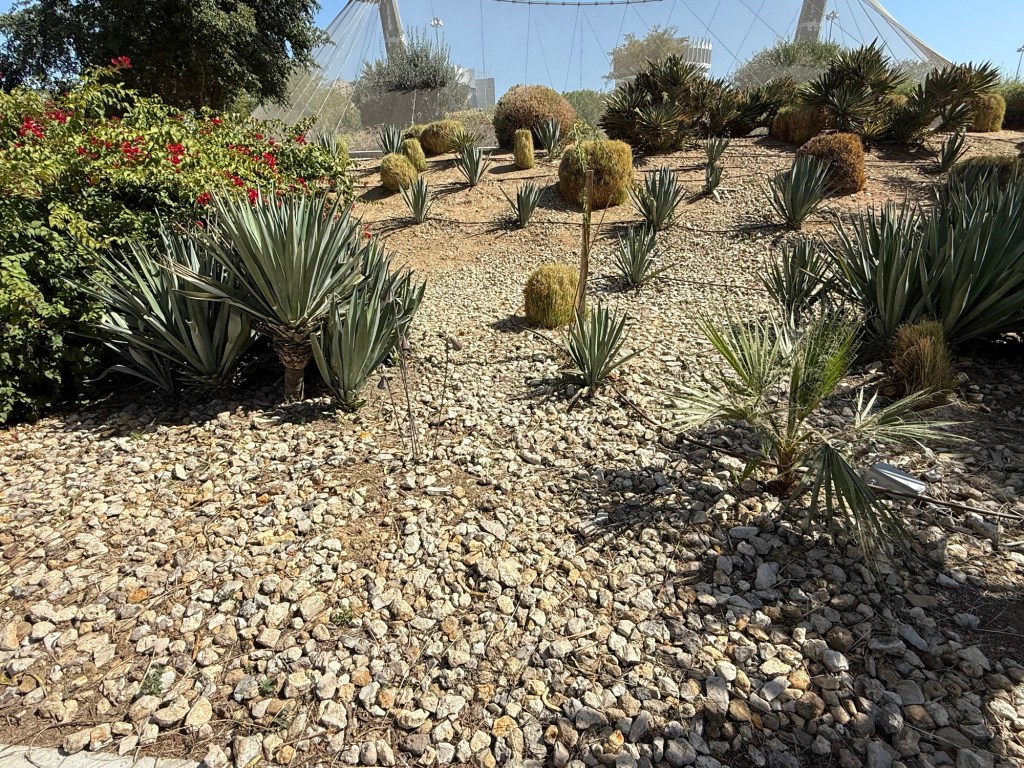
I took a cab to the National Museum of Kuwait, but despite its website saying it was open, the gates were inexplicably and firmly shut. So I returned to my favourite place in Kuwait City, Al Shaheed Park, a mammoth green space in the city featuring desert landscapes:

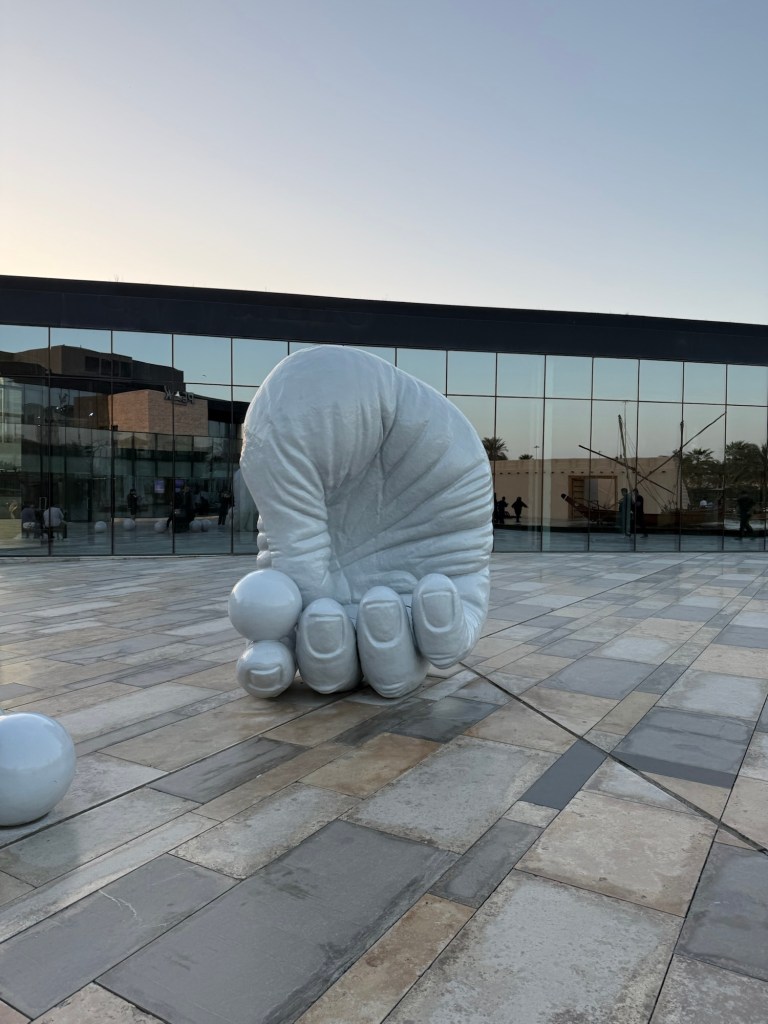
interesting modern art:

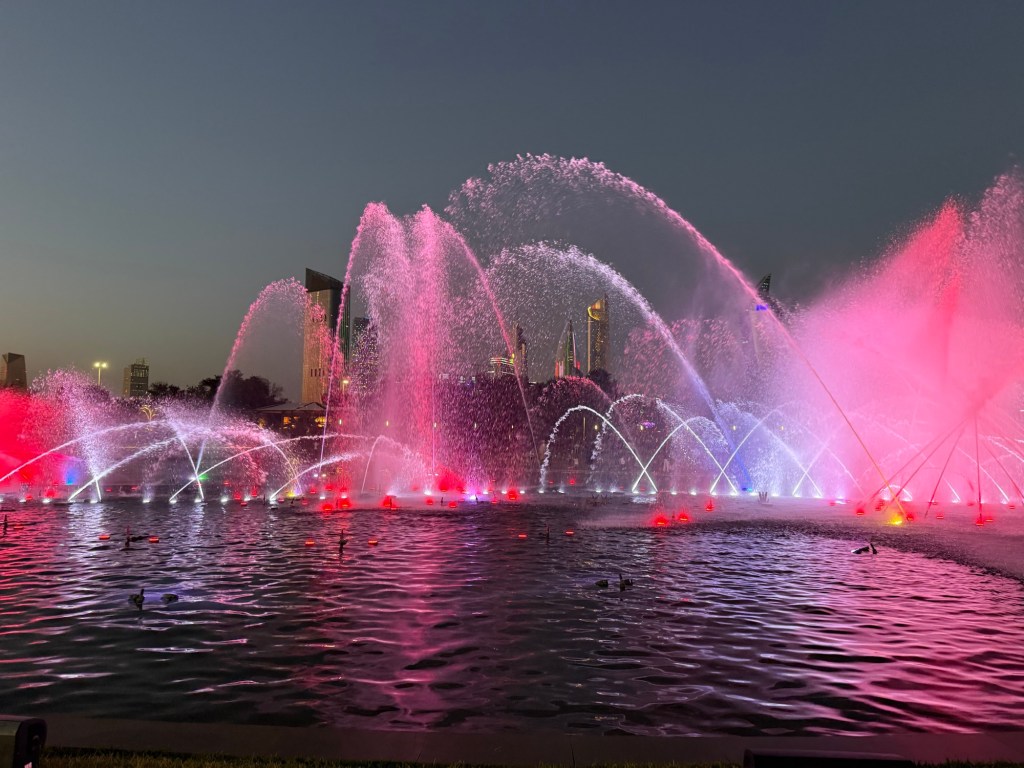
But my favourite in the park was the dancing fountain, which put on a brilliant performance nightly at dusk:

As a sucker for water shows, this was a treat. And more importantly, I walked the 30 minutes back to my hotel feeling completely safe and comfortable. I spoke with a Saudi friend who confirmed that Kuwait is one of the safest countries in the world. Taxis charge only the published rate, people stopped and asked if I needed help ( me looking constantly at google maps) and tipping is discouraged. It felt very comfortable.

Of course, it’s not without its issues for this Westerner. I had resigned myself to no alcohol whilst I was there; it is strictly prohibited. And though I was told to dress conservatively, I felt okay walking about in a t-shirt and long pants as did other non-Arab ladies. No cleavage and cover your knees and all was fine.

So what to make of Kuwait? It certainly failed to live up to its reputation as the rudest country in the Middle East; everyone I met was friendly. A few sights might interest tourists, but only for a day or two. In the end, a vlog I watched summed the country up best: it is very wealthy from its oil, so rich it has no need to build up a tourist industry. Tourists are not unwelcome, but unlike Dubai or Qatar, it’s not investing in mega projects to attract tourists. It’s just content being Kuwait.

Next: a glass ( or two) of wine….

Switzerland: Safe, efficient and stunning

I have driven through Switzerland and am too familiar with the Zürich airport, but I had never visited the country as a tourist. Thus, in the fall of 2024, I spent 12 days travelling around the country.

As I prefer cities to the countryside and trains are my favourite way to travel, I crafted an itinerary visiting 6 cities/towns, all going by rail.

First of all, hats off to the Swiss rail system. Their trains are frequent, clean, no problem getting seats and always on time. Even when I had a 6 minute transfer between trains among Zurich’s 42 platforms, it was doable. I never missed a train and, to save lugging a suitcase up and down the platform stairs ( like in the UK), there are escalators or convenient elevators. Why more train systems cannot be more like Switzerland I don’t know but it was a pleasure.

Even local transport was great. Most cities have a tourist program where if you stay in a hotel overnight, the hotel registers you and you get a tourist card entitling you to free bus and tram transit and reduced entrance charges to museums. Like the trains, the trams were great. Frequent, convenient and easy to use even if you don’t speak any of the official languages ( thank you Google Maps).

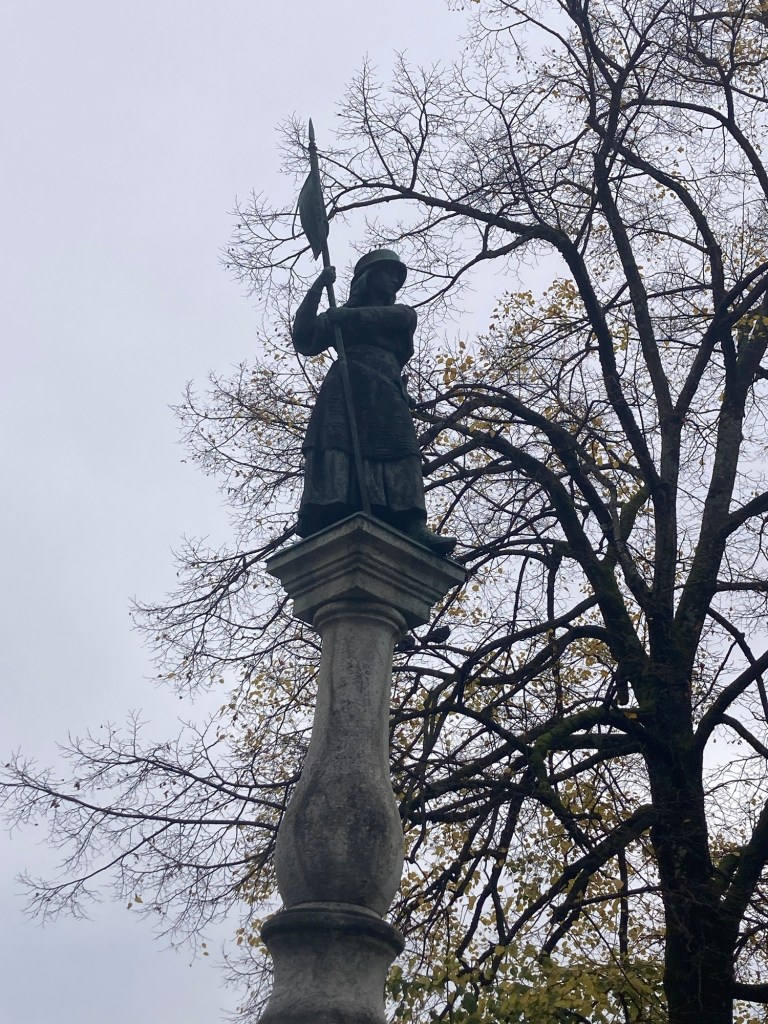
I began my trip in Zürich, Switzerland’s largest city and a beautiful place with a lovely old town, three landmark, churches, and lovely views of the Limmat River, which connects Zürich with Lake Zürich. I walked up and down what is considered to be Zürich’s most beautiful street, Augustinergasse, admired the statue of Hedwig, a 13th century woman who assisted all the women on Zürich in repelling an invasion by the Hapsburgs. She stands as a testament to the strength of women everywhere.

Hedwig Statue

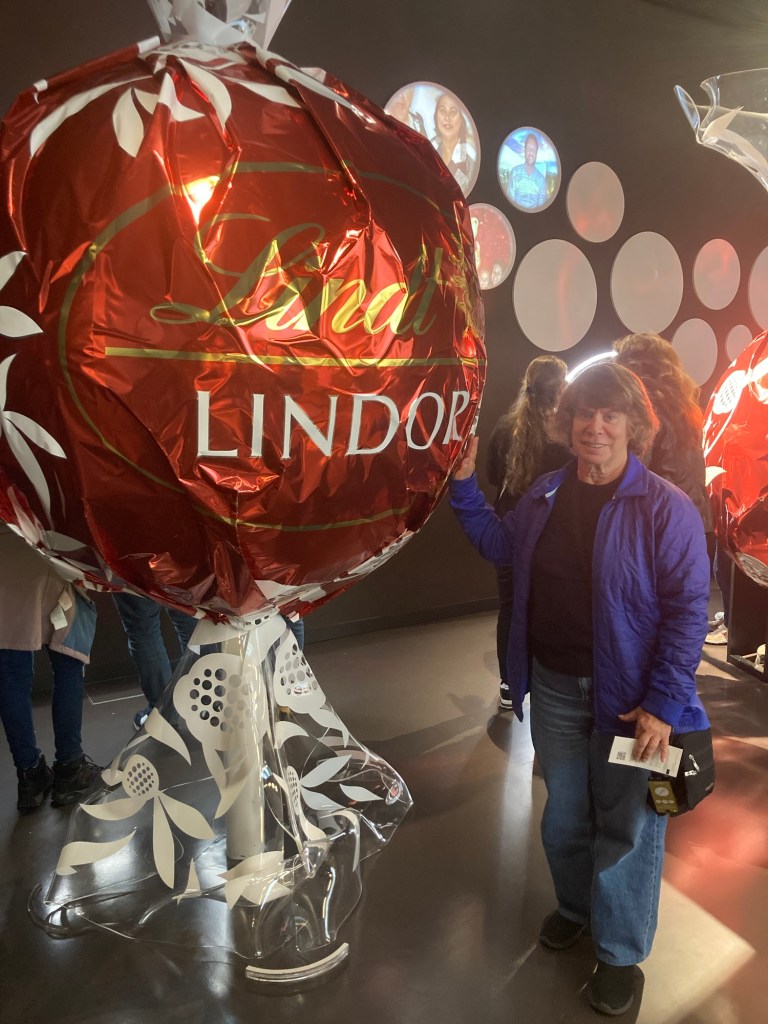
Given my sweet tooth, the highlight of my time in Zürich was probably a trip to the Lindt chocolate factory and museum. Opened in 2020, the tour begins with a description of chocolate cultivation, then the history of chocolate and its transport from South and Central America to Europe to the 19th century when Swiss pharmacists developed a process for making smooth chocolate. The best part of the tour was the tastings, and there were two stations where you could have all the chocolate you wanted. I indulged and left fully sated with some chocolate souvenirs:

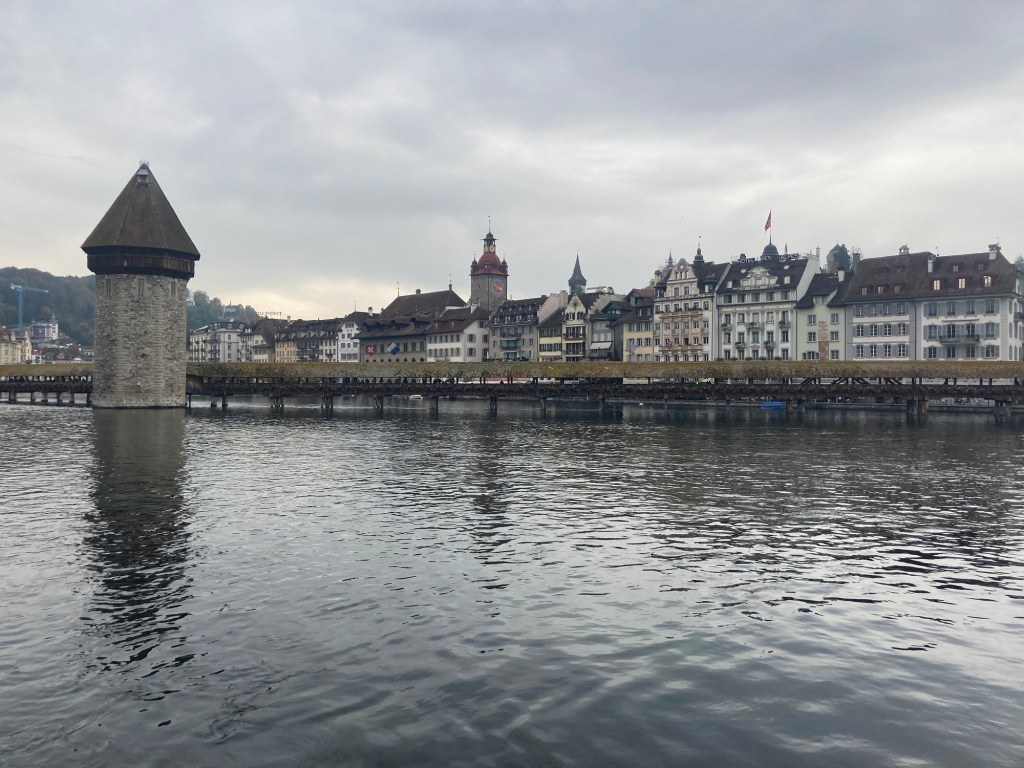
My next stop was the medieval city of Lucerne, with its iconic 14th century wooden chapel bridge:

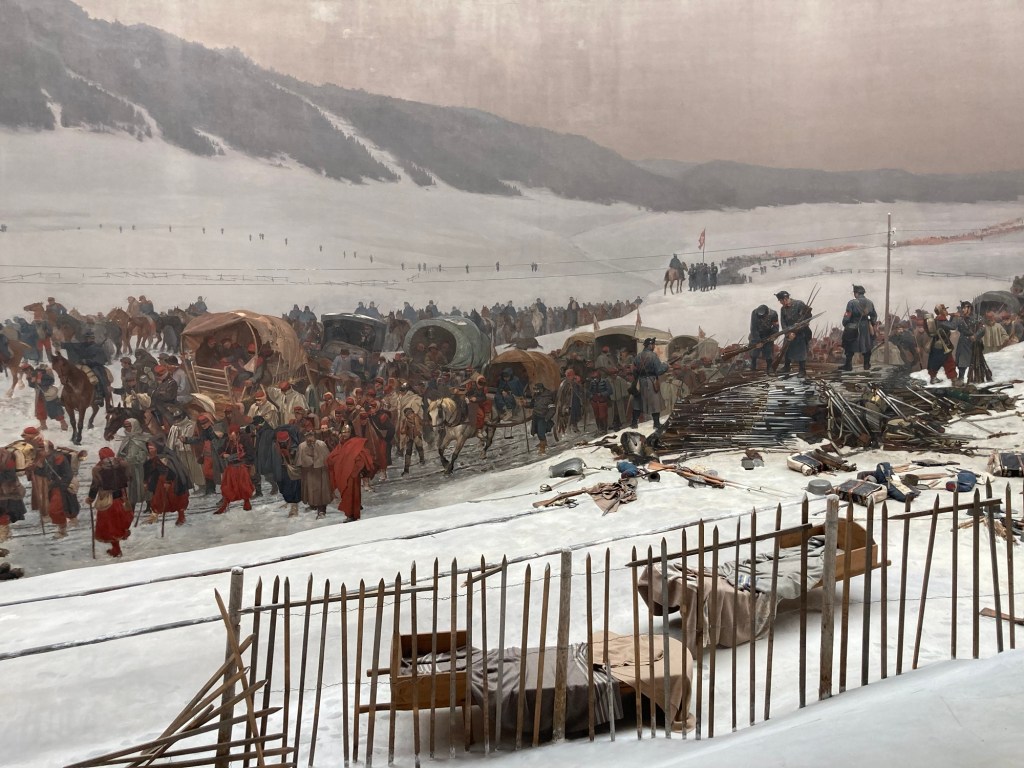
I spent a lovely day in Lucerne walking from site to site, first admiring the old town and walking it mediaeval walls, and moving toward it Mournful Lion, a tribute to all those who have fallen in the wars. I admired the Bouracki panorama, a 360° art piece depicting the retreat of 70,000 soldiers into Switzerland during the Franco Prussian war and the aid provided by the neutral Swiss. It’s gigantic and 3-D, so you feel like you are in the painting:

The Bouracki Panorama

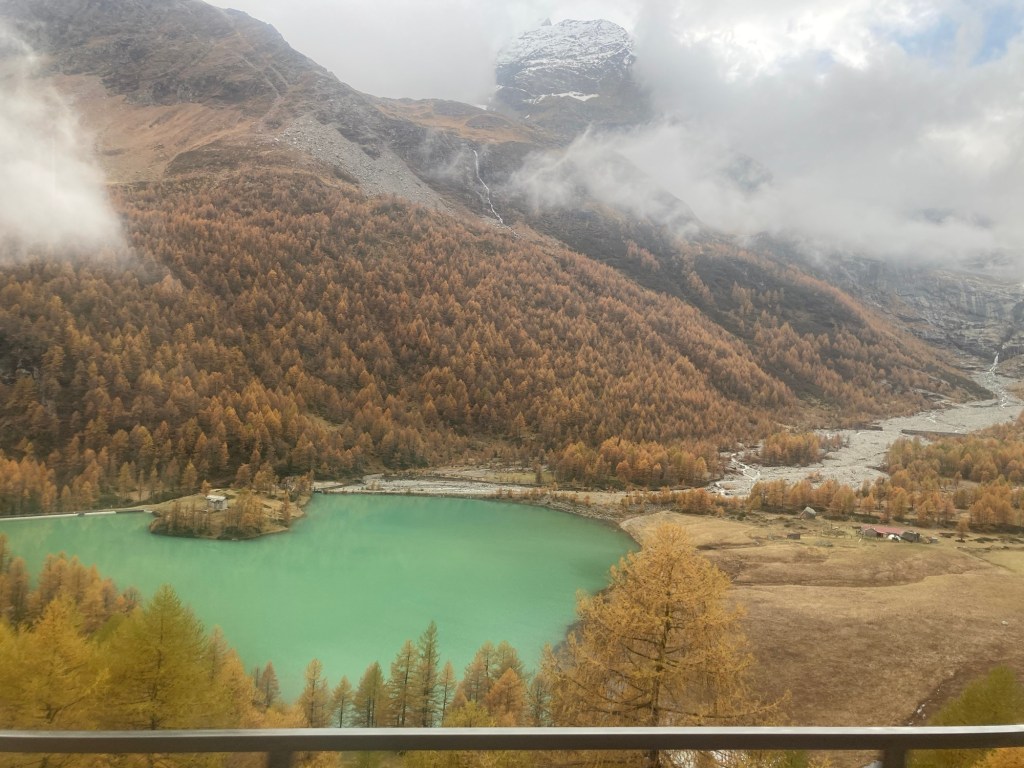
From Lucerne, I took the train to the mountain village of St. Moritz, home of the 1928 and 1948 Winter Olympics and the greatest train rides in the world, the Glacier Express and the Bernina express. Unfortunately, the Glacier express was on vacation while I was there, but the Bernina express was a worthy substitute. Leaving from St. Moritz, the 2 1/2 hour ride to Torino Italy wends its waythrough the Alps beside Emerald Green lakes.

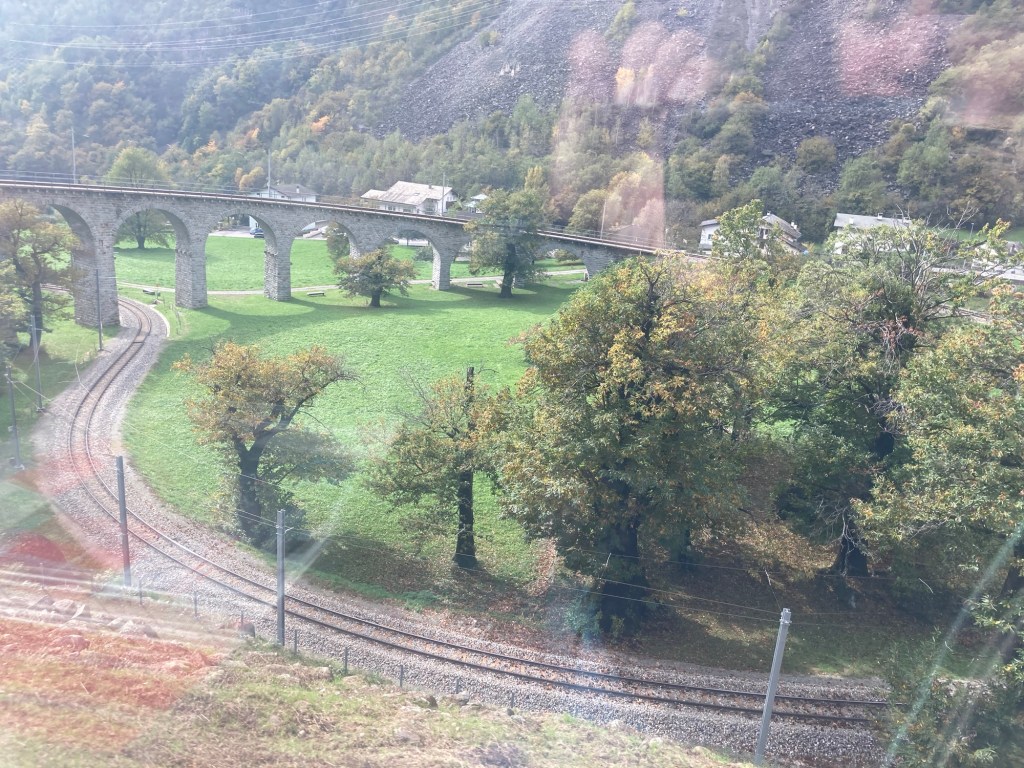
I marvelled at the engineering feats of the railroad builders, including the 360° circle, allowing the train to gain height:

Although the day was foggy, obscuring views of the glaciers and the highest peaks, the clouds could not damp the beauty of the region.

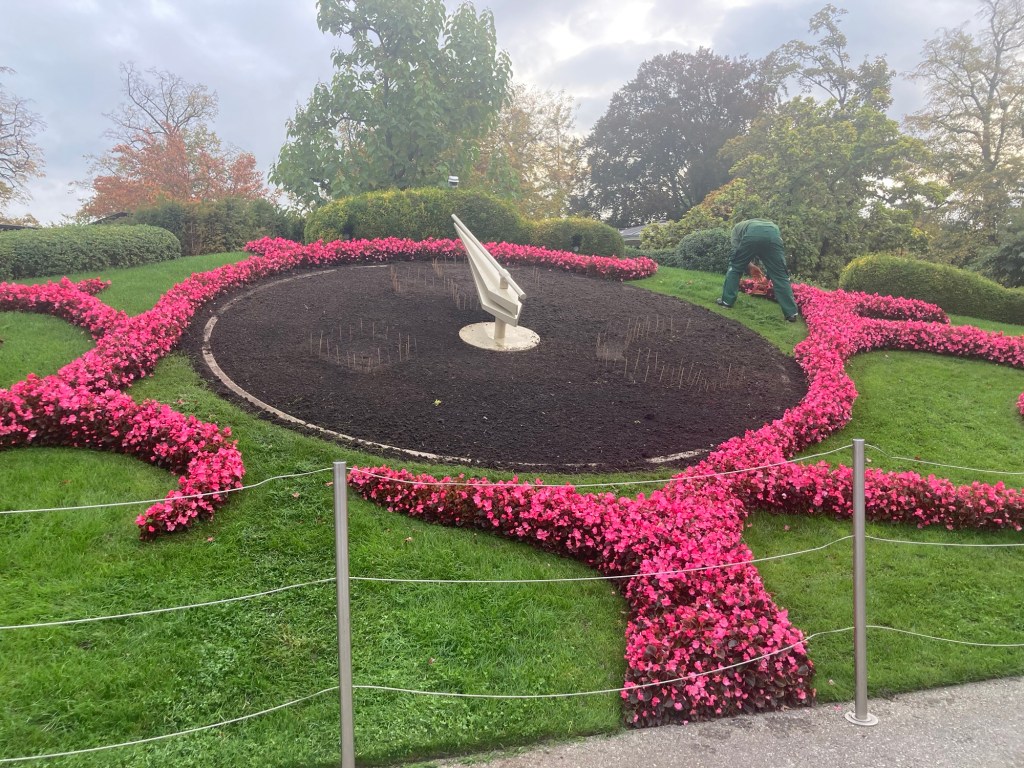
Next stop was Geneva, which I found disappointing. I was met by beggars at the train station, lots of smokers and garbage all around, something I hadn’t encountered before in Switzerland. I went to one of the must-see sights-the Flower Clock-which was being replanted for the fall:

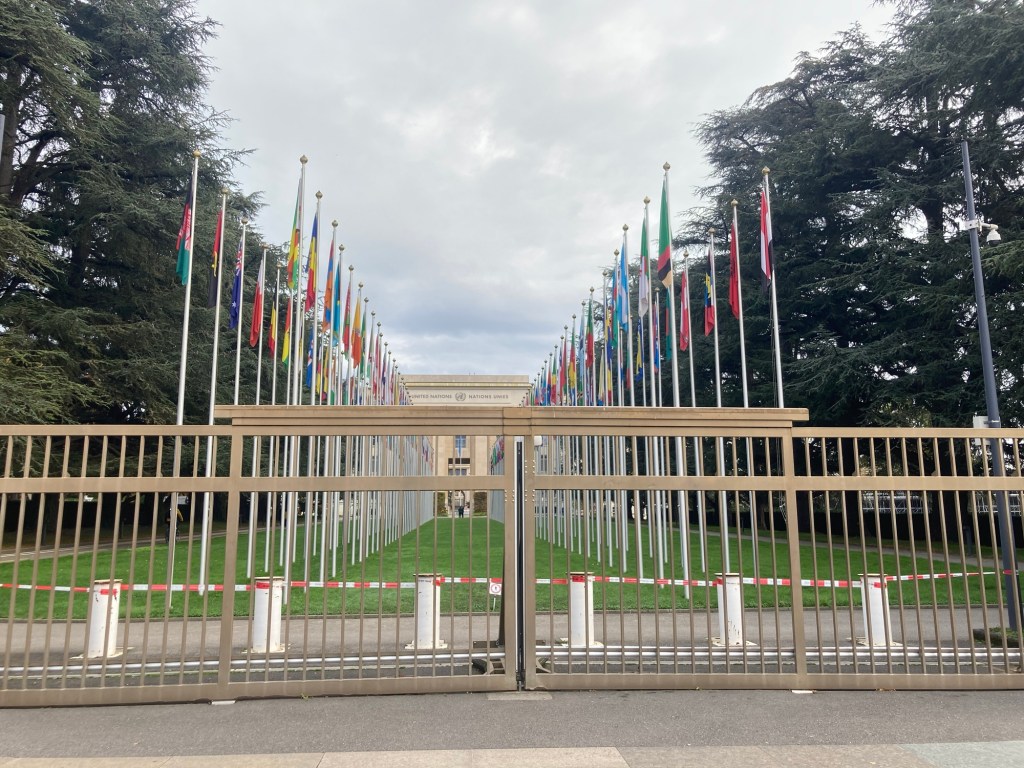
Next up was The United Nations:

The UN in Geneva

I’m sure the heavy security gate was prudent, but it was sad to see it outside a building representing peace.

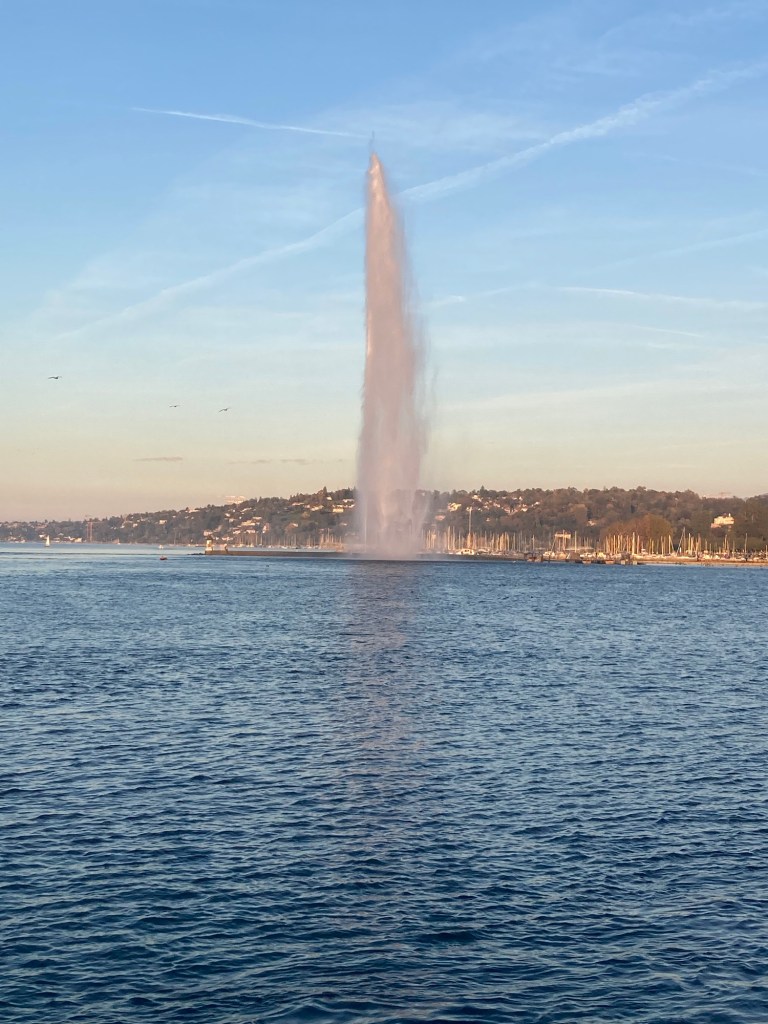
Next up was the jete d’eau, or water jet, a water fountain in Lake Geneva:

Okay, it’s pretty but doesn’t hold a candle to the dancing fountains in Singapore or the colourful water fountains in Dubai.

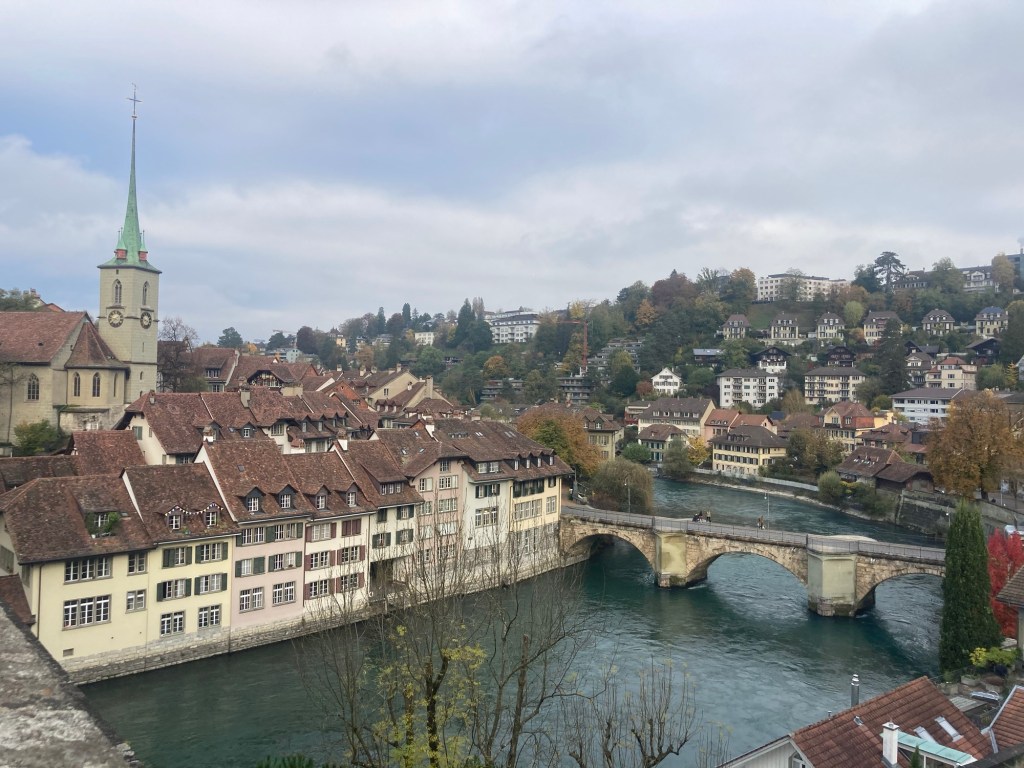
After 2 days I took the train to Bern, with its marvellous Old City, a medieval gem filled with arcaded walkways, 15th century working clocks and beautiful views of the River Aare:

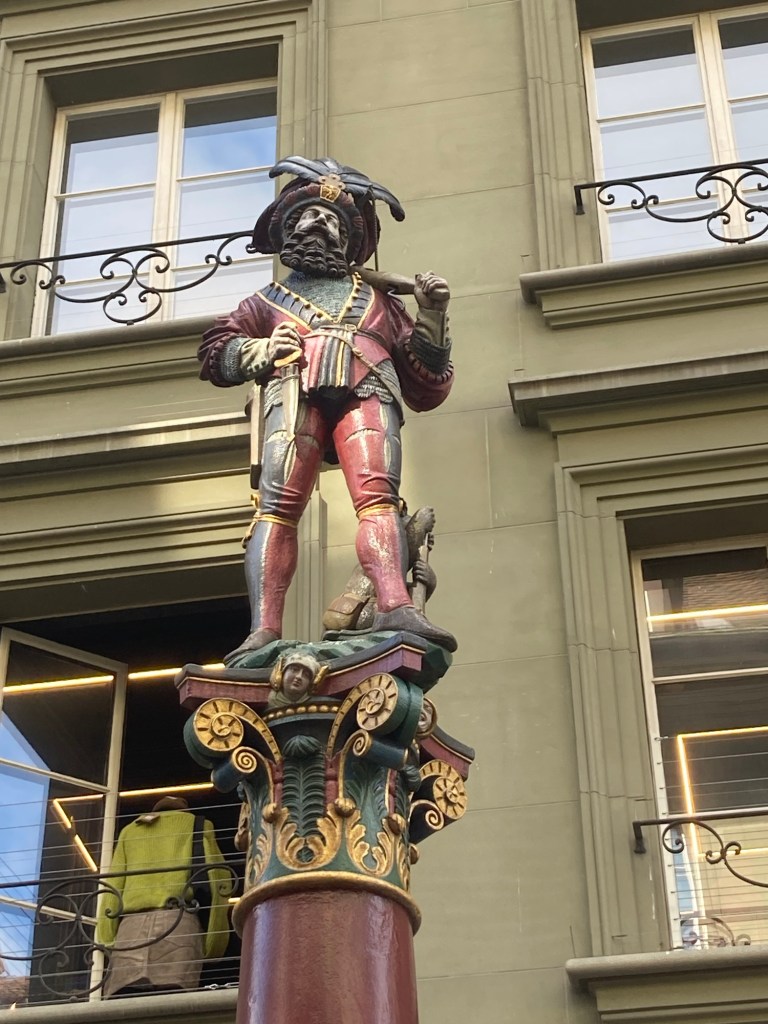
I toured the Einstein House, where he had lived between 1902 and 1909 and the Bear Pit, containing some brown bears after which the city is named. But my favourite activity was a “Where’s Waldo” game where I walked around the Old Town trying to locate the 13 fountain heads sporting a medieval character:

Bern Fountain

I found 11 before giving up.

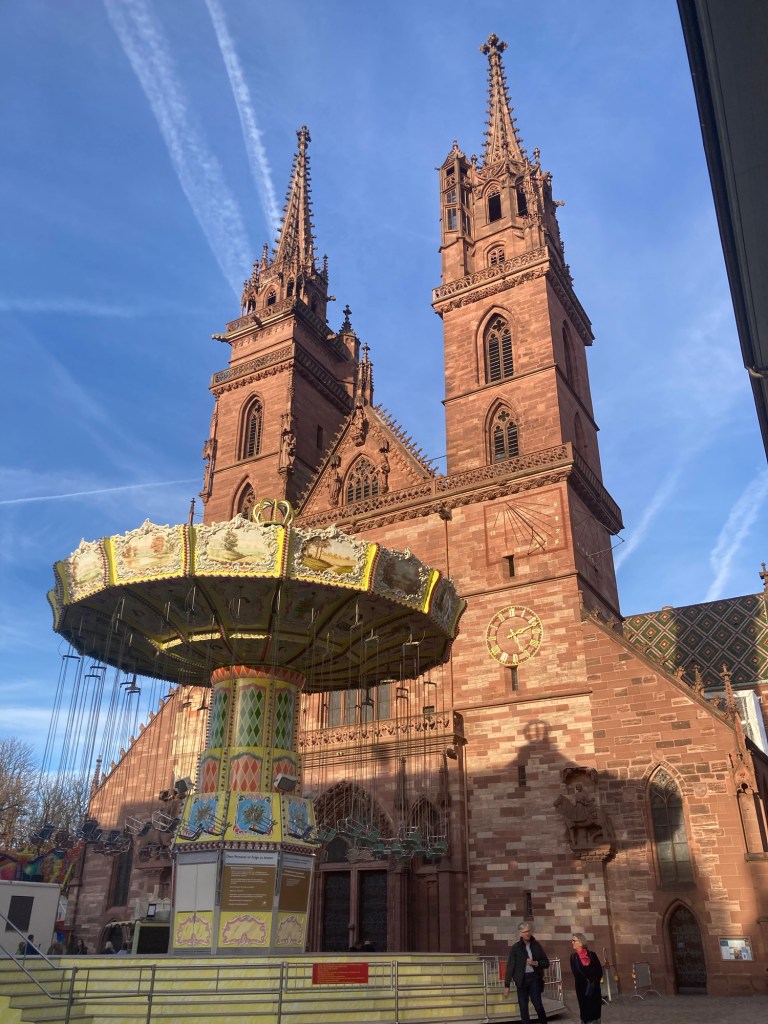
My last city was Basel. It too has a wonderful medieval Old Town with both a Cathedral and City Hall made from red sandstone. Unfortunately for my photos, a festival was starting the next day and amusement parks were set up out front:

Basel Cathedral

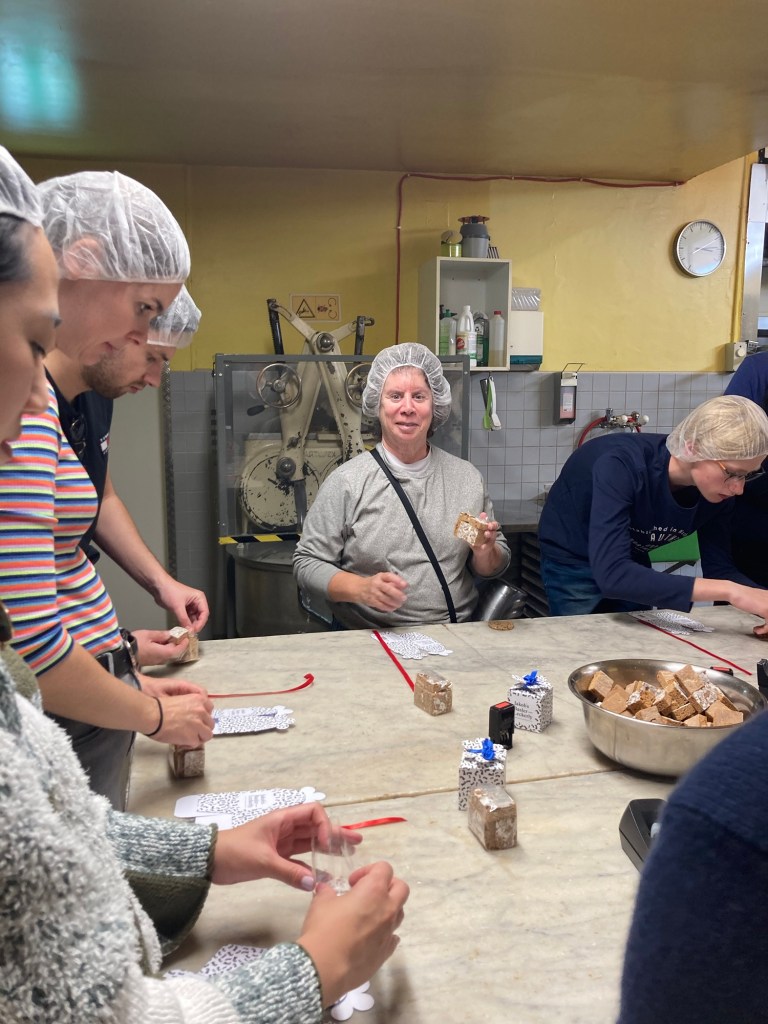
Basel is known as the cultural center of Switzerland and boasts more than 40 museums. However, I eschewed all that culture in favour of a tour of a bakery- Jokob’s Basler Leckerly- which makes leckerlies, an almond and honey biscuit, the traditional way:

We weren’t allowed to try baking, but were able to wrap the goods, an art in and of itself. A fun, and delicious, outing.

And so ended my time in Switzerland. I loved its efficiency, its Alpine scenery and medieval city centers. I was less enthralled with all the smoking and the extremely high food prices.

Up next, a Rhine River cruise.

Transportation Misadventures in Central Europe

Have you ever returned from a sightseeing vacation only to realize you missed some really neat sights? It happened to me in 2019, after spending 8 weeks in the Balkan countries, so this fall, with a bit of time to fill between Turkey and Switzerland, I decided to remedy 4 of my omissions. And a bonus, I could do most of it by train.

Things started off poorly. My leisurely noon hour flight from Istanbul to Sarajevo got switched by Turkish Airlines to a 7:25 AM departure, necessitating being at the airport by 4:30. I was less than thrilled, especially after learning the omelet station in the Istanbul lounge didn’t open until 5:00.

But even worse, the night before, I double checked on my Omission #1, a train ride from Sarajevo to Mostar, often ranking as one of the most scenic rides in the world. I had previously researched it and the website said there was no need for reservations. But for some reason when I rechecked the Bosnian railway website, Mostar was not coming up as a destination.

I checked the news to see if some light could be shed on why, and to my dismay, learned torrential floods a few weeks prior had wiped out the railroad. So much for my train trip.

After the crowds and touts in Istanbul, landing in Sarajevo was a breath of fresh air. The taxi drivers were honest, not inventing a non-existent toll charge on the airport road, and the lack of crowds was a pleasure. I met a small group of Asian tourists at the plaque commemorating the assassination of Archduke Ferdinand in 1916, starting WW1, but that was it.

Instead of the train ride, I endured a 7 hour bus ride to Split, leaving at 6:00am ( why so early???) and arriving only an hour late. I’d like to say the scenery through the Bosnian mountains and quaint towns was spectacular but it was raining, cloudy and generally miserable outside.

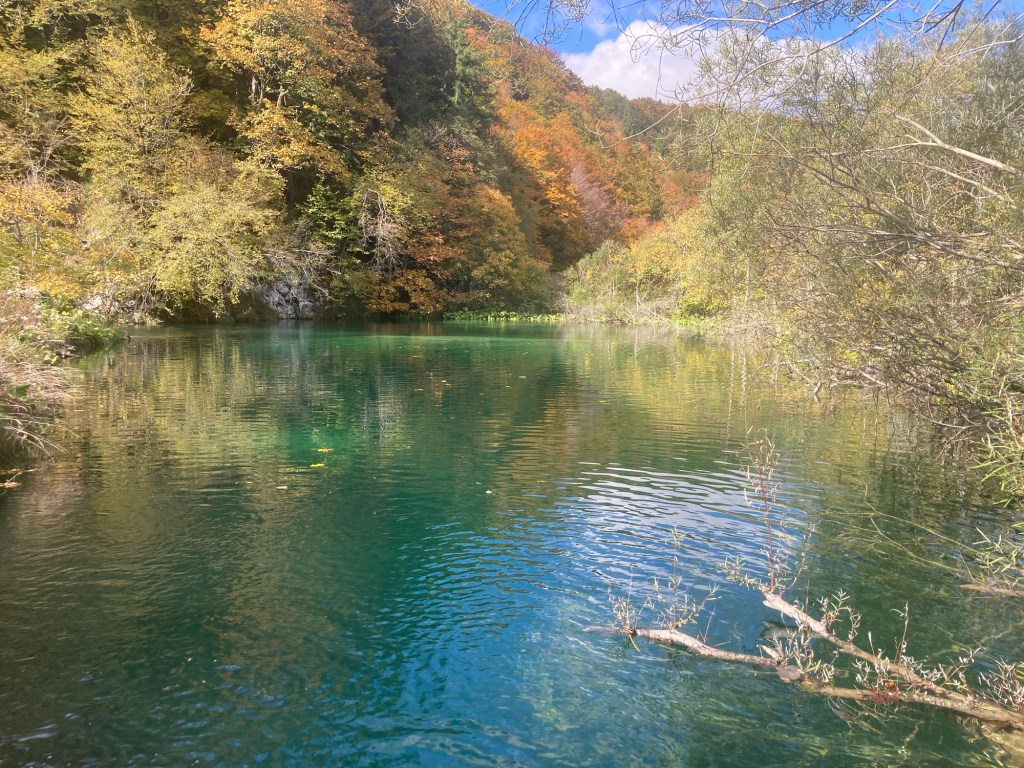
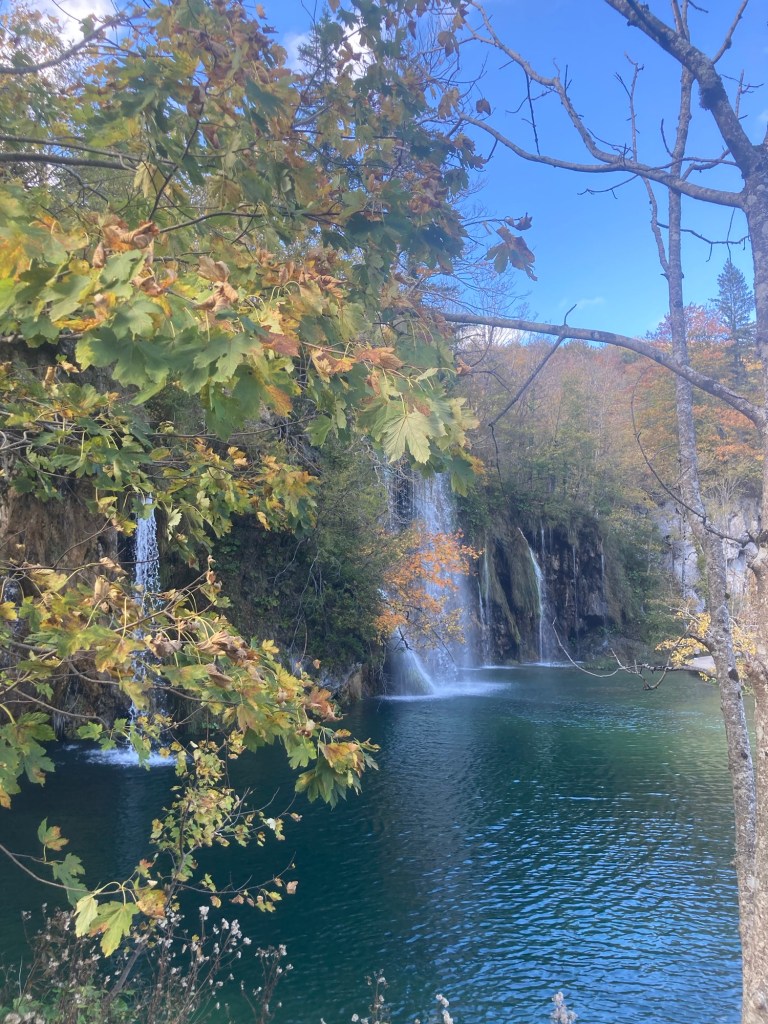
My Omission #2, a visit to Plitvice National Park, went off without a hitch. The park is famous for its numerous and constantly changing waterfalls, caused by a unique chemical makeup of the water and rocks. Even the sun decided to appear:

Plitvice National Park

From Plitvice, the plan was to take a bus to Zagreb, catch a taxi to the train station, then take a train to Salzburg, with a transfer at Villach in Austria. If all went to plan, I would arrive there about 7:30.

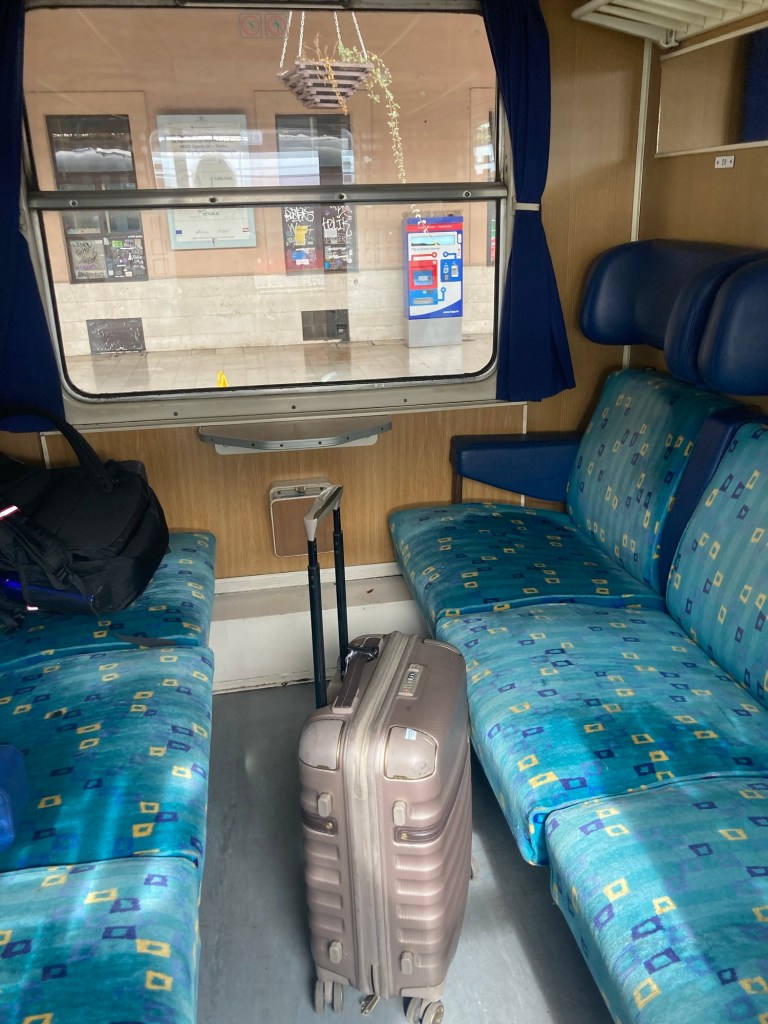
It did not go as planned. The bus to Zagreb miraculously arrived 5 minutes early, but I refused to pay the $30 the taxi cab wanted for the 5 minute ride to the train station. So I ended up walking, but it only took 15 minutes. The Croatian railroad train had seen better days, but it was comfortable and not crowded:

Croatian Railroad

The train left on time, but shortly afterwards, the conductor came by and advised that due to service on the tracks, i would have to get on a bus at Ljubljana, Slovenia. So when we arrived there, me and all the other tourists followed some guy yelling “bus, bus” through the train station to some waiting buses.

A 45 minute bus ride ensued before we were dropped off at another train station. A local Slovenian train arrived, I was on it for 30 minutes before stopping at a train station, and transferring to yet another local train for another 30 minute ride through Slovenia before finally getting to Villach in Austria. Not surprisingly, my train connection had left an hour ago, and I was stuck waiting two hours for the next train. On the plus side, I found a Shawarma place nearby and a convenience store selling Prosecco at a reasonable price so I was not unhappy.

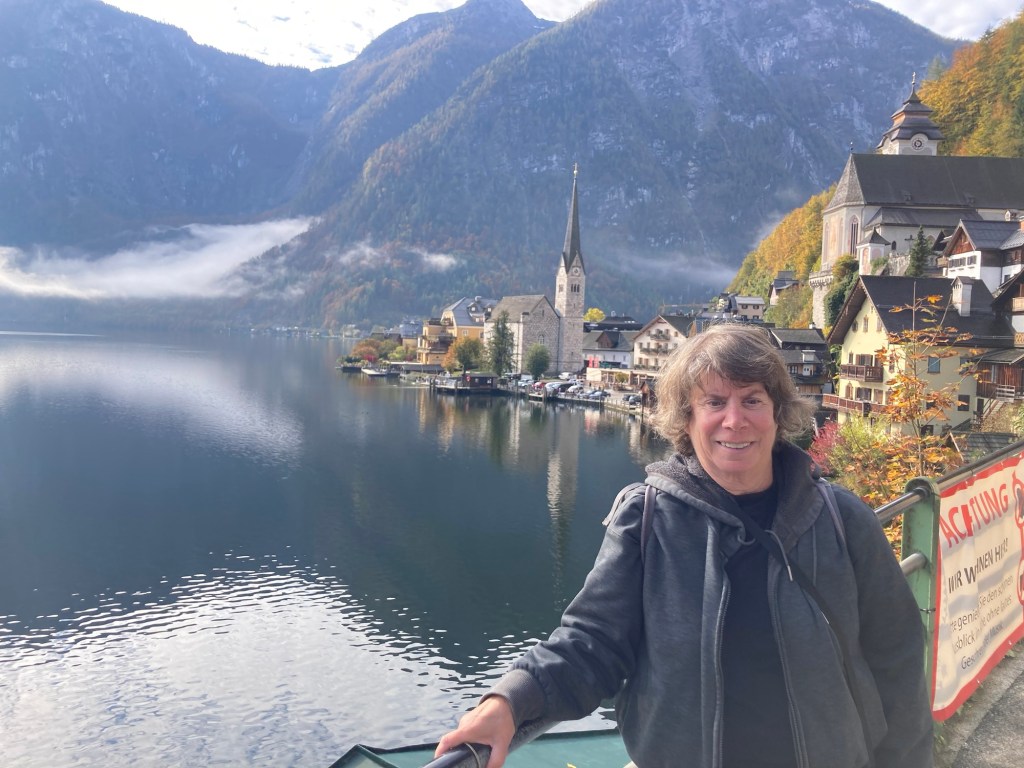
I made it into Salzburg late in the evening, but my hotel was just a short walk away. After a restful night, I set off on Omission #3, a day trip to the town of Hallstatt, often branded as the prettiest village in Europe:

It is beautiful and not even the bus loads of Chinese tourists could dampen the view, although they did photobomb some of my pictures. They started coming here in droves after a Chinese developer built an exact replica of Haltstatt in China. They come to Austria to experience the real Hallstatt.

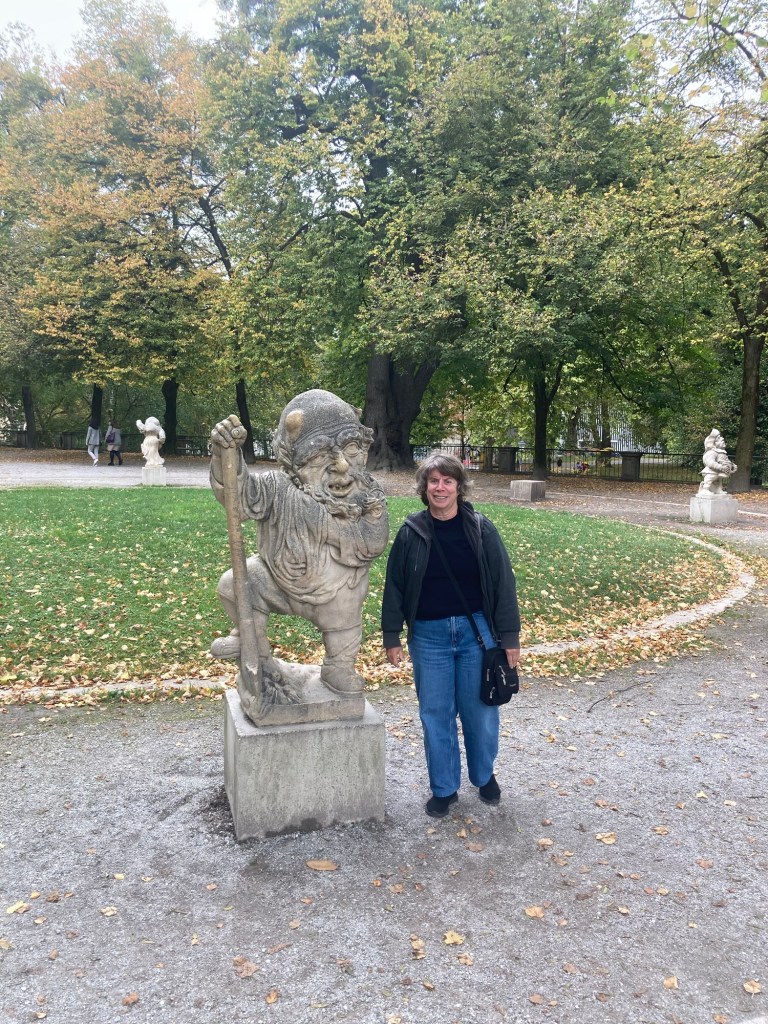
Of course, I couldn’t come to Salzburg without visiting this lovely city. I had been here in 1995 and done a Sound of Music tour, so I wanted to avoid references to it this time. This wasn’t easy. My walking tour guide pointed out the famous fountain, the cemetery, the singing hall and sang Do Re Mi. But we also passed by Mozart’s birthplace and the Mirabell Palace, a lavish home built by an Archbishop for his mistress and their 15 children. In the garden are 15 delightful, although probably not politically correct, Dwarf sculptures dating from the 16th century and the inspiration for gnomes everywhere:

Me and a dwarf sculpture

I had purchased a ticket to Zürich, scheduled to arrive at 7:30, but the first train, to Innsbruck, was 40 minutes late ( no explanation as to why) and my connection to Sargans had left on time, so I had a few hours to kill in the Innsbruck train station.

Over a glass of wine, I started checking travel options for Omission #4, a journey to Liechtenstein. Apparently the best way was to take a train back to Sargans from Zurich and catch a bus. As I now wouldn’t be getting into Zürich until close to midnight, this plan wasn’t making sense. I booked a night in a Sargans hotel and gave up my non-refundable hotel night in Zurich.

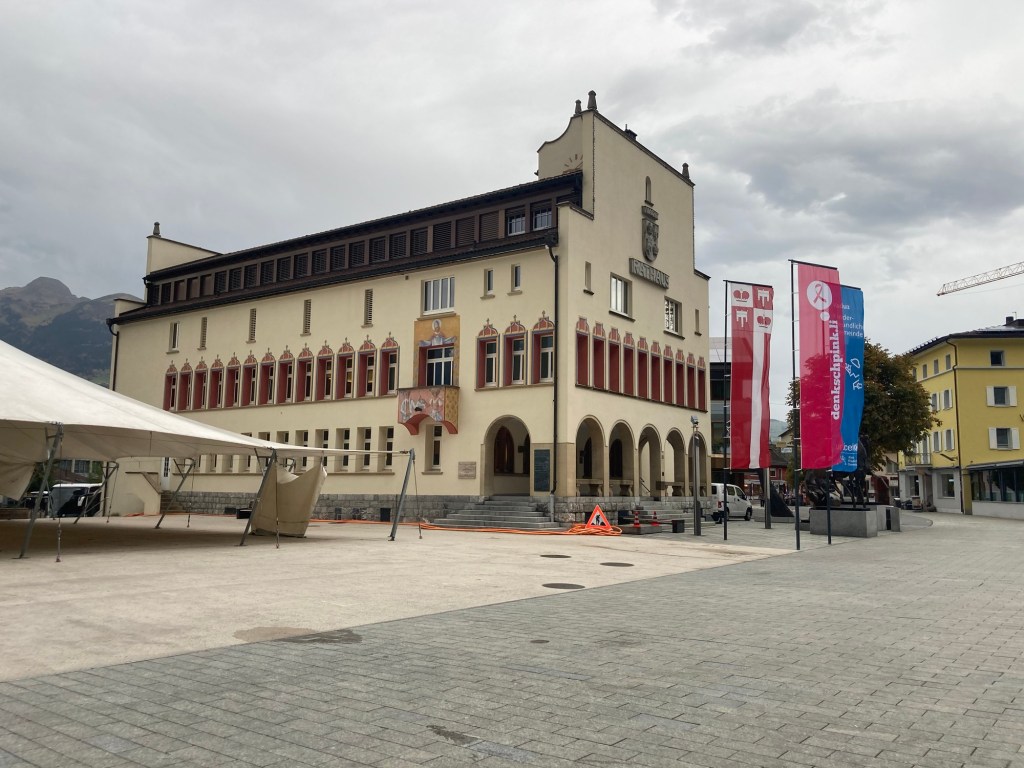
The bus ride from Sargans to Vaduz, the capital of Liechtenstein, took about 20 minutes. I was thrilled as I could now count country 125 as visited. But I cannot say there was a lot to do there. Hiking and mountain climbing were out of the question as it was raining. I walked around the center of Vaduz, taking photos of the church, the Parliament, the castle where the Prince resides, the pedestrian walkway and some modern art structures. There wasn’t much else to do. Even the tourist train didn’t start until 1:00pm.

Liechtenstein Parliament

So I returned to Sargans where my on-time Swiss Railway train whisked me to Zürich.

Next up: Switzerland

Proving Accepted Knowledge Wrong: Gobleki Tepe

One of the things I love about retirement travel is my ability to add detours to itineraries just to see something of interest. My foray into Turkey, and my flight to Sanliurfa to see Gobleki Tepe fit the bill.

Let me begin by explaining the allure of Gobleki Tepe. For centuries, historians, archeologists, anthropologists, just about everyone, concluded that civilization (another controversial topic but let’s call it large settlements, stratification of work and classes and some sort of communal administration) only began after Homo sapiens discovered agriculture, settled and had food security so people could devote their time to other matters like religion, trade and inventing useful stuff like pottery. Timing for this agricultural revolution depended on the region but the earliest is considered about 8,500 BC.

Prior to this, the academics said, Homo sapiens were hunter gatherers, living nomadic lifestyles following the herds. Settlements were small, maybe 50 people, and might be huts or lean-tos, very primitive with no evidence of communal buildings. If there was a religion, it focused on animism, a connection with the natural world.

These “truths” were taught in schools; , it was what I learned in my history classes in university in the late 1970’s. They were logical, nothing existed to the contrary, so they must be correct.

And then, in 1994, Gobleki Tepe was discovered. Translated from Turkish as “pot-bellied mound”, the hill was known for years to contain ruins but assumed to be a Byzantine cemetery. A German archaeologist named Klaus Schmidt decided to explore the hill a little deeper and, to the world’s astonishment, unearthed giant monolithic structures that date to 10,000 -8,500 BC, at least 4,000 years before humans were supposed to be able to construct anything of this magnitude.

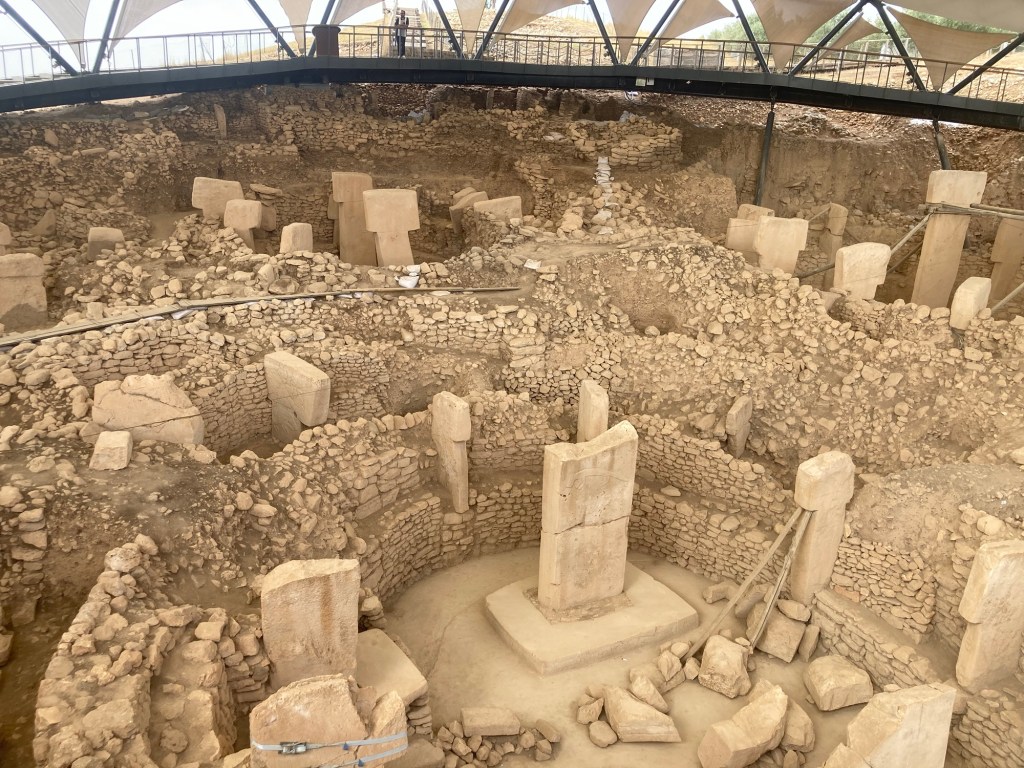
Not only that, but these builders were hunter gatherers who managed to organize hundreds if not thousands of people to quarry the limestone, move monoliths over 6 meters high and weighing 4-6 tons from nearby quarries without benefit of wheels, then create over 20 circular structures, ornately decorated, painted and perhaps roofed.

Gobleki Tepe Structure A

History had to be reconsidered in light of this discovery. Hunter-gatherers were capable of coming together and organizing large projects, capable of producing grand structures and for 1500 years, came in large numbers to Gobleki Tepe to gather, contrary to all accepted knowledge.

There are doubters. The most famous, a YouTuber named Graham Hancock, proposes that a long distant civilization, maybe Atlantis, survived the last ice age and either built Gobleki Tepe themselves or instructed the hunter- gatherers how to build the site. Others believe aliens came and built it. No one is really sure who built it but I don’t subscribe to the alien theory.

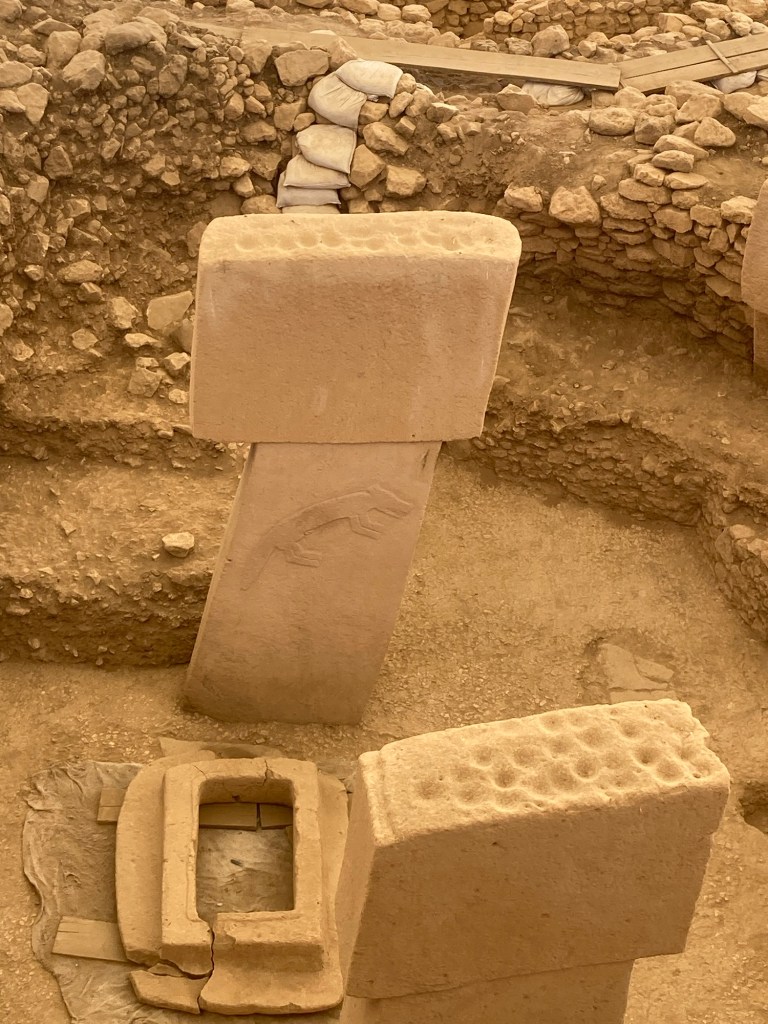
Nor is it known why. Some of the giant monoliths line up with the night stars, so perhaps it was an observatory of sorts. Many of the sculptures depict animals, so maybe it was a place of animism worship. Many of the human sculptures have outsized phallic elements, so it could have been a place where marriages were made. No one knows.

Carved pillar

After Gobleki Tepe was excavated, archeologists discovered numerous more Palaeolithic settlements nearby, some with similar monolithic structures, some with residential buildings, some 1,000 years older. History must be rewritten again.

So I came to Gobleki Tepe to wonder what other “truths” are perhaps wrong. Maybe humans could fly 50,000 years ago. Maybe the Chinese discovered North America before the Vikings and Columbus. Maybe….well I could go on but you get the idea.

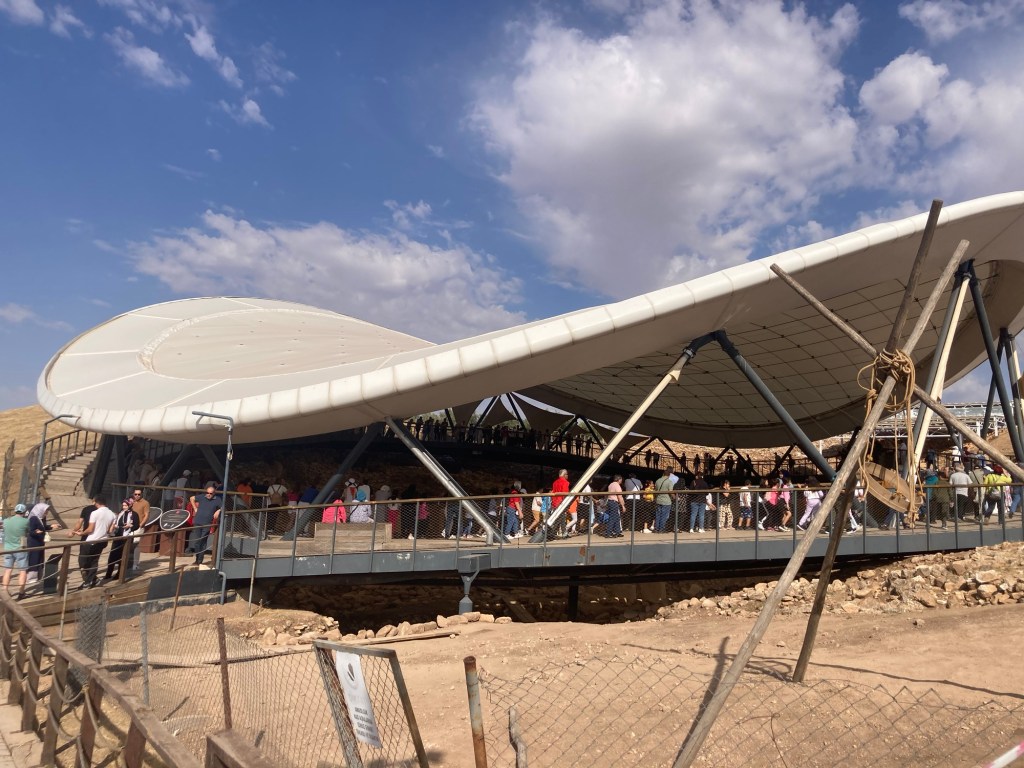
Sadly, my story of Gobleki Tepi ends on a discouraging note. Only 5% of the 120 acre site has been excavated. Underground radar has established at least 20 more megalithic circles still buried. But in 2020, the Turkish government turned over management of the site to a private group, who have prioritized profits over knowledge. To make the site more accessible to tourists, asphalt roads were constructed and a wooden walkway erected with metal poles indiscriminately stuck into the ground for support without regard to the damage caused to the structures below.

Tourists at Gobleki Tepe

While I appreciate the ease of traversing the site the walkways and roads bring, I deplore that such conveniences for tourists are being done at the expense of destroying Gobleki Tepe and limiting the archeologists’ work. This place is an important part of human history, a rare treasure, not a paleolithic Disneyland.

Next: Balkan trains

Proving Accepted Knowledge Wrong: Gobleki Tepe

One of the things I love about retirement travel is my ability to add detours to itineraries just to see something of interest. My foray into Turkey, and my flight to Sanliurfa to see Gobleki Tepe fit the bill.

Let me begin by explaining the allure of Gobleki Tepe. For centuries, historians, archeologists, anthropologists, just about everyone, concluded that civilization (another controversial topic but let’s call it large settlements, stratification of work and classes and some sort of communal administration) only began after Homo sapiens discovered agriculture, settled and had food security so people could devote their time to other matters like religion, trade and inventing useful stuff like pottery. Timing for this agricultural revolution depended on the region but the earliest is considered about 8,500 BC.

Prior to this, the academics said, Homo sapiens were hunter gatherers, living nomadic lifestyles following the herds. Settlements were small, maybe 50 people, and might be huts or lean-tos, very primitive with no evidence of communal buildings. If there was a religion, it focused on animism, a connection with the natural world.

These “truths” were taught in schools; , it was what I learned in my history classes in university in the late 1970’s. They were logical, nothing existed to the contrary, so they must be correct.

And then, in 1994, Gobleki Tepe was discovered. Translated from Turkish as “pot-bellied mound”, the hill was known for years to contain ruins but assumed to be a Byzantine cemetery. A German archaeologist named Klaus Schmidt decided to explore the hill a little deeper and, to the world’s astonishment, unearthed giant monolithic structures that date to 10,000 -8,500 BC, at least 4,000 years before humans were supposed to be able to construct anything of this magnitude.

Not only that, but these builders were hunter gatherers who managed to organize hundreds if not thousands of people to quarry the limestone, move monoliths over 6 meters high and weighing 4-6 tons from nearby quarries without benefit of wheels, then create over 20 circular structures, ornately decorated, painted and perhaps roofed.

Gobleki Tepe Structure A

History had to be reconsidered in light of this discovery. Hunter-gatherers were capable of coming together and organizing large projects, capable of producing grand structures and for 1500 years, came in large numbers to Gobleki Tepe to gather, contrary to all accepted knowledge.

There are doubters. The most famous, a YouTuber named Graham Hancock, proposes that a long distant civilization, maybe Atlantis, survived the last ice age and either built Gobleki Tepe themselves or instructed the hunter- gatherers how to build the site. Others believe aliens came and built it. No one is really sure who built it but I don’t subscribe to the alien theory.

Nor is it known why. Some of the giant monoliths line up with the night stars, so perhaps it was an observatory of sorts. Many of the sculptures depict animals, so maybe it was a place of animism worship. Many of the human sculptures have outsized phallic elements, so it could have been a place where marriages were made. No one knows.

Carved pillar

After Gobleki Tepe was excavated, archeologists discovered numerous more Palaeolithic settlements nearby, some with similar monolithic structures, some with residential buildings, some 1,000 years older. History must be rewritten again.

So I came to Gobleki Tepe to wonder what other “truths” are perhaps wrong. Maybe humans could fly 50,000 years ago. Maybe the Chinese discovered North America before the Vikings and Columbus. Maybe….well I could go on but you get the idea.

Sadly, my story of Gobleki Tepi ends on a discouraging note. Only 5% of the 120 acre site has been excavated. Underground radar has established at least 20 more megalithic circles still buried. But in 2020, the Turkish government turned over management of the site to a private group, who have prioritized profits over knowledge. To make the site more accessible to tourists, asphalt roads were constructed and a wooden walkway erected with metal poles indiscriminately stuck into the ground for support without regard to the damage caused to the structures below.

Tourists at Gobleki Tepe

While I appreciate the ease of traversing the site the walkways and roads bring, I deplore that such conveniences for tourists are being done at the expense of destroying Gobleki Tepe and limiting the archeologists’ work. This place is an important part of human history, a rare treasure, not a paleolithic Disneyland.

Next: Balkan trains

Moldova: Wine, warm and a little weird

If you’re like most people, your first question is “ Where is Moldova”? It’s in Europe, a small country nestled between Romania and The Ukraine. The next question is “Why Moldova?” The short answer is I am trying to visit all the countries in Europe, and aside from Belarus and Andorra, this is one of the few I haven’t been to.

But it has other virtues. It’s the least visited country in Europe, with only 10,000 visitors last year, so crowds would not be a problem. It is also renowned for its wine, with more vineyards per capita than any other country. During the Soviet times, when Moldova was a Soviet republic, it and Georgia supplied 100% of the Soviet Union’s wine. It is also warm- after enduring rain, winds and highs of 10 during my 3 weeks in the UK -the sunshine and 25 degree temperatures were welcome. And it is weird- I’ll try and explain Transnistria; the country that doesn’t exist- a little later.

I started with a private day tour of the monasteries and the wineries, conducted by Marcel who, when he wasn’t acting as a tour guide, was a driver for the US embassy. That work had picked up hugely since the Russian invasion of Ukraine as the Americans had moved many of their Ukrainian personnel to Moldova’s capital, Chisinau, for obvious reasons.

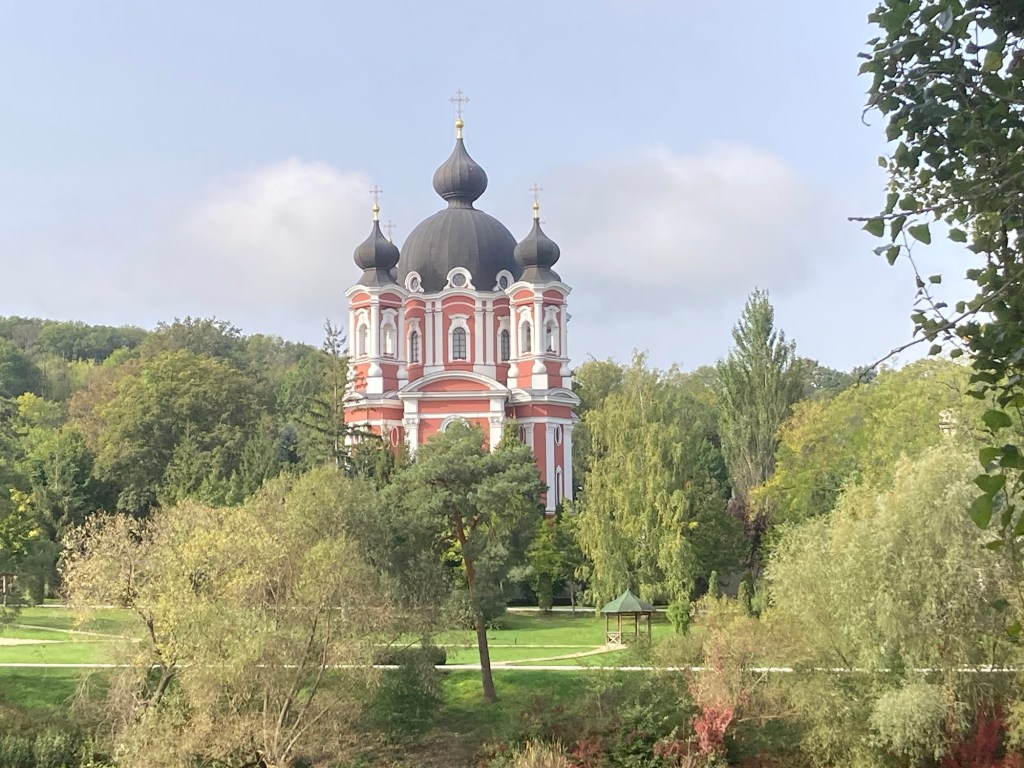
We started with one of three monasteries we would visit, Curchi, considered the most beautiful;

Pretty and inside, filled with icons and gold, but since churches and monasteries had been banned in Soviet times it was fairly new. This one has been used as a psychiatric hospital by the Soviets.

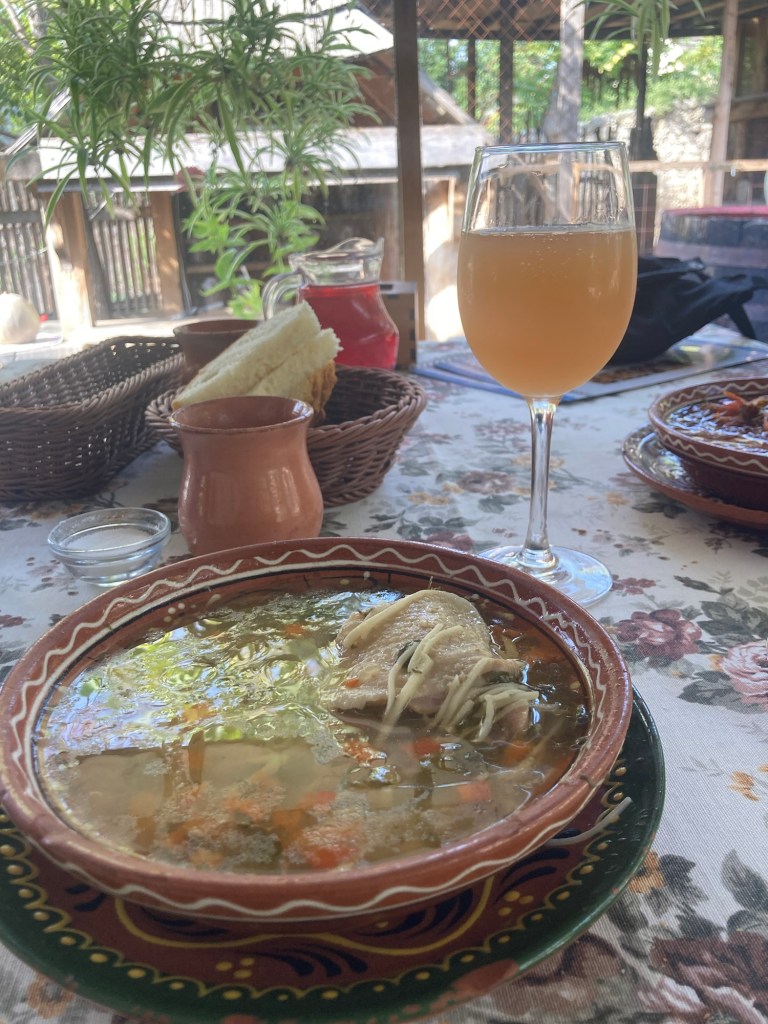
Lunch was in a typical rural community with traditional dishes like Zeama( soup) and placinta, a pastry filled with cheese, cabbage, potatoes or apples, all accompanied by wine.

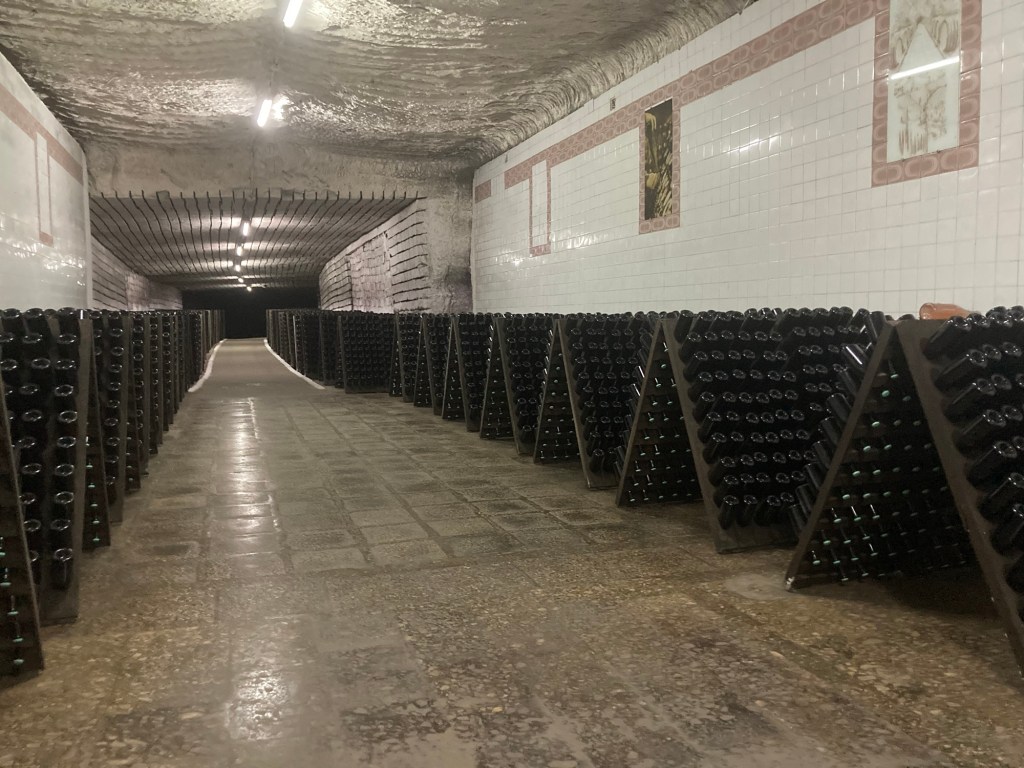
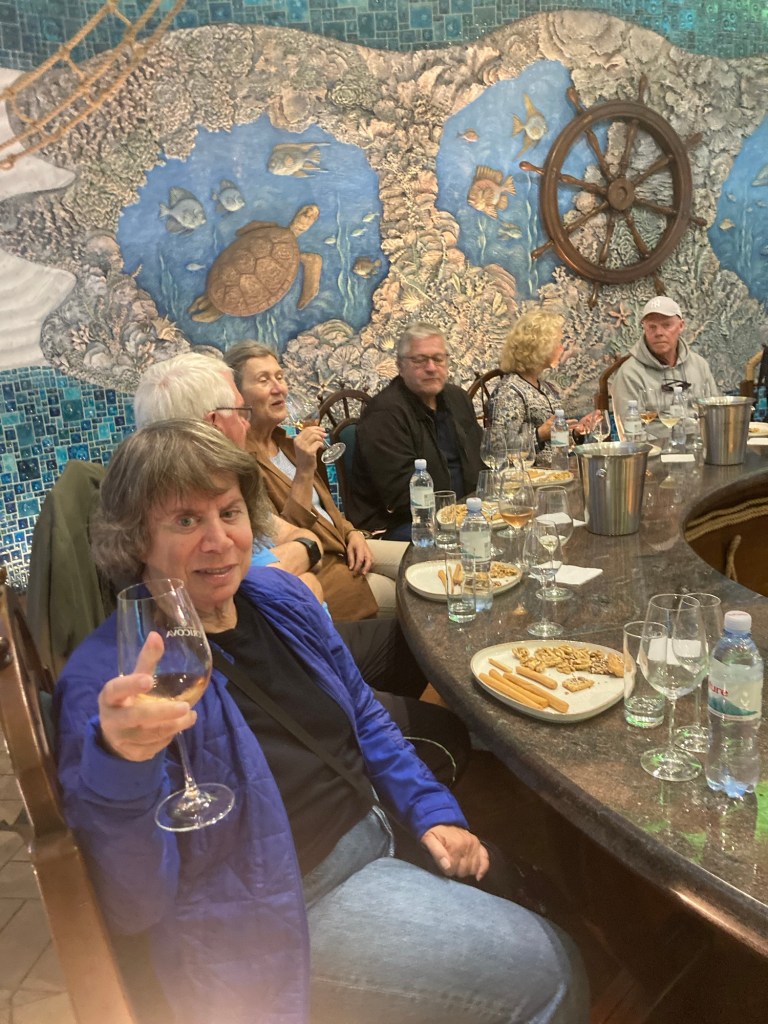
The highlight was a tour and tasting at the country’s second largest winery, Cricova. Over 120 kilometres of limestone tunnels store in excess of 12 million litres of wine. Me and a group of 13 Norwegian tourists were driven through the tunnels, stopping at bottle storage locations, a small museum and the private cellars where celebrities kept their collections until arriving at one of 3 wine tasting rooms

We sampled 4 wines, one each of red, rose, white and sparkling, which is sold as Crosseco, a nod to Italy’s Prosecco.

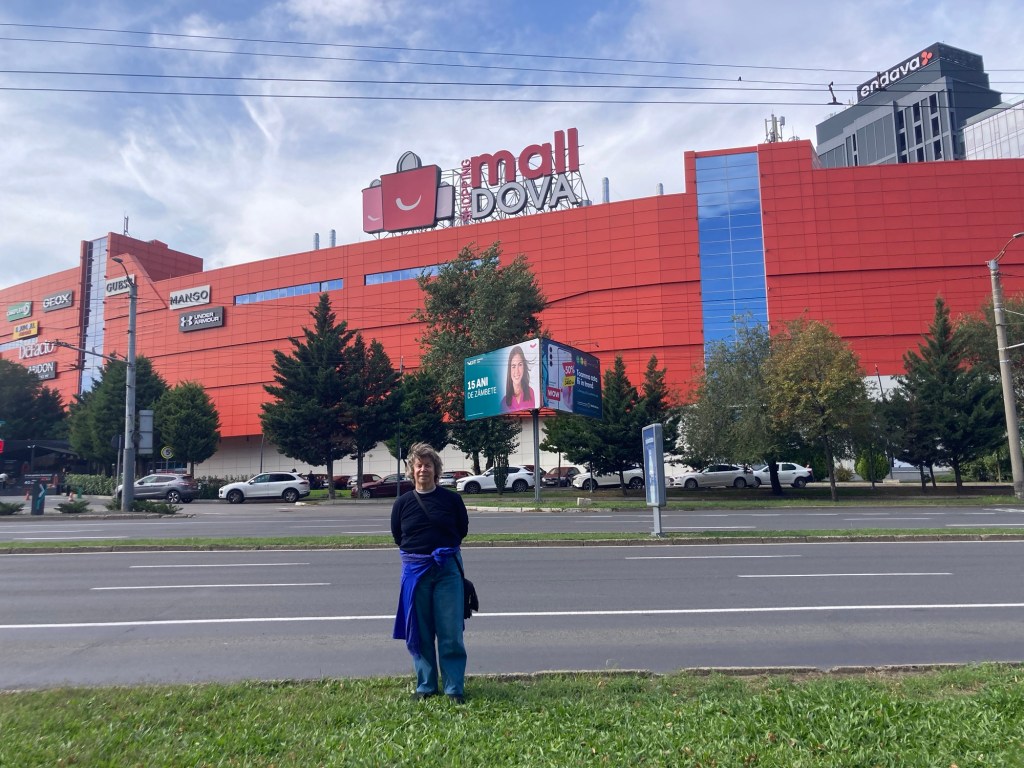
Next up was a tour of Chisinau starting with a picture of the iconic “MallDova”

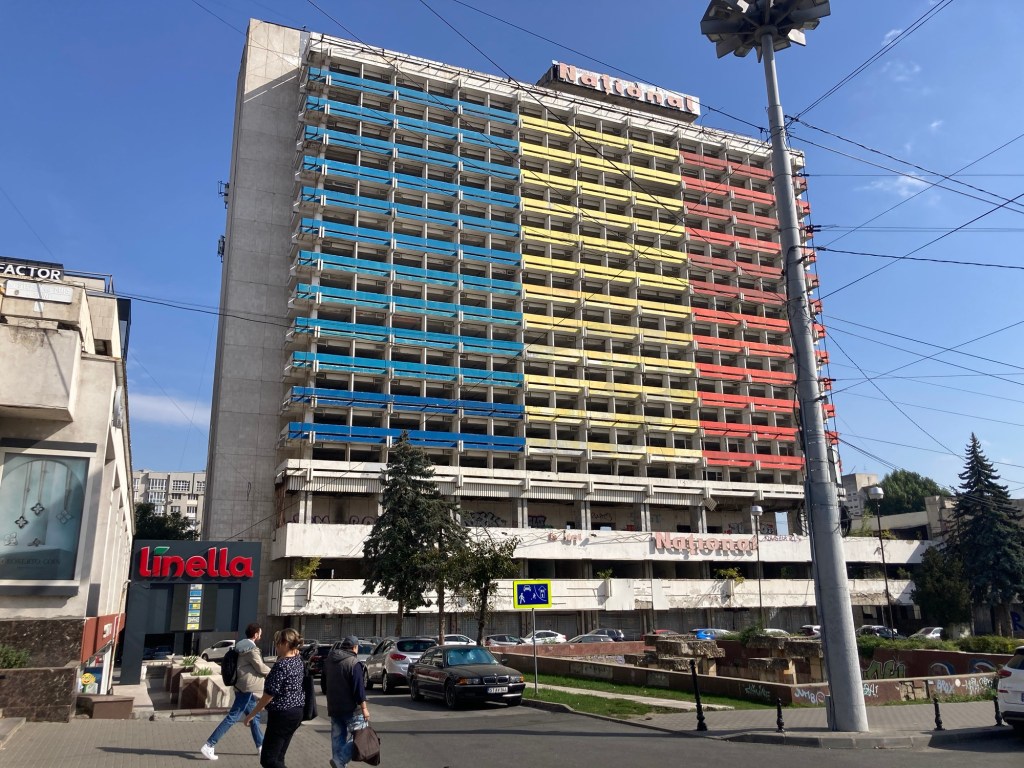
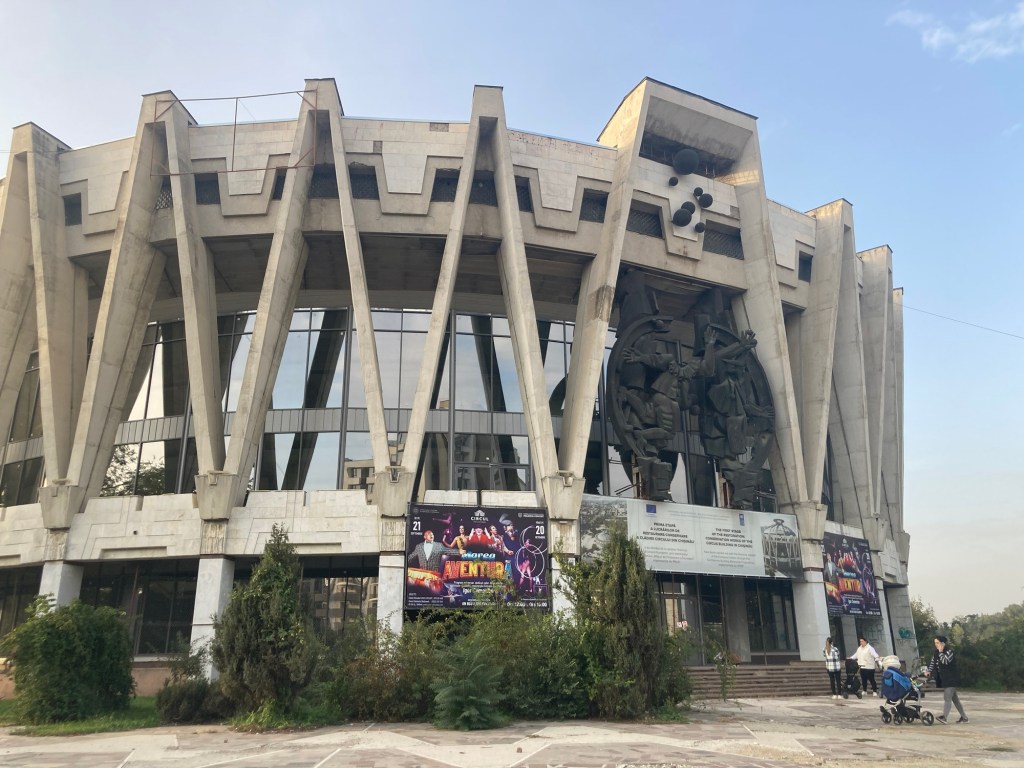
Chisinau has a mix of Soviet architecture and more modern buildings but my favourites were two abandoned buildings, one the former National Hotel, a grand Soviet monstrosity and the Circus building, where the circuses performed:

The former national hotel
The Circus Building

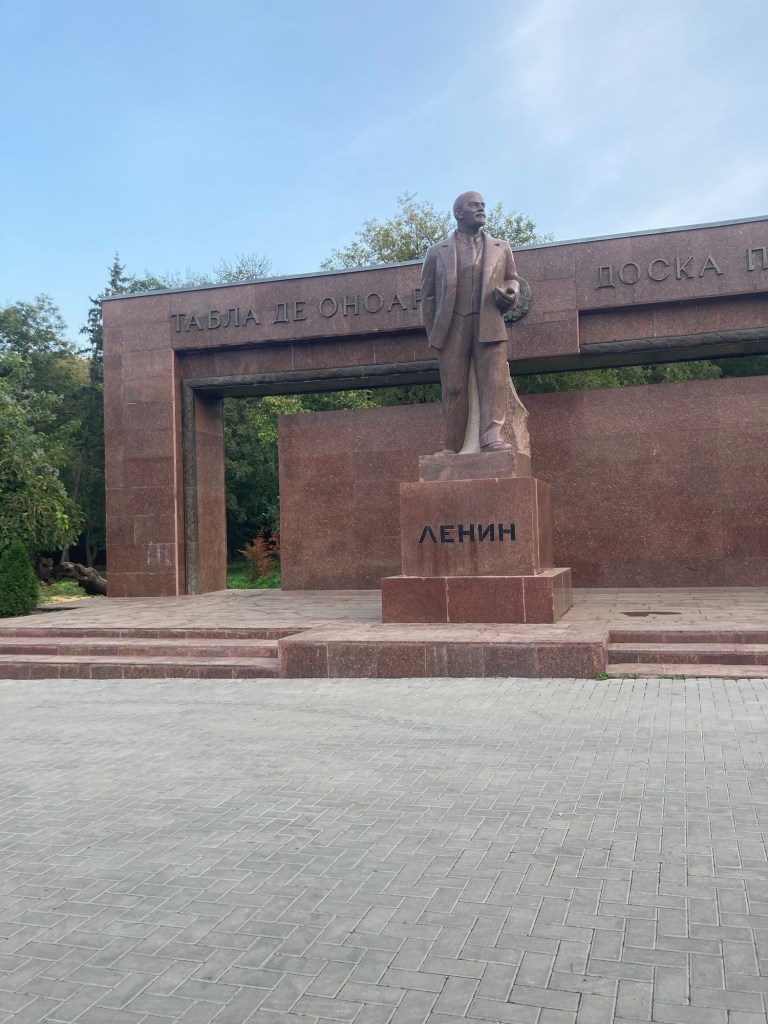
The inevitable statues of Lenin, Marx and Engels no longer were displayed prominently, but they weren’t too hard to find:

Lenin

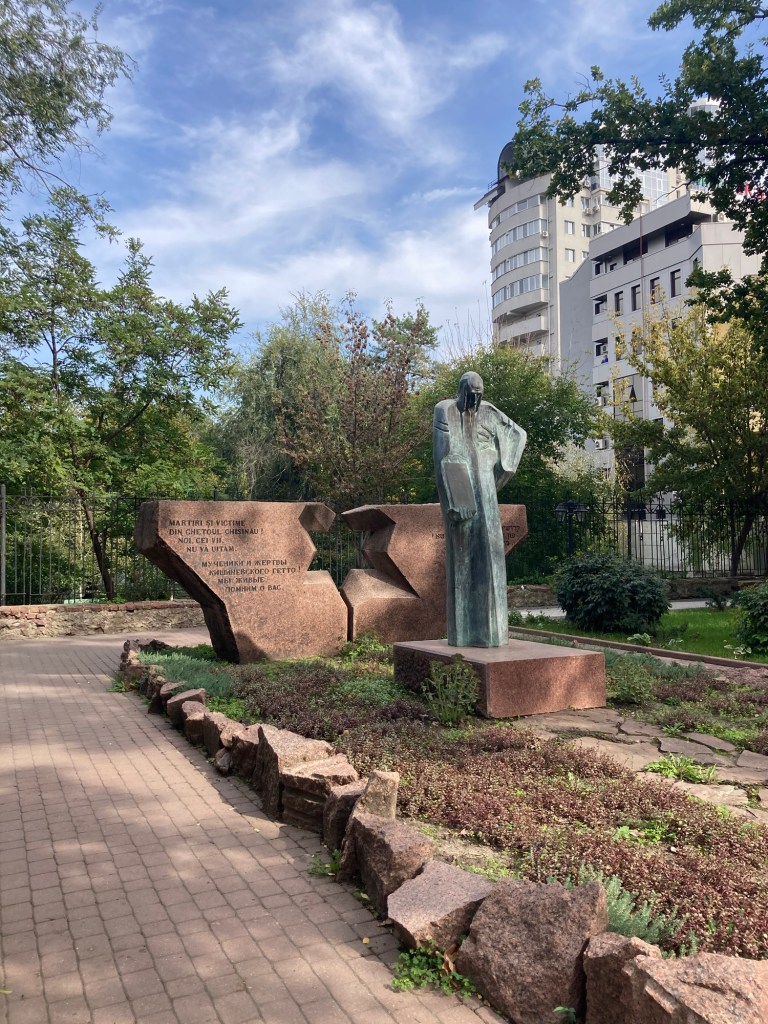
Moldova’s population had, prior to WW2, been 50% Jewish, but occupation by the brutal Romanian nazis and pograms during the Soviet period which followed decimated them. There are abandoned synagogues, numerous cemeteries and a memorial statue where the gate to the Jewish ghetto once stood in Chisinau:

Memorial to the Jewish population

And now for the weird. I’ll spare you a long history of the area, but it’s fair to say since the 1400’s, the current area of Moldova has been fought and ruled over at various times by Romania, the Ottomans and Russia. After WW2, it became a republic of the USSR, with a Romanian speaking section west of the Dneipster river and a mostly Russian speaking population to the east in an area known as Transnistria. In 1990, when everyone was declaring their independence from Russia, the whole of the republic Moldova also did.

Moldova, being a small country, seriously considered joining Romania. It also enacted a law making Romanian the official language. Neither of these actions was appealing to the Russian speaking populace of Transnistria so, in the spirit of the time, it declared itself independent from Moldova. Moldova did not like this and sent in troops.

A civil war ensued and 2,000 were killed on the Moldovan side. Russia stepped in and enforced a peace. Russian peacekeepers are still in Transnistria today and an odd state of affairs remain, with Transnistria considering itself an independent country, which no other country recognizes and Moldova, considering it part of Moldova.

In support of its independence, Transnistria has its own money, its own government, its own law courts, its own military etc. To enter “the country” one has to cross the border, go through passport control and get a visa. Because of its status, it is economically shunned by all countries except Russia. There’s no McDonalds, credit cards aren’t accepted and Moldovan SIM cards don’t work.

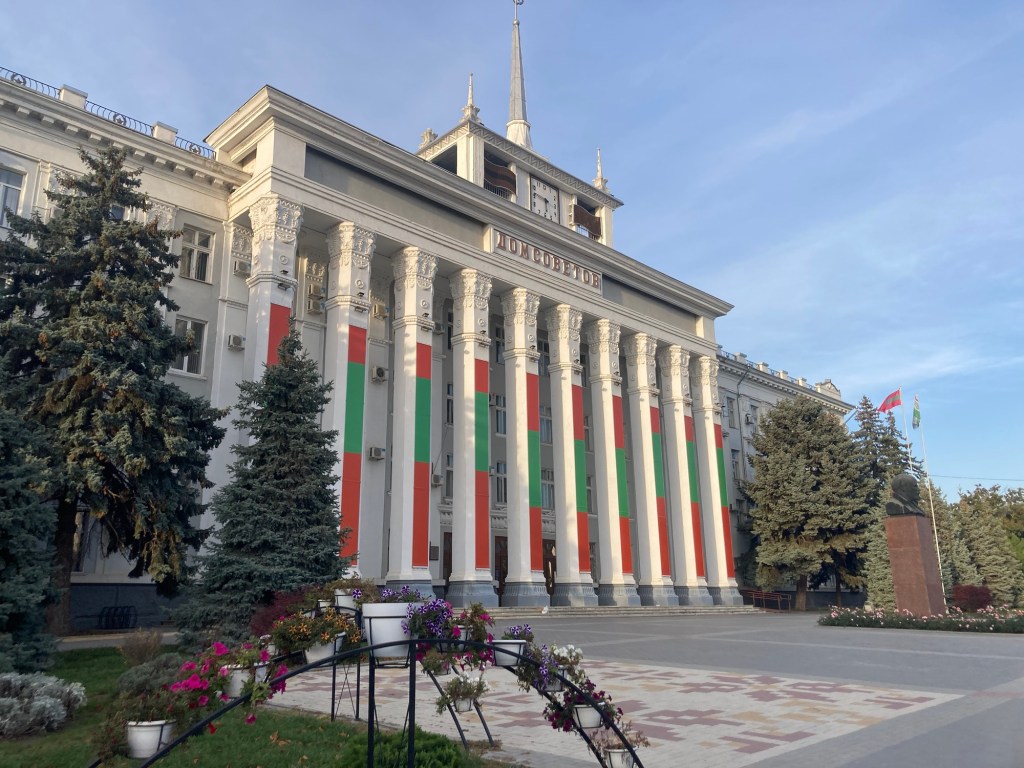
We visited two cities here; Bendery and Tiraspol. Both, in some ways, are throwbacks to the Soviet era, with the city hall in Tiraspol the epitome of Soviet brutalist architecture:

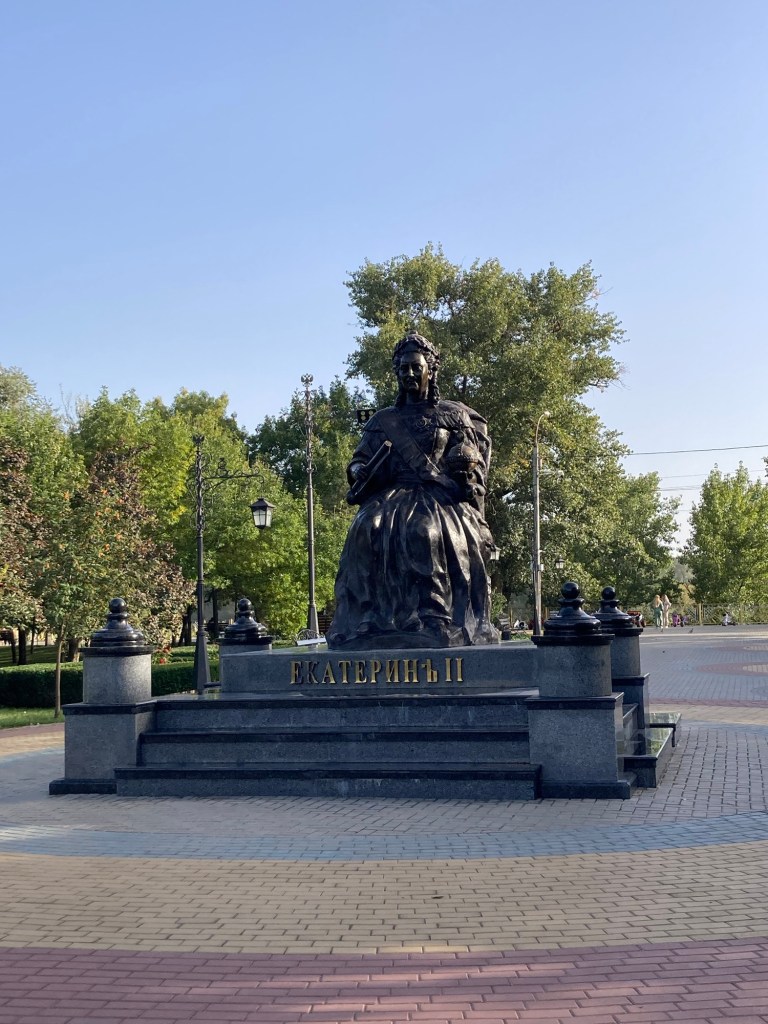
Reminders of Transnistria’s closeness to Russia and its Soviet past were everywhere, from its excessive (in my view) adoration or Russian generals, to statues of Lenin to homage to the Motherland:

Statue of Catherine the Great

But in the end, its people weren’t that weird. The markets were full of the same food we’d see back home, except everything was organic and no citrus fruits were available. People drove the same cars , but for a Volga, kids in uniform raced home from school and young girls sporting obviously fake fingernails chatted on cell phones.

And so ended my days in Moldova. Pretty, a little different, glad I went but not sure I’d race back.

Next up…the place where everybody got it all wrong..,..,

Castles, Cathedrals and a lot of Trains: The UK

I’ve been to the UK countless times but mostly stay in London or the south. Realizing there were large swaths of the United Kingdom I had never visited, I decided to remedy this deficiency with a train journey through some of its iconic places.

I chose the stops mostly based on their proximity to famous Cathedrals or Castles, so my itinerary ended up being York, Lincoln, Warwick, Llandundo, Cardiff and Bath.

Using trains seemed to be the most practical means of transport and the British Rail site was easy enough to navigate to purchase a pass and reserve seats. Fortunately, of the 14 trains I took, only one ran an hour late and posed no problem. But what was annoying was my stupid decision to travel mostly on the weekends, thinking the trains would be less busy. How wrong I was. On the weekend, the football fans travel to their games, beers in hand at 9:00 am, drinking and singing football songs and crowding the trains. I spent a few uncomfortable rides squished in the door compartment listening to some awful singing.

In York, I started by walking the remains sections of the Roman Walls and visiting its massive Cathedral for eveningsong prayers. The Cathedral was originally on the site of a Roman Fort, where Constantine the Great was crowned emperor, then a Norman Church before getting its current form beginning in the 13th century. Nearby are the Shambles, a medieval street which was the inspiration for Daigon Alley in the Harry Potter series:

The Shambled

A number of Harry Potter shops line The Shambles, but the most popular one is a store selling little ghost figurines:

The lines to get in can be up to 3 hours long. On-line shopping is an option, but this apparently defeats the purpose, since the ghost choses its owner, which cannot be done on-line.

The only remnant of York’s Castle is Clifford’s Tower, a 13th century stone building;

Clifford’s Tower

The original wood castle was burned down in 1190, in one of York’s darker periods, when the city’s Jews sought refuge there from a mob. The Jews had originally come to York with William the Conqueror who used them to raise funds; Christians were prohibited from lending money. The Jews had later lent funds to the crusaders, but whether it was anti-Christian sentiment or a means of eliminating their debt, the York mobs set the castle on fire and killed all the Jews within.

Lincoln had no such ugly history, but it too has a marvellous street lined with Norman and Tudor buildings called Steep street because it is very steep:

Steep Street

There is a mammoth Cathedral and a Castle which retains its original walls. Part of the original 13th century keep remains, but since the 15th century, the grounds have served as a prison. Numerous and public hangings took place here and the building served as the filming location for Mr. Bates’ prison in Downton Abbey.

York Castle with prison inside and the Magna Carta

Deep in the vaults of the prison is one of four original copies of the Magna Carta. Photos of it are not allowed but it was good to see. Two of the other originals are in the British Library and the third in Salisbury Cathedral.

My next stop was Warwick, to see its magnificent medieval castle. Originally a wooden fort constructed by the Normans ( this is getting slightly repetitive), it was rebuilt in stone in the 12th century, played a large part in the Civil War and was turned into a country house in the 17th century.

Warwick Castle

Sadly for me, it was purchased by an entertainment group some decades ago and turned into a playground, with the Grand Hall decked out for an upcoming wedding ceremony and the grounds filled with little boys brandishing toy swords and girls running about in princess dresses. The “ attractions” were mazes and archery displays for the kids with very little for adults. Even the interiors were done up with wax mannequins representing 1920’s lifestyles:

Think Windsor Castle goes to Disneyland. Very disappointing!

I embarked on a 4 train, 3 transfer trip to Llandundo ( pronounced Clindinda) in Northern Wales. A cosy seaside town, it received large sums of public funds in the 1870’s to develop itself as a beachside resort, which it did very nicely with lots of well preserved Victorian hotels:

Llandundo

I had signed up for a bus tour of Snowdonia National Park and 3 Castles. Our first Castle was Conwy Castle, in Conwy:

Conwy Castle

We drove through Snowdonia Park, where our view of Wales’ tallest mountain, Mount Snowdon, was obscured by the rain clouds. Lunch was at The National Slate Museum, on the premises of a former slate foundry.

The National Slate Museum

Much of the equipment was on show, along with a display of slate splitting. While slate ( along with coal, tin and copper) had made Wales rich in the 19th and 20th centuries, most of the mines have long since closed.

Castle 2 was Dilbadarn, built by a Welsh prince, and not so impressive:

The last castle, Caernorfarn, is where the Prince of Wales is crowned. The ceremony arose after Edward 1 of England captured the Welsh in the 13th century but declared he would make the Prince of Wales someone born in Wales who didn’t speak English. When his son was born at Caernarfarn Castle a few days later, he made him Prince of Wales.

Needless to say, Edward 1 is not remembered fondly by the Welsh, as evidenced by a sculpture at the castle:

King Edward 1

Next up was Cardiff, the capital city of Wales, where I visited yet another castle:

Growing slightly tired of so many castles, I indulged in a Welsh Cake or two:

Made from flour, sugar, butter and raisins, they taste a bit like baked cookie dough.

Next stop was Bath, where I toured the Roman Baths:

I joined a walking tour, where the focus was on some of Bath’s architectural treasures like the Royal Crescent, a semi-circle shaped group of townhouses constructed in Bath’s distinctive yellow limestone and Palladian style:

I ended in London, where a day long walk took me past the Victoria & Albert Museum, beside Harrods, to Buckingham Palace, Westminster Abbey, St. Paul’s Cathedral and The Tower of London. A final castle, a final Cathedral.

Goodbye United Kingdom, now off to a country of the former Soviet Union..