Biking and Barging in Belgium and Holland

My endeavors to cycle independently through France had met with mixed success; I had made it to St. Malo and Roscoff on my bike, however my overarching success had been to figure out how to use the French train system toting a bicycle. It turned out to be fairly easy – just find a train and a train car with a bicycle symbol and wheel one aboard, pushing aside all those baby carriages and wheelchairs who deigned to park their apparatuses in the exclusive bicycle section.

Unwilling to concede defeat to the bicycle and buoyed by the beautiful photos posted on Facebook by two of my colleagues who were cycling independently through The Netherlands and Belgium, I signed up for a week long Bike and Barge tour offered by tripsite.com, going from Bruges to Amsterdam during the tulip season. We would cycle the flat bike paths in Belgium and The Netherlands during the day and meet up with our barge/floating hotel each evening. It sounded like a very civilized way to tour a country and get some exercise.

My first hint that things might not go smoothly was upon receiving the joining instructions – the group was to meet at Schiphol airport in Amsterdam to be transported to the barge moored in Ghent. I had wrongly presumed a trip titled “from Bruges to Amsterdam” would start in Bruges and had booked a hotel there for the preceding 3 days, thus requiring me to take a train to meet the boat in Ghent.

The barge, named the Clair de Lune could not be described as luxurious; perhaps functional is a better label. The top part contains the bridge, with the steering wheel, a large interior dining area/lounge and a sun deck with a box containing life vests should they be needed. Below deck were 9 single and double cabins. My cabin was bigger than the couchette I had on the Australian Ghan train, but that’s not saying much. A single bed, a tiny sink, a toilet that used river water and a shower that was smaller than a breadboard. As I said, functional not luxurious.

IMG_6270(1)
The Clair de Lune

Age (pronounced aghher) , a 65 year old former IBM project manager and our tour guide, met me at the boat and helped me aboard. I was introduced to Michael, the skipper, and Chris, the cook and second (and only) mate. In the next few hours, I met my fellow 16 travelers, 4 Australians, 2 South Africans, 2 Germans, 8 Brazilians and me. Between us, there were 2 doctors, a dentist, a pathologist, a leukemia researcher, 2 lawyers, a nurse, an engineer, a teacher, a pharmaceutical consultant, some housewives and 2 businessmen. The youngest was 44; the oldest 72. It was a congenial group although the Brazilians were not the best at being punctual, which drove the Australians crazy. Best of all, not a single smoker.

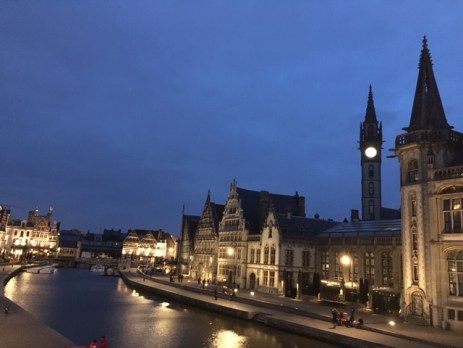
After Chris served us the first of many hearty meals, Age fitted us on our bikes and we rode 5 kilometers to the center of Ghent, where we had a brief guided tour. As was becoming the custom in the Belgian cities visited, there was a marvelous belfry near the town square, a Cathedral, too many churches to count and 2 old castles, all nestled between ancient canals and cobblestone roads.

IMG_6219(1)
Ghent by night

Most of the group took the train to Bruges the first day, but since I had just spent 4 days there, I chose instead to walk around Ghent. I visited Grovensteen castle, where the audio guide seemed focused on its builder’s (Phillip of Alsace) inability to procreate and the various means of torture and execution preferred in medieval times. An entire room was devoted to medieval torture instruments, making current interrogation techniques seem kind and gentle.

As Ghent is a canal town, a canal boat tour seemed in order. Five minutes after embarking, the skies opened up and the rain cascaded upon us. The boat operator/tour guide spent most of the time racing under one bridge to the next, but did provide a good history of Ghent’s golden age. Like Bruges before it and Antwerp later on, its fame in the Middle Ages came from its strategic location on a river that led inland from the North Atlantic, becoming a trading centre as its multitude of still existing warehouses attest, and wealthy from the tolls collected from the use of the canals.

The next day was our first real cycling day – 50 kilometres to the city of Dendermonde – alongside lazy canals with lovely, secluded bike paths running on each side and the occasional pasture where sheep or cows grazed. Age led the way, wearing a yellow vest, with one of us appointed the sweeper each day whose job was to also don a yellow vest but always be last. If Age could see the sweeper, we were good. If not, we stopped until the last joined up. The Brazilians were intent on documenting every second of their trip, so they made frequent photo stops, took pictures while cycling, raced ahead to film the cyclists coming forward and after a while, even the ever patient Age asked them to reduce their photo stops. Once that was sorted out, the group cycled at a reasonable pace, only about 10 kilometers an hour with a 45 minute coffee break, lunch and small pit stops near interesting things where Age would share some aspect of Belgian history or lifestyle with us. No one tried to race and everyone kept up the pace.

IMG_6257
Me, the bike and lots of sheep

Dendermonde was a pretty, medieval town like the other Belgian ones we toured without the name recognition of Bruges or Ghent. The next morning, we set out for Antwerp, arriving there after 5 hours on our bike at 3:00PM, much earlier than our barge which had been held up at a lock which refused to fill with water, then by rush hour traffic in Antwerp during which the harbour master wouldn’t open the drawbridge to let the boats through. It was a good opportunity to sit outside and enjoy a glass of wine and watch all the Hasidim walk by – the only clue to Antwerp’s position as a diamond industry giant.

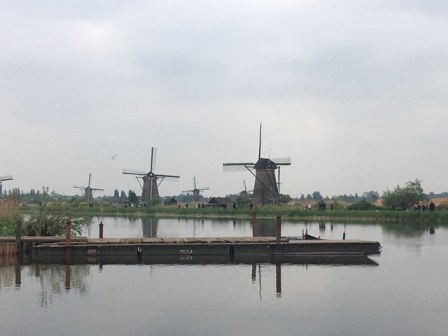
On day 5, we cycled across the border into Holland, with only a small concrete post marking the boundary and began our trek in search of windmills. Soon enough, we arrived at Kinderdijk, the place of 18 windmills and a bustling tourist attraction, with busloads of Asians doing their European highlights tour and river cruise excursions bringing scores of Americans to the Visitor Center, both likely part of a concerted effort to get tourists out of the overly crowded Amsterdam. The mills themselves were beautiful against a backdrop of cloudy skies and the video, which explained the purpose of the windmills (water level management) and their mechanics, informative.

IMG_6362
The Windmills at Kinderdijk

From Kinderdijk, we cycled to Gouda, home to Gouda cheese. The barge was moored close to the main square, which again was charming, with a town hall and medieval hall which weighed the cheese and other goods for tax purposes. I located a cheese store and sampled all their different varieties of Gouda- green pesto, black lemon, almonds – before settling on a medium, an aged and a spicy red pepper one and posing for the obligatory picture holding a (plastic and hollow) round of cheese.

Day 5 had been all about windmills and Gouda cheese; day 6 was devoted to tulips. Our trip had been advertised as a tulip tour; unfortunately Mother Nature had the final say. Thanks to a prior week of glorious sunshine and hot weather, most of the tulips had blossomed early and the farmers had cropped their fields already. We were able to locate a few still carpeted with flowers, where everyone sang Tiptoeing through the Tulips and took pictures, but the best display was at the Keukenhof, botanical gardens outside of Amsterdam ablaze with tulips of all colours and varieties. The tulips there are planted sequentially, ensuring a longer bloom. The gardens are massive; I spent 3 hours there and wished I had more time.

We cycled to Amsterdam and met the barge for one last city stroll, dinner and an evening of drinking and exchanging email addresses. We had cycled about 250 kilometers, endured 2 flat tires, 1 bike falling into the canal (but fished out again) and 2 falls where the worst damage was some scraped knees. The bike and barge had been a nice way to see Belgium and The Netherlands. People were uniformly friendly along the route, the pace relaxed and I felt that I was able to see some of the “real” country.

I was reluctant to do much touring in Amsterdam. I’ve been here before and the crowds are unreal, but I couldn’t resist a canal boat ride, some pancakes, some brownies and stopping in at the Rijksmuseum to see the All Rembrandt show, featuring all of Rembrandt’s paintings and most of his sketches. I enjoyed it so much I abandoned my pledge not to visit any more art galleries and went across the road to the Van Gogh museum. It exhibits his early paintings in Amsterdam followed by his Impressionist period in Paris through to his madness and ultimate suicide in the south of France. The gallery does an excellent job of explaining Van Gogh’s paintings through his interests – whether about religion, nature or the peasant lifestyle – and his influence on his art friends and later painters.

After 5 weeks in France, Belgium and The Netherlands, where it seemed to rain for all but a few days, I am off in search of sunshine in Croatia.
Three days in Brussels

I had last visited Brussels in 1979, my first stop on a backpacking trip through Europe with an EuroRail pass and a copy of Europe on $5 a day. I stayed in a hostel, visited the Grand Place and sadly realized that $5 per day would not allow for guided tours, chocolate samples or buying lace.

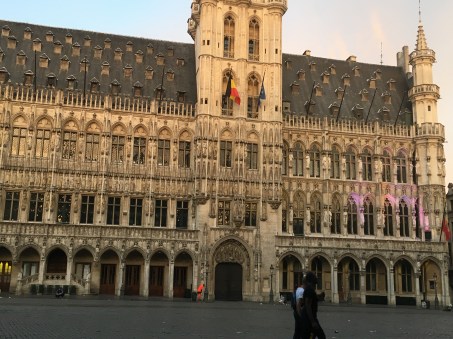
I returned this week with a more generous budget and a longer list of places to see. The first stop was still the Grand Place, the medieval main square at the center of the old city. It hasn’t changed much in 40 years, but the large number of tourists was a big shock compared to the relatively foreigner free towns I had just come from in Brittany. Despairing of getting any photos without large crowds, I returned the following morning at 6:30AM to take some pictures, the square empty but for a group of young Americans still partying from the night before and the street cleaners.

IMG_5837
The Grand Place – City Hall

Brussels: The Walking Tour:

I joined a walking tour offered by Sandemans, a local “free, tip what you think it is worth” tour led by Magalia and her dog, Joseph. We started in the Grand Place, where Magalia provided a brief history of the architecture of the buildings. It had been a market square for centuries. The City Hall, still in use today, is a excellent example of 14th century Gothic style, except for the fact that it completely lacks symmetry. The entrance, topped by the 90 foot spire, is off-centre, as are other features, the result of too many architects and spontaneous innovations. The remaining buildings are all Baroque style guild halls, dating from the 18th century, reconstructed following the complete demolition of the original, wooden structures by the French king, Louis XIV, on one of his quests for more land.

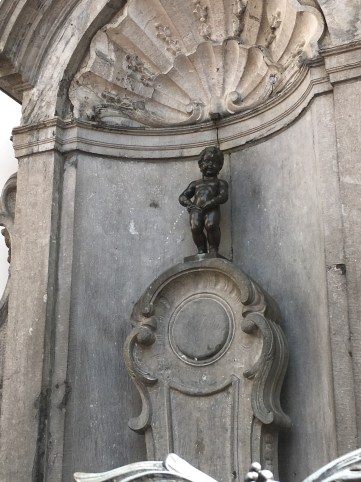
Just a block away is Manneken Pis, a bronze statue which translates into exactly what it looks like, a peeing boy. Mention of it was reported as long ago as the 15th century, but it took its current location in 1618. In fact, it is a replica – the original is in the City Museum. Much beloved and considered the symbol of Brussels, the city employs a full time tailor to put different costumes on it 2-3 times a week, such as Santa Clause, Dracula and Madonna.
IMG_5853

From architecture, Magalia turned to talk of Belgium food, specifically beer (the best), waffles, chocolates and french fries. According to her, fries were invented by the Belgians, but Americans, seeing them for the first time during WW1 with persons speaking French, incorrectly assumed they were “French fries” and the name stuck. True Flemish fries are cooked in animal fat twice, to get the outside crispy but keeping the inside soft. She recommended the Café Georgette for some of the best fries. I order a portion there later that day. They came wrapped in a paper cone and were good, but I’m not sure I would say they are the best ever.
From the Grand Place, we walked to St. Michael Cathedral, an example of early Gothic architecture, more simply decorated than middle Gothic architecture. This Cathedral was finished just 12 years after Notre Dame and bore many similarities, but no rose window.

Brussels is a mecca for Modern Art and we walked in one of the districts, but it was closed and deserted on Easter Monday. Magalia entertained us with a short history of Belgium. There is no traditional Belgium language (French, Flanders Dutch and German are the official ones), tribe or land. Rather, Belgium was occupied and fought over at various times by its neighbors the Dutch, French and Germans, along with the British, Spanish and Austrians. In 1830, in part to stop the continual warfare between the states, Belgium was proposed as a separate entity to provide a buffer zone between the warring countries, on condition that it always remain neutral. A king (from a German family) was appointed and Belgium came into being. It remained neutral until WW1. Germany sought safe passage through it to attack The Netherlands, fully expecting to receive it since Belgium was supposed to be neutral. King Phillip had other ideas and rejected the German request. Thus, Germany invaded Belgium and overran most of it in a few days. So ended Belgium neutrality, but King Phillip became a hero.

The Hollerbos Forest:

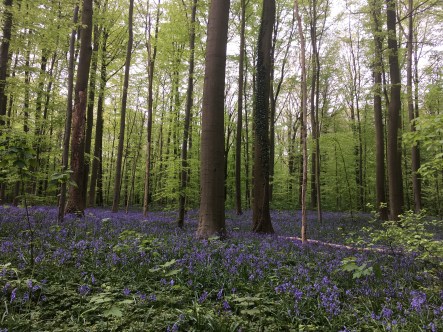
Every April, the Hollerbos forest erupts in a sea of violet bluebells. A short train ride to the Halle station, followed by a 10 minute bus ride on the 114 (Brussels transit system is fairly easy to figure out), I arrived at the gates to the forest. Stretching about 6 kilometers, it has paved paths for vehicles and pedestrians and some well marked walking dirt paths that took me into the forest proper and away from the tour groups, cyclists, dog walkers and pretty much everyone else into an enchanted garden of flowers, trees and sunlight dancing atop the blossoms. I walked about for 2 hours, mesmerized by the beauty of it all:

IMG_5878

Chocolate Tasting Tour:

Brussels offers chocolate tours appealing to all tastes; how to make chocolate, history of chocolate and the one I settled on, a tasting tour at 5 different chocolatiers. Stefanie, a local studying law at the university, was our guide. As an aside, she told me she was doing her Masters in commercial law and that her tuition, like all Belgians, was heavily subsidized. She paid about 1000 Euros a year, although she was responsible for purchasing her own textbooks.

She promised after the tour we (me and 10 Americans) would all become chocolate connoisseurs. After a brief introduction about the cocoa bean and its components, the butter and the mass (the paste), Stefanie explained why some chocolates, like our first tasting place, Leonidac, sold its chocolate for 20 Euros a kilo but the last ones charged 80 -120 Euros per kilo. Part of it was based on where the cocoa bean came from (Central America, Central Africa, India, Vietnam were the most common), but also the quality of the other ingredients (organic was better) and most importantly, if the chocolates were hand made or machine made. The latter were far less expensive and not as tasty.

Leonidac is one of the oldest and least regarded chocolatiers. Yesterday, Magalia had explained that giving chocolates is a tradition in Belgium and the better the quality, the more respect you were showing to the recipient. If you wanted to insult someone, you gave them chocolates from Leonidac. With a similarly negative introduction, Stefanie handed us each a white chocolate, which is not chocolate at all but only the cocoa butter, and broke one in half to show us the well-defined layers of white chocolate, pralines and a coffee mousse-like center. We all bit in – it was sickly sweet and a bit gritty. Our second sample was a milk chocolate, but again quite sweet.

We moved on to Neuhaus, then to Mary, two mid-range chocolatiers where we sampled different sweets, including a champagne one. The chocolates got darker, the interiors less segregated and more of a conglomerate of flavours rather than distinct layers. We were introduced to “ruby chocolate,” which as its name suggests is a rosy pink colour. Introduced in 2017, it is the first new chocolate colour since Nestles created white chocolate. Why it is pink is a patented secret. Some speculate it comes from red cocoa powder made during processing, others claim it arises when the cocoa bean, which is naturally red, is left to dry for only a few days rather than the normal 60. Others allege genetic modification creates the ruby colour. Whatever the reason, it was tasty.

Our final two stops were at the high end (read hand made) shops of Whittaker and Frederic Blondel. At the latter, “nouveau French” chocolates were offered – dark chocolate with spices and fruit designed to provide a rolling taste explosion in your mouth. The cardamom/blackberry starts with a spicy hit of the cardamom, followed by the freshness of the blackberry and ending with the semi-sweetness of the dark chocolate. This was all getting a bit hoity-toity for me, but the chocolate was delicious and my favourite on the tour. But following 8 tastings, for the first time in my life, I’d had enough chocolate.

Mini-Europe: 

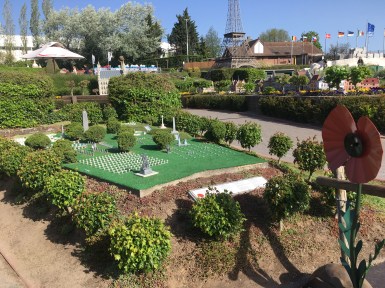
For anyone without the time or means to visit all of Europe but a desire to see all the iconic buildings or for those whose favourite place in England is Miniature World at Legoland outside of London, Mini-Europe is a must. A 30 minute metro/tram ride from the centre of Brussels, this park contains accurate 1:25 reproductions of many of Europe’s most famous sites. The trains move, the ships on the canals sail and the windmills turn. In the miniature bullring, a matador challenges the bull; at the Gdańsk shipyard, protestors carry signs reading “Solidarity.” The giant silver sculpture in the background is the Atomium, designed for Brussel’s World Fair in 1958.

Mini-Europe is newer. It’s theme is European unity and it focuses only on EU countries. Its exhibits are designed to display those that are significant to European and EU ideals: the Brexit vote results are displayed outside of the UK House of Parliament, the Brandenburg gate still shows the Berlin Wall and my favourite,, the Canadian memorial at Flanders Field, showing the world’s involvement in WW1.

IMG_5979
Flanders Field at Mini-Europe

The Africa Museum, the worst museum I have ever visited: 

I finished my time in Brussels on a negative note, the Royal Museum of Central Africa. Going in, I knew it was controversial and dealt with a difficult topic- Belgium’s colonial past – but nothing prepared me for the feelings of dismay and anger from my visit there.

Some history and context is necessary. Belgium’s second king, Leopold II, wanted to join the European colonies in their quest to conquer and exploit Africa. Through savvy negotiating and with the assistance of Morgan Stanley (he of “Dr. Livingston, I presume fame”), Leopold managed to become king of the Congo Free State in 1885. Fortunately for Leopold, the Congo Free State had an abundance of rubber trees, a highly desirable commodity at the time. Unfortunately for the native Congolese, Leopold embarked on one of the worst enslavement and genocide of the local population known to man in an effort to extract as much rubber as possible. Between 1885 and 1908, when the Belgium government wrested control of the Congo from their King, between 3 and 15 million Congolese died through starvation, beatings and execution. Atrocities abounded, most prevalent was the cutting off of hands and feet when a Congolese failed to meet his or her daily rubber quota.

As a result of this exploitation, Leopold II became the richest man in Europe. He used his wealth to fund massive building projects in Belgium, including the palatial structure housing the museum. In a desire to obtain widespread acceptance for his Congo project, Leopold II hosted the Universal Exhibition in 1897 to showcase the potential of the Congo Free State, complete with an authentic Congolese village populated by a few hundred Congolese imported specifically for the Exhibition. In order to make the Exhibition a success, Leopold II ordered his minions to acquire as much African art and artifacts as possible and transported them to Brussels.

For a century, the Palace of the Colonies/Africa Museum exhibited these materials, with the underlying theme of “how Belgium brought civilization to the Congo.” Finally, in 2013, the museum closed for an extensive renovation designed to bring the collection into the 21st century, de-emphasizing Belgium’s “civilizing “ influence and reconstituting the collection to emphasize African life and art. Five years and 66 million Euros later, it reopened  proclaiming its vision to be of a decolonized and contemporary vision of Africa. In my view, it failed in every aspect.

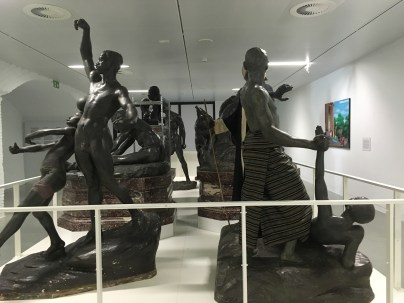
The first room in the Museum displayed  statutes of Africans in various poses which were generally derogatory. The introduction explained, almost red-faced, the source of the entire collection and how the statues were part of an outdated and negative European view of Africa and its colonization that the current museum rejected. The current focus of the museum was to educate people about central Africa and explain its traditions, history, topography, animals and resources, curated with the assistance of various African communities.

IMG_6096
The Statues at the Africa Museum

We were introduced, through artifacts, videos and written explanations in 4 languages, what life had been like in the mid 17-19th century in Africa – birth, initiation (education), religion, rituals and death. This continued through a few rooms, before we came to the animals. In one room were stuffed crocodiles, off to the side and easily missed was a room displaying information about colonialism and Belgium’s part in it

It was a complete whitewash. King Leopold’s horror show was buried under a general discussion about the causes of colonialism – the slave trade and desire for ivory. Only a single board focused on King Leopold in the Congo, with a half dozen photos showing some of the cruelty, a video discussing the genocide, and an explanation that atrocities were committed with the rather banal observation that some estimated millions died but no-one really knew but what was known was there were more deaths in some areas of the Congo than others.

That was it! No attempt to explain or apologize or to analyze the long term effect. The next room was filled with taxidermy animals, an elephant, a giraffe, a hippopotamus. Other rooms identified central Africa’s natural resources and current economic successes. Aside from some history about the differences between Congo, Rwanda and Burundi, the museum steered clear from any mention of politics or conflict. I don’t recall any mention of the Rwanda genocide.

The whole museum was disappointing. Given the money spent and the consultation with the affected communities, I expected an open and honest analysis of Belgium’s role in the Congo,  perhaps some expression of regret. Instead, I left with the sense that Belgium and the museum were too ashamed about its past exploits to address them. For me, that is sad. I left Brussels more than a little disappointed with the Belgians that all the chocolates, waffles and silly peeing statues couldn’t diminish.


Brittany Highlights

After 3 weeks in the region, I will be reluctantly leaving Brittany tomorrow. The area is beautiful, replete with rolling green fields bordered by wildflowers, sandy beaches along the Atlantic coast and enough villages and cities filled with medieval timber frame houses, gothic churches and majestic castles. It’s a history lover’s dream – with its population proud of its Celtic (we are not French, they reminded me) roots, Arthurian ( of the British King Arthur) connections and a bevy of new world explorers, privateers and slave traders.

The people I met seemed more relaxed than in Paris; maybe it’s the small town mentality or the lack of hordes of tourists. People were patient with my attempts to speak French and instead of telling me they spoke English, most asked me if I would like to them to speak English. Walking the streets was a pleasure. Cars stopped to let me cross the street if I so much as looked at the street, zebra stripes or not. At the abundant pedestrian crossings, without fail, every vehicle stopped to let me pass. Cycle paths were plentiful, unfortunately so were hills. That, along with solid rain and cool temperatures, limited my enthusiasm for cycling long distances in the region.

St. Malo:

Following a long day of cycling to get to St. Malo, my legs were in no shape to get back on a bicycle, so I spent the day exploring the city.  The town earned its fame as a maritime city, its Atlantic shores blessed with bountiful supplies of fish and crustaceans. Early inhabitants were fishermen, later it became a center for shipbuilding and exploration. Both Jacques Cartier and Sebastian Cabot set sail for the new world (although Cartier was aiming for China) from here, eventually landing in Newfoundland and Quebec. In the 17th century, the port became wealthy with loot earned by privateers capturing gold laden ships departing South America. Today, in addition to its fishing booty, cruise ships dock here and disgorge their passengers who mostly race out of town on pre-paid shore excursions to nearby Mont. St. Micheal.

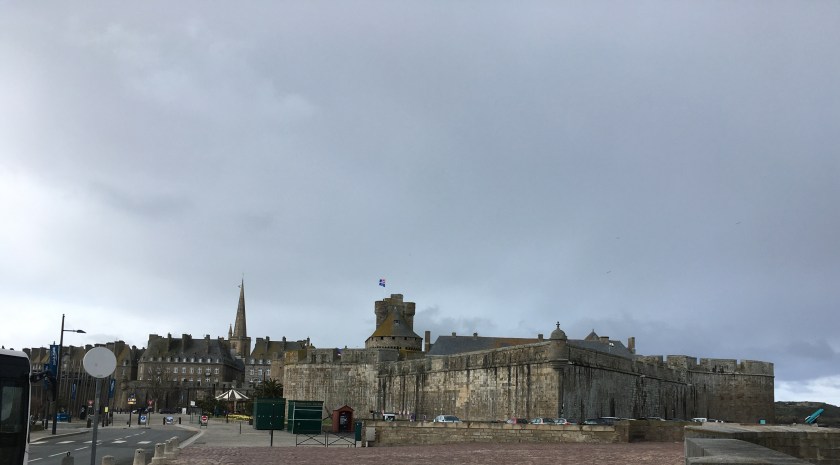
St. Malo has a glorious castle and ramparts. The castle’s foundations date to the 6th century AD, but its current reincarnation was built between the 15th and 17th centuries, Today, it is a museum showcasing the city’s history,  with the exhibits only in French , so my comprehension was limited. But the real star was the building, medieval with thick stone walls, tiny arrowslits and an entrance to the tower roof, where a view of the city and the Atlantic awaited.

IMG_5555
The walls and castle at St. Malo

The ramparts, or walls, encircle about 2/3rds of the old city and were a pleasure to walk, with pathways as wide as 10 feet and paved in large tiles, rather than cobblestones awaiting to trip the unsuspecting walker. Strolling atop the ramparts, all of the architectural features of the city were on display: reconstructed 18th century houses (the city was heavily shelled during WW2), the castle, Fort National built on an island in the ocean, a lighthouse, watchtowers and an outdoor Olympic size swimming pool. Statues of local celebrities dot the path, including at least one honouring a privateer,  a fancy name for a state sanctioned pirate.

Today, St, Malo is best known as a beach town, with two beautiful white sand beaches bordered by pleasant walkways. Maybe it was too early in the season, but there were no signs of the tacky fish & chip shops and salt water taffy stands that deface the British seaside resorts I know (Margate comes to mind). Instead, there were creperies and brassieres (bars). Even the merry-go-round was quaint, reminiscent of a 1920’s model with pink horses and golden curlicues decorating the edges.

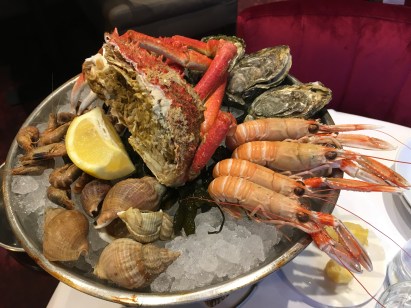
St. Malo is also famous for its seafood – oysters were for sale everywhere – and boat signs announced they had a fresh catch. Restaurants promoted their “fruit de la mer” and I couldn’t resist. After playing it safe with a St. Malo filet (dory) one night, the next I braved the seafood platter. With apologies to my Jewish family and friends, the offerings included oysters, escargot (snails), prawns, whelks, crabs and some things I couldn’t identify.

IMG_5670
Seafood platter in St. Malo

I gave it my best, but the oysters were really salty, the escargots chewy and tasteless, the prawns were fine but mostly bone and very little meat. Having tried at least one of everything on the platter, finishing the prawns and crab legs, I was still hungry, so I had my favourite part of the meal – the pumpernickel-like bread with butter.

Mont. St. Michel:

Beautiful bike routes of about 50 kilometers exist between St. Malo and Mont. St. Michel and my original plan had been to cycle there, but the previous day had seen hail and the day’s forecast was for rain. My bike stayed in storage and I took a train to Dol de Bretagne, then the bus conveniently waiting at the train station to the Mont. St. Michel visitor center to catch the trolley that dropped me and the other waiting tourists to within 500 meters of the island. From there, we were left to walk, using the causeway, or drop down to walk across the sand but as one could only walk on the sand with a licensed guide. I stayed on the causeway.

After entering through the walls, a winding narrow cobblestone alley with shops and restaurants on either side leads, after a heart pounding climb, to the abbey proper. I followed the audio guided tour through the abbey. Originally constructed in the 8th century, it has been rebuilt, expanded and reconstituted over the centuries. Inside are chapels, cloisters, greeting rooms and studies, most open to the public. The decoration was less elaborate than other churches I had visited – no stained glass windows or tapestries – but impressive in its simplicity.

I emerged to a thunderous storm and made my way down the street, ducking into one of the many overpriced restaurants selling Mont St. Michel’s specialties – galettes, crepes, and seafood- and enjoyed a Mont. St. Michel omelette, which was  fluffy with a light cream sauce.

Mont. St. Michel is impressive, but its most awe-inspiring aspect for me was that first glimpse, of the abbey and spire pointing to the heavens, atop an island. I walked the 3 kilometers back to the visitor center, frequently turning back for another view and a picture of the island.

Morlaix:

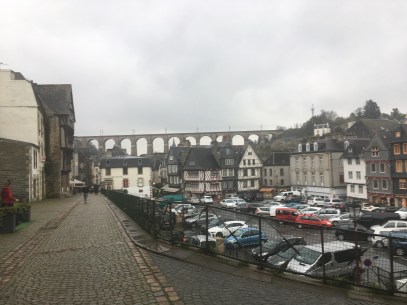
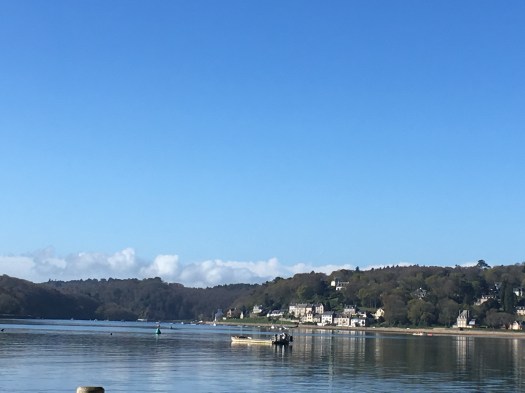
Five days into my 3 week long cycling trip, I’d given up on long distance cycling, but the town (15,000 residents) of Morlaix on an estuary for which I could not find the name (everyone said “the Morlaix harbour” but it wasn’t a harbour as I understand the term) had lots of bike paths. It’s a pretty town, with 123 timber buildings, numerous churches, a viaduct built in 1861 for trains and way too many stairs, which I did my best to avoid.  I stayed in the 200 year old Hotel L’Europe. Morlaix has long been a haven for ships, with the unnamed river/estuary only 6 kilometers from the ocean, but it became rich in the 15th and 16th century thanks to its manufacture of tobacco. An exhibit at the former tobacco manufacture plant explained the relationship of Morlaix to this industry and boasted that Morlaix had the largest number of smokers in France in the 1990’s. The plant is now an arts school and no cigarettes are made in the town anymore. Sadly, pretty as Morlaix was, its former market square had been turned into a parking lot.

IMG_5729
Morlaix, with the viaduct and former market square

Roscoff:

Roscoff is a small city on the Atlantic about 28 kilometers from Morlaix. My desire to cycle there was met with the dilemma of too many options. My Voies Vert (green routes for cyclists) book had one route, GoogleMaps another, maps.me a third and the signs with a green bicycle saying “Roscoff” pointed to yet another. I choose to follow the green road signs, which didn’t mention the route is probably good training for the Tour de France, with way too many steep climbs for my liking and a few off-road treks through farmers’ fields ripe with the bright yellow blooms of canola or smelling of manure. The signs were relatively easy to follow- only one wrong turn easily remedied when the  path led straight into the ocean – and less than 4 hours later, I arrived at my destination.

Roscoff is primarily a fishing and pleasure boat center, having no discernible beach. Its buildings spanned the centuries, its main church topped with a unique spire emphasizing its square building blocks, and plenty of restaurants lining the marina. I stopped for a typical Breton pastry, the Kouign-Amann, which is butter and sugar added to a croissant-like dough. Not great for dieters, but warmed-up, it was the perfect reward for a long bike ride. After demolishing one in quick fashion, I took a look at the brewing storm clouds and began the long ride back to Morlaix. I was drenched by the time I made it back, but nothing a hot bath and a glass of wine couldn’t cure.

IMG_5681
Roscoff

Dourduff:

The one thing I figured out about cycling in France is the route along the river or canal is likely to be flat. With that thought in mind, I cycled the 6 kilometers on the very flat roadway beside the still unbeknownst to me named river from Morlaix to Dourdoff. Despite the roadway being a minor (“D” series) highway without shoulders, the drivers were ultra considerate, always swerving generously to leave me wide berth, sometimes even slowing behind me for a few minutes until the center line became broken and passing was again permitted. Dourduff itself is fairly non-descript but offers beautiful views of the Atlantic.

IMG_5701
Dourdoff, facing away from the Atlantic

Brest:

Brest is a coastal city on the southern edge of Brittany, so I was expecting another charming seaside town, perhaps with a beach or two and an abundance of architecture. Unfortunately, as my train approached and I read up on the city, I learned that it had been, and still was, the headquarters of the French navy.  Thus, it had been bombed to smithereens in WWII; only a single original castle housing a maritime museum (in French only) withstood the barrage. Today, 1950’s office and apartment buildings line the river and harbour, with high fences topped with barbed wire and signs (again in French) warning it is military property and beware of the dogs. Looking down into the river, I could see a vast array of military ships and submarines. It was not my favourite stop, but its main pedestrian road had a bagel store, called Bagelstein, which made me a very good smoked salmon with cream cheese and red onions bagel.

Quimper:

Quimper marked a return to the scenic, quaint town, traversed by the canal along the Odet river and highlighted by the Saint Corentin cathedral, another gothic cathedral, this one dating to 1239. Architecture in the town again spans the centuries, with an unique Art Nouveau theater. Quimper and its suburb of Locmaria gained fame for its arts & crafts, especially its Faience pottery, for which there is a dedicated museum that is pleasant and informative. Feeling quite touristy, I took the tourist train for a ride around the center and, as the history buff in me demanded, visited the History of Quimper museum, with a large display of stone and Iron Age implements.


Nantes

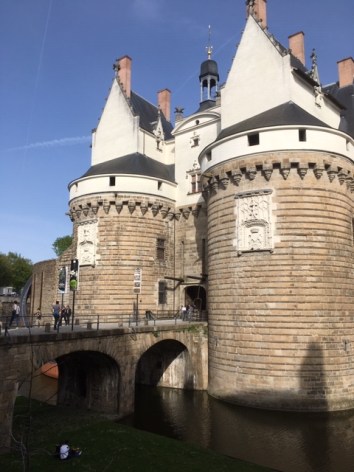
Nantes, a city of 300,000, is the administrative seat of the Loire-Atlantique region. Why it is not part of the administrative region of Brittany is a mystery, but it isn’t.  Situated at the last navigatable point where ships could sail upstream from the Atlantic Ocean along the Loire River, and having two other convenient estuaries, it has a long history as a major port city. Its center is dominated by the Château of Anne, Duchess of Brittany, who had the good (or bad, depending on your viewpoint) fortune to marry two different kings of France, became a patron of the arts and completed the Chateau that bears her name. Entrance to its grounds, via drawbridge across a moat and around its ramparts, was free; the history museum charged but it was worthwhile. Although it detailed Nantes’ long legacy, the most informative displays recited Nantes’ role in the African slave trade.  Nantes’ ships sailed to Senegal, picked up slaves, sold them in the West Indies and returned to Nantes laden with mostly sugar cane, but also tobacco. Nantes wealth – its soaring gothic Cathedral (started in 1434 and not finished until 1891), its canals, its streets and public houses were largely financed with profits made by the slave traders. France abolished slavery during the French Revolution, but Napoleon reinstated it. It was outlawed for good in 1831.

IMG_5785
Entrance to the Chateau to Duchess Anne

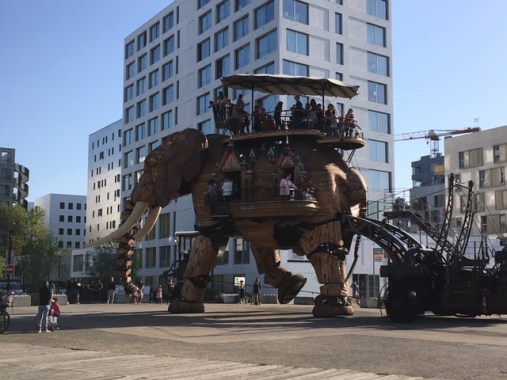
Nantes, more than any other city in Brittany, prides itself on its forward thinking. Many of its buildings represent cutting edge architecture – my hotel had large orange and turquoise green pieces of plexiglass decorating its exterior, maybe resembling sails or maybe the colours of the football stadium which it adjoined. I don’t know. Nantes’ most lauded artistic achievement is Les Machines de l’Ile, a former shipbuilding site that artists turned into a place to construct and exhibit interactive plants and animals made from machines. The crowd favourite is the 3 story high, Grand Elephant, which carries passengers about and can spout water from its trunk.

IMG_5816

And so, with a mechanical elephant, I end my days in Brittany.


Cycling in Brittany

Dervla Murphy, an Irish octogenarian, is one of my favourite travel writers. In 1965, at the age of 30, she hopped on her bike and cycled to India, sleeping rough or in hotelis or truck stops for 1 pound a night, indulging in her preferred beer, Tusker, at least nightly and encountering an amazing number of English speakers willing to engage in far ranging conversations from politics to AIDS that frequently made their way into Ms Murphy’s books.  Her globetrotting cycling  through Africa, Asia and the Middle East and, with her young daughter, over the Andes by donkey, continued until Siberia in 2010 – which proved her undoing – after a fall damaged her knee, she gave up the bicycle but continued her voyage by train and bus, again resulting in an highly entertaining travel book.

She was my inspiration, but I knew I wasn’t going to completely emulate her.  I don’t drink beer and my hotel requirements extend well beyond a room with a bed and door,  but I had planned to do a lot of cycling. The hilly roads in Paris where I stayed in the fall, along with the aggressive nature of its drivers deterred me from renting a bike there and, except for bike share rentals in Sweden and Australia, my resolve to do some serious cycling had thus far eluded me. Returning to France and cycling weather in April, it was time to remedy the situation.

As an avowed fair weather cyclist, I kept watch on the weather forecasts in the weeks preceding my return. The region of Brittany, or Bretagne as is referred to in France, was expecting sunny skies and temperatures in the 20’s. It is also known as a cyclist’s paradise, with numerous velo verts or greenways dedicated to cyclists. Plus, Mont. St. Michel, a place I had always wanted to visit, was within cycling distance. After one last check on the weather before I left Doha confirmed the favourable conditions, I booked a hotel in Rennes, a bicycle, complete with 2 panniers (saddlebags) and a water bottle for 10 days and another hotel in St. Malo, 67 kilometres, from Rennes.

When I landed in Paris 7 hours later, the weather forecast had changed dramatically. For the first few days, the forecast held, but on the day I was to bike to St. Malo, rain and temperatures in the single digits were predicted. I was not happy, but there was little I could do except channel my inner Dervla Murphy, who was never put off by a bit of rain, and make the best of it.

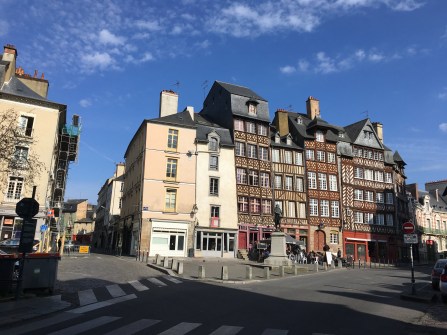
I spent two days wandering about Rennes – it is a beautiful city of 200,000, home to the region’s parliament building and a charming old town. Medieval houses, with timbers criss-crossing the exteriors, dominate the old town.

IMG_5481

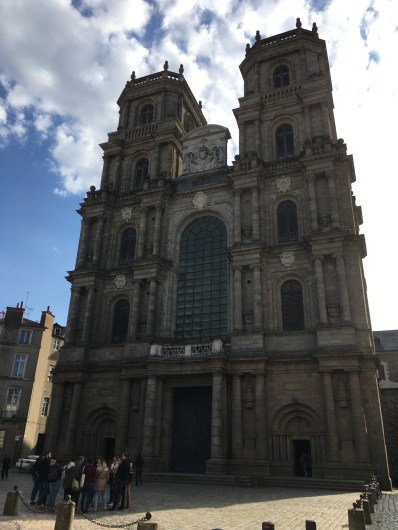
The Cathedral was started in 605 and evolved over the decades from Gothic to classical:

IMG_5472

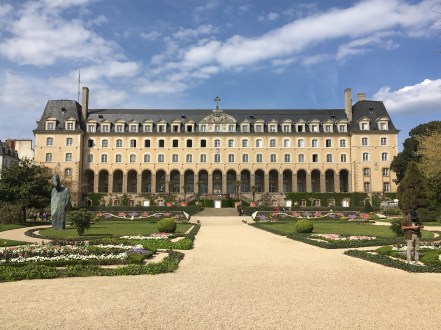
The medieval gates were under scaffolding, but the Park of Thabor, with its traditional French garden design (symmetrical rather than mimicking nature like English gardens) was in full bloom.

IMG_5489

After 2 relaxing days in Rennes, it was time to get serious and cycle to St. Malo. My bike was to be delivered at 9:00AM, plenty of time to beat the afternoon rain if the Google Map’s distance of 67 kilometres was accurate. But 9:00AM, then 10:00AM came and went without signs of the bicycle. After a number of increasingly heated phone calls, my bicycle was finally delivered by an apologetic man who spoke good English. He showed me how to lower the seat, work the gears, unlock the panniers and where the tire puncture repair kit was located. When I shot him a dirty look, he said :

“Not to worry, there are repair shops all along the canal which can help if you have a puncture. Besides, we have reinforced the tires to prevent punctures.”

“Canal?” I queried. “I am going to take the Google Maps bike route.”

“Oh, no, no, no, you must take the canal, Velo 2. It is so much more peaceful,” he explained.

“Is it any farther? I haven’t done a lot of distance biking lately.”

“Not so much farther, but so much nicer.”

“Okay”, I said, “you know better.”

And I was off. Finding the canal route was easy since it was 3 blocks from my hotel, and, as indicated in its name, by a canal. In fairness to my sense of direction, there were two canals so getting on the correct one involved at least a modicum of intelligence. The sign post saying Velo 2 also helped.

The bike route started out beautifully. As promised, there were no cars, except where the path crossed well marked roadways. A few barges made their way upstream. Birds – ducks, geese, cranes – chirped and swooped into the water, completely oblivious to a lone cyclist. Three kilometres out I ran into a sobering sight. Police and an ambulance were tending to a downed cyclist. I do not know what happened to cause his injuries, but it was not an auspicious beginning.

Less than 15 minutes later, another police car slowly made its way up the cycle path. I swerved to let it pass, but instead, it stopped and a 30ish year old officer rolled down the window and held up a machine that looked like a large phone with a man’s photo on it. “Have you seen this man?” I was asked, in French. “No, I haven’t seen him,” I replied still in French. “Merci,” he said, rolled up his window and drove on. “Wonderful,” I thought, “the police are doing a manhunt on my bike path. For all I know, there is a psychopath ax-murderer stalking cyclists and I could be next.” Shades of Strasbourg entered my head, along with recognition of my total vulnerability if someone should try to shoot me. At best, my cycling speed is slow and I was weighed down by two loaded panniers and gears I hadn’t yet mastered. There were few other people around – some dog walkers, a few joggers and the occasional grey haired rambler getting what seemed to be his or daily exercise, a couple of other cyclists on the path – and cars were rarely visible. No one who could take down a gun-toting murderer should he appear.

Since there wouldn’t be much I could do if someone decided to jump out and start shooting, there was nothing to do but put such thoughts out of my mind and enjoy the scenery. Verdant forests lined the path, with occasional wild flowers peeking through the grass. The birds provided a symphony of nature sounds, fish splashed up and back into the water. Despite the cloudy sky, rain fell only for a few minutes a couple of times. I cycled on, listening to the sound of the bike wheels crunching the gravel below. It was heavenly.

After 2 1/2 hours, I sat down on one of many conveniently located benches, close to more conveniently provided water dispensers and a bathroom (an empty campground was nearby), pulled out some cheese, a baguette, an orange and ate lunch. I checked my mileage, only to discover I had done only 30 kilometres. Exactly how much longer than 67 kilometres was this path? Google told me: 107 kilometres. 2-3 hours longer than 67 kilometers at my usual 15 kilometres per hour pace. At the rate I was going, , it would take me 9 hours to get to the end of the path, then be faced with a short ferry ride to St. Malo. I had better speed it up!

Regretfully, the path had other plans. It turned from gentle gravel to large rocks, uphill climbs and slippery downhill slopes on what seemed to me an old logging road, with felled trees and a detour away from the canal. Suddenly there were no people around and the skies finally opened and a torrent of rain let lose. All that was missing was lightning. I got off the bike and pushed it through the now muddy dirt and rocks until, after an hour, the path returned to the canal and the gentle packed dirt. But it was already 3:00PM and my mileage computer told me I was barely half way to my destination.

I considered my options, or rather Google Maps did. The path would take at least 5 hours at my current speed. But if I continued on the path for 45 more minutes, then turned out and followed the roads to St. Malo it would take just another 2 hours. It seemed like the better choice.

After leaving the path, with Google Maps informing my I was 2 hours and 10 minutes from my destination, the instructions from Google Maps got me lost 3 times in short order, once into a farm yard with a frightful looking dog who started barking loudly as I wandered into his territory and another time up the 2 biggest hills in Brittany. After cycling off the path for an hour, I finally saw a road sign for St. Malo. I checked Google Maps – my battery was just about dead and I still had 2 hours and 4 minutes to go! I would have to follow the road signs from here on in, but given how badly Google Maps had mislead me, this was not an unwelcome development.

I cycled on the “D” series of highways, pretty country roads without shoulders but with little traffic and slow speed limits. What they did have were mountains. Now my son would call them molehills, but to me, after 6 hours and not in the best of shape, they were giant obstacles. I did what any sane person would do, climbed off my bike and walked myself and the bike up the mountains. But, dammit, on the third such climb, my legs started cramping!

Seven hours later, with St. Malo still 30 kilometres away, the wind picked up, the rain fell non-stop and I had had enough. My thighs were cramping, not only on the climbs or the walks, but on the gentle cycles on the flats. A small town loomed on the horizon. What would Ms. Murphy do? She would push through to the nearest town, find a grubby room costing only a few pounds, locate the nearest pub, have a beer or two and bear down for the night. I had a not inexpensive prepaid hotel room in St. Malo, could not find a bar to save my life and do not like beer. With a great deal of pain and will power, I made it to the town, found the only sign of life at a training school for bakers of crepes and pizzas (I kid you not) and asked them to call me a taxi.

Thirty minutes later, the taxi driver drove me and my bike the 25 kilometres to St. Malo, took us on an impromptu tour of the town (the prettiest beach in the world he claimed ) and deposited me at my hotel.

Ms Murphy would not choose this ending, but it worked for me. A hot shower, 2 glasses of wine and a dinner of St. Pierre filet (dory) and risotto later and I was a very happy camper.


Doha: Multicultural and Diverse?

I have a list of countries I would like to visit, but Qatar is not on it. Nonetheless, I sit here in its capital, Doha, on a rooftop terrace looking out over the city, skyscrapers lighting up the skyline in brilliant blues, greens and purple, warmed by a dozen artificial fires burning in nearby lamps, slowly sipping a $35 glass of wine and munching on nuts and nachos.

Getting here involved one of my guilty indulgences, no, not wine (although that probably qualifies as another guilty indulgence), but business class flights on long haul journeys. Back in October, when I was searching for ways to make the minimum 24 hour trek from Bali to Paris, 2 things caught my eye. First, business class was not even double the price of economy fare and second, I could take it on Qatar Airlines.

Here comes another guilty confession. Tons of blogs, websites and videos are devoted to reviewing, analyzing and rating different airlines’ business class experiences (see, eg: thepointsguy.com or onemileatatime.com). The self appointed business class critics, who usually fly on points, detail whether flight attendants fail to smile enough, do or don’t address the passenger by name, if the lie-flat bed comes with a thick enough mattress and whether the wifi speed measures up to their expectations. Food and food service is portrayed in minute details: is real china used (plastic is a big no-no), is white linen put pleasingly on the tray, is the meal served in separate courses or, the horror, all at once, and does the wine list meet their exacting standards? They are all pretentious as can be, but I cannot help myself. I lap them up. The one thing they all have in common is identifying their favourite airlines and Qatar is always in the top three (Emirates and Singapore Airlines also earn high accolades).

I couldn’t resist booking the flight, even though it initially entailed an 11 hour wait in the Doha airport. As the date grew closer, I started dreading the layover followed by a 1:00AM flight to Paris. I examined alternatives, and the one that made the most sense was a 3 day layover/mini-vacation/opportunity to get closer to the century mark achieved by visiting 100 countries. I changed my outbound flight and booked 3 nights at a Doha hotel.

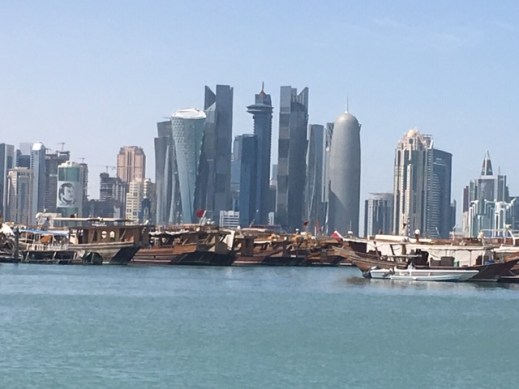
I was in for a treat after arriving at 3:00 PM Doha time. Business class passengers are directed to a private lounge where they are invited to sit while waiting for immigration or, as I was the only one there, to go to the dedicated immigration officer. A quick stop at the HSBC ATM delivered local cash -Riyals – and I was off to the taxi line 15 minutes after landing. The ride into the city goes along side the Corniche, a horseshoe shaped road lining the harbour, affording views of the skyline, replete with architecturally unique skyscrapers shaped like shards or vases, but all having their basis in Islamic Art. Away from the downtown, more traditional buildings made of sandstone, in various hues of white to beige, with flat roofs and arched windows lined with carved awnings, prevailed.

IMG_5430
Doha skyline with traditional dhows in the harbour

My hotel was clean and modern and advertised that guests  could relax by the pool with a drink from the pool bar. It failed to mention that the “drinks” were limited to soft drinks and mocktails. No alcohol was served in this hotel, but the one down the street did. To get in, I had to show a passport (or have a special resident’s permit which I did not). I doubt they were checking for age. Alcohol was ridiculously expensive – the cheapest glass of white wine was $35, although it was half price during happy hour. Going to a liquor store was not an option. State run monopoly stores do exist, but a permit is needed to buy alcohol and I had no desire to get one. Bringing a bottle or two of alcohol into the country is also not an option; it is illegal along with importing pork or drugs.

Despite the alcohol issue, Doha has some pluses. It has lots of sidewalks, unlike Bali which, in the few streets where there was something that might qualify as a path separate from the roadway, cars and scooters saw them as convenient parking spots or  large trees sprouted up, cracking the concrete and making the whole thing a long, uneven obstacle course. It was the one thing I disliked in Bali, my inability to go for long walks unless I risked life and limb walking on the streets.

On my first morning in Doha, I started walking to the Corniche, a distance of about 3 kilometres, enjoying the wide, empty sidewalks, the pedestrian crossing lights and the lack of scooters honking. But, halfway there, I was stymied. The sidewalk ended with construction barricades and there were no pedestrian detours. My choices were to tempt death crossing four lanes of speeding traffic in each direction to reach the sidewalk on the other side or retreat, admit defeat and catch a cab. I chose the latter. It was a pattern that would be repeated more than once during my 3 days, starting down a nice sidewalk only to have it end abruptly with no alternatives but to go back. In Doha, the car is king and pedestrians are an annoyance.

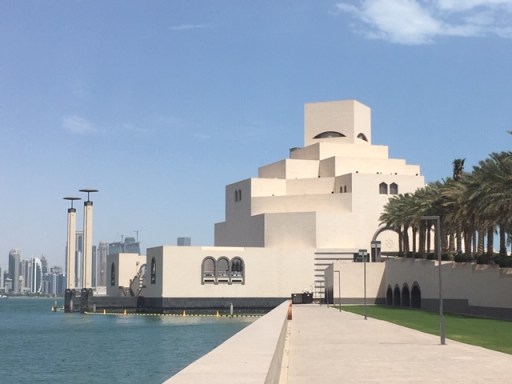
The cab dropped me at the Museum of Islamic Art, another architecturally stunning building. I will quit saying this – all the buildings in Doha that are meant to appeal to tourists are designed by world famous architects, cutting edge design, with no expense spared.  The airport terminal, the sports stadiums (for the 2022 soccer World Cup), the newly built subway stations, and especially the museums all elicit oohs and ahs.

IMG_5404
The Museum of Islamic Art

The museum’s third floor traces Islamic art from its origins in the 7th century through its evolution to today, illustrating its variety with Chinese, Indian and other Asian influences. The second floor illustrates Islamic art in textiles, carpets, calligraphy, buildings and books. It was informative,  well curated, with beautiful examples of each type of art without being overwhelming.

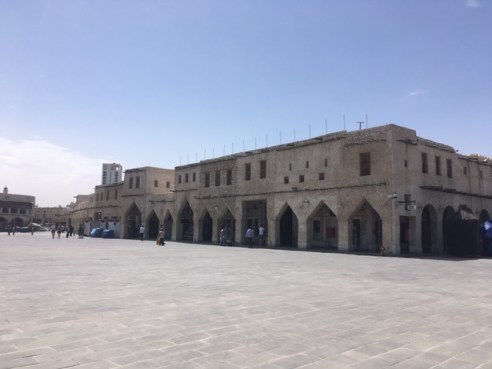
A few blocks away is the Souq Waqif, and using the only pedestrian underpass I saw in Doha (no doubt so that the thousands of cruise ship passengers walking between the Museum and the Souq don’t get killed crossing the road), I walked over. It is a true Souq, an Arab bazaar filled with dark alleyways, men transporting goods in wheelbarrows, vendors politely asking if I would like to see their wares. Although a bazaar has stood on the grounds for at least a hundred years, the Souq was renovated in 2006 but maintains many traditional Qatari features: single story, no set pattern, wooden beams jutting out from the walls to hold the structure. Best of all, very few of the 100 plus stalls sell tourist related items. Spice stores, candy shops, textiles galore, toys and hundreds of colourful tiny birds jammed together in cages. Restaurants and hooka bars surround the Souq. I had my best meal in Doha there, a mutton curry served with the largest piece of a roti-like bread, with complimentary lentil soup and yogurt.

IMG_5411
Souq Wadif

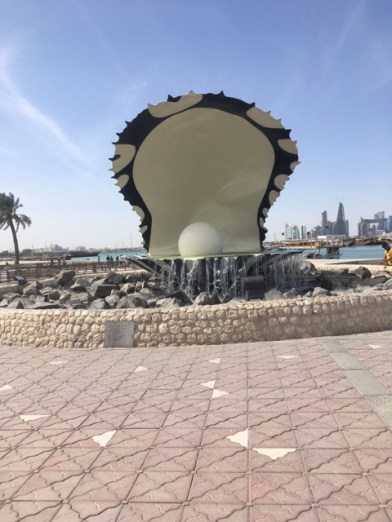
A short walk away is The Pearl, which as its name suggests, is a sculpture of a pearl, a reminder of Doha’s beginnings as a pearl diving town.

IMG_5427
The Pearl

Highly recommended was a visit to The Grand Mosque (aka the Imam Muhammad Ibn Wahab Mosque), the largest and most important mosque in Qatar. Women were welcome, although in separate sections, but children under the age of 5 were not. All religions were also welcome, but with warnings that the mosque had recently been the scene of some anti-Christian and anti-Jewish sermons. I passed.

That night, I read about the grand opening the next day of the National Museum of Qatar.  As reported by Qatar’s daily newspaper, a speech by the Qatari Minister of Culture and Sports indicated this was part of Qatar’s commitment to its multiculturalism and diversity (thepeninsularqatar.com/November 17, 2018). Huhhhhh???? I read highlights of the speech. Qatar was very multicultural as there were over 150 nationalities who lived in the country. Its cultural diversity manifested itself in a variety of cultural pursuits: a film festival, art museums, sporting events, conferences promoting interfaith dialogues. Okay, I guess multiculturalism and  diversity have different definitions.

Intrigued, I scoured the internet for more information.  Of the 2.8 million people living in Qatar, only about 12% are Qatari. The rest are temporary workers, with large numbers from India, Pakistan and The Philippines, making the country truly multicultural. I don’t know if the foreign workers worship in the main mosques, but I saw no churches, Hindu temples or synagogues. I also doubt that most of the migrant workers (westerners aside) could afford the lifestyle lived by most Qataris – private drivers, air conditioned apartments, even the hamburger at the fast food chain was $25. Instead they are housed in cramped compounds on the outskirts of town, transported in on decrepit buses (unlike the air-conditioned buses used in the center of the city) to work long hours for low pay. One Pakistani taxi driver I spoke with had moved to Doha after 12 years in Dubai. He worked 12 hours a day, non-stop every day, for 11 months and returned for the remaining month to Islamabad and his wife and 4 children.

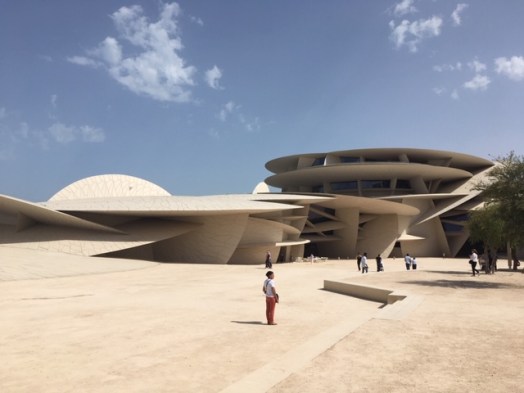
I decided to brave the crowds and attend opening day at the The National Museum of Qatar to learn more about the nation. Not unexpectedly, the museum is housed in a magnificent building, with its contours evoking the desert rose.

IMG_5454(1)
The National Museum of Qatar

Inside, it was refreshing to be greeted by Arab women dressed in long black abayas, all with their hair covered, some with their faces hidden, employed as cashiers and guides. The museum starts at the beginning, explaining the land formations millions of years ago, then identifying the animals and fauna that exist, or did exist in the desert (the Arabian ostrich was hunted to extinction).

The next part focuses on the people, hunter gatherers for thousands of years who converted to Islam in the 7th century. They lived in small tribes, diving for pearls in the Arabian Sea during the summer and heading inland to the desert in the winter to graze their animals. Doha was also a trading stop, with the pearls exported all over the known world. Until the 17th century, little is known about the Qatari region, but it eventually attracted colonial attention. Between the 17th and 20th centuries, the tribes variously fought or allied with British, Dutch and Ottoman forces and did the same with other local tribes in Saudi Arabia, the UAE and Bahrain.

1930 was a pivotal year in Qatar. The Great Depression hit with devastating effect – the economic crisis decimated the demand for pearls and what little remained was filled with the newly manufactured and cheaper, cultured pearls. Fortunately for the Qataris, vast quantities of oil were discovered that same year. Today, Qatar has the second largest reserves of oil, its citizens enjoy one of the highest standards of living and it is often considered the world’s richest country with a GDP of about $130,000 per citizen.

The remainder of the museum highlighted the achievements of the ruling family – an autocratic monarchy which rules with a tight fist (this wasn’t mentioned at the museum) – establishing schools, hospitals, banks etc. using Qatar’s significant oil revenues and lastly, the growth of Doha as a modern metropolis.

Conspicuously silent at the museum were a number of issues: conditions of foreign workers, women’s lack of equality, constitutional rights, freedom of the press or lack thereof….I could go on and on about its omissions. It highlights the Qatari state owned Al Jazeera cable news channel, which is highly respected and is permitted to air critical stories, so long as the stories are not critical of Qatar. For example, a recent story by Danish journalists about the horrid working and living conditions of construction workers in Doha was banned ion Al Jazeera, but this is not referenced in the museum.  Despite the museum being housed in a beautiful building and  providing historical and geographical background of the Qatari people, it completely lacks introspection. Words like “shallow” and “superficial” keep springing to mind.

I decided to do a little more internet research about Qatar and its commitment to “multiculturalism and diversity.”  To become a citizen of Qatar, one must live in Qatar for at least 20 years and have a good grasp of Arabic. Some exceptions exist for wives of Qatari men (up to 4 of them) but none for husbands of Qatari women. “Surely there must be leniency for people like Syrian refugees,” I thought. But no, Qatar is not a signatory to the UN Convention relating to Refugees and therefore does not recognize refugees. A grand total of (depending on the source) 42 (Wikopedia) or 83 (borgenmagazine.com) Syrians were granted refugee status in Qatar by 2017. Qatar points out that it did extend visas for about 50,000 Syrians already in Qatar, but since those people would already have been living and working in Qatar, the gesture seems rather futile. Qatar also provided significant funds (half a billion $) to aid in the feeding and sheltering of refugees in camps, as long as the camps were not in Qatar.

All this left a bad taste in my mouth. Qatar is super wealthy and touts itself as a leading global citizen (it had a seat on the UN Security Council a few years ago), but it does so with elaborate sporting events and grand buildings. It fails miserably in sharing its wealth in any meaningful way, welcoming immigrants (except as cheap labour) or upholding basic (albeit Westernized) human rights.

It does, however, have a very nice airline.


Stalking Dragons in Komodo

People have aversions to one type of animal or another. A good friend refuses to visit Australia for fear of poisonous spiders; another is petrified of dogs and still another went to such extremes as banning barbecues and other forms of outdoor eating to avoid encountering bears at her Lake of the Woods cabin. My particular dislike is reptiles. I refuse to touch a snake, am fearful of crocodiles and not enamoured of frogs since being introduced to the venomous strawberry dart frog in Costa Rica,

I make two exceptions. Turtles and tortoises are benign stately creature that invoke feelings of gentleness and peace, not terror. Then there are lizards. By all accounts, they should be on my Avoid At All Costs list, but for some unfathomable reason, I like them. Give me an iguana park, such as in Guayaquil, Ecuador and I am a happy camper, plopping grapes onto their darting 6 inch long tongues and watching them snap back into their mouths. Or geckos, whose presence deters the far more frightening cockroach and reduces the mosquito population.

Thus, I could not forego the opportunity to see the granddaddy of all lizards, the Komodo dragon. Measuring over 3 metres, weighing up to 150 kilos and capable of running at speeds of up to 20 mph, Komodo dragons are mammoth carnivores. Their numbers, however, are slim. There are only between 3,000 and 5,000 in the wild, congregating on a half dozen Indonesian islands including Flores, Rinca, Komodo and Padar, all 450 kilometres from Bali.

Getting there was a challenge. I took an hour and a half flight from Bali to Flores, enjoying the spectacular scenery below of  hundreds of Indonesian islands ranging from jungle terrain to grass covered mountains, over inhabited islands with rice paddies and fishing fleets hugging the coast to barren volcanic outcrops.

Flores is touting itself as the new Bali, with a population of only 200,000 and the laid back feel that Bali may have had 40 or 50 years ago. Its newish airport, in the city of Labuan Bajo, is aptly called Bandara Komodo and a giant mural of a Komodo dragon greeted me as I stepped off the plane.

After checking into my hotel (with AC, good bathroom, WIFI, pool and ocean view room), I set out for the main town to arrange a tour to Komodo. Labuan Bajo feels small. Although there are asphalt roads and I encountered at least one traffic light, most of the “downtown” lines the harbour, where tour agencies and dive schools dominate the main street. I arranged for a tour to Komodo along with 5 other stops, aboard a fast boat for the next day.

I met my other tour mates in the car doing the hotel pick-ups: a Venuezalan working in Singapore who had worked for two years in London at the University of Western Ontario, a lady from Latvia who, when asked, told everyone she was from Europe because no one had heard of Latvia, and a couple from Singapore, the fellow was working in Jakarta and was fluent in Indonesian. We also met our two guides, Katherine and Sari, neither of whom looked over 18, and our boat captain and his assistant, both chain smokers in their early 20’s. We embarked on our boat, Wonderful Komodo, which had seating for 12, all outdoors except for a small covered cabin which offered minimal protection due to a smashed window, and no bathroom facilities. To provide seating, the crew threw the life vests onto the roof, never to be seen again.

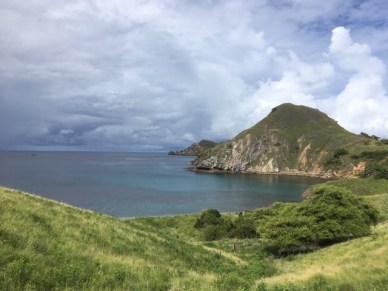
After an hour motoring amongst the islands, we arrived at our first destination, the island of Padar, one of 3 larger ones (and 26 smaller ones) that makes up the Komodo National Park. The Park is dedicated to preserving the Komodo dragon, whose survival is in doubt due to villagers killing the dragons’ natural food (deer and pigs) and environmental pressures like fires. Tourism is viewed as a possible saviour – the fees and employment brought by the tourist trade provides strong incentives for the Indonesians living on the islands to work to preserve the animals rather than kill them.

We disembarked at Padar, paid the park entrance fee and climbed up one of its many hills to enjoy breathtaking views:

IMG_5224

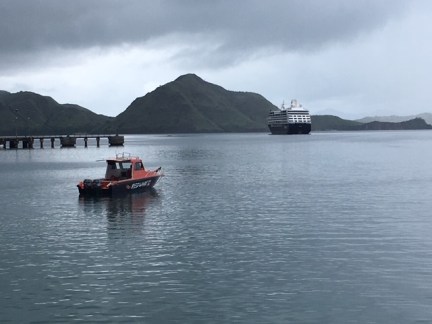
Another 30 minutes by boat and we approached Komodo, where, to my chagrin,  a cruise ship was moored in the harbour. I shouldn’t have been surprised – this ship had been the subject of an episode of Mighty Ships and the stop at Komodo was one of the highlights. Still, after all the challenges I had faced to arrive at Komodo, I felt a little cheated to see the ship there, It certainly detracted from the remoteness of the place.

IMG_5236(1)
Cruise ship off of Komodo Island

As we approached the park office, our luck with the weather ran out. We had been one step ahead of ominous rain clouds all morning, but they caught up with us and opened with a flood of water. We took cover under the tarpaulin shielding the eating area, but after a while there was 6 inches of water underfoot and we were all sitting high on benches in a vain attempt to keep our feet dry. Our guides gave us a choice – wait out the rain (it could be a very long time), or don rain jackets and go visit the dragons. We chose the latter.

As required, we paid the ranger fee and met our ranger who told us the rules. “The dragons are dangerous”, he explained. “Stay on the paths, in a group and if approached by one, let me handle it.” He carried a yellow wooden two pronged pitchfork, which would be used to tame a dragon if it came near. “The dragons have a third eye on the top of their head and if the stick was placed there, it disorients the dragons.” With that, we started along a path towards a watering hole where dragons often congregated.

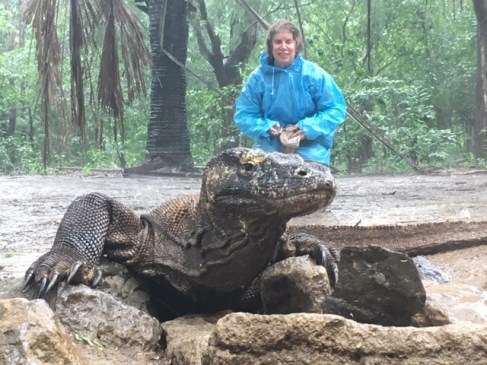
Sure enough, a dragon was laying there. Eight or 9 feet long, its eyes followed us as we moved around, occasionally lifting its head, but never its body. The ranger knew this one well; he said it was an older one (he could tell by its weight, or lack thereof) and that it was unlikely to attack. With that, he directed each of us to go around and behind the dragon (what happened to staying with him in a group?) while he expertly took pictures of us with the dragon. Despite our ranger’s assurance that this dragon would not hurt us, its powerful arms were intimidating. If we were in a foot race, I have no doubt who would win:

IMG_5250
Me and the dragon

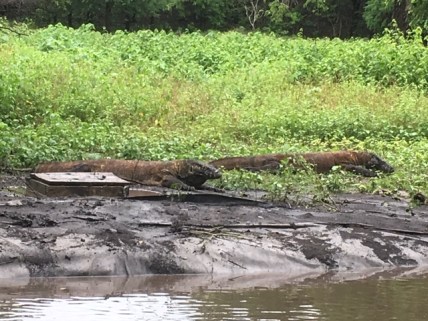
Over the course of the next hour, we came across 3 more dragons, all near watering holes and none standing, They lay still for hours on end, completely camouflaged with the surrounding ground, until an unsuspecting deer comes for a drink, then they pounce. They secrete a poisonous venom, along with biting their prey with strong, sharp teeth. They have been known to kill humans. The younger ones, under 7 or 8 years old, climb trees and spend their formative years there, to avoid being cannibalized by their parents, staying on the ground only once they become too heavy to climb.

IMG_5259
Komodo dragons lying in wait

The rest of the day was spent snorkeling, walking on pretty pink beaches and searching (unsuccessfully) for mantra rays in the water. But I didn’t care. I had come to see the dragons and they did not disappoint.

Beautiful Bali

Bali Hai, the song made famous in the musical South Pacific, doesn’t really have anything to do with Bali. The novel by James Michener, upon which the musical was based, was inspired by the Pacific Ocean island of Vanuatu, some 7,000 miles away, where Michener was stationed during WWII. Similarly, the movie was shot on the Hawaii island of Kauai, about 6,300 miles east. But because of its association with Bali Hai, Bali is forever regarded as the epitome of the Pacific island paradise, with white sand beaches, pure blue water, palm trees swaying in the breeze and beautiful women in grass skirts and bikini tops made of coconuts swaying to ukulele music.

In fact, Bali’s topography does match its reputation, although there are no native women in grass skirts. As one of between 17,500 and 18,300 islands (no one can quite agree on the figure) making up the archipelago of Indonesia, its shoreline is fringed by spectacular beaches with both white and black sand, clear turquoise waters replete with crashing waves beloved by surfers and a green interior, home to palm trees, coffee plantations, orchids and rice paddies. At 5,800 square kilometres, the island supports a population of about 5 million and has over 5000 hotels with close to 60,000 beds. An attempt to add land to Bali via reclamation was defeated, but threats to resurrect the scheme abound.

Indonesia’s population is primarily Muslim, but Bali is the exception. Its inhabitants adopted Hinduism between the 2nd and 4th centuries AD after coming into contact with Indian traders. Java, the larger island  to the east and home to the capital, Jakarta,  was eventually conquered by Muslim invaders, after which the Hindus and Buddhists decamped to Bali and have stayed since, resisting all attempts to be converted by Muslims and Christians.

Thus, Bali adopted Hindu gods, traditions and architecture, but not the caste system. Walking around today, offerings are placed at every entrance way each morning, made of betel leaves holding betel nuts, lime, tobacco and gambier overlaid by flowers. Hindu temples, with their interior sanctums housing shrines with images of deities, multi-level roof towers and ornate carvings, are ubiquitous; estimates indicate there are over 20,000 temples in Bali and seemingly on every corner.

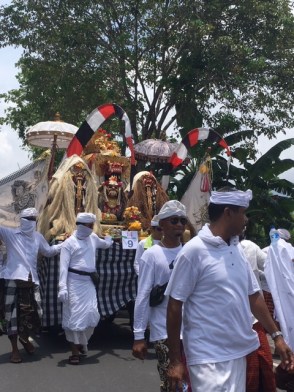
I had arrived just before the Balinese New Year’s celebration, Nyepi, or day of silence. During the week preceding it, Balinese roads are filled with processions of Bhuta (demons), accompanied by white clad gentlemen and bands banging on pots and pans and bamboo tubes. I was lucky enough to run into one and took pictures while traffic stood still; the driver was less enamoured of the 30 minute delay.

IMG_5010

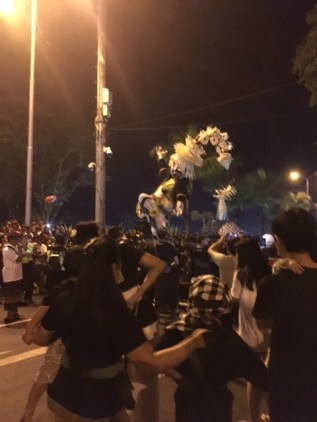
The night before Nyepi, Ogoh Ogohs – bamboo statues of demons or negative spirits – are paraded through the streets before being burned in cemeteries. I attended at one parade, but so many people were straining for views and making it difficult for me to see much.

IMG_5017

During Nyepi, four rituals are performed: no light or electricity, no work, no travelling and no revelry. It is a day of reflection, forgiveness and looking forward to the new year., reminding me of a Balinese Yom Kippur. In practical terms, it means the airport shuts down, TV stations go blank, mobile networks are off-line, special police patrol the streets ensuring no one is about and meals, if one is not fasting, must be consumed by sundown. Fortunately for me, tourists and pregnant women (not applicable) are excepted from the prohibition on lights and revelry, but not the travel ban. My hotel had power and food before 6PM, but we were not allowed out and had to draw our drapes after dark. The internet did work and I noticed a large number of Indonesian guests who came for the day and left the next, after Nyepi and travel was once again permitted.

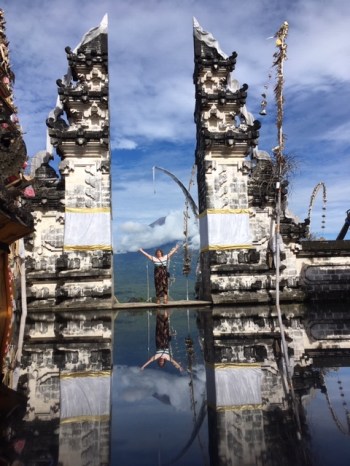
I engaged the services of a guide/driver to do some sightseeing. First up was the famous Lempuyang temple, whose gates frame the volcano Gunung Agung. Much beloved by Instagramers, the temple imposes strict rules on visitors, including the compulsory donning of a sarong, a ban on menstrating women (how they check I do not know), no kissing and forbidding yoga poses at the gates. If one looks at Instagram, the reason for the last rule is apparent. Hundreds of tourists decided that yoga postures (mostly disrespecting the Buddhist/Hindu restriction of having feet pointing to the gods) would best show themselves off. The first one or two photos may have been beguiling but after a few, they just become cliches.

After climbing a steep roadway to the temple’s entrance, I passed through a gate and into the courtyard, where a line of tourists waited patiently for their turn to have a picture with the volcano behind. “It wasn’t too busy”, a guide told me, “the wait will only be 20 minutes. Sometimes, it is hours”. A gentleman, probably a combination photographer and rule enforcer, chastised a lady when she started raising her leg in a prelude to a tree pose. When my turn came, I gave him my I-phone and a tip and he snapped a few photos while directing me how to stand – both feet firmly on the ground.

IMG_5069

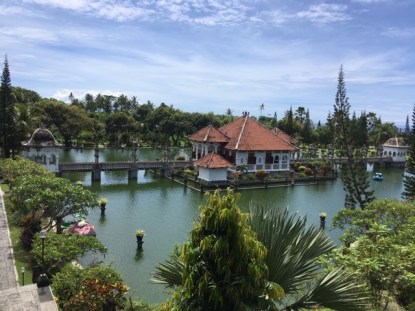
We went to Tirtagangga, a water palace built by the king of Bali. Yes, Bali was a kingdom (or 9 of them, depending on the century) from 914 to 1908, when the Dutch overlords finally had enough. The royal family still exists, and while administration has been ceded to the central government in Jakarta, the family still regards itself as the guardian of the Hindu faith on the island.

The grounds today are preserved primarily as a tourist site and wedding destination venue. The pools are the highlights, with stepping stones allowing visitors to get up close and personal with the richly carved statues:

Another water palace is Taman Soekasada Ujung, a pretty place featuring ponds, bridges, gardens and pictures of the king:

IMG_5168

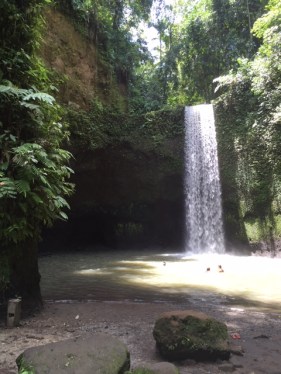
Lastly, we stopped at the Tibumana Waterfall. Bali is blessed with many lovely waterfalls, surrounded by the verdant rainforest with cooling watering holes fed by the clean water. Unfortunately, as I entered the water, two idiot Italian girls followed me in with cigarettes dangling from their lips, blowing smoke in my direction and totally oblivious to the hypocrisy of enjoying nature while smoking.

IMG_5186

This is my second time in Bali and so far, it is as enjoyable as the first. It is far more built up than in 1996, but the Balinese are kind and welcoming hosts. Tourists proliferate, mostly Australians; think suntanned blonds with tattoos and surfboards riding on scooters. Bali has decent infrastructure, first world amenities and enough cultural attractions and differences to enchant a visitor like me. It’s the perfect place to relax, de-stress and wait out winter.

Boracay: Paradise Lost

With Manila failing to impress, just another overcrowded, smog filled mega city with limited historical, architectural or cultural attractions of interest to me, I turned to what all the experts identified as the crowning glory of the Philippines, its islands. It has over 7,000, but 3 kept coming up as particularly beautiful: Cebu, Palawan and Boracay. Cebu was on the Canadian Foreign Affairs watch list, so I vetoed it. Palawan looked positive, but hours of searching on Expedia.com failed to turn up appealing hotels within my price range. They were either outrageous, hundreds of dollars per night for western style resorts, or so cheap that necessities like air conditioning and private bathrooms were lacking.

Thus, Boracay won by default, but it was a risky choice. In April, 2018, the Philippines’ president, Rodrigo Duterte, declared the island “closed” due to its lack of cleanliness; he actually called it “a cesspool.” For 6 months, the island was off-limits to tourists, while the locals picked plastic off the beach, reconstructed sewer lines so that hotel sewage did not flow directly into the sea and upgraded infrastructure to ensure environmental standards were adequate. The island had reopened in October, 2018. I thought, naively, that since it had only been open for a few months, there would be few tourists, far less than the 2 million that arrived there in 2017, and everything would be relatively clean.

If I wanted to create a case study in how to make a bad first impression of a sun destination, Boracay would be perfect. After an uneventful, but expensive ($600 round trip) 40 minute flight from Manila, me and the other passengers walked to the miniscule Caticlan airport arrivals area where we waited half an hour for our luggage to be off-loaded manually from the plane, put into luggage carts then again manually unloaded, not onto conveyor belts, but raised tables. As soon as a few bags were placed on the tables, the 150 or so passengers surged forward to see if their bags were some of the offloaded lucky ones, only to be pushed from behind by other like-minded passengers. When it couldn’t get much worse, an Air Asia flight landed and dislodged another 150 passengers into the already cramped arrivals area. More pushing and shoving ensued.

Eventually, I retrieved my luggage (Philippine Airlines had decided it was not appropriate hand luggage, despite fitting easily into the metal measuring contraption) and went outside to look for a sign with my name from my pre-arranged hotel transfer. I found it and was escorted to a mini-SUV where 3 Filipino Americans were waiting. They were here for a wedding and the mother, perhaps in her 60’s, was none too happy. They had flown from Los Angeles that day, the wedding was in two days and she had been excluded from the planning process. Nonetheless, she said, 70 of the groom’s friends and relatives had flown in from the USA for the ceremony. Her daughter volunteered the bride’s family was from Boracay, which partly explained the location, but more importantly, it was 1/3 the price of a similar wedding in the USA.

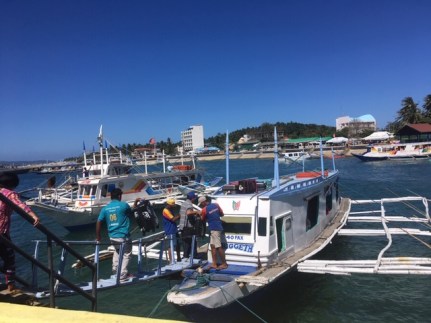
We drove a grand total of less than 10 minutes in the comfort of the air conditioned SUV, when the transfer guide ordered us out of the vehicle. We had reached the boat jetty but before we could enter the terminal, we had to stand in line for registration and confirmation of a hotel on Boracay that had been issued an environmental compliance certificate. Naturally, this required filling out forms in triplicate using carbon paper (hadn’t seen that in decades) along with presenting our passports and providing personal information (occupation “not applicable” sufficed) which bore little relevance to protecting the environment.

Upon finishing the formalities, our guide hustled us into the boat jetty terminal, past the ticket taker and onto the pier, a concrete affair with basic, but colourful catamarans lining both sides, tethered by ropes and narrow, shaky gangplanks we were forced to traverse to enter the boat. I handed my bag to the guide, uncertain if I would be able to either maneuver it into the boat  or throw it on the roof where a crew man caught suitcases and piled them high on the cabin, with no visible signs of securing the bags. With misgivings, but no other choice, I ensured my cell phone was pushed deep in a pocket, grabbed both of the flimsy railings and gingerly crept the 10 feet or so down the wooden plank and onto the boat.

IMG_4958
Boat transfer to Boracay

Inside, the luxury level remained low. A narrow passageway was flanked by rows of narrow wooden seats, each carrying two passengers. Above the seats hung two long poles, holding life vests which were uniformly ignored by all. As soon as the last seat filled, the captain turned the motor, backed out of the mooring place and off we scooted to Boracay, less than 10 minutes away on a relatively smooth crossing.

Arriving at Boracay, we disembarked on the same, rickety gangplank, but instead of stepping onto a solid pier, the 100 foot floating jetty in Boracay was made from recycled plastic, which may be environmentally sound, but bounced around in the waves and made pulling wheeled luggage a challenge. To top it off, the jetty ends, not at a wooden or concrete pier, but right on the beach, in sand, through which we now dragged our bags and dirtied our feet.

The guide led us to an open air jeepney which would transport us and our luggage to our respective hotels. Boracay is a fairly small island, only 10.2 kilometres and shaped in an oval, with some parts being only a kilometre wide. The jeepney drove to Main Road (as opposed to Back Road) which, not surprising, is the main road on the island. It is heavily built up, with structures lining both sides, but at least half of the structures were either closed due to lack of environmental certification, or undergoing some sort of construction, making my first impression of Boracay equivalent to visiting a massive building site, with the noise and dust to match.

I wrongly would have expected Main Road to bear some resemblance to an actual road. Aside from being bordered on both sides by buildings, it didn’t. To comply with the environmental decrees, new sewers under the road were being drilled, leaving most of the road unpaved and sandy, with the work not expected to be complete until 2020. Sidewalks did not exist and the road was so narrow that two normal size SUVs could barely pass each other. Welcome to Paradise!

IMG_4967
Main Road

It was time to hit the beach and see if all the accolades were valid. To some extent, they were: the water was the requisite turquoise and clear, the sand soft and white and palm trees lined the back of the beach, providing much needed shade. Just past the palm trees was a pedestrian path of sorts, half asphalt, half sand, where hundreds of buildings faced the sea – restaurants, massage parlours, tour agencies offering water sports and souvenir shops galore. Signs warned of dire consequences if you dared to litter, smoke, use plastic, drink alcohol, play loud music or construct commercial sand structures on the beach.

To be fair, the beach area appeared spotless. In the 4 days I stayed, I didn’t see a single plastic bag, discarded cigarette or any trash whatsoever on the beach, although some energetic locals sculpted the words “Boracay, 2019” with the precise date in sand and charged tourists to pose in front of it, which I suspect would constitute a “commercial sand structure,” but no one seemed too concerned.

There were, however, thousands of tourists, primarily Korean and Chinese but also a smattering of Russians and Australians. When I say thousands, I mean so many that it was hard to see the sand for all the people. And, for the most part, these tourists didn’t sunbathe in the way I think of sunbathing – getting a towel, lying on the beach under an umbrella which were sorely lacking, slapping on sunscreen and reading a juicy romance novel. Rather, most preferred to stay well covered up from the sun save for the mandatory run-into-the-water photo or video, and parade up and down the beach in large groups, so there was a constant army of people marching back and forth making my attempt to claim a little piece of sand as my own for a while completely futile.

IMG_4971
The beach

Now I recognize that I am being completely hypocritical when I complain about too many tourists, being one myself, but I had not appreciated until I went to Boracay how overtourism can destroy a place. The environmental damage, emanating from the rapid and shoddy construction of too many resorts to accommodate the growing number of visitors, the dumping of sewage straight into the sea and the sheer volume of garbage, must have been mammoth to cause a complete 6 month  shutdown of the island.

But no amount of clean-up will address the other problem: the large number of tourists. Some places – Venice, Barcelona, Dubrovnik – come to mind, are dealing with the problem of too many visitors by charging admission, imposing maximum numbers or restricting cruise boats. The Philippines are too poor to undertake such actions. An attempt to limit the number of beds on Boracay to 5,000 fell by the wayside. Boracay and the other popular beach islands provide too many jobs and opportunities for too many people and the nouveau tourists of the Asian giants, buoyed by budget airlines and cheap food and hotels, are going to keep coming for their beach experience, In isolation, their Instagram inspired photos will look magnificent, but pull back a little, see the hordes that crowd the island and Boracay is less a paradise than a warmer version of the rat race, with tourists scurrying about to do their beach vacation just like the photos say they should.

IMG_4975
Me and hundreds others enjoying a sunset

Trying to find the Philippines: Manila

I arrived in the Philippines with no expectations, just a desire to see and learn about a country whose people, when they emigrated to Canada, struck me as gentle and kindhearted. Internet searches touted Manila as a vibrant, cosmopolitan city, the Unesco world heritage rice terraces of the Philippine cordilleras were highly recommended and, of course, the thousands of islands, tropical paradises all with the requisite white sandy beaches, turquoise waters and palm trees swaying in the wind.

I looked closer into going to the rice terraces, but every guided tour involved a bumpy 6-8 hour ride in a four wheel drive vehicle, followed by a night in lodgings universally described as rustic and basic, which translated to no air-conditioning, no indoor plumbing and the possibility of plenty of unwanted insects or worse. It was a lot of effort to see rice fields, which, despite their 2000 year old history,  Instagram perfect photo opportunities and heritage status were still, at the end of the day, rice paddies. I passed.

Thus, I decided to concentrate most of my time in Manila, a conglomerate of cities with a population in excess of 12 million and the dubious honour of being the densest city on the planet. Despite my unfortunate drugging/robbing incident, I persisted in spending 8 days in the city trying to understand a bit more about Filipinos, their history, culture and what makes them tick.

I started with a 2 1/2 hour walk from Makati to Manila Bay, seeing a cross section of neighborhoods, from the wealthy skyscrapers in Makati to the shantytowns that line the airport and waterways. While I didn’t inspect the shanties on foot, they didn’t differ much from the worst shantytowns I had visited in Johannesburg or Calcutta; houses built piggly wiggly, with corrugated metal roofs and walls made from a few wooden planks filled in by cardboard. The waterways provided the only available plumbing and electricity was freely stolen from electric poles, with wires dangling along what passed for roads.

IMG_4877
One of many shanty towns in Manila

I had decided to walk as the traffic was horrendous, but I hadn’t realized how pervasive the smog was. As I started from my residence, the heavy gray air emanating from millions of vehicles spewing diesel fumes obscured the sun. Thirty minutes into my walk, the smog entered my lungs, making me wish I could buy one of those textile face masks that were worn by a third of the populace on the streets. It got worse – an hour later – I could feel the grit on my skin, where it stayed until I showered back at the residence. I had heard about the smog problems in Beijing and New Delhi, but Manila should certainly be added to the list of very polluted cities.

Curious to see more picturesque sites than smog and shanties, I signed up for a day tour of Tagaytay, promising volcanoes, palaces and a bamboo organ. A driver and guide picked me up promptly at 8:30 and announced I was the only participant today. Great, I thought, no fights about the middle seat but not so wonderful for meeting people. After 2 hours in Manila traffic, we finally arrived at our first attraction – the palace. Not some ancient Filipino/Hindu/Spanish palace, but a summer home started yet never finished by the former dictator, Ferdinand Marcos and his wife, Imelda – she of the thousand shoes- fallen into disrepair. There’s a darker side to the house/palace. Construction began to welcome then US President Ronald Reagan to the Philippines in 1981 at a cost of US$ 10 million, but Reagan cancelled his visit and the mansion was abandoned. What is left is a monument (amongst many) of the Marcos’ opulent spending and a reasonably well maintained road to a better view sight of the Taal Volcano.

IMG_4856(2)
Abandoned Marcos” Palace

After taking a Jeepney to the very best view sight, the volcano was completely obscured by the abundance of low lying clouds. Undeterred, the driver and guide drove down below the clouds, where at least a view, if not bright blue skies, was possible.

IMG_4871
View of the volcano. The structures on the water are fish farms.

The tour went downhill, literally and figuratively, from there. After another hour in Manila traffic, we stopped at tourist sight number 3- the Jeepney factory. These vehicles are a hybrid Jeep and minibus, adapted by the Filipinos after WW2 to serve as local buses. We walked around for a few minutes, before the guide conceded that the factory wasn’t busy because it was soon to be closed. The government had ordered all diesel Jeepneys to be replaced by electric ones, making this factory obsolete.

IMG_4886
Me and a jeepney

Our final stop was the church housing a Bamboo Organ, the only one in the world. Unique it may be, and it did make beautiful sounds, but I will spare the details other than to say it was hardly overwhelming.

Feeling no further enlightened about anything Filipino after this tour, I signed up for another one, this time to Corregidor Island, located 40 miles from Manila.

Some history, much of it gleaned from my guide Brian on the Corregidor tour. In 1521, after becoming the first European in centuries to visit the Philippines (via South America), Ferdinand Magellan arrived, claimed it for Spain (he’d had an argument with his Portuguese king), converted some of the locals to Catholicism and was promptly killed in a battle by a poisonous arrow. The Spaniards stayed for roughly 375 years, until they managed to lose the area to the Americans after the Spanish – American war and the 1898 Treaty of Paris (and payment by the US of $20 million). The Americans ruled it until 1942, despite what the Americans refer to as the Philippine insurgency and the Filipinos refer to as the American-Philippines war circa 1898-1902. Between 1941 and 1945, the Japanese occupied it, but eventually a US/Filipino force liberated it following the devastating battle of Manila, in which over 100,000 civilians were killed. A year later, the Philippines were granted independence, but didn’t get rid of the last US armed forces base until 1991.

Corregidor is one of 5 islands strategically located in the Bay of Manila and was the center of the US presence since 1902. A large US base was located there, complete with cinema, bowling alley, a railroad and all the trappings of a small US town. Not so prevalent in small town USA was the Malinta tunnel, burrowed under the mountains to provide security for civilian and military headquarters, a hospital and food and arms storage.

On May 8, 1941, 9 hours after Pearl Harbor was bombed, the Japanese Air Force stuck the main Philippine island of Luzon, followed by ground troops a few days later. Opposition came from a makeshift amalgamation of regular US and Filipino soldiers – the latter had been separately trained since 1934 in anticipation of independence in 1944- but they lacked the arms and manpower to overcome the Japanese, who proceeded forward to Manila quickly and were targeting Corregidor. MacArthur was ordered to leave the island by Roosevelt. On March 20, 1942, he made his famous “I shall return” speech from the boat launch on Corregidor Island, where now a statue marks the spot.

IMG_4913
Me, the statue of MacArthur and the wind on Corregidor

Corregidor was eventually captured by the Japanese army, but instead of the 50 days they expected to take to overrun the island, the spirited fighting of the Filipino forces engaged their enemy for 150 days before conceding defeat. Brian was very proud of this fact and repeated it numerous times during our tour. Eventually, the Japanese prevailed and were ruthless in their victory. In the infamous death march, over 70,000 US and Filipino soldiers clamoured through the jungle for two weeks without food or water to a POW camp. Over 20,000 did not make it.

Today, Corregidor Island is a monument to the war. Tours drive past the remnants of the army barracks, the 19.5 miles of railway line, the tennis courts and the anti-aircraft batteries. Three monuments commemorate those who died during the war – the Pacific War Memorial funded by the US, the Filipino Heroes Memorial and the Japanese Memorial Garden. When the joint American and Filipino forces invaded Corregidor in February, 1945, most of the 2000 Japanese soldiers committed suicide rather than surrender, including blowing up the Malinta tunnel. The 20 Japanese soldiers who did not die were tasked with salvaging the tunnel. Today, it had been rebuilt and a sound and light show is presented walking the tourist through its construction, uses and significant events during the war, with the finale being the playing of the Philippines anthem. Tours today are offered in both English and Japanese. Brian said the content of the Japanese tour differs slightly, emphasizing Japanese strategy and battles.

It was an educational tour, enlightening me about WW2 and the war in the Pacific beyond my high school highlights of Pearl Harbour and the atomic bombs. But despite the efforts of the tour guides at Corregidor, I still didn’t feel I understood the Philippines, or in the vernacular, what makes it tick.

Various internet sources about what to see in Manila were uninspiring. Too many of them focused on its fabulous shopping centres, something I do my best to avoid, its food markets, of which I had my fill or Intramuros, the old walled city I had walked through on my first foray out of my residence, but it was dominated by Spanish colonial history. Surely the Philippines had a history before the Spaniards came.

It was just a little hard to find, but I persisted and made my way to the Ayala Museum. Housing archeological treasures, gold artifacts, textiles and dioramas displaying centuries of Filipino history, it provided a chronological retelling of settlements, societies and significant events in the Philippines. There was life before the Spaniards! 4000 years ago, waves of Chinese and Malays migrated to the islands, integrated with the largely fisherman tribes who had been there for 40,000 to 50,000 years and began farming the islands. Indians arrived as early as 900AD, creating Hindu/Buddhist states. Rather than a single empire, these were largely small, local cities or villages. The earliest writing is attributed to a text in 900, in which the ruler released a local fellow from his debt. In 1380, the first Arabs arrived and created some Sultanates, the remnants of a small Muslim minority still exist mostly on the southern islands.

Then the Spaniards arrived. I heard, from tour guides, that the Spaniards gave the islands its religion – Catholicism – and the Americans gave it English. Today, Tagalog (Filipino) and English are the two official languages, with most schools teaching in English.

I left knowing a little more Filipino history, but still not understanding much. Everyone said that if I wanted to appreciate the Philippines, I had to go to one of the islands. So my next stop is the island paradise of Boracay.

Drugged and Robbed in Manila

This is a tale of letting my guard down, trusting seemingly kind people and ending up being drugged and robbed. Six days later, all is fine, but some hard earned lessons were learned.

I arrived in Manila on Thursday and immediately encountered its infamous traffic as the taxi took nearly 2 hours to drive the 6 miles from the airport to my Airbnb in one of Manila’s most upscale areas, Makahati, and the Gramercy Residences. It is the highest building in Manila at 76 floors and its neighbour, for better or worse, is the Trump Tower.

On Friday, I decided to avoid the traffic and walk the 7 kilometres to the old part of Manila, Intramuros. Armed with Google Maps, I made my way towards the Bay of Manila, passing through wealthier and poorer neighborhoods, where the sidewalks were jumbles of broken concrete,  poles were threaded with electricity stealing wires and clothes hung out to dry at every window.

IMG_4743
Chaotic street scene in Manila

Tuk-tuks and scooters were the transport of choice, along with a uniquely Filipino vehicle – the Jeepney – an elongated Jeep adapted after WW2, plying set routes as mini-buses throughout the city. In Intramuros, I stopped at the 15th century San Agustin Church and walked through Casa Manila, a museum made up to mimic wealthy 19th century Manilian life during the height of the Spanish colonial rule. After having walked around for 5 hours, I indulged in the Manila equivalent of Uber, called Grab, costing  $5.00 for the 45 minute ride back to the Gramercy.

Saturday morning came and I was feeling far less ambitious in terms of walking, so I went to the nearby Salcedo market, a weekly food market offering both Filipino and foreign dishes. It was too early for lunch, so after walking through the market, I left and walked down Makahati Avenue to see its sights.

IMG_4773
Grilled Mackeral and Monkfish in the market

They turned out to be pretty slim, unless non-descript skyscrapers, bank buildings, 7-elevens and the Filipino equivalent of KFC, Jolibee, are to your taste. I started back toward the Salcedo market. Midway there, a 60 year old Filipino lady brandishing an umbrella to protect her skin from the sun asked me if I knew how to get to the Salcedo market. I said I was going there and we could walk together. She introduced herself as Gina and said she was a chef from the Ilocos province, visiting Manila for a few days  with a friend whom she was to meet at the market. Gina said she had 15 grandchildren and one grandson and showed me his picture on her phone. Gina had married at 15, had her first child a year later, but had been widowed for 10 years.

We arrived at the market and sat down. Gina said she would ensure I had proper Filipino food and brought over both a mango and a cucumber drink. I chose the mango, refreshing in the Manila heat. Gina brought other Filipino dishes, including barbecue pork and chicken skewers, rice wrapped in banana leaves, chicken adobo and empanadas. Soon her friends, Sazzann and Baya arrived; Sazzann was 67, but Baya was much younger. They both introduced themselves as business women. Sazzann had a mango farm in Ilocos while Baya bought clothes cheaply in Manila and resold them in her hometown.

The ladies indicated they wanted to go to a cheaper market that sold clothes and asked if I wanted to join them. I’m not a shopper, but I thought, hey, why not have an authentic experience in Manila with some Filipinos. We caught a regular bus and went to the Baclaran market, where hundreds of umbrellas make up the stalls.

IMG_4776
A few of the thousands of umbrellas at the Baclaran Market

Clothes and lots of other things were for sale here at very cheap prices.  Gina bought a hand held portable sewing machine for her granddaughter’s birthday and Baya bought some earrings but that was it. It was hot and noisy and the ladies said it was time for a beer and a Jeepney ride. They asked if I wanted to join them and I said yes. Baya took our picture inside the Jeepney.

IMG_0008
Gina (with the peace sign), me and Sazzann squeezed into a Jeepney

We stopped at an open restaurant/karaoke bar. Gina said her two nieces were going to join us – they were close by and liked to practice English with a native speaker. Meanwhile, Baya bought some drinks: San Miguel beer for them and a Tanguay for me-it tasted like a Smirnoff Ice but with only 5% alcohol and rum rather than vodka based.

IMG_0011
Me, Gina and Baya at the Karaoke Bar

Eventually the nieces joined us, alcohol started flowing freely and the karaoke began. I’m not a singer, but Gina loved to sing – lots of Carpenter songs and Bonnie Tyler’s Straight from the Heart were a few I remember. The nieces said they were both studying business administration in local colleges and seemed like nice girls but there were warning signs. I asked to friend them on Facebook, and they said sure, but later. One of them asked to see the pictures I had taken and spent a long time looking at them on my I-Phone. More food was ordered, more drinks appeared and there was a lot of singing (but not by me). All seemed well.

About 4 PM, one of the nieces asked if I wanted to join them on a shopping trip to the biggest mall in the Philippines, The Mall of Asia. As it had been on my To Do list, I readily agreed and the 6 of us climbed into a Grab taxi. Oddly, we stopped at a Jolibee for more food, which I declined (I was full) and then more alcohol came out. We had been in the cab for at least half an hour, which was again odd as I could see the planes landing at the airport and knew the mall was close to the airport. I asked what the hold up was – why weren’t we at the mall yet………..

The next thing I remember I was walking back from a bank close to my Airbnb on Sunday about noon. I had tried to withdraw money and couldn’t remember my PIN so I got a message on my phone from the bank saying it detected fraud and I had to call the bank. I walked back to my residence, so unsteady on my feet that I tripped on the sidewalk, ripping my new pants at the knee. A passerby saw me and helped me up, then walked with me the 2 blocks to my place. Try as I might, I have no memory of anything after being in the cab on Saturday, not where I slept that night or what prompted me to go out to the bank that Sunday.

As the fog in my head started to clear, I took stock of the damage. It didn’t take a genius to figure out I had been drugged, probably with Ativan, also known as the date rape drug, but aside from a bruised knee when I fell and a heavy head, I felt physically fine. I still had my I-Phone and my purse, but looking through it, I noticed by debit card was gone, along the equivalent of $80 in pesos and a note about my PIN on my US dollar Visa card. In retrospect, it was a pretty stupid place to leave the PIN. My Canadian $ Visa was still there; that was the one I had been trying to withdraw cash from when my memory returned.

A few days later,  I still have no recollection of anything between 4PM on Saturday and noon on Sunday. I asked the building’s security to review the CCTV to find out when I came home and how but have no results yet. I also had a strange note in my pocket, partly in my writing saying “you stole 10,000 k from me” (the equivalent of $250) and a cab’s license number in writing I didn’t recognize.

When I checked my bank accounts, 10,000 Philippine pesos had been withdrawn from my US $ Visa account. I quickly cancelled the account (and CIBC said they would reimburse me the funds since it was fraud and I was a good customer) along with my debit card. To date, nothing untoward has happened with my Canadian $ Visa card and I can only assume they either missed it or ignored it if I was unable to give them the PIN. They left me with my passport, health care card and driver’s license, far more considerate than the pickpocket in Riga. I suspect they made sure I got back to my residence. Other internet posts I have since read say this is the norm as they hope if not too much is missing and you end up back at your place, you won’t go to the police.

On Monday, I went to a local walk-in medical clinic to learn more information about the drug. It cost only $12.50 to see a GP. She advised of the problematic warning signals to watch out for – seizures, shortness of breath and excessive sleepiness past two days. She also offered to arrange for a toxicology exam so I could determine exactly what drug I had been given. As I did not seem to have any lingering symptoms, I declined but I did go see a neurologist to discuss the potential symptoms as well, This cost $29 and I had to wait half an hour for an appointment. Whatever issues I may have with the criminals in Manila, their medical system was a treat.

I also decided to go to the police station and make a report. Unfortunately, the officer seemed completely uninterested until I told him I had photos of the culprits. Although the nieces had erased the photos on my camera roll, I had sent some photos to my son and brother and they had not been deleted. The police officer took a picture of the thieves and another of the note with the driver’s license, but wouldn’t let me fill out a report. As I couldn’t remember where the theft had occurred except near the airport, he concluded that it was outside of his jurisdiction and he couldn’t or wouldn’t do anything about it.

It’s been 6 days since and all is well. Part of me wants to contact Grab and find out if the license number on that paper is theirs and, if so, to see if they have records of who called the taxi. But I have decided against it. I have to let this go and chalk it up to a bad experience which could have turned out a lot worse. I am out $80 but am completely healthy and like to think a little wiser about being victimized by scammers.  Although I had heard about scams like this, it was always young people in bars at night, not grannies in popular food markets. Sadly, I will be more reluctant to trust locals. I will also be adamant only to drink from bottles I have seen opened, never let my drink out of my sight and never share food with anyone, no matter the culture.

When I told my father what happened, his reaction was to return to the safety of Canada. I didn’t even think of doing that for a second. I have loved every adventure, positive or negative, I have encountered in the last year. Being drugged and robbed was definitely not a highlight, but it will give me endless stories. And despite its ending, I thoroughly enjoyed the Jeepney ride, the karaoke singing and the Tanguay drink with the grannies.

Next post: I Shall Return, said General MacArthur, but I probably will not.