Settling into Paris

Paris did not begin well. I didn’t make it out of the airport…. actually, I did and that was the problem. I was in the taxi line before I realized I had forgotten to pick up my suitcase. Years of traveling without checking a bag had habituated me to walking directly from the plane to the taxi line.

I doubled back to the passenger exit to be met by an intimidating  “passage interdit” sign. Even my bad French told me that going through those doors would not be a good idea. Two heavily armed police officers came by – not for me- so I asked them, again in my really bad French, what to do. Something clicked because they took me by the hand (I think after they gave up giving me directions) and deposited me at Luggage Services. I explained my dilemma to the lady there, who waved me to another Luggage Services counter behind some walls. There, another lady told me in English to go to Post 1 and look for the short man with glasses before turning to her colleague and saying something in French. I am sure I heard “idiot”.
Making my way to Post 1, which is not as easy as it sounds as there are tons of posts at Charles de Gaulle airport, mostly with signs of some sort, I saw a man with glasses near the “passage interdit” door. For the record, he was about 5 foot 8 inches, which I wouldn’t describe as short. He greeted me by name and I asked him how he knew who I was. He said there was only one unclaimed bag and it had my name on it. We both chuckled, he led me to my bag and I left the airport again, this time with my suitcase.


My next challenge was entering the Airbnb suite I had booked. Normally, the Airbnb host is supposed to greet you, let you in and show you around. I had no such luck. When I emailed my host the time of arrival, he said he would be out of town for the weekend, but left the most convoluted instructions. They went something like this:

…the keys will be under the doormat. Use the longer key to unlock first using the locker second from above. Be careful it goes in the wrong way so to unlock you turn from left to right as if you wanted to lock! And then take the shorter key to push the door open by turning right to left. You will not use the upper and bottom locker. In any case, do not force with the keys you would break them…..

I had sweated my ability to perform this operation for a week, but thought I had better give it a try since I didn’t have much of an alternative. To my amazement (and with an extremely gentle turn to the right on the second of four locks), the door opened and I was in. Relief set in and was even more pronounced when I connected to the wifi. Mission accomplished!
My neighborhood in the 17th arrondissement is a 10 minute walk from Montmartre, but miles away from the tourist haunts. There is a bar/restaurant next door to my building and dozens more within a few blocks. Patisseries selling fresh baguettes abound, with colorful macarons in the windows and tempting tarts, strudels and croissants. Within 2 blocks of my place are 4 butchers, an oyster shop, 2 cheese stores, too many wine stores to count and at least one laundromat every 100 meters.
Aside from being well equipped with all the necessities, the striking feature of the neighborhood (and all of Paris) is the diversity. In stark contrast to the homogeneity of the Baltics and to a lesser extent, Sweden and Finland, Paris is multicoloured. Blacks, Arabs and Asians speaking perfect French; Lebanese and Turkish restaurants, the lady who cut my hair talking Arabic, the beggar in the metro station with the sign saying “Nous Somme Syrian refugees”. Multiculturalism is thriving here.
The myth of the rude Parisian was also quickly dispelled. When I tried to buy a SIM card for my phone from the non-English speaking telephone store clerk, he locked the store and walked me down the block to the Tabac to buy some minutes. The shelf stocker in the grocery store laughed when I resorted to Google Translate to ask where the flour (florine) was, but showed me its location, which, for some unfathamable reason, is beside the eggs in dairy. The counter clerk in the Bureau de Post (Post Office) walked me over to the machine to buy a stamp to send an envelope to Canada and punched in all the information sought by the machine (weight, air mail, etc.) when the machine kept asking me questions in French.


My local bar/restaurant is also very tolerant. The waiter and I have connected on my preferred order- a large glass of Chardonnay – which does not have the oaky taste so prevalent in Canada.  Strangely, Pinot Gris and Sauvignon Blanc are not readily available and the only Pinot Gris I purchased from the store was quite sweet.
The single exception to the “be nice to tourists” attitude I generally encountered occurred in the most unexpected spot – the official tourism office. I expected to find one near the Arc de Triomphe, but couldn’t see one. Google Maps sent me to the nearby Official Tourism for the island of Mauritius which, while very pleasant, was totally useless in my queries. Finally, Google Maps directed to the official Paris Tourism office in the Place de Congress some 4 kilometres away. I later discovered a much closer one just outside the Louvre, but Google Maps is oblivious to it.
Back to the tourism office. After passing through the security post, a lady behind the counter beckoned me over. She said she spoke a bit of English – she was pretty fluent to me. I told her I had 5 questions:
1. How do I sign up for Velbo- the bike ride share in Paris? She looked at me as if I was from Mars then pointed to the “Information for residents” and suggested they could help (Correct answer-sign up on the internet and download the app).
2. How do I use the Metro? She looked at me again aghast. “How should I know? I do not use it. Go ask the person at the station.” I cannot believe that in however long she worked there not a single other person ever asked how to use the metro. Beside, it was another wrong answer. There is no person in the metro station. The correct answer is: Go to a machine, tap on the flag of the UK for English, and follow the very straightforward instructions.
3. Where do I go to deal with visa issues (as in immigration not credit cards). Another “ how the f*($&**should I know” totally useless response.
4. How do I recharge my SIM card for my phone? The third “how should I know” answer. Correct one is go to any Tabac, buy a card then dial the number on the back of the card and enter the code. Why I buy a SIM card at a carrier store but recharge it at a Tabac was never explained but at its face seems totally irrational.

5. Can I have a map of Paris? She actually got this right- sweeping her hand toward a large display of maps at the back. “Go there and get one. They are free.”

She was useless on 4 of 5 questions and seemed to begrudge me the time it took to respond to my queries. Nonetheless, she was the exception. Everyone else has been quite lovely.

And so went the better parts of my first week in Paris. Next up, the pitfalls of traveling with technology.

Lithuania: The Dark and Lighter sides

Nine days on a highlights tour of the Baltics had saturated my desire to see Medieval castles, Lutheran churches and Catholic cathedrals, but Lithuania was next on the agenda and there were plenty of the above, along with Orthodox churches, both Russian and Ukrainian. I chose, instead, to focus my free time, after the standard city tours of medieval castles, churches and cathedrals, on my Jewish heritage. Both my maternal and paternal grandfathers had ties with its capital, Vilnius, so I was curious to learn what life might have been for their families in the past.

First, some history to put everything in context. Like the other Baltic states of Latvia and Estonia, Lithuania was first invaded by German crusaders in the 13th century. Unlike those other countries, Lithuania successfully repelled them, making it the last pagan kingdom in Europe. The Duchy of Lithuania ruled Lithuania, battling the Germans, Poles, Mongols and Russians over the centuries. In 1387, the Grand Duke married a Polish princess, converted to Catholicism and created the Polish/Lithuanian Commonwealth, a marriage having significant impacts for the next 450 years.

The Commonwealth prevailed until about 1522.  200 years of Russian invasions and territorial concessions followed.  In 1791, Lithuania was formally annexed into Russia where it remained until it declared independence in 1918 amid the chaos ensuing from the Russian Revolution. Unfortunately, Poland also lay claim and was granted the city of Vilnius since it was 40% Polish (and 40% Jewish). Lithuania’s capital moved to Kaunas, but emotions simmered between the Poles and Lithuania over who Vilnius belonged to. Re-enter the Russians in 1939, who promised to return Vilnius to Lithuania if it could station a few thousand troops there. Lithuania agreed, it got back Vilnius, but Russia set up a local puppet government which promptly agreed to join the USSR. So much for Independence.

The Russians began their Sovietization, deporting over 10,000 Lithuanians to Gulags or Siberia. But on June 22, 1941, the Nazis invaded and Lithuania capitulated within a week. At first, the Nazis were welcomed as liberators from the Russians, but when their motives became clear, they too became occupiers. Some Lithuanians were happy to collaborate with the Nazis; others took to the woods to become partisans or freedom fighters. The Nazis remained until January, 1945, when the Russians again annexed the country into the USSR, where it remained until it finally gained independence in 1991, but not without bloodshed. In a confrontation with Soviet soldiers at the Vilnius TV Tower, 14 Lithuanians died.

The Dark Side: Lithuania’s Jewish Heritage

Way back in the 1300’s, the Grand Duke recognized that his people were great soldiers, farmers and fishermen, but lacking in the merchant and trade department. So he issued an invitation to the Jews to come and settle in Lithuania. They came in droves, mostly from Germany fleeing the crusaders amid allegations that they were somehow responsible for the bubonic plague sweeping the continent.

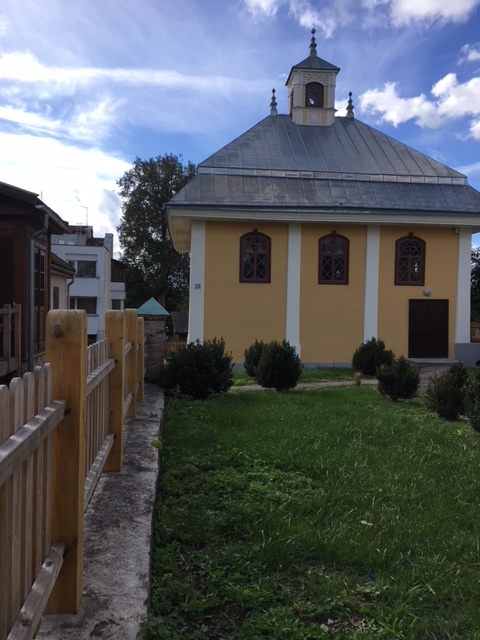
They came also from the Crimea, a distinct sect known as the Karaim who rejected the Talmud. Their language is Turkic and they variously describe themselves as the real Jews or, to avoid death in WWII, claimed not to be Jewish. They worship in Kenesas, one of which we viewed in Trakai. We also ate at a Karaim restaurant there, where I had a meat filled pasty that reminded me mostly of an empanada.

IMG_2093
The Kenesa

Back to the history: the Jews were granted a Charter in 1388, allowing them to govern themselves, raise taxes and enforce their own laws in their communities. They had separate schools, separate churches, separate community centers. Conversations were in Yiddish, except when conducting trade with the Poles or Lithuanians. As most Jewish boys were required to study the Torah from a young age, they were literate in an age when few could read. Thus many occupied roles as trusted advisors to the noble class. Not surprisingly, this lead to jealousy amongst the locals. In addition, the independence allowed the Jews in their communities meant that they didn’t integrate with the Poles or Lithuanians, but rather lived a separate existence side by side.

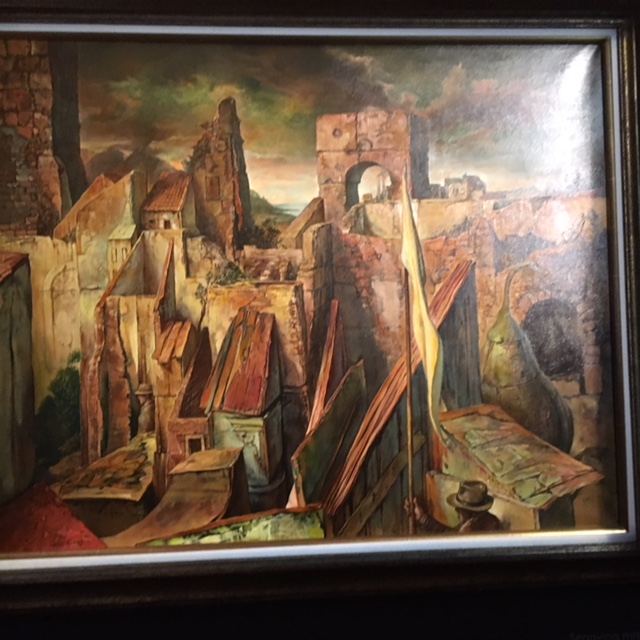
The Vilna Gaon Jewish State Museum narrates this history, along with art displays by Samuel Bak, a Vilnius holocaust survivor and prodigy who had his first exhibit in the city at 9. During the Holocaust, 95% of the 250,000 Jews in Lithuania were exterminated by the Nazis, mostly taken to nearby woods and shot.  Memorials in the woods  are situated next to the mass graves.

IMG_2187
Bak’s vision of Vilnius

In Vilnius itself, little remains of the vibrant Jewish culture that once thrived in the Jerusalem of the North. The Great Synagogue was bombed by the Nazis, then razed by the Soviets to make way for a school. A few signs remain, the writing in Yiddish, Hebrew and Polish. There is a plaque at the Theatre honouring the Jewish theatre group which, controversially, performed in the ghetto during the Nazi period.

Milda, the guide for the Jewish Vilnius tour was not Jewish, but a student working on her master’s thesis in Religious Studies. She took us through the streets of the old ghettos, pointing out the memorials to the victims and statues of famous Jews who had once lived there. It was only in the last decade or so, she explained, that real progress had been made to honour the former Jewish culture. During the Soviet period, the Soviets tried to quash all religious references that violated its official policy of atheism. This extended to prohibiting memorials that mentioned Jewish victims of WWII; one could only refer to victims. In the decade following Independence, the focus had been on rebuilding the economy.

But now a number of initiatives were underway to celebrate the city’s Jewish past. The school where the Great Synagogue stood is set to be demolished and archeologists are planning to excavate the huge underground ruins. Troves of books and papers, nearly 17,000 items, secreted from the library and hidden in a church for 70 years, came to light last year. And the story of Lithuania’s Oscar Schindler is being told and retold. He was Chiune Sugihara, a Japanese diplomat who disobeyed his country’s orders and issued over 5,000 exit visas to Jews, allowing them to escape Lithuania by taking the Transiberian Railway to China and onward to Japan.

Milda was blunt about Lithuanian collaborators with the Nazis and explained there was a debate going on as to how to deal with it. Some Lithuanians thought it necessary to acknowledge and come to grips with its past; others saw it as something that happened long ago which would be better forgotten. As for the current attitude, like any society, there is an element which is anti-Semitic, racist and against immigration. Lithuania (and all the Baltics for that matter) is glaringly homogeneous.  As another of my tour guides said, very few immigrants want to come here. Still another volunteered that if you were a Syrian refugee, you would probably not be comfortable here.

The Lighter Side of Lithuania

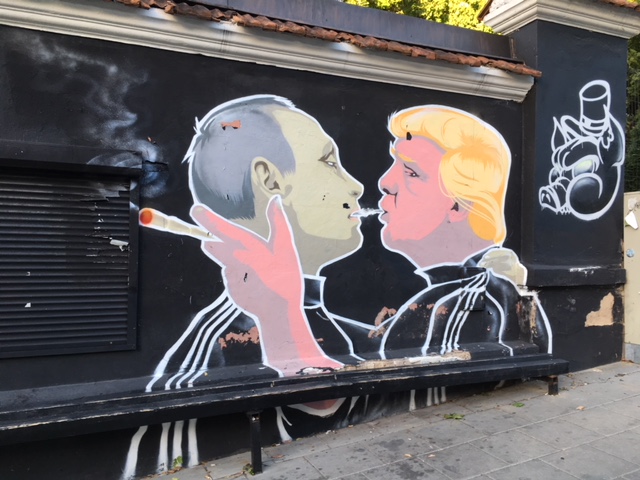
IMG_2103

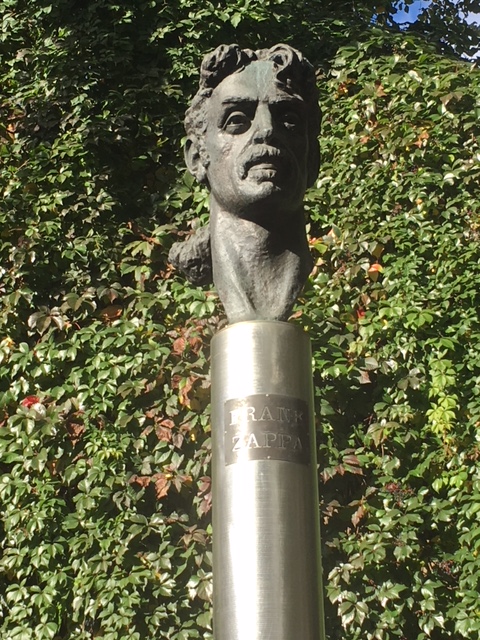
There is a definite kooky side to Lithuania, such as the bust of Frank Zappa in Vlinius. What connection has the non-conformist American musician to Vilnius? Absolutely none. He was never there; he had no Lithuanian blood in him. I heard two versions of why he had been honoured. One was a Lithuanian super fan managed to convince the city council that Zappa really was Lithuanian and deserved a bust. Another is slightly darker. Following the departure of the Soviets, local artists wanted to see how far they could push the envelope in terms of anti-establishment personalities and Zappa was the most notorious person they could think of when they submitted his name to the council to test its limits. Whatever the truth, there is a bust of Frank Zappa in the city.

IMG_2176

Then there is the Republic of Uzupis, an artist’s quarter located in the old city. It declared its independence in 1997, and celebrates it every April 1st by demanding all visitors acquire a visa, which is accomplished by smiling. It has its own flag, currency, an army (of 11) and a constitution drawn up over a few pints of beer with such articles as People have the right to have no rights. Internet cafes, malls and kiosks are banned. The area is awash in amusing artwork and the lowest price bars in town.

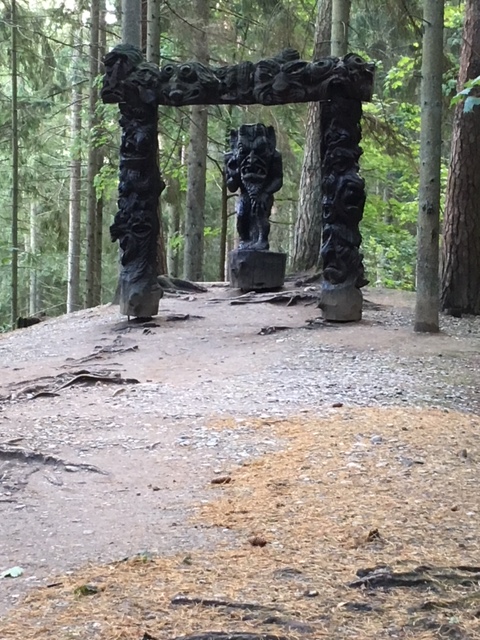
The Hill of Witches is located in a forested area on the Curonian Spit, a narrow strip of land Lithuania shares with Russia. It is exactly as its name implies, a forest trail filled with 80 wood carvings of pagan and folklore symbols. It was started in 1979 and tolerated by the Soviets so long as it didn’t contain any religious or anti-Soviet images. The figures draw on Lithuania’s long history of wood carving and are wonderfully expressive.

The carving called the Gates to Hell features the Gates and the Devil. Legend says that if you walk through the Gates, touch the devil, then return back through the Gates, you can brag that you have been to Hell and back again.

IMG_1973

Which seems like a fitting metaphor for my thoughts on Lithuania.


Loving (not) Latvia

The second Baltic country on our tour’s itinerary was the smallest- Latvia – sandwiched between Estonia and Lithuania. It shares a history with Estonia: invaded by German crusaders in 1202 who captured the land, converted the pagan tribes to Christianity, then spent the next 750 years battling, in no specific order, the Danes, Swedes, Russians, Germans and Poles, before being granted independence in 1918. That was short lived, as the Soviets invaded again in 1940, retreated when the Nazis marched in and occupied Latvia, then became part of the USSR in 1945 until independence was reasserted in 1991.

Given its history, it is not surprising that its main tourist attractions are religious (Catholic cathedrals, Orthodox domed churches and Lutheran churches) and the remains of medieval castles and walls, mostly restored after centuries of neglect and bombings during WWII. Our first stop covered all bases, at the “beautifully restored” 14th century Castle of the Livonia Order at Cesis and another across the valley at Sigulda.

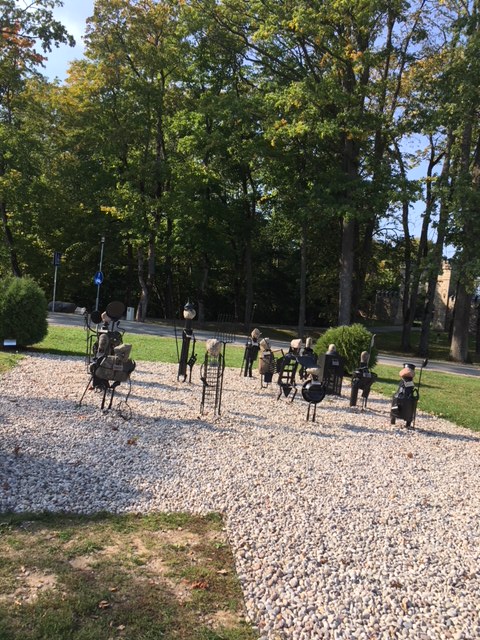
At least the town had a sense of humour when it came to statuary:

IMG_1834

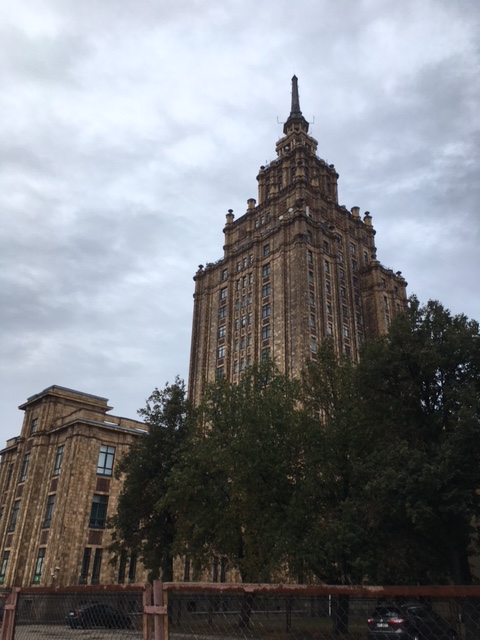
The capital, Riga, was the next stop. The landmark building was a gift from the Soviet Union, a testament to Socialist architecture and nicknamed “Stalin’s Birthday Cake”. It was almost an exact replica as the one in Warsaw and equally gaudy and disliked.

IMG_1850

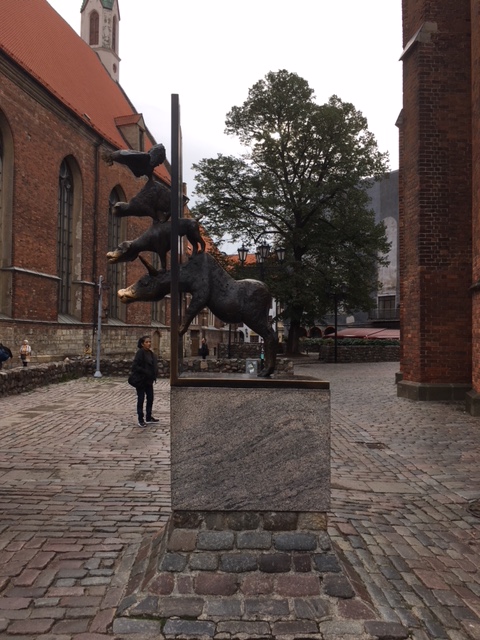
A walking tour of Riga took us to through the Market, made of abandoned Zepplin hangars, the Old Town, the walls of the medieval town, lots of churches being gussied up in anticipation of the Pope’s visit the following day, and a tribute to its sister city in Germany, Bremen, with the animals peering though a wall. Much of the Old Town had been bombed during WWII, so many of the buildings were restorations but it was hard to guess which ones.

IMG_1859

There was the inevitable Freedom Monument and an Occupation Museum which I visited. In 1949, during the Soviet Occupation, over 40,000 Latvians were deported to Siberia as part of the socialization of the country. These were the wealthy farmers and intellects; their deportation was designed to encourage the remaining farmers to voluntarily give up their land to the collective good. The displays included a film about the deportees lives in the Gulag and Siberia and their return in 1955 after the death of Stalin. The museum kept referencing that the deportees made of 2.2% of the entire population of Latvia.

The outdoor memorial to the Holocaust and Riga ghetto also references numbers, 70,000 Jews killed by the Nazis, 200 existing synagogues destroyed, less than 1,000 Jews remaining in Latvia after the war. Complicity by some Latvians was acknowledged, as were efforts by other Latvians to save the Jews. A house from the ghetto, furnished as it would have been in 1941, had been moved to the memorial and numerous photos illustrated  life in the ghetto. The ghetto was just a few blocks from my hotel, but as I walked around it, there was nothing indicating its former use. There was a memorial where the Great Choral Synagogue of Riga had stood, alongside its ruins.

None of this was very uplifting, so I decided to see if the KGB museum would bring a smile to my face. I don’t mean to be catty, but there has been one in every former USSR city I have visited and there is a certain similarity which, given that the KGB probably used the same playbook everywhere, is entirely expected. The directions were simple- go through the market (watch out for pickpockets), cut through the Old Town, go by the Freedom Monument for 10 blocks and arrive. I carefully cradled my backpack/purse through the market, then let my guard down on the rest of the walk until I arrived at the KGB museum, looked at my backpack and discovered I had been robbed. My wallet, with about 100 Euros, my driver’s license, one of my Visa cards and my debit card (which had not been working in any event), was gone. SHIT…………….

On the plus side, I still had my passport, a Visa card (I always travel with 2) and little bits of cash stashed all over the place. I wasn’t destitute, just pissed off. I spent the next 3 hours doing what I had happily avoided for the past 2 weeks – getting a Latvian SIM card so I could cancel my Visa card and order a replacement Visa and debit cards. If I thought getting robbed was a pain, it was nothing compared to the total stupidity of CIBC card services. They are quite happy to courier a Visa card to my son, but a debit card can only be sent to me and my lack of an address does not have any impact. As for those “free” collect calls to report a stolen card, the SIM card doesn’t recognize collect calls, so after being put on hold for 35 minutes, (we appreciate your business; our first available agent will be right with you), my SIM card ran out. I think the KGB museum would have probably been more pleasant and far less bureaucratic.

Between the Holocaust memorial and the pickpocket, Latvia was leaving a bad taste in my mouth, But it had one more treat: Rundale Palace. Built by the same architect who designed the Hermitage and Summer Palace in St. Petersburg, it was Baroque all the way -over the top design with garish painted panels, gold leaf cherubs and generally, bad taste. Commissioned by a German (the Duke of Courland) but taken by Catherine the Great in 1795 and given to her favourite boy toy of the day (she had many), it was also used by Napoleon’s army in 1812. It suffered serious damage in WWI, but the Soviets, recognizing its potential commercial opportunities, restored it during their occupation.


On the day we visited, it was being used for another bourgeois purpose. The BBC was filming a mini-series based on Catherine the Great starring Helen Mirren. Catherine’s death scene will be interesting if filmed-she died of a stroke on her toilet. Which seems like a fitting way to exit Latvia.

Estonian Escapades

My 3 country Baltic tour began in Tallinn, the capital of Estonia. I was touring with a British based tour company called Explore, which focuses on small group travel for the over 30’s crowd. My tour mates included an American, 2 other Canadians and 12 Brits, along with our Estonian tour leader, Tounal. Aside from Tounal, our average age was about 65, contained 2 smokers, a rocket engineer, 2 Toronto lawyers, a bunch of teachers, a former banker and a lot of IT people, none of whom were able to explain how to use the Fongo phone app. which theoretically allows you to keep your local phone number.

We started our tour in the wonderfully preserved medieval city of Tallinn, with its imposing walls and watch towers which both provided protection from foreign invaders and divided the city into the High Town and the Low Town. Some history is needed to appreciate the significance of High vs. Low in Tallinn, so let me give an abbreviated version:

After the Ice Age (circa 10,000 BC), the ice receded, leaving the Baltics fertile and inhabitable by early hunters/farmers. These people enjoyed a happy, pagan life until 1227 when  German crusaders invaded, forced Christianity on the locals, grabbed the best land and made themselves nobles. These Germans occupied the high land in Tallinn; the locals had the low land. Hence the need for walls. The Germans and the Estonians, who were reduced to serfdom, lived more or less together until Estonia declared Independence in 1917 (from Russia) and took back the land held by the German nobles. In 1939, the last of the Germans were expelled.

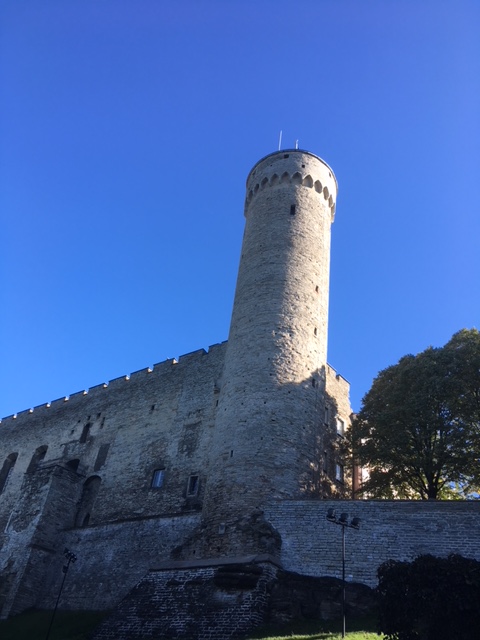
IMG_1633
Tallinn City Wall and Tower

Of course, plenty of others invaded Estonia. It occupies a strategically important place in the Baltics, bridging east and west, its lands are fertile (rye, flax and wheat) and forested and its seas swarming with fish. It was, at various times, overrun by Swedes, Danes, Poles, more Germans and Russians. Russia seized control of Estonia from Sweden during the Great Northern War between 1700 and 1721 and retained it until the events of the Russian Revolution allowed Estonia to declare independence in August, 1917, whereupon it was promptly invaded by Germany. Following WWI, it was granted independence until the Nazis invaded. The Russians “liberated” it from the Nazis, annexed it into the Soviet Union and didn’t leave until 1991.

The attitude of Estonians to their former Russian occupiers (as they are always referred to) is extremely negative. Notwithstanding the dislike of the Russians, of the 1.3 million people in Estonia, nearly 1/3 are “the Russian minority.” When Russia departed, it left Estonia without social services, insurance, pensions or a currency. It banned all fish from Estonia, since the fish had, overnight, gone bad. Estonians need visas to go to Russia, even though a river dissects the city of eastern Estonian city of Narva from Russia.

Against this backdrop, in Tallinn, we saw the medieval walls of the city (built by Germans), Lutheran churches, Orthodox churches ( for the Russian minority) and a Guild Hall, the 14th century equivalent of an old boys club/community center where important matters were decided and significant events performed, all under the watchful eyes of the married, male nobility. It is perfectly preserved and currently a museum of Estonian history.

Adorning the old market square are buildings of various centuries, numerous restaurants and souvenir shops. When I asked what the famous Estonian dishes are, the response was “rustic.” Most restaurants featured schnitzel, burgers, salmon and dark rye bread. Creamy mushroom sauces and butter grilled fish were ubiquitous, but nothing particularly Estonian. My two significant finds were September raspberries in the fruit market and a decent selection of not too expensive wines in the supermarkets from Europe, Australia and Chile. None from the USA and the 3 vineyards in Estonia did not produce wine in commercial quantities.

Estonia is famous for other things, notably folk singing festivals in every town, every season and marking every event (declare independence? let’s sing about it…). There is also a plethora of kooky statues, honouring everything from poets, scientists, the pig and fisher people:

From the main city of Tallinn, our tour proceeded to the Baltic island of Saaremaa, where we explored the well preserved/reconstructed Bishop’s Palace. It was built as early as 1380 by the German crusaders seeking to consolidate power, but Danes, Swedes and Russians occupied it over the centuries. As medieval castles go, it is fine, but the more offbeat exhibit is one of Soviet life in Estonia during the most recent occupation. The kitchen is miniscule, food is rare, the single bedroom has multiple beds, the bathroom has a toilet and a bucket to heat the water. On the stairs, were different jokes about the Soviets (Lenin was good, Stalin was bad, Gorbachov? We will get to know when he dies….). The exhibit was not a tongue in cheek look back at the Soviet occupation; it was a stark reminder of how difficult those times were.

We visited a fishing village on the island, learned the timetable of the airport (two flights weekly from Tallinn and charter flights from Finland) and other fascinating facts about the area. It was basically a former fishing area which could no longer sustain itself from fishing, so it promoted itself as a tourist destination –the lake country of Estonia. It boasted that hallmark of capitalism, the first golf course in Estonia, naturally constructed after the Russians departed. As a bit of trivia, the first golf course in Russia was not constructed until 1993.

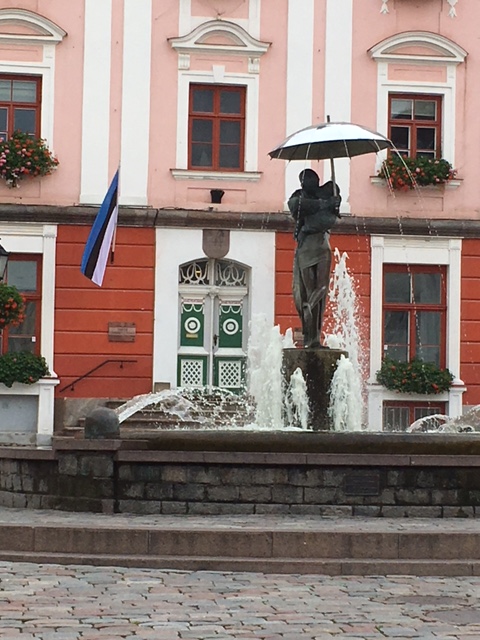
After two days in Saaramaa we returned to the mainland. We looked at the remains of another medieval castle at Viljander and some churches (Lutheran and Orthodox). Our last stop was in the second largest city in Estonia, Turtu, which has the remains of a medieval cathedral, some Lutheran churches and a pub in the old gun armory of the medieval castle, which hosts a weekly beerpong tournament. Naturally, there was a pretty market square, food markets and its symbol, the Fountain of the Kissing Students, reflecting its large student population.

IMG_1795

After a week in Estonia, I had my fill of medieval Castles, Orthodox churches, the former Russian occupation and schnitzel. It is a wonderful country- very clean (it is famous for its garbage clean-up campaigns) and lots of historical buildings, and a gentleness or naivete, depending on your point of view, from having true independence for less than 30 years. Time to move on.

Stockholm Sights

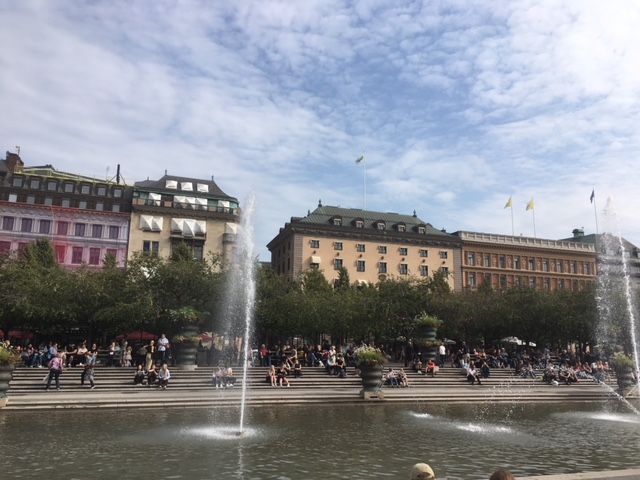
I began my sightseeing in Stockholm with a walking tour in the Gamla Stan or Old Town. The tour guide started with a succinct history of Sweden which went something like this: After the Iron Age came the Vikings. They disappeared during the Dark Ages. For 500 years, there were petty kings and lots of battles with Denmark. In 1523, a noble named Gustav consolidated power, made himself king and Sweden as we know it today was born. Gustav’s progeny ruled for a few hundred years, with their most notable legacy being making the Lutheran Church the national religion. This was more a land grab from the existing Catholic Church than a theological metamorphosis, but it stuck. In the early 19th century, the last of the Gustav line died without heir so the Swedes asked Napoleon what to do. Why Napoleon was never explained, but he proposed a wealthy Frenchman who had no royal blood and didn’t speak Swedish. The Swedes accepted and, to this day, his heirs are the Swedish royal family. They have since learned Swedish but their taste in marriage partners still runs toward the common- an American businessman and a reality TV star.

The tour walked us through some of the significant buildings where these events occurred – the Church where the Gustavs are buried, the Royal Palace, the main square which was the sight of a bloodbath of Swedish nobles by the Danes and the narrowest alleyway imaginable, constructed only 35 inches wide to discourage people from using it as a toilet. The streets were all cobblestone,  everything was pretty and the entire tour with the historical commentary took a grand total of an hour and a half.

I cycled to the Vasa Museum, a wonderful monument to total stupidity. There is even a syndrome called the Vasa Syndrome, which refers to a pigheaded ruler who doesn’t listen to anyone and fails to see disaster looming. The Vasa was a ship built quickly under orders from one of the King Gustavs to battle the Poles who were at war with Sweden at the time. King Gustav wanted to impress the Poles, so he ordered that there be two gun or cannon decks, rather than the usual one, but failed to make allowances for the extra weight the second gun deck added. Not surprisingly, on the day of its launch in August, 1628, it gloriously sailed 1300 meters (1400 yards) and sank.

The Vasa was raised in 1961 and carefully reconstructed (98% is original). It is now housed in a purpose built museum with ramps allowing visitors to view it from different levels, along with exhibits showing aspects of life in the city based on artifacts found on the ship. Raising and restoring the Vasa was a mammoth undertaking and it is a fabulous relic, but even I, with a limited knowledge of seaworthiness principles, could tell it was top heavy.

So I turned to a more seaworthy topic- the Vikings – at Vikingaliv, a museum devoted to  Vikings. There I learned that the Viking image as fierce sailors and warriors was not accurate; the museum portrayed them as simple farmers forced into occasional forays of plunder and murder along the coasts of England and Ireland. There were models of Viking ships and references to their extensive trading as far as Constantinople and China, but the focus was on their farm houses, their family life and their burial rites, with special attention paid to a 10th century Arab traveler who wrote of the Vikings practice of weekly baths and daily hair combing. Very enlightening.

Desirous to learn a little more about Swedish history, I went to the aptly named Swedish Museum of History. It told the same story as the tour guide and the Viking museum, with more artifacts but no more detail. I was beginning to understand why all my European history courses had failed to mention Sweden- after the Vikings it was not involved in much except local wars with the Danes, Russians and Poles.
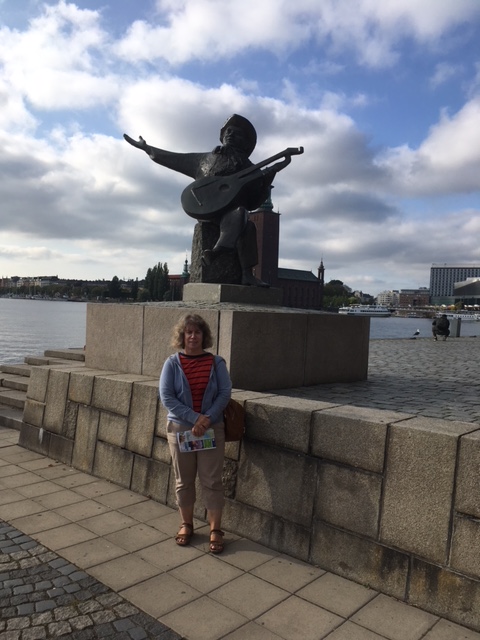
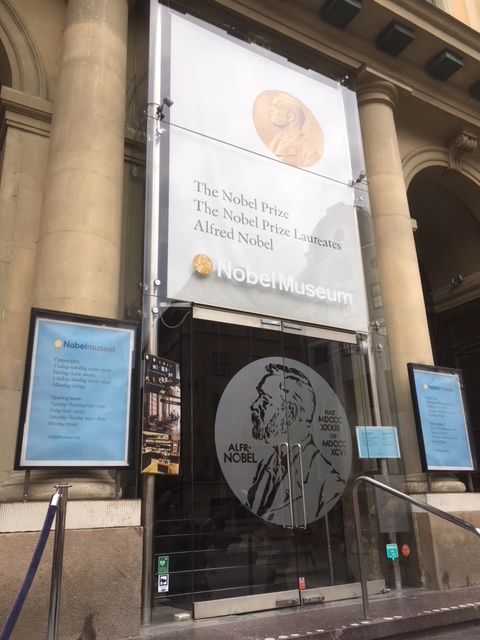
Sweden did produce one noteworthy individual – Alfred Nobel, of the Nobel prize fame and the subject of the Nobel Museum. Occupying a prominent place in the Main Square of the Old City, the Nobel Museum traces the life of Mr. Nobel – born in Sweden, invented dynamite and became stinking rich, lived in various places throughout Europe, died without heirs so bequeathed his entire fortune to the founding and funding of the 5 prizes (chemistry, physics, medicine, peace and literature) with the 6th prize in economics added in 1969. Each is awarded annually with great fanfare in Stockholm.

IMG_1520

However wonderful the concept of the Nobel prize or the achievements of its recipients, it does not make for a particularly fascinating museum. A tribute to the Literature Prize winners showcased each person’s name, country, famous works and the reason why he or she was chosen: “So and so was born in …..and raised ….He/she was greatly influenced by ……..The Academy chose so and so because……” Other than giving me ideas of some books to read, the whole thing was boring.

Seeking something more engaging, it was off to the Nobel theatre, which ran short films of 24 Nobel recipients, letting them speak of matters dear to their hearts. The Dahai Lama contributed a film as did Barbara McClintock for her work on corn genetics. Each short film provided appropriate tributes to the awardee, but the entertainment value of the films was fairly limited.

Hoping to see something more interesting, I turned to the artifacts exhibits, but seeing letters written by Einstein or a model of DNA did not excite me. I left shortly afterwards to visit the museum devoted to Sweden’s most famous citizens: ABBA.

ABBA was the iconic music group of the 1970’s. The two ladies (Agnetha and Anni-Frid) and two gents (Bjorn and Benny) were well known singers and song writers in Sweden in their own right, but shot to international stardom after winning the 1974 Eurovision song competition with Waterloo. Hit followed hit followed by movies, a Broadway show (Chess), marriages to each other ,then divorces and the gradual break up of the group.

IMG_1543

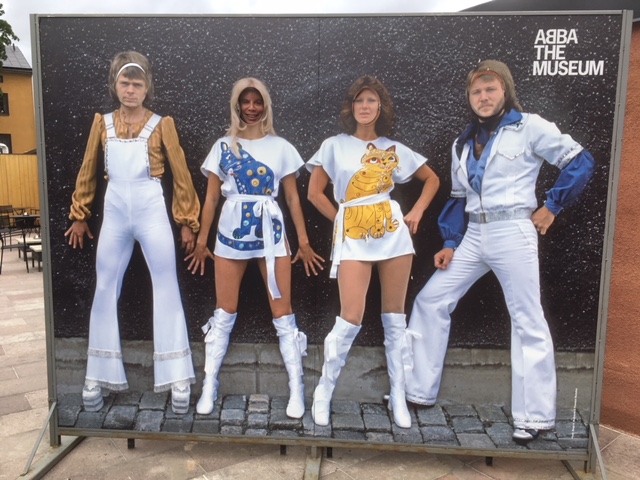
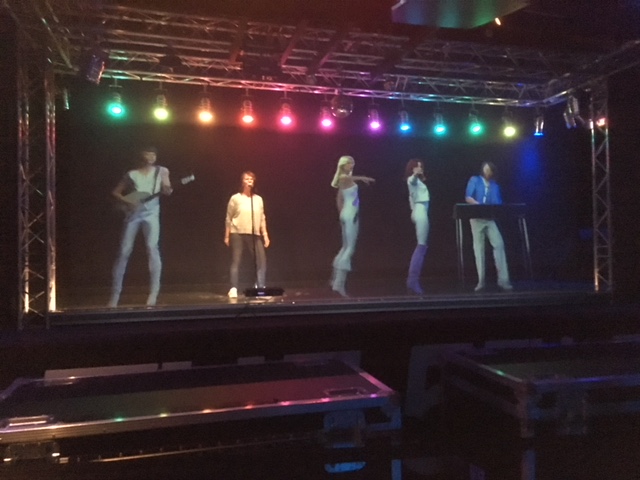
All is lovingly retold in the ABBA museum, complete with videos, an infectious soundtrack that follows you around, a frightening number of shiny bell bottom pants and the most interactive exhibits one could want. While I limited myself to having my picture taken in the cutouts, other tourists partook in photo sessions, karaoke and the ultimate dance- on stage with holograph ABBA singing and performing the moves to one’s choice of Dancing Queen or Mama Mia. I didn’t have enough hutzpah to get on stage and try, but others did.

IMG_1547

It was a fitting end to my time in Stockholm- a pleasant but not too serious museum. The price, as usual in Sweden, was outrageous to my Canadian sense of cost, but I left with positive vibes of Sweden and humming Supertrouper as a left.


Welcome to Europe: Stockholm

After spending a week in Toronto, I flew to Germany en route to Sweden. I arrived at the immigration booth and had the following conversation with the customs officer:

“Where are you going?”

“Sweden”

How long?” he inquired.

“Not sure.” I said.

“Welcome to Europe,” he replied, handing me back my passport and waving me through.

And that was that. Just a perfunctory question or two in Germany and I was in Europe for an indeterminate time with no probing whatsoever into my intentions, finances, or hotels. Nothing. I’m guessing that the profile of a middle-aged Caucasian woman speaking English with a Canadian passport doesn’t raise any red flags, but it does make me feel slightly privileged compared to the welcome I suspect awaited the thousands of recent would be refugees.

But on to Sweden. I don’t know if it was the contrast to 10 weeks of driving around the USA or memories of unfortunate first encounters with airport taxi drivers or the clean streets in Stockholm, but I am loving this country. The 5 minute late departure of the flight from Frankfurt was the subject of no less than 3 apologies from the pilot, no immigration awaited me  in Stockholm and the signs for the express train to downtown were in English and easy to follow. My credit card worked in the ticket machine, my seat mate on the train spoke perfect English and the directions to the hotel (go out of the station, turn left and walk for 250 meters) were accurate. Less than an hour after landing, I was happily ensconced in my downtown hotel.

Better yet, there was a bike share rack across the street. I hadn’t been on a bike most of the summer and was anxious to try Stockholm’s much vaunted cycling system.  I bought a bike card (conveniently on sale at my hotel), went to the bike rack and got a bike. It was that simple. No idiotic written cycling test (as in Mexico City) or wait for a code/fob/secret password (like Toronto). Just buy the card, get the bike and go. Which I did – there were bike paths all over the place – in pale red on the road, on sidewalks with different stones or asphalt to keep us apart from pedestrians, some paths raised off the street, other times with guardrails to separate cyclists from the buses. We had our own traffic lights,  crossings, passages under the bridges, even our own lane on roundabouts. Best of all, everyone – cars, pedestrian, other cyclists, even cab drivers – were kind and tolerant. No cars tried to kill me by turning right in front of me, pedestrians mostly respected the lines between bike paths and sidewalks and no crazy cyclists tried to recreate the Tour de France. Everyone was so relaxed, so non-aggressive, so kind. It becomes infectious. I started going around the idiot tourists who stood in the bike paths to get that great picture with an understanding smile. Cars stopped and gestured for me to cross the road even though there was no light or zebra stripes. I moved over for faster cyclists and waited for bike lights to turn green. Unlike Toronto, cycling here does not feel like a death defying act but an enjoyable experience.

Of course, I got lost. A lot. Stockholm is built on a series of islands, some of which are connected by ferries, other by bridges and most with unpronounceable names that were hard to decipher as I cycled over one bridge and onto another island. Google Maps was less than useful. Google Maps would tell me it was 12 minutes by bike away….just turn here, continue on ….street, then go left….etc., but the voice could not be heard on a bike and no cyclists had headphones on (or, for that matter, very few helmets) and once I spent more than an hour with no destination in sight, I turned to more traditional methods of finding my way. I asked people. Most of my conversations started with a polite:

“Hello, do you speak English?”

“Of course” would be the somewhat indignant retort.

After a few “of course” answers I changed tactics slightly. Instead of asking “do you speak English?” I switched to “Hi, can you help me in English?” which was met variously with “certainly”, “absolutely” and “for sure” but not once with “I don’t speak English.” As I said, everything was pretty easy here.

IMG_1478
Even the statues are happy

Food was the next order of business. Normally, liquor would also be high on the list, but my pre-trip readings had all warned of the extremely high price of wine. However, as a foreigner, I was entitled to bring in up to 4 liters of wine. Breaking my “no checked baggage” rule, I put a few bottles of Pellar Estates Pinot Grigio in my suitcase. Call me cheap, but the few times I ordered a single glass of mediocre wine in Stockholm, the cost was always over $20.

My principle foray into Scandinavian cuisine was a healthy indulgence at the hotel’s daily breakfast smorgasbord, including all I could eat smoked salmon, cured salmon, cooked salmon, pickled herring, liver pates and a variety of novel (to me) cheeses along with made more traditional omelets, bacon and breads. Good thing I like salmon.

My hotel’s flagship restaurant was Kitchen & Table, a concept by the Ethiopian born, Swedish raised and current Food Network expert chef, Marcus Samuelson, where local sourced vegetables are the stars and proteins ordered as sides. I treated myself to a Jerusalem artichoke served in a parsnip puree and caramelized onions, with braised lamb on the side. Delicious.

Within a few blocks of the hotel were numerous Indian, Italian and sushi restaurants, but nothing that served Swedish meatballs or reindeer. For those, I went to Ostermalm’s Market Hall, the main food hall. Both were available, but neither looked particularly appetizing. A food truck festival was happening nearby, so falafels won out.

IMG_1512
Saturday afternoon in downtown Stockholm

Greetings in Sweden took me a bit of getting used to. Everyone uniformly says “heh.” Not, “heh heh” or the current millennial’s favourite “hey” but a guttural, throat clearing “heh.” The first few times it was barked in my direction, it startled me, like someone had caught me doing something I shouldn’t, but after I looked up the English translation (hello) and proper spelling (hej), I warmed up to it. I could not bring myself to use it, preferring “hi” to announce my need for English. Everyone seemed okay with that, because the Swedes I met were generally okay with everything.

So, having mastered the local transportation, food, wine, greetings and my lack of Swedish, I felt ready to tackle the sights. Next up, some museums.


The City of Tourist Love: Philadelphia

After attending a scrapbook convention in Edison, New Jersey, I headed to Philadelphia. I had  low hopes for this city – I was visiting simply because I had never been there and was curious. Initial impressions were negative when my downtown hotel booking advised of the US $45 per day parking charge. Outrageous I thought, but the daily rate at the airport was only $8, so I parked there and took the shuttle to the terminal to catch the train downtown.

I stood by the ticket machine and, to my surprise, a young man in a transit uniform came up and asked if I needed help using the machine. I looked at the instructions: “pick station, insert cash or card, then press button and take ticket and receipt.” I thanked him and said I thought I could figure it out. Which I could-no strange “what zone are you going to?” issues or “one way, return or 3 day” multiple choice questions. Within seconds, I had my ticket and went to the track. The train arrived 10 minutes later and a live conductor validated my ticket with a hole punch. No strange turnstiles or validation machines or other odd contraptions waiting to trap unwitting tourists into doing something wrong. Just employees happy to help. Maybe I would grow to like this city.

30 minutes later I was at my station. Well marked, easy to read maps guided me along the short walk to my hotel – maybe not so hard since the city is mostly on a grid, but a welcome change from Toronto’s incomprehensible Path signage. There were many sights along the way – the City Hall is impressive and statues adorned the streets everywhere, with helpful plaques advising who the statues are and why they were there. Ben Franklin was popular; that was to be expected:

Rodin’s Thinker and the tribute to Copernicus (the earth is rotating around the sun) were less obviously connected to Philadelphia.

When I read the plaques, it turns out that Philadelphia has the largest Rodin exhibit outside of Paris thanks to the benevolence of Jules Mastbaum, a Philadelphia movie magnate who donated his collection to the city. The homage to Copernicus was a donation by a Polish-American group to honour the 500th anniversary of his birth.

As this was Philadelphia, I felt compelled to visit Independence Hall, where the Declaration of Independence was drafted and proclaimed, along with various other important documents (the Constitution, etc.). Tickets to the Hall are free, but timed, so in between receiving the ticket and the tour, I went to visit another icon of the US- The Liberty Bell. After successfully passing through security, I walked through the placards explaining the struggles of the US to obtain its independence and the significance of the Liberty Bell. It was a refreshingly sympathetic discussion of the early settlers’ attitudes and actions towards the Native Indians and the slaves, to the point of suggesting that they were wrong. Clearly, I was not in the south anymore.

I finally got close to the Liberty Bell- it is protected by railings. Let’s just say it is a bell, with a very large crack in it. It may represent liberty, independence, freedom etc. to some, but to me it was just a bell with a crack in it.

Likewise, Independence Hall. The ranger led free tour provided the context for the US colonies’ revolts leading to the declaration of independence, along with the events prior to the July 4th declaration and the personalities involved, but at the end of the day, Independence Hall consists of a few rooms, one set up like a courtroom and the other with the round tables where the signatories debated the wording and put pen to paper.

There are other museums and houses dedicated to various 1776 celebrities; The Betsy Ross House, The Franklin (Science) Museum, the house where George Washington lived, but I felt I had done my share of historical sightseeing. Next stop, a foodie tour.

Unlike some cities, Philadelphia’s food scene can be visited in a single stop at its Reading Terminal Market. Filled with over 100 merchants selling produce and counters selling cooked food, it is a glorious hodgepodge of every type of food imaginable, with one glaring exception-no chains. A number of counters sold the famous Philly Cheesesteak, a hot dog bun filled with beef, cheese, peppers and onions. Delis, Indian, Shawarmas, sushi, ribs, ice cream, Greek, Italian, cookies, burgers, an oyster bar, Thai, Chinese, everything one could want to eat, was on offer here. Conveniently located just a 10 minute walk from my hotel, it became my go to place for every meal.

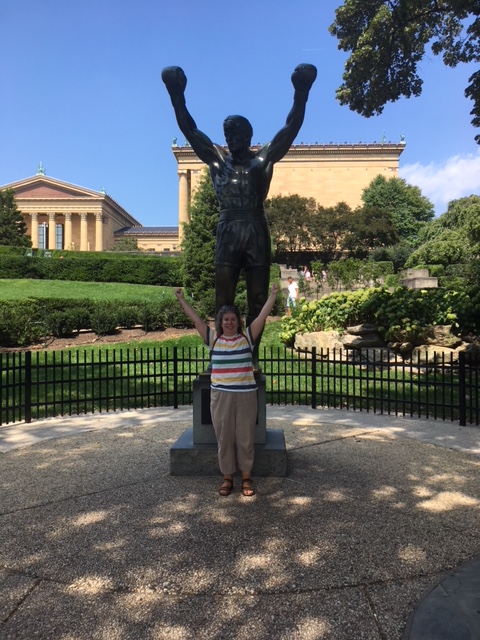
On my last full day here, I did what every visitor to Philadelphia must do- re-create Rocky’s run up the 73 stairs at the Philadelphia Museum of Art and turn triumphantly to the city with arms raised high. When Sylvester Stallone did it, I suspect the temperature wasn’t north of 35, there was no scaffolding obscuring the stairs and he hadn’t endured a two mile walk through an obstacle course of construction, homeless people and more statutes. I did, and approached the building hot, sweaty and in no mood to run up those steps. I wasn’t even a big fan of the Rocky movies.

Fortunately, as in everything else, Philadelphia has considered the tourist. It probably didn’t want to face liability lawsuits from middle aged tourists suffering untold injuries racing up the stairs. The statue (yes, another statue) of Sylvester Stallone/Rocky was not where one would expect it –at the top of the stairs- but in the shade just to the right and at the bottom of the stairs. With a giant sigh of relief, I asked another tourist to take my picture, raised my arms high, just because, and left.

IMG_1446

I am leaving Philadelphia happier for having visited. Next is Toronto for a week before flying to Sweden. 6 nights there, 2 days in Helsinki, a tour of the Baltics before finally settling in Paris.

Still South: Monroeville, Montgomery and Nashville

Monroeville:

I took a detour off the interstate between Mobile and Montgomery to stop in Monroeville, aka Maycomb, aka the Literary Capital of the USA. Still scratching your head and asking “what”? Here’s the answer: Monroeville was the home of two of the most famous authors in the USA-Truman Capote and Harper Lee. They lived next door to each other in the late 1930’s when they were 5 years old and became best friends.

Harper Lee’s father was a lawyer and she spent many hours in the Monroeville courthouse, which stands today as a museum to Harper, Truman and To Kill A Mockingbird. Harper admits that many of Atticus Finch’s traits (the hero lawyer in the novel) were inspired by her father. The novel was made into an Academy Award winning movie starring Gregory Peck as Atticus. The courthouse in Monroeville was not used for the actual movie, but an exact replica was made in Hollywood.

Today, Monroeville is typical of many dying Southern towns. The main square, where once stood dress shops and diners, hardware stores and lawyers offices, still exists, but at noon hour on a Thursday afternoon, I was the only pedestrian. No restaurants were visible on the square, and the only shop that was open was the Thrift Store, a mainstay in every small southern town I passed through. Later, I did see 2 people walk into the library, but no one else.

Inside the museum/courthouse, the cashier asked if I was on a literary tour of the US. “No”, I said, “I didn’t realize there was such a thing.”

“Most definitely,” she replied: “Monroeville is high on the literary tour list. Did I want a walking map of Monroeville so I could visit the sites where Harper Lee and Truman Capote’s houses once stood?”

I declined and instead walked through the museum’s rooms: a lawyer’s office with books and furniture from the 1930’s, a room devoted to Harper Lee’s life and writings and another devoted to Truman Capote’s life in Munroeville, a room with a giant picture of Harper Lee and Gregory Peck when the movie was being shot and the crowning glory, the courtroom where Atticus defended the wrongly accused black man of raping a white woman:

Montgomery:

Montgomery is famous in the civil rights movement for the non-violent protest marches from Selma to Montgomery in 1965, led by Martin Luther King Jr. and other civil right leaders. I was looking forward to seeing Alabama’s state capital as a champion of civil rights in the US. I could not have been more wrong.

Granted my choice in museums was odd- the first White House of the South. If you google White House South, you will probably be taken to Mar-a-Lago, Trump’s preferred residence in Florida. But there is a real White House of the South, 3 of them in fact, better known as the White Houses of the Confederacy because Jefferson Davis lived in each of them during his tenure as the one and only Confederacy president.

I approached the White House of the South expecting to see a protestor or two, maybe a sign saying that even though its inhabitants had stood for unacceptable (i.e. slavery) beliefs or just something acknowledging that some people (like the vast majority of the population) might find the continued existence of the house offensive. Nothing of the sort greeted me and its location, across from the Alabama State House , the Veteran’s Affairs Department and beside the Alabama State House, ensured its prominence amongst the Alabama government buildings.

I was greeted by a kind gentleman offering a free bottle of water (much appreciated as it was about 35), free admission and a binder containing a walking tour of the building. Papers scattered about the house laud Davis’ achievements – West Point graduate, soldier in the War with Mexico, Mississippi senator, US Secretary of War under President Pierce, first to suggest a transcontinental railroad, first person to envision the Panama Canal Zone, first person to try and buy Cuba…..and reluctant President of the Confederacy. A brief mention of his post Civil War incarceration at the hands of the Union is made but nothing of his pardon. Absent was any reference to the huge numbers of slaves he owned for his plantation (in excess of 100), his fervent belief that the white man was superior to the black man and his basic incompetence as a politician.

But the mere fact that this building stands as a shrine to the principles of the Confederacy is astonishing. As I write, the statue of Jefferson Davis has been unceremoniously relocated from downtown Memphis to an undisclosed location and a “guerilla demonstration” in North Carolina toppled the Silent Sam statue, described as an enduring tribute to white supremacy.

The hypocrisy in allowing this building to stand as it does is amazing, but then, this country elected Donald Trump so why should I be surprised?

Nashville

Needing something to lighten the mood, I arrived in Nashville and made my way to the dozens (hundreds?) of Honky Tonks lining South Broadway. A Honky Tonk is basically a bar serving mostly beer and whiskey (the Jack Daniels Distillery is 2 hours away) in plastic cups with an unpaid country and western band trying to out yell the band next door with giant speakers. The food is overpriced and greasy, vegetables are hard to find and you cannot take your alcohol onto the street. I survived with my hearing intact and no obvious case of food poisoning.

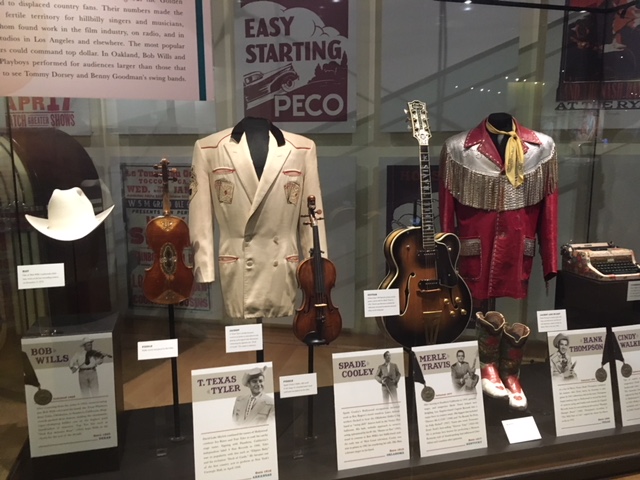
The next day I did the honorable thing- I went to the Country Music Hall of Fame. After paying the $25 entrance fee, I saw the first exhibit-something devoted to Taylor Swift and education. I passed and entered the next one-a tribute to the Judds. My lingering memories are they sure got divorced a lot and they had really bad hair days in the 1980’s, 1990’s and early 2000’s. They seem to have tamed their locks more recently, but the how and why were glossed over.


The Hall of Fame charted the early start of country music with a few videos from the 1920’s, then proceeded to identify every single inductee with a “so and so rose from obscurity to fame with [insert name of song(s)]” and “He or she donated [check the box] boots, a guitar, a suit or, in Elvis’ case, a car.” On and on and on. After 2 hours of blurring names and songs, I gave up and left.

IMG_1378

But I had the Grand Ole Opry ticket-surely that would be better. Let’s be clear – I like some country music. I have Johnny Cash on my playlist, I love Kenny Roger’s The Gambler and I think Dolly Parton’s rendition of 9 to 5 is the best thing about the movie. But after an hour at the Grand Ole Opry, I was bored. I emailed my son a picture with the comment “ Stuck here listening to country music for 2 more hours and I paid 70 (us) for the privilege. Definitely once (and only once) in a lifetime experience. Performer is now making sucking crawfish jokes.” He responded, with the wisdom of a 24 year old: “No one is forcing you to stay :p”. He was right. I am retired. My motto is “do only what I want.” I left.


In the Deep South: Mississippi and Alabama

In 1991, I drove to Charleston, South Carolina, my first foray into the deep south. I was struck by how friendly and superficially polite everyone was, but racial issues were never far away. I recall entering a gas station just off the interstate and being told, in a this is for your own good kind of way by the black attendant that I should get my white ass out of there (which I did). On one tour of a former plantation, the white tour guide asked if anyone on the tour had negro blood – none of us did – so she told us she would give the white version of the tour. I have no idea what the black version sounded like.

Fast forward to 2018 and I was curious to see if my nearly 30 year old impressions were still valid – that is of a group of white people tolerating the racial equality mandated by the government and the courts- but secretly harboring a desire to return to the good old days before the civil war; a world of slavery and Scarlett O’Hara, of plantations and debutante balls. Sadly, a week in Mississippi and Alabama reinforced my opinion that racial equality was tolerated, but deep down, the old white aristocracy has never come to grips with their defeat in the Civil War.

Jackson, Mississippi

The Museum of Mississippi History and the Mississippi Museum of Civil Rights both opened in December, 2017, next to each other. The first thing that struck me was the  odd warnings about the water, probably sponsored by Evian:

IMG_1232

I started in the Museum of Mississippi History, which did an adequate job of explaining the original native inhabitants and their forced exile to lands west of the Mississippi River by President Andrew Jackson. Slaves were brought to the area by “white settlers” where some of them worked in “difficult conditions.” From there, the museum went downhill quickly. The Civil War happened when the south ceded from the Union and Jefferson Davis was reluctantly (their words) elected as the first president of the Confederacy. Davis was mentioned a number of times, Lincoln not so much.

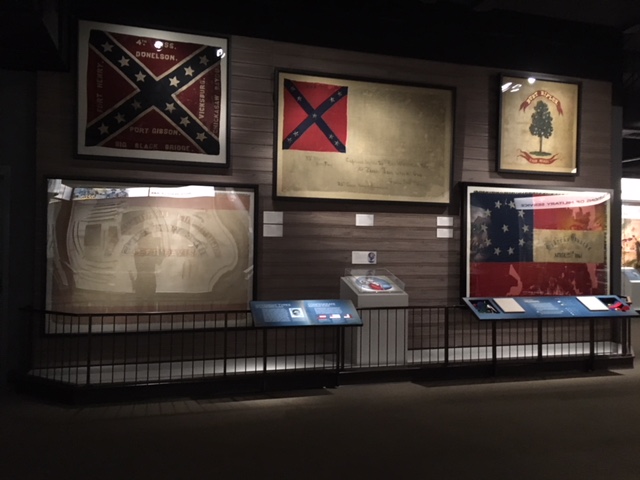
The Museum pointed out that over 70,000 Mississippians (white) joined the Confederacy army and as many as 20,000 Mississippians (black) joined the Union army. As for the civil war, two messages came through loud and clear: the Confederacy went through a number of different flags and the Union General Tecumseh Sherman destroyed all the railroads and bridges in Mississippi. That the latter might have been a good military tactic is not mentioned, nor is the Confederacy loss. After the Civil War, according to the Museum, Mississippi had trouble recovering because Union General Sherman had destroyed their railroads and bridges (this fact was repeated at least 3 times). The fact that Mississippi’s economy had been based on slavery is not mentioned as a reason in its economic decline; that is attributed solely to the North’s policies during and following the Civil War and (again) the destruction of the railroads and bridges by the north.

IMG_1227
Confederacy Flag Exhibit

Following the Civil War, the museum focuses on Mississippi’s recovery, gives mention to the reconstructionist period, then proceeds through the ups and downs of the late 1800’s to the present day. If you want to learn anything more about the non-white struggles, you are sent next door to the Civil Rights Museum,  which is the biggest issue I have with the dual museum approach. The Civil Rights Museum is excellent, but why is it incorporated in a separate building? The two museums are connected, both physically and by admission, but the very fact that there are two separate museums reeks of a separate but equal approach, as if the struggle by African Americans for equality is somehow not intrinsically wrapped up in the history of Mississippi.

Mobile, Alabama

Unbeknownst to me until I arrive in Mobile, it has the oldest Mardi Gras in North America, started by the French in 1703 when New Orleans was still a swamp, as my tour guide in the Mobile Carnival Museum relished in pointing out (twice). Mobile’s Mardi Gras parade is also a family affair-if I wanted something other than family entertainment (she didn’t say exactly what), I should head to New Orleans.

The Mobile Mardi Gras parade is the culmination of months of preparation, balls where ladies must wear gowns, men tails and mystic societies where acceptance is by invitation only. These societies are not cheap- each is expected to fund a parade float or a parade march where the participants toss “throws’ to the eager crowds lining the route. There are now two kings and queens –one each white and  black – by agreement (more separate but equal?). Being a king or queen is no small feat- they must drag elaborate trains costing thousands of dollars and weighing upwards of 80 pounds each. The heavy ones have ball bearings sewn under the back end of the trains, making them easier to pull.

My guide was a genteel lady in her 60’s or 70’s who delighted in stopping at every single train in the museum and explaining the meaning of every detail- if there were kings or queens in the family, there would be a crown or two on the train, a nurse queen had a medical symbol on hers, a king with Scottish heritage announced that on his train, another queen’s train paid homage to the grandmother who raised her. After an hour and a half, I couldn’t bear the thought of learning about the significance of yet another train, so I made up a noon hour lunch date and left. For me, the entire Mardi Gras in Mobile smacked of elitism with no redeeming value other than maintaining outdated and obsolete traditions.

Hoping for something that didn’t involve balls and debutantes, I walked to the History Museum of Mobile. On the plus side, it has an impressive collection of stagecoaches. On the not so great side, it too waxed poetic about Jefferson Davis, the Confederate flags and the single sinking by the Confederate Army of the Union ironclad ship Tecumseh despite the war cry “Damn the Torpedoes, Full Speed Ahead” by the Union general. The museum also lauded Mobile’s role as the Paris of the Civil War,  but there was scant mention of the causes of the Civil War or the Confederacy’s loss.

Tired of the lopsided perspective of the Civil War in the Museum,  I indulged in some down home southern cooking. The fried catfish was heavy and greasy, fried green tomatoes smothered in a  very rich crawfish sauce, grits with cheese and garlic (tasted like cheese and garlic) pralines, pecan pie and lots of fried chicken. Not a single salad.

Next, finally heading north after 10 weeks on the road.

Memories of Memphis

The drive from Oklahoma City to Memphis takes less than 7 hours, but it was like crossing into a different country. Gone were the flat prairies of the Midwest, replaced by lush greenery and rolling hills marking the tentacles emanating from the Mississippi River. It wasn’t just the scenery which changed; strong-willed pioneers opening up a new land were replaced by civil rights advocates and cowboys became music legends, setting the stage for blues and rock and roll and soul.

Memphis has a lot of stories to tell and I spent 4 days trying to understand this city. Commencing with a walking tour, our first stop was the now absent statue of Jefferson Davies, the one and only president of the Confederacy, whose secession from the United States of America started the Civil War in 1861. Memphis deals with its treatment of African Americans more fairly than the other places I visited. Our tour guide, a retired white man and long time resident of Memphis, boasted unashamedly about the great man, Martin Luther King Jr. and the sorry legacy of Memphis’ place of his assassination. We walked past the radio station WDIA, the first all black radio station in the US, Lansky’s clothing, costume maker to the stars like Elvis Presley and Sun Records, where early R&R singers recorded.

IMG_1144
Former place where statue of Jefferson Davis stood

Peabody Hotel’s Duck Walk

The tour was timed to enable us to watch the 11:00 AM parade of the ducks at the Peabody Hotel. 5 ducks (4 femaIe and 1 male) march from their roosts on the roof of the hotel, into the elevator and down the red carpet to a fountain in the lobby precisely at 11:00AM every day. They spend the day there, until they march back up to the roosts in an equally pompous ceremony at 5:00PM, both waddles loudly announced by the Duckmaster and enjoyed immensely by the appreciative audience. A number of videos of the duck march are available on YouTube-search Peabody ducks. This is one of those events that had no deeper meaning- it is just fun and cute.

IMG_1147

The National Civil Rights Museum

Situated on the premises of the Lorraine Motel where Martin Luther King Jr. was assassinated in 1968, the museum charts the failure of the Reconstruction period after the Civil War, to the rise of the Jim Crow laws and the separate but equal results to the seeds of the civil rights movement. The exhibits and commentary, with news clip videos and mock-ups of burning buses and drugstore counters, recount in vivid detail the struggles of black Americans for voting rights, equality and integration. Pivotal events – the March from Selma to Montgomery, the murder of civil rights workers in Mississippi, the Memphis sanitation workers strike- and the people –Rosa Parks, Martin Luther King Jr. – were documented with photos, personal recollections and informative commentary about their impact. Of the many civil rights museums I visited, it was by far the most thorough and thoughtful.

Rock & Soul Museum/Beale Street

Memphis has a plethora of musical museums and iconic places pivotal to soul and Rock & Roll. The Rock & Soul Museum traces the origins of soul music and its influences on rock & roll with plenty of opportunities to hear past songs.

To experience the music, Beale Street is the place to be. Lined with restaurants and bars, the pedestrian only street is home to the Memphis music scene. Carrying alcohol from bar to bar is permitted, so I grabbed a large Margarita, indulged in barbeque ribs and fried chicken, and walked from place to place, listening to the bands playing everything from Elvis to Otis Redding to Jerry Lee Lewis.

Graceland

I couldn’t leave Memphis without visiting Graceland Mansion, Elvis Presley’s home and mecca for Elvis fans. I like Elvis’ music, but I was never a hard core fan. Thus, I opted out of the Ultimate VIP Elvis tour for $169 which includes an expert guide, Elvis’ plane, a meal voucher and access to a private lounge and went cheap, for only $39, I would receive only the basic Mansion tour with audio commentary.

Upon arrival, I was forced to pay anther $10 to park my car. I waited in a line for my timed entry (every 15 minutes) and was shown a short video about Elvis. From there, our 11:00AM tour was herded to a compulsory photo in front of a cutout of the Mansion and put into a line for the shuttle to the actual mansion. We stood in line for 20 minutes, to take a 5 minute shuttle ride across the street. After leaving the bus, we stood in yet another line waiting for a briefing on the do’s and don’ts of visiting inside Graceland. Finally, about noon, the 11:00AM tour entered the Mansion.

Graceland is furnished as it was when Elvis died in 1977, with added Elvis memorabilia and photos of Elvis at home. I am not sure what I was expecting, but my overwhelming impression was that Elvis had really bad taste in home décor, culminating with green shag carpeting on the floor and ceiling of his recreation room. Every room is a shrine to Elvis, which I am sure his diehard fans appreciate, but I could not look past the decorating faux pas. After touring the building and visiting Elvis’ grave on the grounds, I left after yet another long wait for the shuttle.

After 4 days in Memphis, it was time to drive to the deep south. Mississippi and Alabama were next.